
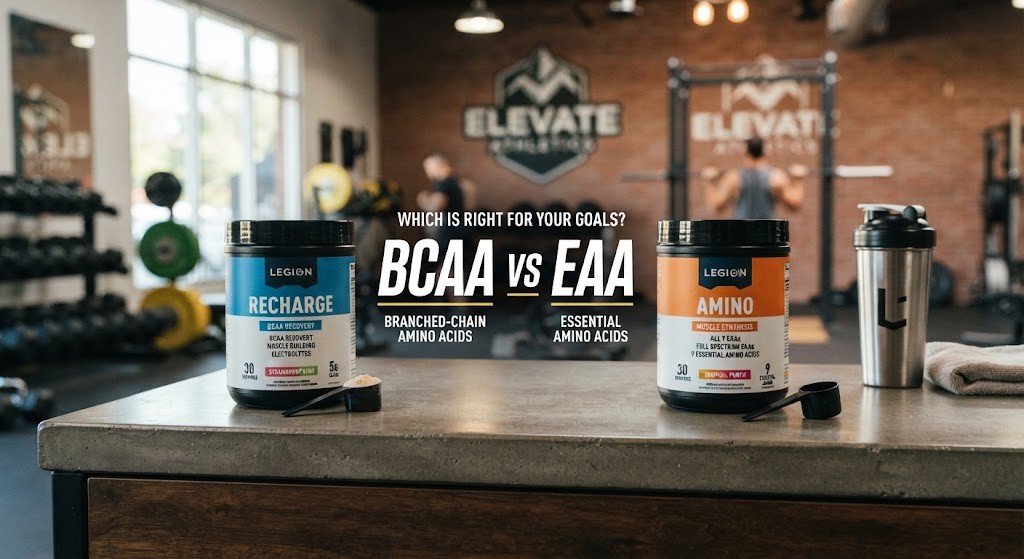
If you already use protein powder or other workout supplements, you have probably seen both BCAA and EAA supplements marketed for muscle support, exercise performance, and recovery. But while the two are closely related, they are not the same.
BCAAs provide just three essential amino acids—leucine, isoleucine, and valine—whereas EAAs provide all nine essential amino acids. That difference affects how each supplement fits into a nutrition and training plan.
In this guide to BCAA vs EAA supplements, you’ll learn what each supplement contains, how they compare for muscle protein synthesis and recovery, when to take them, how they differ from protein supplements, and how to choose the right option based on your diet and fitness goals.
What Are BCAA and EAA Supplements?
BCAAs are three essential amino acids—leucine, isoleucine, and valine—while EAAs include all nine amino acids that the body cannot produce on its own. Therefore, BCAAs are a subset of EAAs, rather than a completely separate category of amino acids.
What Are the Nine Essential Amino Acids?
The nine essential amino acids are amino acids your body must obtain from food or supplements because it cannot make enough of them itself.
They are:
- Histidine
- Isoleucine
- Leucine
- Lysine
- Methionine
- Phenylalanine
- Threonine
- Tryptophan
- Valine
Foods such as eggs, dairy, meat, fish, soy, and many other complete protein sources provide multiple essential amino acids together. The exact amino-acid profile varies by food, but complete proteins generally provide all nine EAAs.
BCAAs are three of the nine EAAs, not an alternative definition of essential amino acids.
What Makes BCAAs Different From EAAs?
BCAAs are distinguished by their chemical structure and consist of leucine, isoleucine, and valine. EAAs, on the other hand, are defined by nutritional necessity and include all nine amino acids that must come from dietary sources.
For example, a 2:1:1 BCAA supplement commonly provides two parts leucine for every one part each of isoleucine and valine. An EAA product instead aims to provide a broader mixture of essential amino acids.
Why Does the Difference Between BCAAs and EAAs Matter?
The distinction matters because muscle protein synthesis requires all essential amino acids, not just the three BCAAs. Although BCAAs can participate in muscle-related signaling and metabolism, they do not provide every essential amino acid needed to build new muscle proteins.
Leucine, in particular, can act as an important signal involved in initiating muscle protein synthesis. However, adequate availability of the other essential amino acids is also required to support the actual construction of new proteins.
This is why complete protein foods and EAA formulas have a broader nutritional role than BCAA-only supplements.
Muscle protein synthesis requires all essential amino acids, so consuming BCAAs alone does not provide the complete amino-acid profile supplied by EAAs or complete protein.
Why Does Amino-Acid Completeness Matter?
Amino-acid completeness matters because the body needs multiple amino acids to assemble new proteins. A signal to start protein synthesis is not the same as having every building block available to complete it.
For example, eating a complete protein meal after resistance training supplies leucine along with the other essential amino acids required for muscle protein production. An isolated BCAA drink provides a much narrower amino-acid profile.
Do BCAAs and EAAs Matter for Recovery?
BCAAs and EAAs can contribute to recovery nutrition, but overall protein and energy intake remain more important foundations. Recovery also depends on training load, sleep, hydration, carbohydrate availability, and sufficient total nutrition.
For example, an athlete who already consumes adequate protein throughout the day may gain less from adding isolated amino acids than someone whose meal timing or protein intake makes complete protein less convenient.
What Are BCAA Supplements?
BCAA supplements are products containing leucine, isoleucine, and valine, often formulated in ratios such as 2:1:1. They are commonly marketed for workout nutrition, muscle support, and recovery.
A BCAA serving might provide several grams of the three amino acids in a flavored powder designed to mix with water during training. See our guide to BCAA supplements for workouts for more detail on their practical use.
What Are the Benefits of BCAA Supplements?
BCAA supplements provide a convenient source of leucine, isoleucine, and valine around exercise. Their main appeal is targeted delivery of three essential amino acids rather than nutritional completeness.
For example, someone training between meals may prefer a flavored BCAA drink because it is easy to consume without preparing a full meal. However, that convenience does not automatically make BCAAs more effective than complete protein.
BCAAs can be useful as a targeted amino-acid supplement, but they are not nutritionally equivalent to complete protein.
What Does a 2:1:1 BCAA Ratio Mean?
A 2:1:1 BCAA ratio means the formula contains approximately twice as much leucine as either isoleucine or valine.
For example, a serving containing:
- 2 grams of leucine
- 1 gram of isoleucine
- 1 gram of valine
follows a 2:1:1 ratio.
Importantly, the ratio describes the relative amounts of the three BCAAs, not the overall quality or effectiveness of the product. The actual serving size and total amino-acid amounts still matter when comparing products.
What Are EAA Supplements?
EAA supplements are products that provide all nine essential amino acids, giving them a more complete essential-amino-acid profile than BCAA-only formulas.
EAAs include:
- Leucine
- Isoleucine
- Valine
- Histidine
- Lysine
- Methionine
- Phenylalanine
- Threonine
- Tryptophan
For example, an EAA drink can provide the three BCAAs plus six additional essential amino acids. You can explore the topic further in our guide to EAA supplements for muscle growth.
What Are the Benefits of EAA Supplements?
EAA supplements provide a broader pool of essential amino acids that can support muscle protein synthesis when consumed in an appropriate nutritional context. Their biggest nutritional advantage over BCAA-only products is completeness within the essential-amino-acid category.
For example, an EAA supplement may be considered when someone wants essential amino acids between meals or around training but does not want a larger protein serving.
EAAs provide a more complete essential-amino-acid profile than BCAA supplements because they supply all nine essential amino acids.
Are EAAs Better Than BCAAs for Muscle Growth?
EAAs can be a more complete option than BCAAs for supporting muscle protein synthesis because they provide all nine essential amino acids. However, neither supplement should automatically replace adequate complete dietary protein.
Someone eating sufficient high-quality protein from dairy, eggs, meat, fish, soy, or other complete protein sources may have little reason to add either product specifically for muscle growth.
The practical question is therefore not simply “BCAA or EAA, which is better?” Instead, ask:
“What is missing from my current nutrition?”
BCAA vs EAA Supplements: What Are the Key Differences?
The main differences between BCAA vs EAA supplements involve amino-acid composition, completeness, nutritional context, and practical use.
| Factor | BCAA Supplements | EAA Supplements |
|---|---|---|
| Amino acids | Leucine, isoleucine, valine | All nine essential amino acids |
| Completeness | Partial EAA profile | Complete EAA profile |
| Common ratio | Often 2:1:1 | Varies by formula |
| Main appeal | Targeted BCAA delivery | Broader essential-amino-acid supply |
| Workout use | Often intra-workout | Often pre-, intra-, or post-workout |
| Dietary role | Limited compared with complete protein | Broader than BCAAs but still not a full food |
| Best context | Specific situations and preferences | Situations requiring broader EAA availability |
How Do BCAAs and EAAs Compare for Muscle Protein Synthesis?
BCAAs and EAAs can influence muscle-related processes differently because BCAAs provide only three essential amino acids, while EAAs provide the full set required for complete muscle protein synthesis.
Leucine can stimulate pathways involved in muscle protein synthesis, but the body also needs other essential amino acids as substrates for producing new muscle proteins.
This distinction is central to understanding BCAA vs EAA for muscle protein synthesis.
Are EAAs More Complete Than BCAAs?
Yes. EAAs are more complete than BCAAs because they contain all nine essential amino acids.
A BCAA supplement cannot provide the six essential amino acids that it leaves out.
For example, a drink containing leucine, isoleucine, and valine does not supply lysine, methionine, phenylalanine, threonine, tryptophan, or histidine unless those amino acids are separately added.
Which Is More Practical for Workout Nutrition?
Practicality depends on your diet, workout duration, and reason for using an amino-acid supplement.
EAAs generally offer broader amino-acid coverage, while BCAAs can be simpler when someone specifically wants the three branched-chain amino acids.
For example, someone who already consumes adequate complete protein but enjoys a flavored intra-workout drink may choose BCAAs based on preference rather than nutritional necessity.
When Should You Use BCAAs vs EAAs?
BCAAs and EAAs are most relevant when your overall diet, meal timing, or training circumstances create a reason to supplement amino acids.
The usefulness of BCAA or EAA supplements depends on overall protein intake, diet quality, training demands, and individual goals.
For example, someone training early in the morning without a meal may approach amino-acid supplementation differently from someone who eats a protein-rich breakfast shortly before training.
When Should You Take BCAA Supplements?
BCAA supplements are commonly taken before or during workouts, particularly when convenience is a priority. There is no universal requirement to consume BCAAs at a specific minute before or after exercise.
For example, someone training several hours after their last protein-containing meal might use a BCAA drink during training because it is convenient and light.
For broader guidance, see our supplement timing for workouts.
When Should You Take EAA Supplements?
EAA supplements can be taken before, during, or after training, depending on the individual’s diet and supplement strategy.
Their broader amino-acid profile makes them more appropriate than BCAAs when the goal is to provide all nine essential amino acids in one product.
For example, an athlete who cannot comfortably consume a complete meal around a long training session may find an EAA drink convenient. Timing should still complement, rather than replace, a well-planned nutrition strategy.
Should You Take BCAAs or EAAs Before or During a Workout?
Both BCAAs and EAAs can be used around workouts, but the choice should depend on what your existing diet already provides.
A complete protein meal before training can already deliver all essential amino acids without requiring a separate BCAA or EAA product.
For example, someone eating a protein-rich meal containing dairy, eggs, meat, soy, or another complete protein source before training may not need an amino-acid drink during the same workout.
How Do BCAAs and EAAs Compare With Protein Supplements?
Protein supplements provide a broader mixture of amino acids than isolated BCAA products and can supply all essential amino acids when the protein source is complete.
Protein powder is therefore a fundamentally different nutritional tool from a BCAA supplement.
For example, a serving of whey protein provides protein plus a broad amino-acid profile, whereas a BCAA product provides only leucine, isoleucine, and valine.
Do You Need BCAAs or EAAs If You Already Eat Enough Protein?
People who already consume sufficient high-quality complete protein may have less need for either BCAA or EAA supplements.
Improving total protein intake and overall dietary quality often provides a stronger foundation than adding isolated amino acids.
For example, someone consistently meeting their protein needs through meals and a complete protein supplement may gain limited additional nutritional value from adding BCAAs.
For people who already consume sufficient high-quality complete protein, adding BCAA or EAA supplements may provide less additional value than improving their overall nutrition and training strategy.
Is Complete Protein Better Than BCAAs?
Complete protein is generally the more comprehensive nutritional choice when you need to increase total protein intake.
Complete protein supplies essential amino acids together with a larger amount of total protein.
For example, using a protein-rich meal or protein shake to close a daily protein gap addresses a different need than drinking BCAAs for convenience around a workout.
How to Choose a BCAA or EAA Supplement?
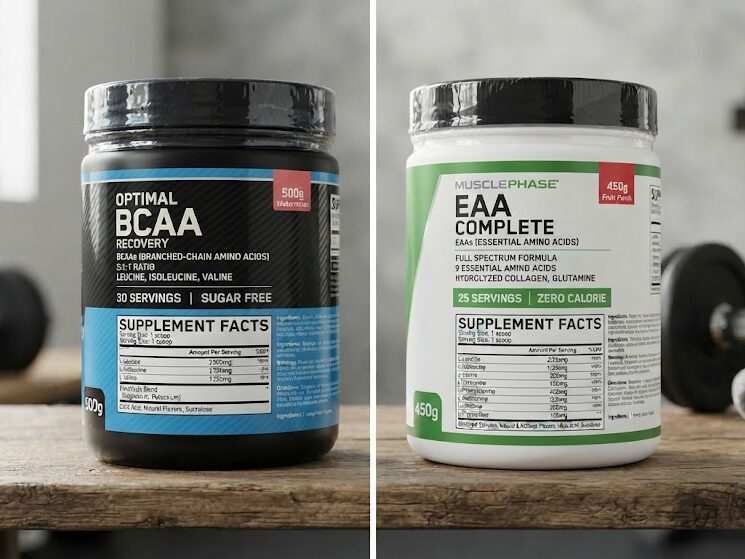
Choosing a BCAA or EAA supplement means looking beyond the front of the package. Check the ingredient panel, amino-acid amounts, serving size, added ingredients, and quality controls.
Transparent labeling is more useful than relying on aggressive marketing claims.
For example, compare two products by checking whether each clearly states grams of leucine, isoleucine, and valine—or the amounts of all nine EAAs—instead of hiding quantities inside a proprietary blend.
What Should You Look for on a Supplement Label?
A quality supplement label should clearly identify the amino acids and their amounts per serving. You should be able to determine exactly what you are consuming without relying on vague proprietary-blend terminology.
Look for:
- Individual amino-acid amounts
- Clear serving-size information
- Sensible ingredient lists
- Minimal unnecessary additives
- Allergen and dietary information
- Appropriate manufacturing and quality standards
- Third-party testing when available
For example, if an EAA product claims to contain all nine EAAs but does not disclose meaningful individual quantities, comparing it with another formula becomes difficult.
Should You Choose Powder, Capsules, or Flavored Products?
The best format is the one you can use consistently and that fits your nutrition strategy.
Powders are commonly practical around workouts, while capsules can be convenient when you want a simpler format.
For example, a long-training athlete might prefer a flavored powder mixed with water, while someone who dislikes flavored drinks may prefer capsules.
Practical Examples: Which Supplement Fits Different Fitness Goals?
The most appropriate supplement depends on your specific fitness goal, diet, and training situation rather than a universal ranking.
BCAAs and EAAs can serve different roles within a broader protein-focused nutrition plan.
| Fitness Goal or Situation | Practical Approach |
|---|---|
| Muscle growth with adequate protein | Prioritize total protein and meals |
| Training fasted | Consider broader EAA support depending on goals |
| Long endurance session | Consider hydration, carbohydrates, and overall fueling first |
| Low-protein diet | Improve complete protein intake before relying on amino acids |
| Between meals | EAAs may provide broader EAA coverage |
| Adequate complete protein intake | Neither may be necessary |
| Preference for a simple BCAA drink | BCAAs may fit personal preference |
What Is Better for BCAAs vs EAAs for Bodybuilding?
For bodybuilding, the foundation should be adequate total protein, resistance training, calories, and recovery.
EAAs may provide a more complete amino-acid profile than BCAAs, but neither automatically replaces sufficient protein intake.
For example, a bodybuilder meeting daily protein needs through complete food sources and protein powder may prioritize those foods rather than adding multiple amino-acid products.
What Is Better for Endurance Training?
Endurance athletes should first consider total energy, carbohydrate, fluid, electrolyte, and protein needs before selecting an amino-acid supplement.
BCAAs or EAAs may fit around longer sessions, but amino acids are only one part of endurance nutrition.
For example, an athlete completing a long cycling session may need adequate carbohydrate and fluid intake during the workout regardless of whether an EAA or BCAA drink is included.
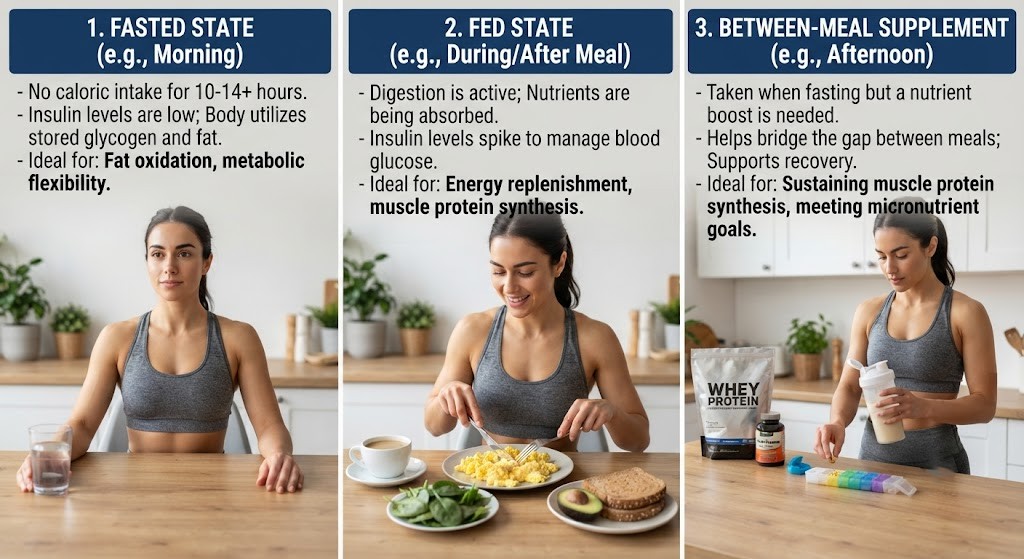
What About Fasted Workouts?
Fasted workouts create a different nutritional context because no recent meal has supplied amino acids.
An EAA product may be more nutritionally complete than BCAAs when someone specifically wants essential amino acids without consuming a full protein meal.
For example, someone who trains early and does not tolerate solid food may choose an amino-acid drink for convenience, while another person may simply eat a protein-containing meal afterward.
What Are the Biggest BCAA vs EAA Myths?
Many BCAA vs EAA misconceptions come from treating isolated amino acids as interchangeable with complete protein.
The most important distinction is that amino-acid signaling, amino-acid availability, and total protein intake are related but different concepts.
For example, saying that leucine is important does not mean that leucine alone can replace the complete amino-acid profile found in a protein-rich meal.
Myth: BCAAs Automatically Build More Muscle
BCAAs do not automatically produce greater muscle growth simply because they contain leucine, isoleucine, and valine.
Muscle growth depends on resistance training, sufficient protein and energy, recovery, and other factors.
For example, adding BCAAs to an already adequate protein diet does not transform an otherwise well-designed nutrition plan into a dramatically better one.
Myth: EAAs Replace Protein
EAAs are not automatically equivalent to a complete protein serving.
EAA supplements provide essential amino acids, while protein foods and protein powders generally provide a broader supply of amino acids and contribute to total protein intake.
For example, an EAA drink may be convenient around training, but it does not necessarily address the same nutritional goal as increasing your daily protein intake.
How Do You Build a Supplement Strategy Around Your Diet and Training?
Building a supplement strategy starts with your diet and training rather than with the supplement label.
Your first priority should be identifying whether your daily protein intake, meal timing, training demands, and recovery habits already meet your needs.
For example, if your diet consistently provides enough complete protein, adding BCAAs or EAAs may be optional rather than essential.
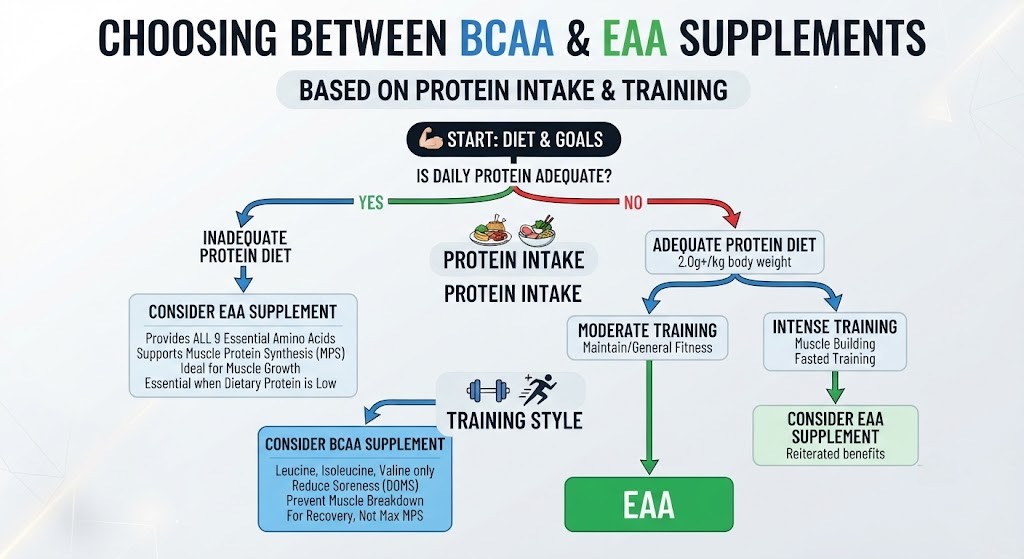
How Should You Decide Between BCAAs and EAAs?
Use a simple decision process before purchasing either supplement:
- Assess your daily protein intake. Determine whether your diet already provides sufficient complete protein.
- Check your meal timing. Consider whether long gaps between protein-containing meals affect your training routine.
- Identify your training demands. Consider workout duration, intensity, and whether you train fed or fasted.
- Define your goal. Separate muscle growth, recovery, endurance, convenience, and dietary preferences.
- Compare labels. Check amino-acid amounts, serving sizes, ingredients, and quality information.
- Choose only if there is a practical reason. Avoid adding a supplement simply because it is heavily marketed.
For example, someone with adequate protein intake and regular meals may decide that neither product is necessary, while another athlete may value an EAA drink because it fits a specific training and meal-timing situation.
For more context, see our supplements for muscle growth
Conclusion
The biggest difference in BCAA vs EAA supplements comes down to their amino-acid profiles. BCAAs provide leucine, isoleucine, and valine, while EAAs provide all nine essential amino acids. As a result, EAAs offer broader essential-amino-acid coverage, while BCAAs can appeal to people seeking a targeted and convenient source of the three branched-chain amino acids.
Neither supplement should automatically replace adequate complete protein, balanced nutrition, progressive training, and recovery. The usefulness of BCAA or EAA supplements depends on your diet, training demands, meal timing, and individual goals.
Ultimately, BCAAs and EAAs can play different roles rather than competing for a single “best” title. By assessing what your current nutrition already provides, you can choose the option that genuinely fits your routine—or decide that you do not need either.
FAQs
Are BCAAs part of EAAs?
Yes. BCAAs are three of the nine essential amino acids.
What is the difference between BCAAs and EAAs?
BCAAs contain three essential amino acids, while EAAs contain all nine.
Should I take BCAAs or EAAs?
EAAs provide a more complete essential-amino-acid profile.
Do I need BCAA if I take EAA?
No. EAAs already contain all three BCAAs.
Is BCAA safe for kidneys?
Yes. BCAAs are generally safe for healthy people when used as directed.
Is it safe to drink EAA every day?
Yes. EAAs are generally safe for healthy adults when used as directed.
What are the three BCAAs?
Leucine, isoleucine, and valine are the three BCAAs.
What are the nine essential amino acids?
The nine EAAs are histidine, isoleucine, leucine, lysine, methionine, phenylalanine, threonine, tryptophan, and valine.
Are EAAs better than BCAAs?
EAAs are more complete because they provide all nine essential amino acids.
Do BCAAs help with muscle growth?
BCAAs support muscle-related processes but do not replace complete protein.
When should I take BCAAs?
BCAAs are commonly taken before or during workouts.
When should I take EAAs?
EAAs can be taken before, during, or after workouts.
Can I take BCAAs and EAAs together?
Yes. However, EAAs already contain the three BCAAs.
Do BCAAs replace protein?
No. BCAAs provide only three essential amino acids.