
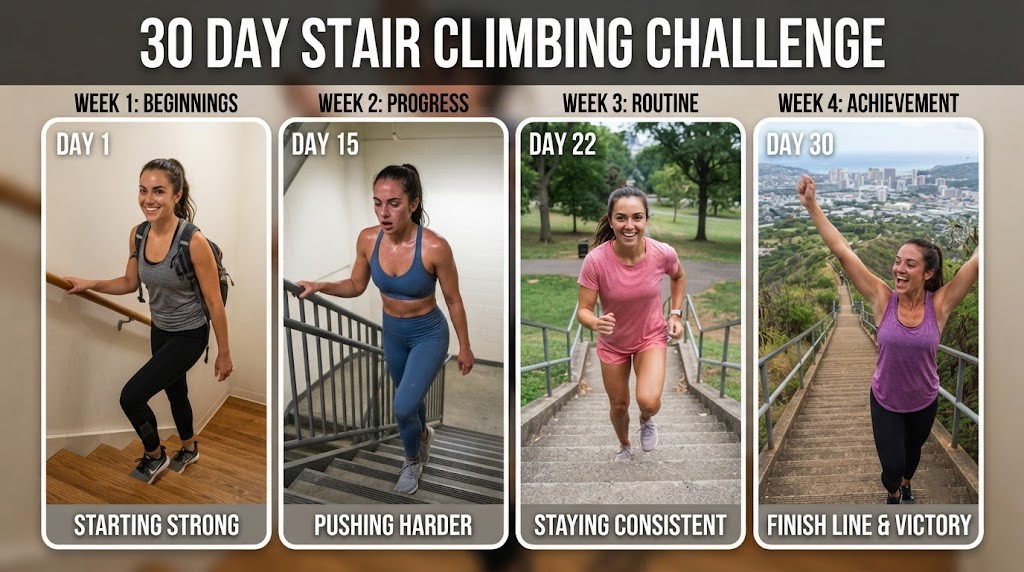
If you have ever climbed several flights of stairs and noticed how quickly your heart rate rises, you already know that stair climbing can be a surprisingly demanding workout. The challenge is turning that everyday movement into a structured routine without doing too much too soon.
A 30 day stair climbing challenge provides a gradual way to build cardiovascular fitness, lower-body endurance, and exercise consistency. Instead of trying to climb as many stairs as possible from Day 1, the goal is to increase your workload progressively while giving your body enough time to recover.
In this guide, you’ll learn how the challenge works, how many stairs to climb, how to progress safely, proper stair-climbing technique, calorie estimates, modifications for different fitness levels, and what to do after Day 30.
What Is a 30 Day Stair Climbing Challenge?
A 30 day stair climbing challenge is a progressive exercise program that uses repeated stair-climbing sessions over 30 days to improve cardiovascular fitness, lower-body endurance, and daily physical activity.
The challenge does not require a specific number of stairs for everyone. A beginner might start with five minutes of easy climbing, while a fitter person may begin with several flights and longer intervals.
Progressive stair training means gradually increasing workout duration, stair repetitions, or intensity while allowing sufficient recovery between challenging sessions. The goal is consistency rather than completing an exhausting workout every day.
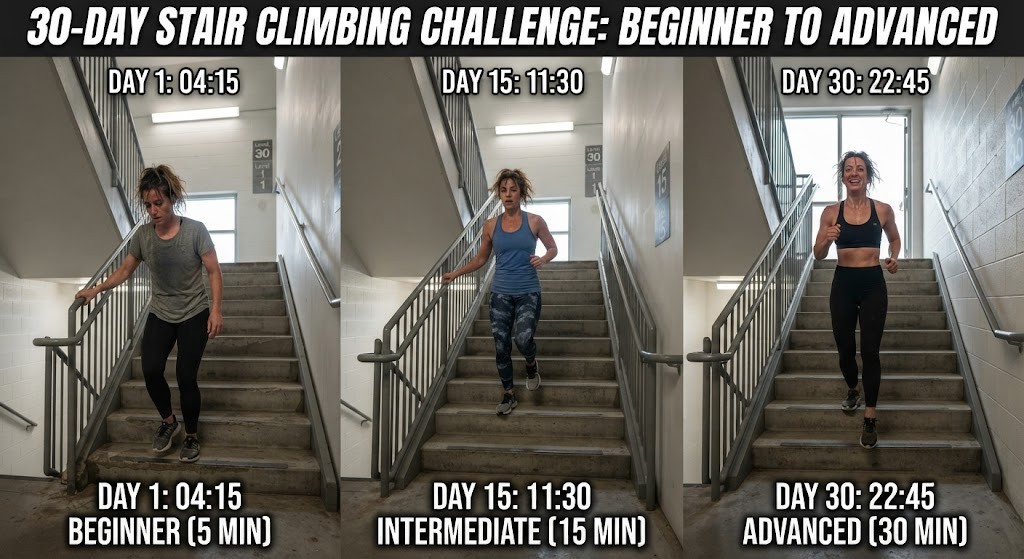
For additional lower-body preparation, combine this challenge with a beginner legs workout.
Why Does a 30 Day Stair Climbing Challenge Matter?
A 30 day stair climbing challenge provides a convenient way to accumulate aerobic activity while repeatedly challenging the muscles of the lower body.
The CDC recommends at least 150 minutes of moderate-intensity aerobic activity per week, along with muscle-strengthening activity on at least two days. — Source: CDC, 2025.
Stair climbing can also be relatively vigorous depending on your pace. The 2024 Adult Compendium lists stair climbing at 6.8 METs generally, 4.5 METs at a slow pace, and 9.3 METs at a fast pace. — Source: Compendium of Physical Activities, 2024.
This means a relatively short stair session can provide a useful cardio workout when you have limited time or equipment.
Research reviews have also found that stair-climbing interventions can improve several cardiometabolic measures in adults, although results vary according to the program and participants. — Source: Stair-Climbing Interventions Scoping Review, 2024.
How Do You Start a 30 Day Stair Climbing Challenge?
Starting a 30 day stair climbing challenge requires a safe staircase, a manageable baseline, an appropriate warm-up, and a simple way to track your workload.
1. Choose a Safe Staircase
Look for stairs with:
- Secure, stable steps
- Good lighting
- Enough space to move safely
- A handrail when possible
- A surface that is not slippery
Indoor building stairs, stadium steps, outdoor staircases, or a stable staircase at home can all work.
2. Establish Your Baseline
Start by climbing comfortably for three to five minutes.
If five minutes leaves you breathing hard but still able to speak short sentences, you may need to reduce your pace or duration. Your starting point should feel manageable enough that you can recover properly.
3. Warm Up
Spend about five minutes warming up with:
- Easy walking
- Ankle movements
- Gentle knee lifts
- Controlled leg movements
A gradual warm-up prepares your body for the repeated stepping pattern.
For additional preparation, see injury prevention exercises.
What Should You Do on Each Day of a 30 Day Stair Climbing Challenge?
A 30-day stair climbing workout plan should gradually increase workload while including easier days for recovery.
| Day | Workout | Effort |
|---|---|---|
| 1 | 5 min easy climbing | Easy |
| 2 | 6 min | Easy |
| 3 | 7 min | Easy-moderate |
| 4 | 5 min recovery | Easy |
| 5 | 8 min | Moderate |
| 6 | 8 min | Moderate |
| 7 | Rest or easy walk | Recovery |
| 8 | 9 min | Moderate |
| 9 | 10 min | Moderate |
| 10 | 7 min recovery | Easy |
| 11 | 10 min | Moderate |
| 12 | 12 min | Moderate |
| 13 | 8 min | Easy |
| 14 | Rest | Recovery |
| 15 | 12 min | Moderate |
| 16 | 13 min | Moderate |
| 17 | 10 min | Easy |
| 18 | 14 min | Moderate |
| 19 | 15 min | Moderate |
| 20 | 10 min recovery | Easy |
| 21 | Rest | Recovery |
| 22 | 15 min | Moderate |
| 23 | 16 min | Moderate |
| 24 | 12 min | Easy |
| 25 | 16 min | Moderate |
| 26 | 18 min | Moderate |
| 27 | 12 min recovery | Easy |
| 28 | Rest | Recovery |
| 29 | 18–20 min | Moderate |
| 30 | 20 min challenge | Moderate-hard |
You do not have to progress every single day. If a particular workout feels unusually difficult, repeat that day instead of increasing the workload.
The safest approach is to begin with a manageable amount of stair climbing and progressively increase difficulty rather than performing a high-volume workout from the beginning.
For higher-intensity intervals later in the challenge, use a HIIT workout for beginners approach rather than sprinting continuously.
How Many Stairs Should You Climb During the Challenge?
There is no universal number of stairs that everyone should climb during a 30-day challenge. Stair height, fitness level, climbing pace, and recovery capacity all affect the appropriate workload.
For that reason, time and perceived effort can be more useful than chasing a fixed stair count.
A beginner may benefit more from five controlled minutes than from trying to reach hundreds of steps. As your fitness improves, you can gradually increase duration, repetitions, or pace.
However, avoid increasing all three at once. Changing one training variable at a time creates a more manageable form of stair-climbing progression.
A 2024 UK Biobank study involving 451,089 participants examined stair-climbing habits and cardiovascular outcomes. However, observational findings do not establish that a specific number of stairs causes a particular health outcome. — Source: PubMed, 2024.
Is Stair Climbing Good for Cardiovascular Fitness?
Yes, stair climbing can be used as cardiovascular exercise because repeated upward movement increases the body’s demand for oxygen and energy.
A 2024 randomized controlled trial found that stair-climbing-based exercise snacks could improve cardiorespiratory fitness in inactive adults, supporting the usefulness of short exercise sessions. — Source: Applied Physiology, Nutrition, and Metabolism, 2024.
This also makes stair climbing convenient for people who have difficulty fitting long workouts into their schedules.
For example, instead of completing one long workout, you could perform two or three shorter stair sessions during the day.
Can Stair Climbing Help With Weight Management?
Stair climbing can support weight management by increasing energy expenditure, but it does not guarantee weight loss on its own.
Physical activity increases the calories your body uses, while overall weight change depends on the relationship between energy intake and energy expenditure. — Source: CDC, 2026.
For example, someone could burn additional calories through stair workouts but experience little change in body weight if their overall calorie intake also increases.
How Many Calories Does Stair Climbing Burn?
The number of calories burned during stair climbing varies according to body weight, workout duration, pace, and the exact movement performed.
The Compendium estimates:
- General stair climbing: 6.8 METs
- Slow stair climbing: 4.5 METs
- Fast stair climbing: 9.3 METs
— Source: Compendium of Physical Activities, 2024.
A commonly used estimate is:
Calories burned ≈ MET × 3.5 × body weight in kg ÷ 200 × minutes
For example, a hypothetical 70 kg person climbing stairs at 6.8 METs for 10 minutes would expend roughly 83 calories according to this estimation method.
What Is the Correct Stair Climbing Technique?
Good stair-climbing technique involves maintaining an upright posture, placing your foot securely on each step, controlling your pace, and using the handrail when additional support is necessary.
Maintain Good Posture
Keep your chest comfortably lifted and avoid excessive forward leaning.
A slight forward lean from the ankles and hips can occur naturally, but you should remain in control of your movement rather than folding forward.
Place Your Feet Securely
Place your foot securely on the step and push through the whole foot instead of aggressively bouncing onto your toes.
Controlled foot placement becomes particularly important as fatigue increases.
Control Your Cadence
Maintain a pace that allows you to breathe steadily.
Beginners should avoid jumping multiple steps because doing so increases the coordination and strength demands of the movement.
Use the Handrail When Necessary
Use the handrail when balance or fatigue makes it necessary. Safety is more important than maintaining a particular pace.
For complementary lower-body training, explore Dumbbells Leg Workout.
How Often Should Beginners Climb Stairs for Exercise?
Beginners should generally start with several manageable sessions per week rather than performing a hard stair workout every day.
Stair climbing repeatedly loads the calves, quadriceps, hamstrings, glutes, and other lower-body muscles. That is why recovery days are an important part of a structured challenge.
For example, a beginner could complete three or four stair-focused sessions weekly while using other days for walking, mobility work, or complete rest.
Anyone with a chronic health condition, disability, or significant inactivity should discuss appropriate exercise intensity with a healthcare professional before starting vigorous activity. — Source: CDC, 2025.
How Can You Make a Stair Climbing Workout Easier or Harder?
You can adjust a stair climbing workout by changing its duration, pace, repetitions, recovery time, or number of stairs.
Beginner Modification
Reduce the session to 3–5 minutes and take longer recovery periods between climbs.
Focus on smooth foot placement and controlled movement rather than speed.
Intermediate Modification
Use 10–20 minute sessions with short increases in pace.
For example, you could climb comfortably for two minutes followed by 30 seconds of faster climbing.
Lower-Impact Modification
If continuous stair climbing is unavailable or uncomfortable, use controlled step-ups on a low platform instead.
This can reproduce a similar stepping movement while allowing you to control the height and pace.
Higher-Intensity Modification
Experienced exercisers can incorporate short stair intervals.
However, intensity should increase gradually rather than turning every session into an all-out sprint.
When stairs are unavailable, combine the routine with LISS Workout.
What Muscles Does Stair Climbing Work?
Stair climbing primarily challenges the muscles involved in repeatedly extending the hips, knees, and ankles.
The major lower-body muscles involved include:
- Quadriceps: Help extend the knee as you step upward.
- Glutes: Contribute to hip extension and upward propulsion.
- Hamstrings: Assist with hip and knee movement.
- Calves: Help with ankle movement and pushing through each step.
Because stair climbing also requires continuous movement, it combines muscular endurance with cardiovascular demand.
Adding complementary strength exercises can help create a more balanced training routine rather than relying exclusively on stair climbing.
What Tools Can You Use to Track a 30 Day Stair Challenge?
Simple tracking tools can make a 30 day stair climbing challenge easier to follow and measure.
You can track:
- Workout duration
- Number of flights
- Estimated steps
- Perceived effort from 1–10
- Rest periods
- Recovery quality
- Weekly consistency
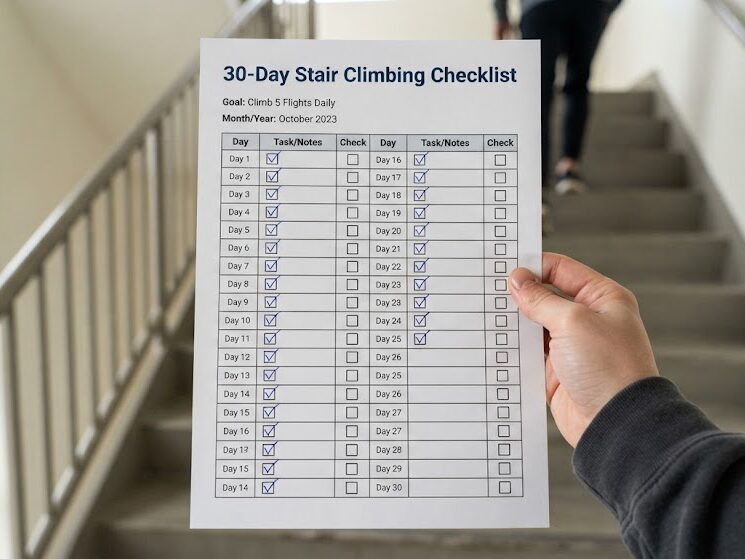
A phone stopwatch, notes app, smartwatch, fitness tracker, or printable checklist can provide enough information without expensive equipment.
The goal of tracking is not to create unnecessary pressure. Instead, it gives you a simple record of how your workload changes throughout the month.
How Can You Tell If You Are Progressing?
Progress during a stair climbing challenge is not limited to climbing more stairs.
You may notice progress through:
- Longer workout durations.
- Better control while climbing.
- Shorter recovery periods.
- A more comfortable pace.
- Greater consistency.
- Improved ability to complete the planned sessions.
For example, if 10 minutes of stair climbing initially feels difficult but becomes manageable after several weeks, that represents meaningful progress even if your stair count has not dramatically changed.
This is why recording both workload and perceived effort can make your 30-day challenge more informative.
What Should You Do After Completing a 30 Day Stair Challenge?
Completing Day 30 should be treated as a transition point rather than a reason to immediately double your workload.
If 20 minutes feels manageable, continue around that level for several sessions before adding additional time or intensity.
You can also combine stair climbing with strength training and other forms of cardio. Adults are advised to perform aerobic activity alongside muscle-strengthening activity on at least two days each week. — Source: CDC, 2025.
For another structured challenge, explore 30 day squat challenge or 30 day weight loss workout challenge.
For recovery guidance, use Vibration Therapy for Recovery and Overtraining Recovery Workout.
Conclusion
A 30 day stair climbing challenge is a practical way to build cardiovascular fitness, lower-body endurance, and exercise consistency without requiring complicated equipment.
The most important part of the challenge is progressive consistency, not completing the highest possible number of stairs. Start at a manageable level, increase your workload gradually, respect recovery days, and adjust the routine when your body needs additional time.
By the end of 30 days, the goal is not simply to have completed a challenge. It is to develop a sustainable exercise habit that can continue beyond Day 30 through a combination of stair climbing, strength training, walking, and other forms of cardio.
FAQs
What is a 30 day stair climbing challenge?
A 30-day workout plan that gradually increases stair climbing to build fitness and endurance.
How many stairs should I climb each day?
Start with a manageable amount and gradually increase your time or stair count.
Can I do the stair climbing challenge every day?
Yes, but include recovery days to help your muscles recover.
Is stair climbing good for cardio?
Yes, stair climbing can provide an effective cardiovascular workout.
Can a 30 day stair climbing challenge help with weight loss?
It can support weight management by increasing activity and calorie expenditure.
How many calories does stair climbing burn?
Calories burned depend on your weight, pace, duration, and intensity.
What muscles does stair climbing work?
It mainly works your quads, glutes, hamstrings, and calves.
What should beginners do if the challenge feels too difficult?
Reduce the pace or duration and repeat the workout until it feels manageable.
Is 30 minutes on the stair climber a good workout?
Yes, 30 minutes can provide a challenging cardio and lower-body workout.
What happens if I climb 200 stairs every day?
It can increase daily activity and improve lower-body endurance over time.
What is the 30-day StairMaster challenge?
It is a 30-day progressive workout using a StairMaster or similar machine.
Does the 30 day AB challenge really work?
It can strengthen your abs, while results also depend on nutrition and body composition.
What should I do after Day 30?
Continue stair workouts and combine them with strength training and other cardio.