
Macro Calculator
Calculate your daily calorie, protein, carbohydrate and fat targets for weight loss, maintenance or muscle gain.
Your Daily Macro Targets
These are estimated daily targets. Protein and fat are set first, and carbohydrates provide the remaining calories.
Macro Breakdown
| Macro | Daily grams | Calories | Percentage |
|---|
How Your Targets Were Estimated
| Estimated BMR | — |
| Estimated maintenance calories | — |
| Goal adjustment | — |
Knowing how many calories you need is important for weight loss and muscle gain, but understanding your protein, carbohydrate, and fat intake can make your nutrition plan more effective. A Macro Calculator estimates your daily calorie and macronutrient requirements based on your age, height, weight, activity level, and fitness goals.
In this guide, you’ll learn how to calculate your macros, choose suitable targets, and track your progress.
What Is a Macro Calculator?
A Macro Calculator is an online tool that estimates your daily calories, protein, carbohydrates, and fats to help you achieve your fitness goals.
The three main macronutrients serve different purposes:
- Protein: Supports muscle repair and tissue growth. Sources include dal, eggs, milk, tofu, and fish.
- Carbohydrates: Provide energy for daily activities and exercise. Sources include rice, potatoes, fruits, and whole grains.
- Fats: Support hormone production, cell function, and vitamin absorption. Sources include nuts, seeds, avocados, and oils.
Protein and carbohydrates provide approximately 4 calories per gram, while fat provides 9 calories per gram.
Why Should You Use a Macro Calculator?
A Macro Calculator helps you distribute your daily calories according to your fitness goals.
- Weight loss: Maintain a sustainable calorie deficit while consuming adequate protein.
- Muscle gain: Eat enough calories and protein to support muscle development and resistance training.
- Maintenance: Consume approximately the calories you burn to maintain your body weight.
For weight management, try our calorie deficit calculator to estimate a suitable starting calorie deficit.
How Does a Macro Calculator Calculate Your Daily Needs?
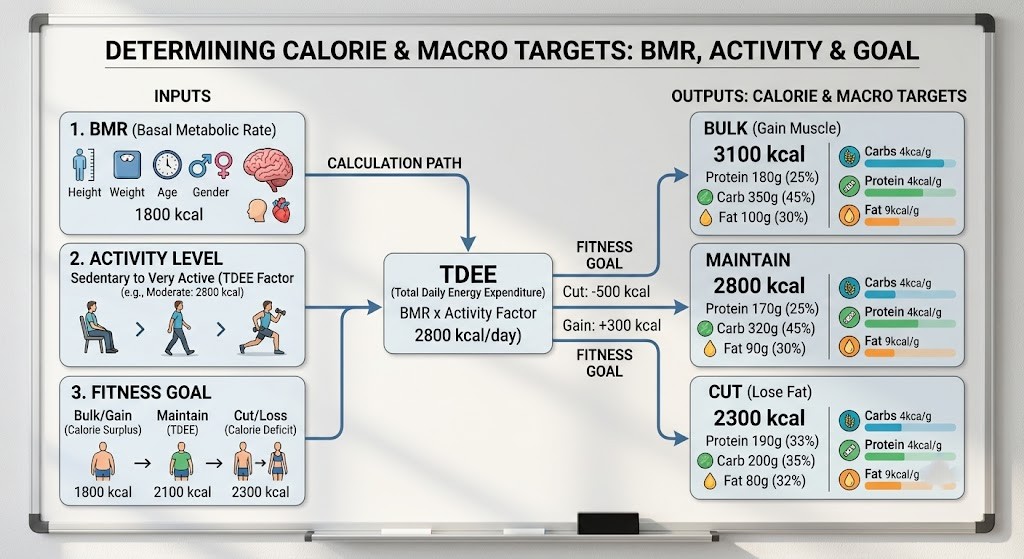
A Macro Calculator generally estimates your calorie requirements in three steps.
1. Calculate Your Basal Metabolic Rate
Basal metabolic rate (BMR) estimates the calories your body uses at rest to maintain essential functions.
Try our BMR calculator for estimating resting calories to estimate your resting calorie requirements.
2. Estimate Your Total Daily Energy Expenditure
Total daily energy expenditure (TDEE) estimates the calories you burn through resting metabolism, exercise, everyday movement, and digestion.
Use our TDEE calculator for daily calorie needs to estimate your daily energy expenditure.
3. Adjust Calories for Your Goal
| Goal | General calorie approach |
|---|---|
| Weight loss | Moderate calorie deficit |
| Muscle gain | Small calorie surplus when appropriate |
| Maintenance | Calories near estimated TDEE |
For example, someone with estimated maintenance needs of 2,400 calories might start with approximately 2,100 calories for weight loss or 2,550 calories for gradual muscle gain. These are illustrative targets, not universal recommendations.
How Do You Calculate Daily Macros?
To calculate macros manually, multiply your daily calorie target by the percentage assigned to each nutrient, then divide by its calories per gram.
Consider a daily target of 2,000 calories with 30% protein, 40% carbohydrates, and 30% fat.
- Protein: 2,000 × 0.30 ÷ 4 = 150 grams.
- Carbohydrates: 2,000 × 0.40 ÷ 4 = 200 grams.
- Fat: 2,000 × 0.30 ÷ 9 = approximately 67 grams.
This example provides approximately 2,000 calories after rounding. The 30/40/30 ratio is an example, not a universally optimal distribution.
What Are the Best Macros for Weight Loss and Muscle Gain?
Your ideal macro ratio depends on your calorie needs, activity level, health, and fitness goals.
Best Macros for Weight Loss
A weight-loss plan should create a sustainable calorie deficit while providing sufficient protein, healthy fats, and carbohydrates for daily activity.
Prioritize nutritious foods, adequate protein, and meals that help you manage hunger.
Explore our calorie deficit diet plan for sustainable weight loss for practical guidance.
Best Macros for Muscle Gain
Muscle growth requires appropriate resistance training, sufficient protein, adequate recovery, and enough calories to support your training.
A modest calorie surplus may help, although some people can build muscle without one.
Explore our lean bulk diet plan for building muscle and use the FFMI calculator for tracking muscular development to explore estimated fat-free mass relative to height.
Best Macros for Maintenance
For weight maintenance, aim to consume approximately your TDEE while meeting your protein, carbohydrate, and fat requirements.
Review your average body weight over several weeks to determine whether your calorie intake is close to maintenance.
How Much Protein, Carbohydrates, and Fat Do You Need?
Your requirements depend on body weight, exercise, dietary preferences, and individual health needs.
The general adult recommended dietary allowance for protein is approximately 0.8 grams per kilogram of body weight daily. For example, a 70 kg adult would need approximately 56 grams per day under this general guideline. People who exercise regularly may need more.
Use our daily protein intake calculator to estimate your protein needs.
Good protein sources include dal, chickpeas, tofu, milk, curd, eggs, fish, and chicken. Rice, potatoes, fruits, and whole grains provide carbohydrates, while nuts, seeds, and vegetable oils supply dietary fats.
For more ideas, explore our high-protein foods for muscle growth and high-protein vegetarian diet plan.
Can a Macro Calculator Help Build Muscle?
Yes. A Macro Calculator can help you estimate the nutrients needed to support muscle growth, but results also depend on training, recovery, and consistency.
Use our one rep max calculator for strength training to estimate strength-training loads when appropriate.
You can also explore recovery measurements with our heart rate variability calculator. However, HRV does not directly determine your macro requirements.
Macro Calculator vs. Calorie Calculator
A calorie calculator estimates your daily energy requirements, while a Macro Calculator estimates how those calories can be distributed among protein, carbohydrates, and fats.
| Feature | Calorie calculator | Macro Calculator |
|---|---|---|
| Daily calorie estimate | Yes | Yes |
| Protein target | Not always | Usually |
| Carbohydrate target | Not always | Usually |
| Fat target | Not always | Usually |
Both tools can help you plan nutrition around your fitness goals.
How Accurate Are Macro Calculators?
Online Macro Calculators provide estimates rather than exact measurements. Your actual calorie needs may differ because of activity, body composition, training, and other individual factors.
For more useful results:
- Enter accurate age, height, and weight.
- Choose a realistic activity level.
- Select a clear fitness goal.
- Track progress over several weeks.
- Adjust targets gradually when necessary.
People with medical conditions, pregnancy-related nutritional needs, or a history of disordered eating should seek individualized professional guidance.
How Can You Track and Adjust Your Macros?
Food-tracking apps, nutrition labels, kitchen scales, and meal planning can help you monitor your intake.
Apps such as Cronometer and MyFitnessPal can record meals and estimate daily nutrient totals. Available features vary by plan and region.
Review your body-weight trends, energy levels, hunger, and workout performance. If your progress consistently differs from your goal, reassess your calorie intake and activity before making small adjustments.
You do not necessarily need different macros on rest days. Keeping protein intake consistent can support a regular routine, while carbohydrate intake can be adjusted according to activity and preference.
If you want another reference point for weight management, try our ideal body weight calculator. Remember that ideal-weight formulas are estimates and do not fully account for muscularity or body composition.
How to Build a Sustainable Macro Plan
A practical macro plan should fit your lifestyle, food preferences, budget, and fitness goals.
Follow these steps to get started:
- Calculate your daily calorie and macro targets.
- Include protein-rich foods in your meals.
- Eat fruits, vegetables, whole grains, and healthy fats.
- Prepare simple meals you can repeat.
- Track progress and adjust when needed.
Avoid treating every gram as a strict requirement. Consistency over time matters more than perfect numbers at every meal.
Conclusion
A Macro Calculator estimates the calories, protein, carbohydrates, and fats you may need for weight loss, muscle gain, or maintenance. Use these estimates as a starting point, prioritize balanced meals, and monitor your progress over time.
With realistic targets, consistent training, and sustainable eating habits, you can work toward your fitness goals without making nutrition unnecessarily complicated.
FAQs
What is a Macro Calculator?
A Macro Calculator estimates your daily calories, protein, carbohydrates, and fats.
What is the best macro ratio for weight loss?
Choose a calorie deficit with adequate protein, fats, and carbohydrates.
How many calories are in each macronutrient?
Protein and carbohydrates provide 4 calories per gram, while fat provides 9.
How much protein should I eat daily?
The general adult recommendation is 0.8 grams per kilogram of body weight daily.
Are Macro Calculators accurate?
They provide estimates based on your personal details, activity, and goals.
Should I track macros to lose weight?
Tracking helps manage intake, but it isn’t essential for everyone.
Should I change my macros on rest days?
Not necessarily. Keep your intake consistent or adjust it to match your activity.
3 thoughts on “Macro Calculator: Calculate Your Daily Protein, Carbs & Fat Needs”