
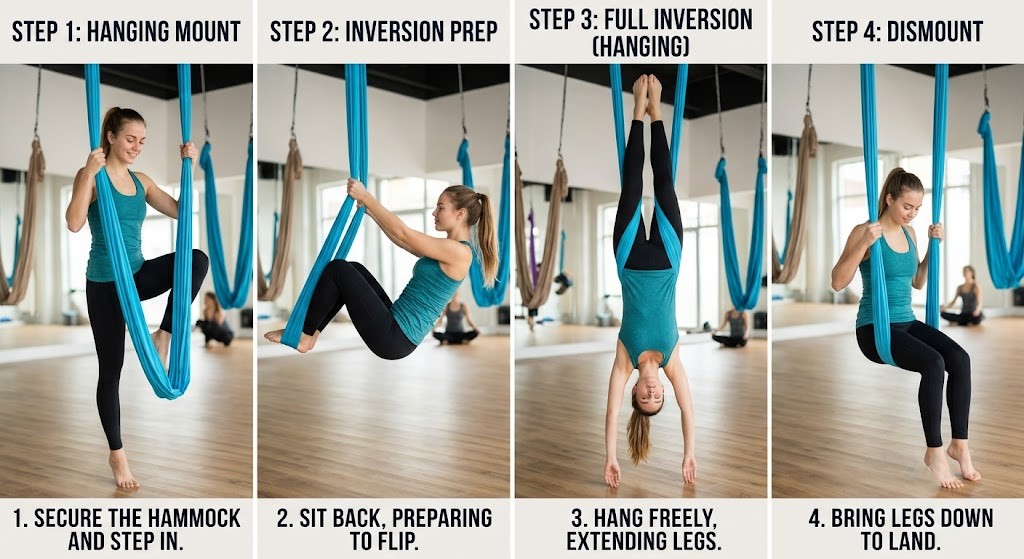
If you already enjoy yoga for flexibility, strength, and relaxation, anti gravity yoga offers a refreshing way to explore movement using a suspended fabric hammock. This unique form of aerial fitness combines traditional yoga-inspired movements with supported stretches, balance exercises, and selected inversions.
However, beginners need to understand the correct techniques, essential equipment, and safety precautions before getting started. In this guide, you’ll learn what anti gravity yoga is, its potential benefits, the best beginner-friendly poses, how to choose a good studio, and how to build a safe practice routine.
What Is Anti Gravity Yoga, and How Does It Work?
Anti gravity yoga is a form of aerial fitness that uses a suspended fabric hammock to support yoga poses, stretching, balance exercises, and selected inverted movements.
Unlike traditional mat-based yoga, anti gravity yoga allows you to use a hammock to support parts of your body while moving through different positions. You might sit in the fabric, lean into a supported stretch, or hold the hammock while practising a gentle lunge.
Anti gravity yoga is commonly associated with aerial yoga, although class formats and teaching methods vary between studios. Some classes focus on flexibility, relaxation, and body awareness, while others incorporate strength exercises and more challenging aerial movements.
The hammock provides an alternative way to explore familiar movements. However, it requires learning how to grip the fabric, distribute your weight, maintain control, and transition safely between poses.
Why Is Anti Gravity Yoga Important for Fitness and Wellness?
Anti gravity yoga offers another way to practise movement, develop body awareness, and explore balance through supported exercises. Its combination of controlled movement and hammock assistance can make certain exercises feel different from conventional yoga.
For example, a hammock-assisted squat allows you to hold the fabric while bending your knees and practising controlled movement. This support may help beginners become more comfortable with unfamiliar positions while developing coordination.
Its distinctive format may make exercise more enjoyable for people who prefer variety. Nevertheless, anti gravity yoga should complement rather than automatically replace cardiovascular exercise or progressive strength training.
What Are the Main Benefits of Anti Gravity Yoga?
The potential benefits of anti gravity yoga include improved flexibility, balance, coordination, muscular endurance, and body awareness. The results depend on your starting fitness level, class structure, exercise selection, and consistency.
1. Can Anti Gravity Yoga Improve Flexibility?
Anti gravity yoga allows you to explore controlled stretches while using the hammock for support. For example, a supported forward fold may help you practise hinging at your hips without relying entirely on your balance.
The fabric can provide assistance during selected stretches, helping you explore comfortable ranges of motion. However, support does not eliminate the risk of overstretching, so avoid forcing your body into a deeper position.
With consistent practice, anti gravity yoga may complement your existing yoga for flexibility routine. Focus on gradual progress, relaxed breathing, and controlled movement rather than achieving an extreme stretch.
2. Does Anti Gravity Yoga Help With Balance and Core Strength?
Anti gravity yoga challenges coordination because the hammock can move as you shift your weight. Maintaining a stable, supported lunge, for instance, requires body awareness and controlled positioning.
Selected poses also engage the abdominal and stabilising muscles. Depending on the movement, you may need to keep your torso steady while your arms and legs change position.
These exercises may complement core strengthening exercises, although the level of muscular effort varies between poses. For more substantial strength development, combine aerial yoga with appropriate resistance training.
3. Can Anti Gravity Yoga Support Relaxation?
Anti gravity yoga combines focused movement with controlled breathing, which may help some practitioners feel calmer during a session.
For example, resting comfortably in a supported position while breathing slowly can create a relaxing end to a workout. The opportunity to move at a controlled pace may also encourage greater awareness of body position and breathing patterns.
However, relaxation is not the same as medical treatment. Anti gravity yoga has not been established as a guaranteed treatment for anxiety, chronic pain, or other health conditions.
4. Can Anti Gravity Yoga Improve Body Awareness?
Body awareness involves understanding how your body moves, where your limbs are positioned, and how your weight shifts during an activity.
Because a hammock can move as you change positions, anti gravity yoga encourages you to pay attention to your grip, alignment, and balance. These skills may help you become more conscious of your movement patterns during exercise.
The degree of improvement depends on the poses you practise and how consistently you train.
What Are the Best Anti Gravity Yoga Poses for Beginners?
The best anti gravity yoga poses for beginners are supported movements that help you learn hammock control before attempting advanced positions.
Start with simple exercises under qualified supervision, and progress only when you can perform each movement comfortably.
| Beginner pose | Main focus | Safety tip |
|---|---|---|
| Supported seated pose | Comfort and body awareness | Keep your feet supported when needed |
| Hammock-assisted forward fold | Gentle stretching | Avoid pulling yourself too deeply |
| Supported squat | Balance and leg movement | Keep your feet stable |
| Gentle hammock-assisted lunge | Mobility and coordination | Move slowly and maintain control |
| Supported plank variation | Core engagement | Learn the correct setup with an instructor |
| Beginner supported backbend | Comfortable spinal movement | Avoid forcing your back into an arch |
How to Practise Beginner Anti Gravity Yoga Poses
1. Supported seated pose
Begin by sitting in the hammock as instructed by your teacher. Relax your shoulders, maintain a comfortable position, and learn how to enter and exit the fabric with control.
2. Hammock-assisted forward fold
Use the hammock for support while gently hinging at your hips. Keep the movement comfortable, avoid pulling yourself into a deep stretch, and stop if you experience pain, dizziness, or uncomfortable pressure.
3. Supported squat
Hold the hammock lightly and bend your knees within a comfortable range. Keep your feet stable and return to standing slowly rather than relying on the fabric to pull yourself upward.
4. Gentle hammock-assisted lunge
Once you are comfortable with the basic movements, practise a shallow lunge with instructor guidance. Focus on balance, alignment, and controlled transitions.
5. Supported plank variation
Some beginner classes introduce modified plank movements to develop core engagement. Learn the correct hammock position and entry technique before attempting this exercise.
6. Beginner supported backbend
A supported backbend may help you explore spinal movement, but it should be introduced only when your instructor considers it appropriate. Avoid forcing your spine into an arch or hanging in a position you cannot exit independently.
Leave inversions and complex backbends until you have developed the necessary technique and your instructor confirms that you are ready.
For additional preparation, explore yoga for ankle mobility.
What Equipment Do You Need for Anti Gravity Yoga?
Anti gravity yoga requires a purpose-designed aerial yoga hammock, compatible suspension hardware, a suitable structural anchor, and correct installation.
The equipment must be appropriate for the intended use, and the entire suspension system must be assessed rather than treating the fabric alone as sufficient.
Essential Anti Gravity Yoga Equipment
- Aerial yoga hammock: Choose fabric specifically designed for aerial yoga and the intended type of practice.
- Suspension hardware: Use compatible, load-rated components designed for the equipment and installation.
- Structural support: Ensure the mounting point can safely withstand the applicable static and dynamic loads.
- Comfortable clothing: Wear close-fitting clothing that covers areas exposed to fabric friction. Avoid clothing or accessories that could snag.
- Suitable flooring: Keep the practice area clear and provide appropriate space and safety provisions recommended by your instructor.
Importantly, ordinary ceiling hooks and improvised anchors are not safe substitutes for properly engineered suspension systems. The suitability of a mounting point depends on the structure, installation method, hardware, and forces generated during use.
Beginners should practise in a professionally equipped studio instead of installing a hammock at home without a qualified structural assessment and appropriate installation.
How Can Beginners Start an Anti Gravity Yoga Workout?
Beginners can start anti gravity yoga by attending a supervised introductory class and learning basic hammock handling before attempting challenging movements.
A good first session prioritises comfort, technique, and safe transitions rather than advanced poses.
A Beginner-Friendly Anti Gravity Yoga Session
- Warm-up: Prepare your shoulders, hips, and ankles with comfortable movements.
- Hammock familiarisation: Learn how to grip, enter, exit, and position the fabric.
- Supported poses: Practise simple seated positions, forward folds, and squats.
- Controlled transitions: Move slowly between poses while following the instructor’s guidance.
- Cool-down: Finish with gentle movements and a comfortable resting position.
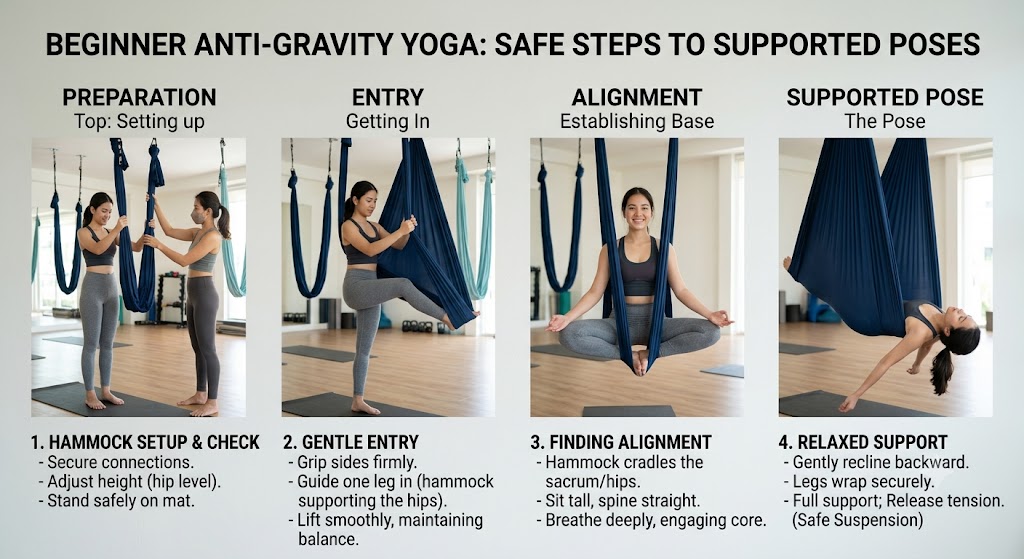
Once your instructor confirms that you can perform the selected movements safely, a short 15–20-minute practice may be appropriate. Beginners should prioritise technique and comfort over completing a fixed-duration workout.
As your confidence develops, you can gradually explore additional movements under supervision. Avoid increasing the difficulty simply because a pose looks easy in a video.
For better recovery, consider incorporating yoga recovery exercises and yoga breathing techniques.
Is Anti Gravity Yoga Safe for Everyone?
Anti gravity yoga can be suitable for many adults when taught appropriately, but it is not automatically safe for everyone or for every pose.
The practice introduces additional considerations because the hammock supports your body weight, may move unexpectedly, and can place you in unfamiliar positions. Inversions and certain spinal movements require particular care.
Who Should Seek Medical Guidance Before Practising?
People with certain health conditions should obtain individualised medical advice before participating, especially before attempting inversions.
These conditions may include:
- Uncontrolled high blood pressure or certain cardiovascular conditions.
- Glaucoma or other eye conditions affected by changes in pressure.
- Neck, spinal, or significant back problems.
- Balance disorders, frequent dizziness, or motion sensitivity.
- Pregnancy, recent surgery, or other conditions that affect safe movement.
The appropriate precautions depend on the individual and the specific condition. For example, a person may be able to perform selected upright movements but need to avoid inversions or particular positions.
Tell your instructor about relevant concerns privately before class, and follow your healthcare professional’s advice about which movements are appropriate.
What Warning Signs Should You Watch For?
Stop immediately if you experience any of the following:
- Dizziness or light-headedness.
- Nausea or unusual pressure.
- Neck, back, or joint pain.
- Significant discomfort or difficulty breathing.
- A feeling that you cannot maintain control of the movement.
Do not push through these symptoms or continue an inversion to complete the exercise. Return to a safe position with your instructor’s assistance when necessary.
Equipment inspection, appropriate instructor supervision, and gradual progression are essential parts of aerial yoga safety.
How Is Anti Gravity Yoga Different From Traditional Yoga?
Anti gravity yoga uses a suspended hammock, whereas traditional yoga generally uses a mat and bodyweight to perform poses and transitions.
Both practices can include stretching, balance work, controlled breathing, and mindfulness. However, the equipment and movement requirements create different experiences.
| Feature | Anti gravity yoga | Traditional yoga |
|---|---|---|
| Equipment | Suspended hammock and rated hardware | Usually a yoga mat |
| Movement | Supported and aerial movements | Primarily mat-based movements |
| Balance | Includes a moving support surface | Relies mainly on body positioning |
| Accessibility | Requires specialised equipment and instruction | Often easier to practise at home |
| Learning environment | Commonly taught in equipped studios | Available in studios and at home |
| Main focus | Supported movement, coordination, and flexibility | Varies by style, including strength, mobility, and mindfulness |
Neither approach is universally better. Anti gravity yoga may appeal to people who enjoy aerial movement and want to explore hammock-assisted exercises, while traditional yoga may suit those who prefer a simpler setup.
You can also combine both practices. For example, mat-based yoga may help you develop foundational mobility and body awareness before you explore aerial movements with a qualified instructor.
How Do You Choose a Good Anti Gravity Yoga Studio?
A good anti gravity yoga studio provides qualified instruction, appropriate equipment, clear safety procedures, and beginner-friendly modifications.
Because the practice involves suspended equipment, choosing a suitable studio is an important part of getting started safely.
What to Check Before Booking a Class
- Instructor qualifications: Look for instructors with relevant aerial yoga training and experience teaching beginners.
- Equipment maintenance: Ask how the studio inspects and maintains hammocks and suspension hardware.
- Professional installation: Check that the mounting systems have been appropriately assessed and installed.
- Beginner-friendly classes: Choose introductory sessions with manageable group sizes and individual guidance.
- Clear safety procedures: The instructor should explain how to enter and exit the hammock and what to do if you feel uncomfortable.
- Suitable modifications: Look for a teaching approach that accommodates different abilities and comfort levels.
Additionally, ask whether the class includes inversions or advanced movements. A beginner class should explain the progression clearly and allow you to decline any exercise that feels uncomfortable.
A good instructor welcomes questions and places safe technique above performing impressive-looking poses.
Can You Practise Anti Gravity Yoga at Home?
You can practise anti gravity yoga at home, but only with suitable equipment, an appropriate mounting system, professional installation, and the necessary training.
Buying an aerial yoga hammock does not establish that your ceiling, beam, or mounting point can safely support the forces generated during movement. Improper installation can result in serious falls or injuries.
Beginners should therefore learn the fundamentals in a supervised studio before considering home practice. This allows you to develop hammock-handling skills, understand movement limitations, and learn how to exit positions safely.
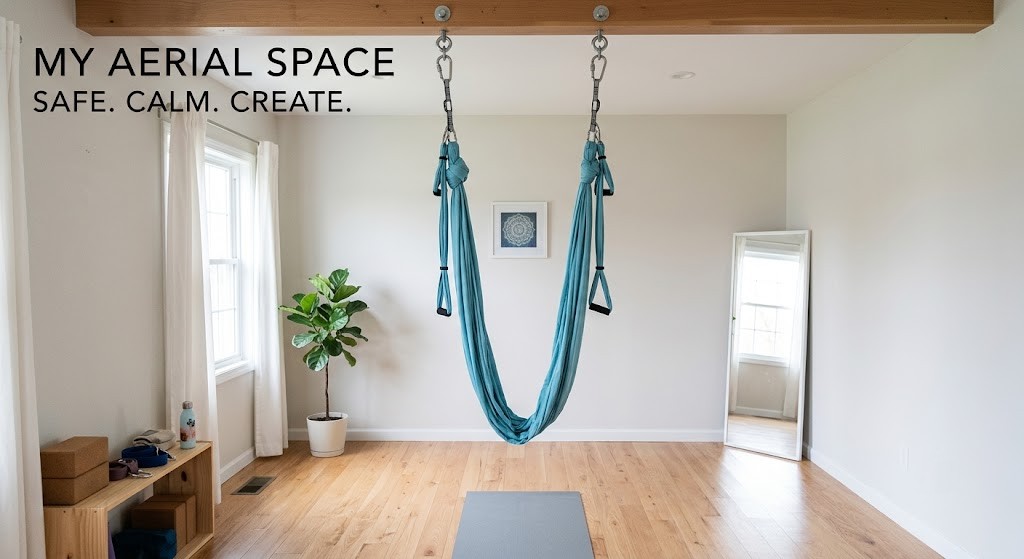
Home Anti Gravity Yoga Safety Checklist
Before practising at home, make sure you have:
- A hammock designed for the intended aerial yoga movements.
- Compatible, appropriately rated suspension hardware.
- A mounting point assessed for the relevant loads by a qualified professional.
- Installation that follows the equipment manufacturer’s requirements.
- Adequate clear space around the practice area.
- Appropriate training in the movements you intend to perform.
Do not rely on an ordinary ceiling hook, an unverified beam, or improvised mounting equipment. Avoid practising inversions or advanced movements alone, particularly when you are still learning.
How Can You Build an Anti Gravity Yoga Routine?
You can build an anti gravity yoga routine by starting with foundational poses, practising consistently, and increasing difficulty only when your technique and comfort allow.
Rather than trying to master every movement immediately, focus on learning the fundamentals and tracking your progress.
Practical Steps for Building Your Routine
- Book an introductory class. Learn the basic equipment setup and hammock-handling techniques.
- Practise foundational poses. Focus on supported seated positions, gentle folds, and controlled squats.
- Track your progress. Notice changes in comfort, coordination, flexibility, and confidence without forcing results.
- Progress gradually. Add more challenging movements only with appropriate instruction.
- Balance your training. Combine anti gravity yoga with suitable strength training, cardiovascular exercise, and recovery.
Furthermore, explore yoga for muscle growth → Yoga for muscle growth guide if you want to understand how yoga may complement a strength-focused routine.
Remember that progress does not require advanced inversions. Improving your control, maintaining comfortable positions, and moving confidently between beginner poses are valuable goals in their own right.
Conclusion
Anti gravity yoga offers a distinctive way to explore flexibility, balance, coordination, and mindful movement using a suspended hammock. Its potential benefits make it an interesting addition to a balanced fitness routine, although individual results vary and research specifically examining aerial yoga remains limited.
For beginners, the best approach is to learn foundational poses, practise under qualified supervision, and use properly installed equipment. Combining anti gravity yoga with conventional strength training, cardiovascular exercise, and recovery can help create a more balanced approach to fitness.
Ultimately, safe progression matters more than mastering advanced poses quickly. Listen to your body, respect your limitations, and build confidence one movement at a time.
FAQs
What is anti gravity yoga?
Anti gravity yoga uses a suspended hammock for supported yoga poses, stretches, and inversions.
What are the benefits of anti gravity yoga?
It may improve flexibility, balance, coordination, and body awareness.
Is anti gravity yoga good for beginners?
Yes, beginners can start with simple, instructor-guided poses.
Can anti gravity yoga improve flexibility?
Yes, supported stretches can help improve flexibility over time.
Does anti gravity yoga strengthen your core?
Yes, some poses engage the abdominal and stabilising muscles.
Is anti gravity yoga safe?
Yes, when practised with proper equipment, qualified instruction, and suitable precautions.
Can I practise anti gravity yoga at home?
Yes, with professionally installed equipment and appropriate training.
What should I wear for anti gravity yoga?
Wear comfortable, close-fitting clothing that covers areas exposed to fabric friction.
How long should beginners practise anti gravity yoga?
Start with a short session and follow your instructor’s guidance.
Is anti gravity yoga better than traditional yoga?
Neither is universally better; the choice depends on your goals and preferences.