

Carb cycling is a nutrition strategy that varies carbohydrate intake across different days to match your training, activity level, and fitness goals. Whether you want to lose body fat, build muscle, or improve workout performance, understanding how to plan your carbohydrate intake can help you make more informed dietary choices.
calorie deficit diet plan for sustainable fat loss
What Is Carb Cycling?
Carb cycling is a dietary approach in which you alternate between higher-carbohydrate and lower-carbohydrate days according to your exercise schedule, energy needs, and goals. Unlike a diet that keeps carbohydrate intake constant, carb cycling changes the amount you eat from day to day.
Carbohydrates provide energy for everyday activities and exercise, particularly high-intensity training. By eating more carbohydrates on demanding workout days and fewer on rest or lighter training days, some people aim to align their food intake with their activity levels.
Carb cycling does not automatically cause fat loss. Your overall calorie intake, protein consumption, training quality, sleep, and consistency remain important factors.
daily protein intake calculator
Why Does Carb Cycling Matter?
Carb cycling can help some active people organize their carbohydrate intake around training demands while maintaining a structured eating routine. However, it is a preference-based strategy rather than a requirement for losing fat or building muscle.
Potential reasons people use carb cycling include:
- Supporting demanding workouts: Higher carbohydrate intake can help replenish muscle glycogen, the stored form of carbohydrate used during exercise.
- Managing calorie intake: Lower-carbohydrate days may reduce overall calories if carbohydrate foods are not replaced with equal or greater calories from fats.
- Planning meals around training: The approach can help athletes organize food intake for heavy training days and recovery days.
- Maintaining dietary flexibility: Some people prefer eating more carbohydrates on days when they exercise intensely.
Research does not establish that carb cycling is inherently superior to a consistent diet with equivalent calories and protein for fat loss. Its usefulness depends on individual preferences, training demands, and whether the plan is sustainable.
TDEE calculator for daily energy needs
How Does Carb Cycling Work?
Carb cycling works by adjusting daily carbohydrate intake while keeping protein, overall nutrition, and total energy intake aligned with your fitness goal. A common approach assigns higher-carbohydrate days to demanding workouts and lower-carbohydrate days to rest or lighter activity.
High-carb, moderate-carb, and low-carb days
These labels describe relative carbohydrate intake rather than universal gram targets. Your needs depend on body size, training volume, total calorie intake, and individual tolerance.
| Day type | Typical use | Food examples |
|---|---|---|
| High-carb | Heavy leg workouts, intense sports, or long training sessions | Rice, potatoes, oats, fruit, whole-grain bread |
| Moderate-carb | Regular strength training or moderate activity | Roti, dal, rice, vegetables, fruit |
| Low-carb | Rest days or lighter activity, if appropriate | Eggs or tofu, vegetables, nuts, seeds, yogurt |
A low-carb day does not mean eliminating carbohydrates. Vegetables, legumes, dairy, and fruit can still contribute useful nutrients and carbohydrates.
Does protein change during carb cycling?
Protein should generally remain consistent from day to day, particularly if your goal is to preserve or build muscle. Instead of drastically changing protein intake, adjust carbohydrate portions and, if needed, dietary fats to fit your daily calorie target.
For people who strength train, adequate protein and progressive resistance exercise are more important for muscle retention than alternating carbohydrate intake alone. (Source: International Society of Sports Nutrition, 2017)
How to Start Carb Cycling for Beginners
Beginners can start carb cycling by matching carbohydrate portions to their weekly training schedule instead of following extreme high- and low-carb days.
Follow these steps to create a practical routine.
- Choose your main goal. Decide whether you want to lose body fat, maintain your weight, or support muscle growth.
- Estimate your calorie needs. Use your activity level and goal to estimate daily energy requirements. Your calorie target should reflect your overall needs, not just your carbohydrate intake.
- Set a consistent protein target. Include a protein source at each main meal.
- Plan carbohydrate portions around exercise. Eat more carbohydrate-rich foods on demanding training days if that helps performance and recovery.
- Keep lower-activity days balanced. Reduce portions only when appropriate, while maintaining vegetables, protein, healthy fats, and adequate overall nutrition.
- Monitor your progress. Review energy, training performance, hunger, recovery, and weight trends over several weeks before making adjustments.
How many carbs should you eat on each day?
There is no scientifically established carbohydrate schedule that works best for everyone using carb cycling. The following is an illustrative starting pattern, not a prescribed intake or a proven optimal ratio.
| Training day | Example approach |
|---|---|
| Heavy workout | Larger portions of rice, potatoes, oats, or other carbohydrate foods |
| Moderate workout | Moderate portions of carbohydrate foods at meals |
| Rest day | Smaller portions if appropriate, with balanced meals and sufficient calories |
For athletes, carbohydrate needs can vary substantially with exercise intensity and duration. Sport nutrition guidance therefore emphasizes individualizing intake to training demands rather than applying a single low-carb target to everyone.
BMR calculator for estimating resting energy needs
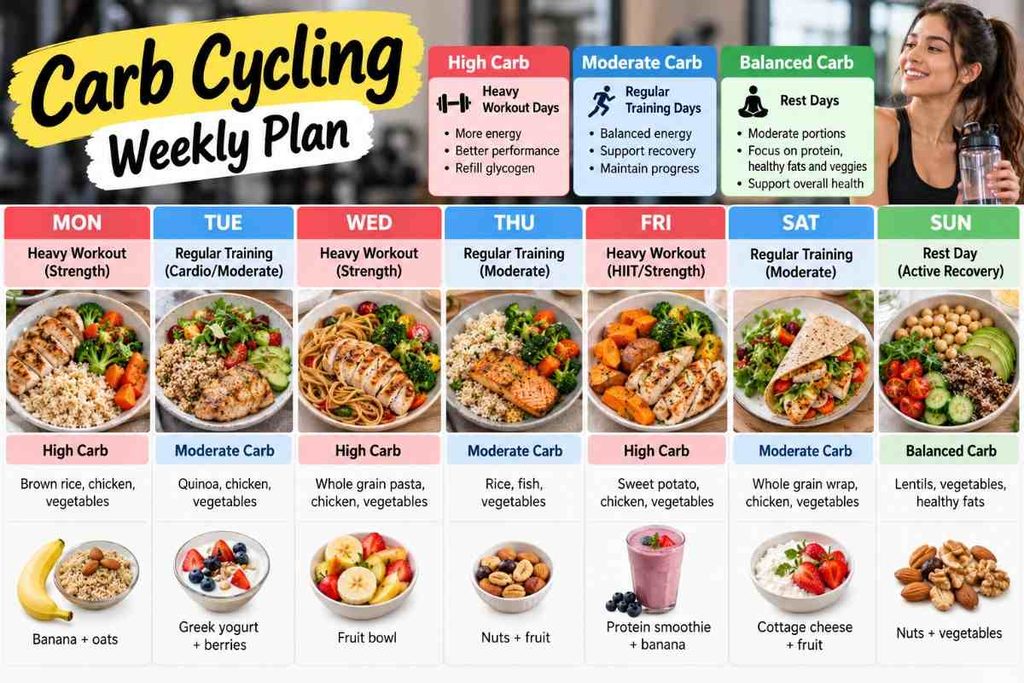
Carb Cycling Meal Plan: A Practical Example
A carb cycling meal plan changes carbohydrate portions across the week while keeping meals balanced and protein intake consistent. The example below uses familiar vegetarian foods and can be adapted to non-vegetarian preferences.
Sample seven-day carb cycling schedule
| Day | Activity | Example meal approach |
|---|---|---|
| Monday | Heavy lower-body workout | Rice, dal, vegetables, curd, and fruit |
| Tuesday | Upper-body workout | Roti, chickpeas, vegetables, and yogurt |
| Wednesday | Rest or walking | Tofu, vegetables, roti, nuts, and fruit |
| Thursday | Heavy full-body workout | Rice, rajma, vegetables, curd, and bananas |
| Friday | Moderate workout | Roti, dal, vegetables, and a protein-rich snack |
| Saturday | Longer or more demanding session | Potatoes, rice, legumes, vegetables, and yogurt |
| Sunday | Rest day | Balanced portions of vegetables, legumes, protein foods, and healthy fats |
The foods and days are examples, not fixed rules. Adjust portions to your energy needs, appetite, cultural preferences, and training schedule. A rest day still requires enough energy and nutrients for recovery.
What does a high-carb day look like?
A high-carb day prioritizes carbohydrate-rich foods to support demanding exercise while still providing adequate protein, fats, and micronutrients.
For example, meals could include:
- Breakfast: Oats with milk and a banana.
- Lunch: Rice, dal, vegetables, and curd.
- Snack: Fruit and yogurt.
- Dinner: Roti, chickpeas or tofu, and vegetables.
What does a low-carb day look like?
A lower-carb day reduces the portions of carbohydrate-rich foods without eliminating nutritious foods or undereating.
Possible meals include:
- Breakfast: Eggs or tofu with vegetables.
- Lunch: A smaller portion of roti with dal, vegetables, and curd.
- Snack: Plain yogurt or a small serving of nuts.
- Dinner: Tofu or another protein source with vegetables and a moderate portion of carbohydrates as needed.
These meal examples should be adjusted for individual calorie and protein requirements. A lower-carb day should not become a very-low-calorie day by default.
High Protein Plant-Based Foods
Is Carb Cycling Good for Fat Loss?
Carb cycling can support fat loss if it helps you maintain a sustainable calorie deficit, but changing carbohydrate intake alone does not guarantee fat loss. When calorie and protein intake are comparable, different carbohydrate-to-fat ratios can produce similar weight-loss outcomes. (Source: International Society of Sports Nutrition, 2017)
A useful distinction is that carbohydrate cycling is a meal-planning method, not a special fat-burning mechanism.
If you eat fewer calories on low-carb days but compensate by eating much more on high-carb days, your average calorie intake may not create a deficit. Conversely, you can lose fat with consistent carbohydrate intake if your overall diet supports the goal.
Research on carbohydrate-restricted diets suggests they can help some people lose weight, but findings about low-carbohydrate diets do not prove that cycling carbohydrates is better than maintaining a consistent intake. (Source: Soltani et al., 2023)
Is Carb Cycling Good for Muscle Gain?
Carb cycling may help organize food intake around demanding strength-training sessions, but muscle growth depends on adequate energy, sufficient protein, progressive training, and recovery.
If muscle gain is your main goal, consider these priorities:
- Eat enough total calories to support your training and recovery.
- Consume adequate protein consistently.
- Include carbohydrates to support workout performance.
- Follow a progressive resistance-training program.
- Get sufficient sleep and allow muscles time to recover.
A low-carb day that leaves you exhausted or unable to train effectively may work against your goals. You do not need to cycle carbohydrates to build muscle; a consistent, well-planned diet can work just as well.
lean bulk diet plan for muscle growth
Carb Cycling vs. a Consistent-Carbohydrate Diet
Carb cycling varies carbohydrate intake between days, while a consistent-carbohydrate diet keeps daily intake relatively stable. Both approaches can work, and the better choice depends on your preferences, training schedule, and ability to follow the plan.
| Factor | Carb cycling | Consistent-carbohydrate diet |
|---|---|---|
| Daily carbohydrate intake | Varies by day | Stays relatively stable |
| Meal planning | Requires more adjustments | Usually simpler |
| Workout fueling | Can prioritize demanding sessions | Can fuel workouts consistently |
| Fat loss | Depends on overall energy balance | Depends on overall energy balance |
| Best suited for | People who enjoy structured variation | People who prefer a predictable routine |
Choose carb cycling if changing meal portions around training feels useful and manageable. Choose a consistent approach if tracking different targets creates unnecessary stress or makes eating difficult to sustain.
macro calculator for daily protein, carbohydrate, and fat targets
Common Carb Cycling Mistakes to Avoid
The most common carb cycling mistakes are making carbohydrate targets too restrictive, ignoring total calories, and changing several parts of a diet at once.
Avoid these pitfalls:
- Cutting carbohydrates too aggressively: Very low intake may leave you with less energy for demanding workouts.
- Eating too little on rest days: Recovery continues when you are not exercising.
- Ignoring food quality: Whole grains, legumes, fruit, and vegetables provide fiber and essential nutrients.
- Changing protein intake unnecessarily: Keep protein adequate for your goals.
- Expecting immediate fat loss: Short-term scale changes can reflect shifts in glycogen and water, not just body fat.
- Treating high-carb days as unlimited eating days: Your overall calorie intake still matters.
- Following a rigid plan despite poor recovery: Persistent fatigue, declining performance, and excessive hunger are reasons to reassess your approach.
fitness recovery strategies for better performance
Is Carb Cycling Safe?
Carb cycling may be appropriate for some healthy adults, but its safety depends on how restrictive the plan is, the person’s nutritional needs, and any underlying health conditions.
Avoid extreme carbohydrate restriction or substantial calorie deficits without professional guidance. Consult a qualified healthcare professional or registered dietitian before making major dietary changes if you have diabetes, take glucose-lowering medication, have a history of disordered eating, are pregnant or breastfeeding, or have a medical condition affecting nutrition.
For people who exercise intensely, insufficient carbohydrate intake can also compromise training quality and recovery. Prioritize adequate energy, a varied diet, and sustainable eating habits rather than trying to make every day fit a strict carbohydrate category.

beginner strength training workout plan
Conclusion
Carb cycling is a flexible nutrition strategy that adjusts carbohydrate intake according to workout intensity and activity levels. It may help some people organize their meals and fuel demanding workouts, but it is not necessary for fat loss or muscle growth.
Start with balanced meals, adequate protein, and an appropriate calorie target. If you choose to try carb cycling, make small adjustments based on your energy, training performance, recovery, and long-term progress.
FAQs
Does carb cycling help you lose belly fat?
Carb cycling does not specifically target belly fat. Fat loss depends largely on maintaining a sustainable calorie deficit over time.
How many days should you carb cycle?
There is no universal schedule. Some people alternate higher- and lower-carbohydrate days according to their weekly training routine.
Can beginners try carb cycling?
Yes, healthy beginners can explore a moderate approach, but a balanced diet with consistent carbohydrate intake may be simpler and equally effective.
Can I build muscle while carb cycling?
Yes. Adequate calories, protein, progressive resistance training, and recovery are essential for muscle growth.
Can I eat rice during carb cycling?
Yes. Rice can fit into high-, moderate-, and lower-carbohydrate days by adjusting portion sizes to your needs.
Is carb cycling better than a calorie deficit?
No. Carb cycling is not inherently better for fat loss than a consistent diet that provides an appropriate calorie deficit and adequate protein.
Are low-carb days necessary for carb cycling?
No. You can adjust carbohydrate intake moderately without making any day extremely low in carbohydrates.
How long does it take to see results from carb cycling?
Results vary with calorie intake, training, consistency, and individual factors. Evaluate progress over several weeks rather than relying on daily scale changes.
Sources
- International Society of Sports Nutrition. (2017). International Society of Sports Nutrition Position Stand: Diets and Body Composition.
- Soltani et al. (2023). Effect of Carbohydrate Restriction on Body Weight in Overweight and Obese Adults: A Systematic Review and Dose-Response Meta-Analysis of 110 Randomized Controlled Trials. Frontiers in Nutrition.
- International Society of Sports Nutrition. (2026). International Society of Sports Nutrition Position Stand: Diets for Body Weight Reduction.
Disclaimer: This article is for informational and educational purposes only and is not a substitute for personalized medical advice. Consult a qualified healthcare professional before making significant changes to your diet, exercise routine, or supplement use.