

Parivrtta Trikonasana, also known as Revolved Triangle Pose, is a standing yoga posture that combines a forward fold, spinal rotation, balance, and leg strength. This intermediate pose can help you develop body awareness, challenge your stability, and improve flexibility in your legs and torso when practiced with proper alignment.
What Is Parivrtta Trikonasana?
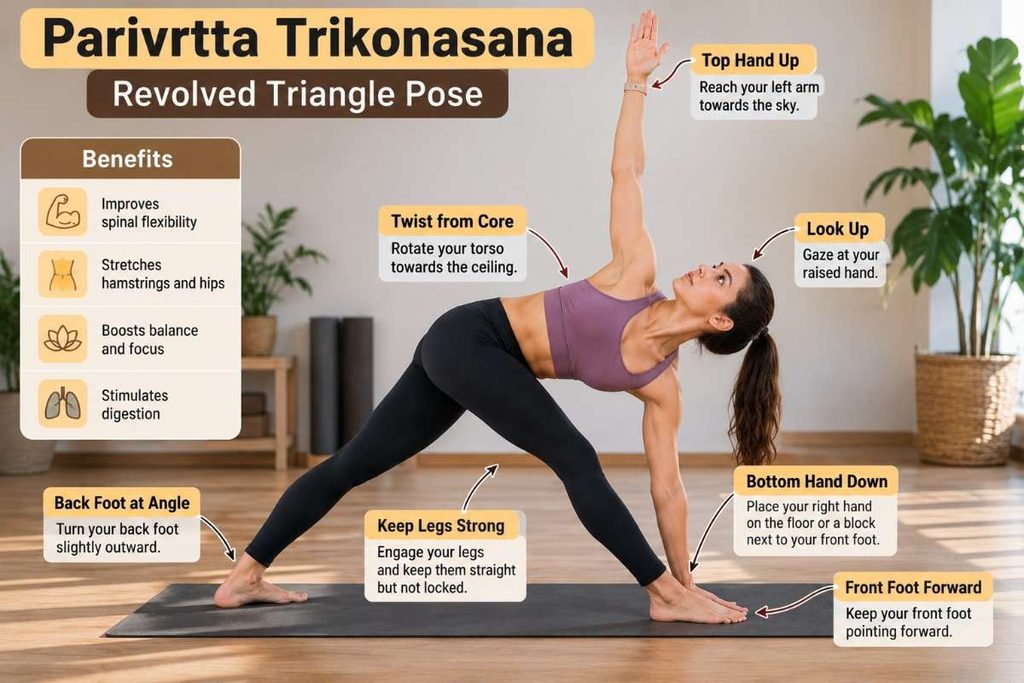
Parivrtta Trikonasana is a standing twisting yoga pose in which you extend your legs, fold forward from the hips, and rotate your torso toward the front leg while reaching one arm upward. The Sanskrit word Parivrtta means revolved or turned, Trikona means triangle, and Asana means pose. Its English name is Revolved Triangle Pose.
The posture challenges your balance and coordination because your feet provide the foundation while your torso rotates. It is generally considered an intermediate pose, but beginners can practice a supported variation with a yoga block or chair.
Why Does Parivrtta Trikonasana Matter?
Parivrtta Trikonasana matters because it combines standing balance, hip-hinge control, leg engagement, and a controlled torso twist in one posture. Regular, comfortable practice may help develop flexibility, balance, and body awareness as part of a broader yoga routine.
Potential benefits include:
- Leg strength: Maintaining the standing position engages the muscles of the thighs and lower legs.
- Hamstring and hip flexibility: The forward fold challenges flexibility in the back of the legs and around the hips.
- Spinal mobility: The twisting action encourages controlled rotation through the torso.
- Balance and stability: Your legs, feet, and core work together to maintain the posture.
- Concentration: Coordinating your breathing, gaze, and alignment encourages focused movement.
These are general movement-related benefits, not guarantees of treating back pain, improving digestion, or correcting a medical condition.
How to Do Parivrtta Trikonasana Step by Step
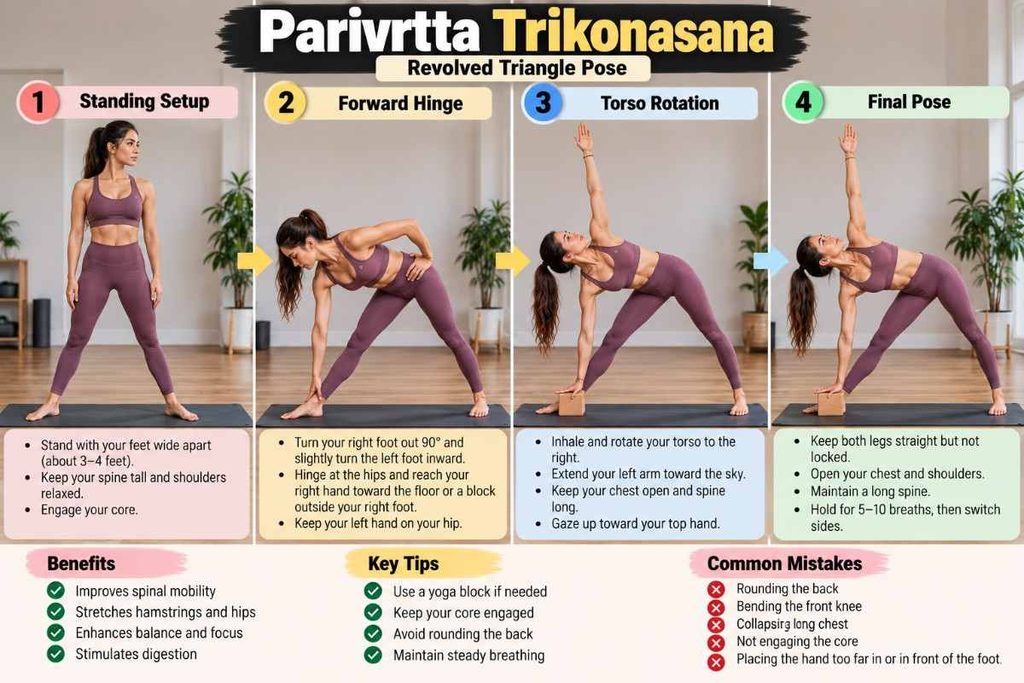
To perform Parivrtta Trikonasana, stand with your feet apart, hinge forward from your hips, rotate your torso toward your front leg, and extend your opposite arm upward while maintaining steady breathing.
Step 1: Start in Mountain Pose
- Stand upright on your yoga mat.
- Step your feet approximately 3–4 feet apart, adjusting the distance for comfort and stability.
- Extend your arms out to the sides at shoulder height.
- Keep your shoulders relaxed and your spine tall.
Step 2: Position Your Feet
- Turn your right foot outward approximately 90 degrees.
- Turn your left foot slightly inward.
- Keep both feet grounded and distribute your weight evenly.
- Maintain a comfortable stance that allows you to balance.
Step 3: Lengthen Your Spine
Inhale and extend through the crown of your head. As you exhale, hinge forward from your hips while keeping your back long.
Avoid rounding your spine simply to reach the floor.
Step 4: Place Your Hand Near Your Front Foot
Place your left hand on a yoga block, on your shin, or on the floor near the outside of your right foot. Choose the position that allows you to maintain a comfortable spinal position.
Step 5: Rotate Your Torso
Inhale to lengthen your spine. As you exhale, gently rotate your torso toward the right, keeping both sides of your torso as long as possible.
Step 6: Extend Your Upper Arm
Raise your right arm toward the ceiling, stacking your shoulders as comfortably as possible. Keep your neck relaxed and look forward or down if looking upward strains your neck.
Step 7: Hold and Breathe
Remain in the pose for around 3–5 comfortable breaths initially. Experienced practitioners may hold it longer if they can maintain steady breathing and good alignment.
Step 8: Release and Switch Sides
Bring your raised arm down, gently unwind your torso, and return to standing. Reverse your foot position and repeat on the opposite side for an equal amount of time.
yoga breathing techniques for beginners
Muscles Worked in Parivrtta Trikonasana
Parivrtta Trikonasana engages the legs, core, and back muscles while stretching several areas of the lower body and torso.
| Muscle group | Role in the pose |
|---|---|
| Quadriceps | Help stabilize and extend the knees |
| Hamstrings | Lengthen during the forward hinge |
| Gluteal muscles | Help stabilize the hips |
| Obliques | Contribute to torso rotation |
| Spinal muscles | Help maintain an elongated, supported torso |
| Calves and ankle muscles | Help stabilize the standing position |
| Shoulder muscles | Support the extended arm position |
The exact muscular demands vary with your stance, range of motion, hand support, and technique.
Beginner Modifications for Revolved Triangle Pose
Beginners can make Revolved Triangle Pose more accessible by reducing the stance width, using support under the lower hand, and limiting the amount of rotation.
Use a Yoga Block
Place a block beside your front foot and rest your lower hand on it. This reduces the need to reach toward the floor and may make it easier to maintain a long spine.
Keep Your Gaze Down
You do not need to look at your raised hand. Looking down or straight ahead can make the pose more comfortable for your neck and help with balance.
Shorten Your Stance
Bring your feet slightly closer together if a wide stance feels unstable. Adjust the distance until you can maintain a steady position without forcing the stretch.
Use a Chair for Support
Place a sturdy chair beside your front foot and rest your lower hand on the seat. This modification can help you focus on alignment without reaching toward the floor.
These modifications are consistent with guidance from Yoga Journal and the Australian School of Meditation & Yoga.
Common Mistakes to Avoid
Avoid forcing the twist or sacrificing spinal alignment to achieve a deeper-looking pose.
- Rounding your back: Lengthen your spine and use a block if needed.
- Over-rotating your neck: Let the rotation come primarily from your torso, and keep your gaze comfortable.
- Losing balance: Widen or shorten your stance, or practice near a wall.
- Locking your knees aggressively: Keep your legs active without forcing the knee joints backward.
- Holding your breath: Breathe naturally throughout the posture.
- Forcing the twist: Rotate only as far as you can without pain or strain.
Safety Precautions for Parivrtta Trikonasana
Parivrtta Trikonasana requires a forward hinge and spinal rotation, so people with back or spinal injuries should seek guidance from a qualified healthcare professional before attempting it. Avoid forcing the pose if you experience pain, dizziness, or difficulty breathing.
Take extra care if you have:
- A current back, spinal, hip, or hamstring injury.
- Balance difficulties that make standing twists unstable.
- A condition that affects your ability to bend or rotate comfortably.
- Symptoms that worsen when twisting or bending forward.
If you are pregnant, have significant spinal problems, or have been advised to avoid twisting movements, ask your healthcare professional about an appropriate modification before practicing.
Gentle Yoga Easy Poses for Relaxation
Conclusion
Parivrtta Trikonasana, or Revolved Triangle Pose, is an intermediate standing yoga posture that combines balance, leg engagement, a forward hinge, and controlled spinal rotation. Practice it slowly, keep your spine long, use a block or chair when necessary, and focus on comfortable breathing rather than achieving the deepest twist.
Consistent practice with appropriate modifications can help you develop greater movement control, balance, and flexibility over time.
FAQs
What is Parivrtta Trikonasana called in English?
Parivrtta Trikonasana is called Revolved Triangle Pose or Revolving Triangle Pose in English.
Is Parivrtta Trikonasana suitable for beginners?
Beginners can practice a modified version with a yoga block or chair, a shorter stance, and a comfortable range of rotation.
What are the main benefits of Revolved Triangle Pose?
The pose challenges balance, strengthens the legs, and stretches the hamstrings and torso while encouraging controlled spinal rotation.
How long should you hold Parivrtta Trikonasana?
Beginners can start with 3–5 comfortable breaths on each side. Longer holds may be suitable for experienced practitioners who can maintain proper alignment.
Does Parivrtta Trikonasana help with flexibility?
It can help develop flexibility in the hamstrings, hips, and torso when practiced consistently and without forcing the movement.
Should you look up in Revolved Triangle Pose?
No. Looking upward is optional. You can look forward or down if turning your head causes discomfort or makes balancing difficult.
Can you perform Parivrtta Trikonasana every day?
Some people can include a gentle version in a daily yoga routine, provided it remains comfortable and does not aggravate an injury. Adjust the frequency to your mobility and recovery needs.
Sources
- Yoga Journal. (2025). Revolved Triangle Pose: How to Practice Parivrtta Trikonasana.
- Australian School of Meditation & Yoga. (2025). Revolved Triangle (Parivrtta Trikonasana).
- B. K. S. Iyengar Yoga. Parivrtta Trikonasana — Revolved Triangle Pose.
Disclaimer: This article is for informational and educational purposes only and is not a substitute for personalized medical advice. Consult a qualified healthcare professional before making significant changes to your diet, exercise routine, or supplement use.