
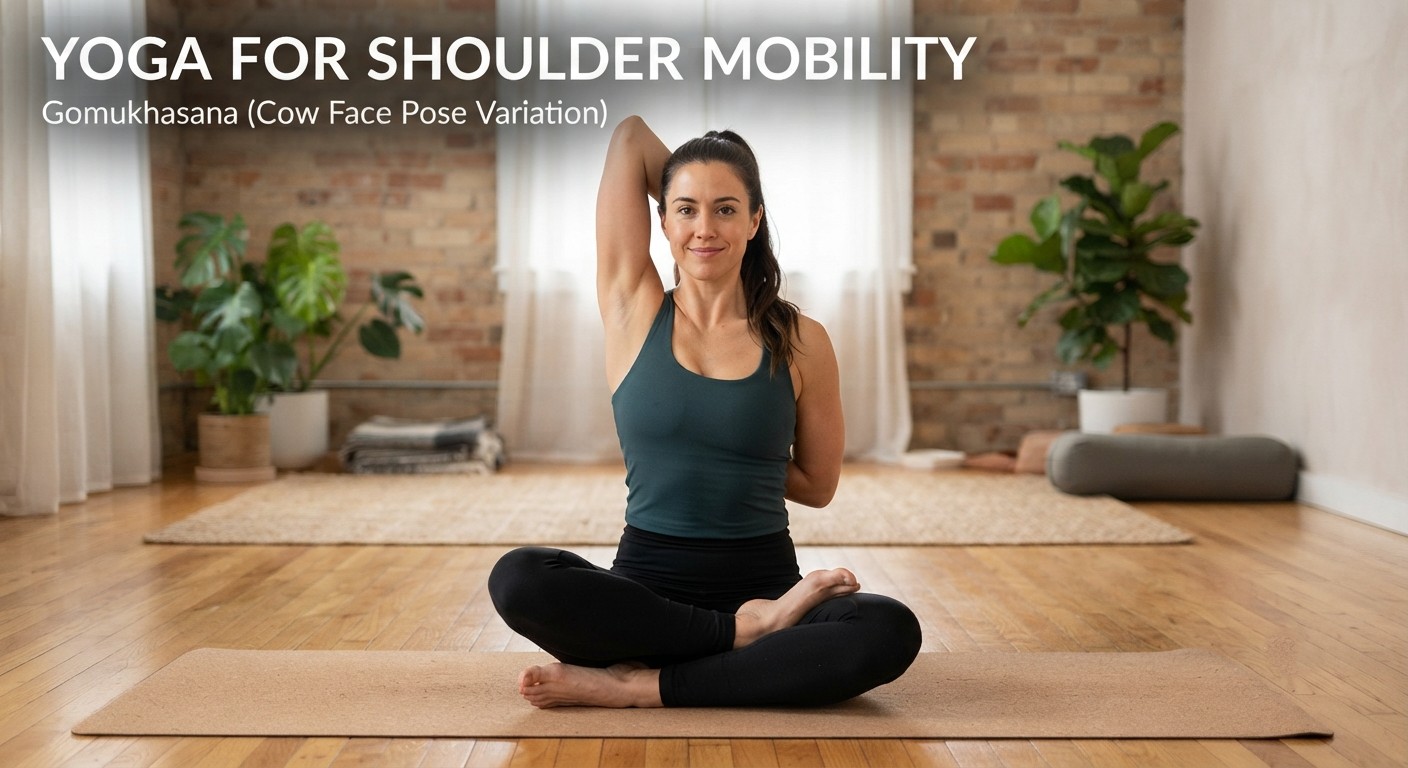
Stiff shoulders can make simple things like reaching for a high shelf or pulling on a jacket feel harder than they should. Yoga offers a low-cost way to move the shoulders through more range, but the research on it is small, so it helps to know what to expect. This guide covers the poses worth trying, how to do them safely, and what the studies actually show.
What is yoga for shoulder mobility?
Yoga for shoulder mobility is a set of yoga poses and stretches that move the shoulder joint, shoulder blades, and upper back through a comfortable range of motion. The goal is easier overhead reach, better rotation, and less stiffness across the upper body.
A typical routine works on several areas at once:
- The shoulder joint itself, through reaching, rotating, and arm-binding poses
- The shoulder blades, which need to glide freely for the arm to lift well
- The upper back (thoracic spine), where stiffness often limits how far the arms can move
- The chest and front of the shoulders, which tighten after long hours at a desk or phone
If you are brand new to the practice, start with Iyengar Yoga for Beginners before adding the poses below.
Why does shoulder mobility matter?
Shoulder mobility matters because the shoulder is one of the most movable joints in the body, and joints that move a lot tend to stiffen when they are not used. Harvard Health Publishing notes that few bony limits hold the joint in place, which makes it flexible but dependent on regular movement. (Source: Harvard Health Publishing)
Good mobility shows up in everyday life:
- Reaching overhead without arching your lower back
- Putting on a coat or fastening a bra without a struggle
- Carrying bags and lifting objects with less strain
- Sitting at a desk without the shoulders rolling forward
It also supports training. If your overhead range is limited, a better shoulder routine can complement shoulder workouts and make pressing and pulling movements feel smoother.
Does yoga actually improve shoulder mobility?
Yoga may help, but the direct evidence is small and mixed, so treat it as a reasonable option and not a proven fix. Here is what the studies found:
- A 2023 cross-sectional study compared 32 women aged 45 to 75 who had practiced yoga for at least two years with 32 women who had not. The yoga group had better shoulder range of motion on the non-dominant side, with differences of about 10% to 22% across several movements. Because the study looked at one point in time, it cannot show that yoga caused the difference. (Source: BMC Women’s Health, 2023)
- A 2024 pilot randomized trial in women with breast cancer (34 analyzed) found no significant difference between the yoga and control groups in shoulder range of motion or upper limb function. The yoga group did improve within the group on some measures, including reach behind the back, but the authors called for cautious interpretation and a larger trial. (Source: Heliyon, 2024)
- In a one-year study of 354 yoga practitioners, about 74% said yoga improved existing pain. The same study found that yoga also caused new musculoskeletal pain in roughly 10% of people, with most of it in the upper limbs. (Source: University of Sydney, 2017)
So far, the studies suggest practitioners may have more shoulder range, but trials that test yoga directly against a control group have been small and have not shown clear gains in mobility.
Best yoga poses for shoulder mobility
The best yoga poses for shoulder mobility are slow, supported movements that take the shoulders through reach, rotation, and chest opening without heavy weight on the arms. Use this table as a starting menu:
| Pose | What it targets | Shoulder-friendly cue |
|---|---|---|
| Cat-cow (Marjaryasana-Bitilasana) | Shoulder blades and upper back | Move slowly with your breath and keep wrists under shoulders |
| Thread the needle | Back of the shoulder and upper back rotation | Rest the shoulder on a folded blanket if the floor feels far away |
| Puppy pose (Uttana Shishosana) | Overhead reach, chest, and upper back | Keep hips above knees and rest your forehead on a block |
| Eagle arms (Garudasana arms) | Upper back and rear shoulder | Cross arms at chest height and keep shoulders away from your ears |
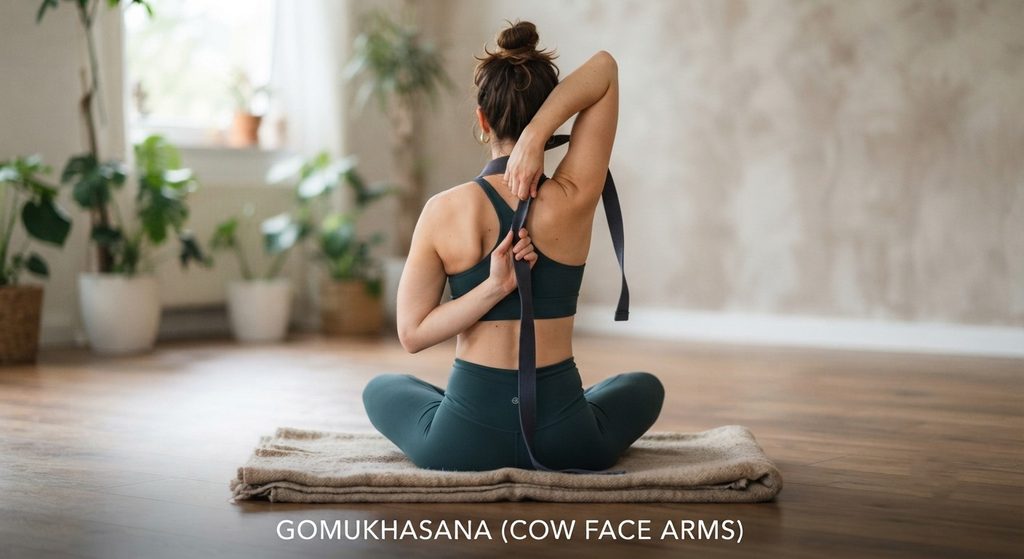
| Cow face arms with a strap (Gomukhasana arms) | Internal and external rotation | Hold a strap and walk the hands closer only as far as is comfortable |
| Standing forward fold with clasped hands | Chest and front of the shoulders | Bend your knees and let the arms fall gently overhead |
| Wall chest opener | Front of the shoulder and chest | Rest a palm on the wall at or below shoulder height and turn away slowly |
Stiff shoulders often go along with a stiff upper back, so adding Yoga for Thoracic Rotation can make these poses easier to reach.
How to do thread the needle
- Start on hands and knees with wrists under shoulders and knees under hips.
- Slide your right arm under your chest, palm facing up, toward the left side of the mat.
- Lower your right shoulder and ear to the mat or onto a folded blanket.
- Keep your hips stacked above your knees and breathe slowly for about 30 seconds.
- Press back up and repeat on the other side.
How to do cow face arms with a strap
- Sit tall on a folded blanket with a strap in your right hand.
- Raise your right arm overhead, bend the elbow, and let the hand drop behind your head, still holding the strap.
- Reach your left hand behind your back and up your spine to take hold of the strap lower down.
- Walk your fingers closer together only until you feel a moderate stretch.
- Hold for 30 seconds, breathe, and switch sides.
A short yoga sequence for shoulder mobility
A short shoulder sequence takes about seven minutes once you are warmed up and works well as a daily routine. Do the poses in this order:
- Cat-cow: 1 minute
- Thread the needle: 30 seconds per side
- Puppy pose: 30 seconds
- Eagle arms: 30 seconds per side
- Cow face arms with a strap: 30 seconds per side
- Wall chest opener: 30 seconds per side
- Child’s pose with arms extended: 1 minute
Thirty-second holds follow the pattern used in the American Academy of Orthopaedic Surgeons shoulder stretching program, which also recommends warming up with 5 to 10 minutes of low-impact activity such as walking first and doing the stretches afterward. (Source: AAOS)
For days when you want something extra, Best Resistance Band Workout add strength to the range you are building.
Which yoga poses should you avoid with stiff shoulders?
Poses that put a lot of weight on the arms or force the shoulders into extreme positions are the ones to modify or skip first. In the one-year study mentioned above, most new yoga-related pain showed up in the upper limbs, and the researchers suggested that postures like downward-facing dog may be a factor. (Source: University of Sydney, 2017)
Common examples and easier choices:
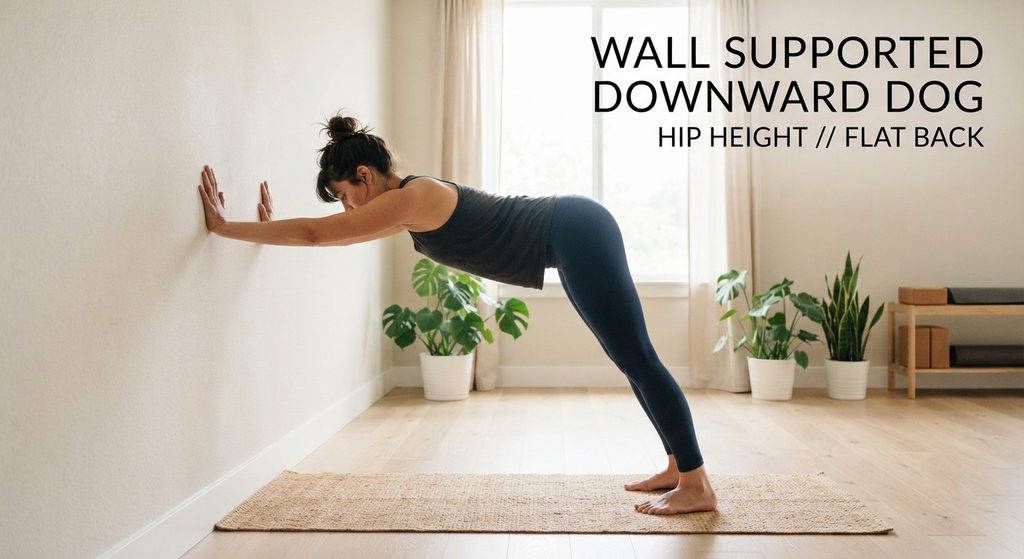
- Downward-facing dog: try the wall version, with hands on a wall and hips back, or keep the knees bent and the weight light on the arms
- Plank and chaturanga: lower the knees, or skip the push-up lowering for now
- Handstand and forearm balances: leave these for later, after your shoulders move comfortably
- Headstand and shoulder stand: the NCCIH advises beginners to avoid these. (Source: NCCIH, 2023)
- Deep backbends such as wheel pose: build toward them slowly, with a teacher’s guidance
How to practice yoga for shoulder mobility safely
Safe practice starts with a warm-up, a moderate stretch, and a willingness to back off when something hurts. Keep these points in mind:
- Warm up for 5 to 10 minutes before stretching.
- Stretch to a mild or moderate pull and stop if you feel sharp pain. The AAOS says you should not feel pain during these exercises, and to talk to your doctor or physical therapist if you do.
- Hold each stretch for about 30 seconds and breathe slowly.
- Keep the shoulders away from your ears and avoid forcing the arm into a position.
- Practice with a qualified instructor when possible. The NCCIH says yoga is generally low risk for healthy people when it is done correctly with a qualified teacher.
- Tell your instructor about any shoulder injury or surgery before class.
- Do not use yoga to delay seeing a health care provider about a medical problem.
A good warm-up routine before workouts gets the muscles ready, and props such as yoga blocks and straps let you hold poses without forcing the joint.
What else helps shoulder mobility besides yoga?
Regular movement in other forms helps shoulder mobility alongside yoga, especially for people who sit most of the day. Consider these additions:
- 10 Minute Yoga to Improve Posture to counter rounded shoulders
- foam rolling for recovery for the upper back and lats, keeping the roller off the joint itself
- mobility workouts for a broader routine across the whole body
When should you see a doctor about shoulder pain?
See a doctor or physical therapist if shoulder pain follows an injury, keeps getting worse, or comes with other warning signs. Get checked for:
- Sudden pain or a popping feeling after a fall or strain
- Weakness or trouble lifting your arm
- Numbness or tingling in the arm or hand
- Pain at night or at rest that does not ease
- Pain during stretching that does not settle (Source: AAOS)
Yoga is not a substitute for a diagnosis, so get new or unexplained shoulder pain checked before building a routine around it.
Conclusion
Yoga can be a sensible way to work on shoulder mobility if you keep the poses supported, slow, and pain-free. The evidence so far is limited: yoga practitioners may have more shoulder range of motion, but small trials have not shown clear gains from yoga alone. Start with a warm-up and a seven-minute sequence most days, use a strap, block, or wall to support your poses, and go lighter on weight-bearing poses like downward dog. If your shoulder is painful or very stiff, check with a doctor or physical therapist before you begin.
FAQs
Can yoga improve shoulder mobility?
Yoga may help, but the evidence is limited. A 2023 study found better shoulder range of motion in long-term yoga practitioners, while a small 2024 randomized trial found no significant difference between groups.
What are the best yoga poses for tight shoulders?
Thread the needle, cow face arms with a strap, puppy pose, and eagle arms are common choices. They move the shoulders through reach and rotation without heavy weight on the arms.
Is downward-facing dog bad for shoulders?
It can be hard on stiff or sore shoulders because it puts weight through the arms. A one-year study found most new yoga-related pain in the upper limbs and suggested postures like downward dog as a possible factor.
How long should I hold shoulder stretches?
About 30 seconds per stretch is a common guideline. The AAOS shoulder stretching program uses 30-second holds followed by 30 seconds of rest.
Is yoga safe if I already have shoulder pain?
It depends on the cause of the pain, so check with a doctor or physical therapist first. The NCCIH advises talking with your health care provider and instructor about modifications if you have a health condition.
Should I warm up before shoulder yoga?
Yes. The AAOS recommends 5 to 10 minutes of low-impact activity such as walking before stretching.
Sources
- Wong, S. S. S., et al. (2023). Health status of aged women with or without the experience of practicing yoga. BMC Women’s Health.
- Wong, S. S. S., et al. (2024). Effects of a tailor-made yoga program on upper limb function and sleep quality in women with breast cancer: A pilot randomized controlled trial. Heliyon.
- University of Sydney. (2017). Yoga more risky for causing musculoskeletal pain than you might think.
- National Center for Complementary and Integrative Health. (2023). Yoga: Effectiveness and Safety.
- American Academy of Orthopaedic Surgeons. (n.d.). Rotator Cuff and Shoulder Conditioning Program. OrthoInfo.
Disclaimer: This article is for informational and educational purposes only and is not a substitute for personalized medical advice. Consult a qualified healthcare professional before making significant changes to your diet, exercise routine, or supplement use.