
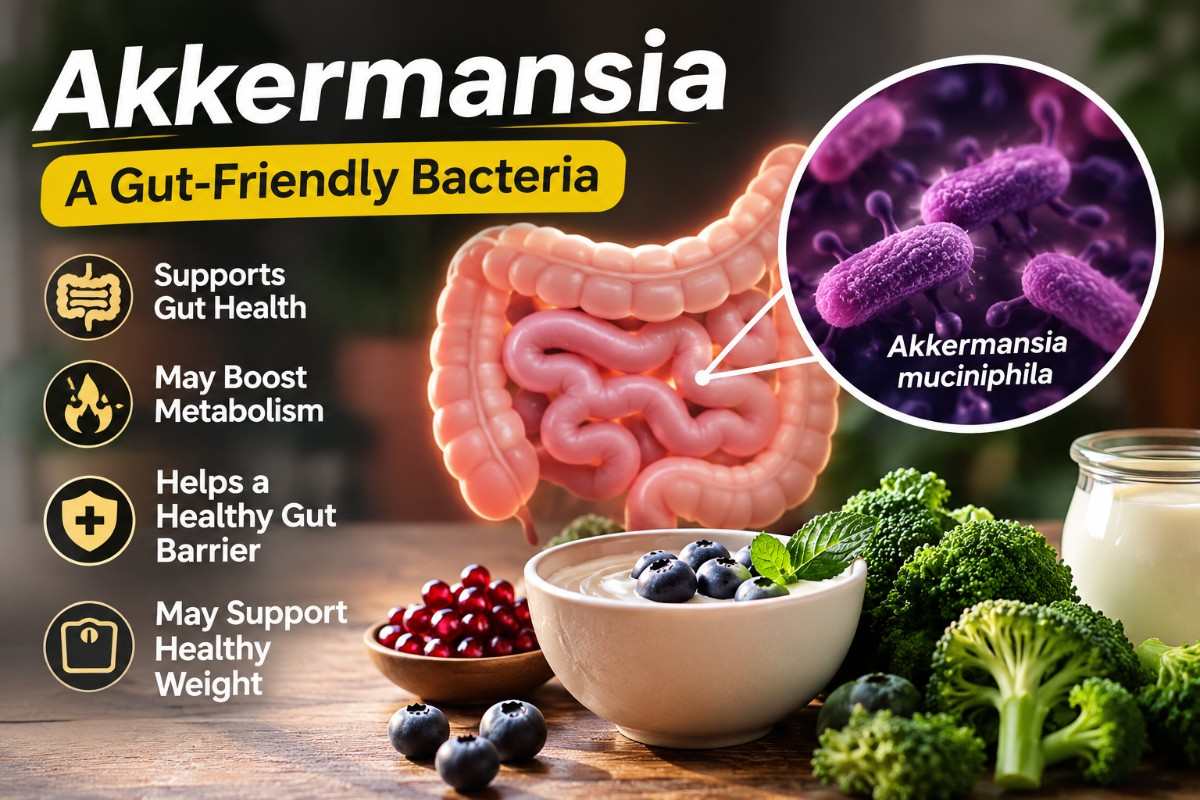
Akkermansia is gaining attention in gut health research because of its potential connection to intestinal health, metabolic function, and weight management. This beneficial gut bacterium, particularly Akkermansia muciniphila, plays an important role in the intestinal mucus layer. Researchers are investigating whether supporting healthy Akkermansia levels could contribute to better metabolic health.
Understanding Akkermansia benefits, its potential effects on the gut microbiome, dietary influences, and available supplements can help you make informed decisions about supporting your digestive health.
What Is Akkermansia?
Akkermansia is a genus of bacteria found naturally in the human gastrointestinal tract, with Akkermansia muciniphila being the best-studied species. This mucus-associated bacterium uses mucin, a protein-rich component of the protective mucus lining of the intestine, as a source of nutrients.
Unlike many gut bacteria that primarily ferment dietary fiber, Akkermansia can utilize mucin. Its activity is associated with interactions between gut microbes, the intestinal barrier, and the host’s metabolism.
Researchers are particularly interested in Akkermansia muciniphila because differences in its abundance have been associated with metabolic health in several observational studies.
The bacterium is considered a promising next-generation probiotic candidate. However, its potential benefits are still being investigated, and not every proposed health effect has been established in large human clinical trials.
For readers interested in the broader relationship between gut bacteria and nutrition, gut health provides a relevant related topic.
Why Does Akkermansia Matter?
Akkermansia matters because it participates in the relationship between the intestinal mucus layer, gut microbial activity, and metabolic processes.
The intestinal mucus layer acts as a protective barrier between intestinal contents and the underlying intestinal cells. Akkermansia interacts with this environment and may influence how other microorganisms function within the gut ecosystem.
Researchers are studying its potential connections with:
- Intestinal barrier function: Its activity may influence the protective environment of the intestinal lining.
- Metabolic health: Research has associated its abundance with insulin sensitivity and other metabolic markers.
- Body weight regulation: Human clinical studies are investigating its potential role in weight management.
- Gut microbial balance: Akkermansia gut bacteria interact with other microorganisms and contribute to the intestinal microbial ecosystem.
- Inflammatory processes: Its bacterial components have shown interesting biological effects in experimental research.
These associations do not mean that having more Akkermansia automatically prevents disease or guarantees better health. Gut health depends on multiple interacting factors, including diet, lifestyle, genetics, and the overall composition of the microbiome.
Akkermansia Benefits: What Does Research Suggest?
Akkermansia muciniphila has several potential health benefits, particularly in areas involving intestinal barrier function and metabolic health. However, the strength of evidence varies between laboratory experiments, animal studies, and human clinical trials.
1. Supports Intestinal Barrier Function
Akkermansia interacts with the mucus layer that protects the intestinal lining. Its activity may help maintain communication between gut microorganisms and intestinal cells.
Researchers are investigating bacterial components such as Amuc_1100, a protein associated with the outer membrane of Akkermansia, for their potential effects on intestinal barrier-related processes.
A healthy intestinal barrier is important because it helps regulate the movement of substances between the digestive tract and the rest of the body.
2. May Support Metabolic Health
One of the most researched areas involving Akkermansia is metabolic health.
Some observational studies have found associations between higher Akkermansia abundance and more favorable metabolic markers. Researchers are investigating whether this bacterium influences insulin sensitivity, glucose regulation, and fat metabolism.
Akkermansia and metabolic health are also being studied in relation to the gut microbiome, as researchers explore how gut bacteria may interact with the body’s metabolic processes.
A 2019 exploratory randomized clinical trial involving overweight or obese insulin-resistant adults found that three months of pasteurized Akkermansia supplementation improved certain metabolic measures compared with placebo.
However, this was a small pilot study, and further research is needed to establish its clinical significance.(Source: Depommier et al., 2019, Nature Medicine)
3. May Help With Weight Management
Akkermansia is being studied for its potential role in weight management, particularly because of its relationship with metabolic processes.
Research into Akkermansia and weight loss has attracted attention because some clinical findings suggest that pasteurized Akkermansia may influence weight maintenance under specific conditions.
A notable randomized controlled trial published in Nature Medicine in May 2026 investigated pasteurized Akkermansia muciniphila in 90 adults with overweight or obesity.
Participants first completed an eight-week low-energy diet and then entered a 24-week weight-maintenance period.
Researchers reported:
- Average weight regain of approximately 1.2 kg in the Akkermansia group.
- Average weight regain of approximately 3.2 kg in the placebo group.
- A statistically significant difference in weight regain between the groups.
This is encouraging evidence, but it does not establish Akkermansia as a standalone weight-loss treatment. The participants also followed a structured dietary intervention.(Source: Mount et al., 2026, Nature Medicine)
4. May Influence Blood Sugar Regulation
Researchers are investigating the relationship between Akkermansia, insulin sensitivity, and glucose metabolism.
Insulin sensitivity describes how effectively the body’s cells respond to insulin, the hormone responsible for helping glucose enter cells.
Some clinical research suggests that Akkermansia supplementation may influence metabolic markers in certain populations. However, the results are not consistent across all participants.
A 2025 randomized trial involving 58 adults with overweight or obesity and type 2 diabetes investigated live Akkermansia supplementation. The reported metabolic benefits depended partly on participants’ baseline Akkermansia levels.
This suggests that an individual’s existing gut microbiome may influence their response to supplementation.(Source: Zhang et al., 2025, Cell Metabolism)
5. May Influence Inflammatory Processes
Akkermansia and its bacterial components are being investigated for their potential involvement in inflammatory pathways.
Experimental research suggests that certain components may influence immune signaling and interactions between intestinal cells and gut microorganisms.
However, these findings should not be interpreted as proof that Akkermansia supplements treat chronic inflammation or inflammatory diseases.
6. Supports a Healthy Gut Microbial Ecosystem
Akkermansia is one component of a much larger microbial community.
Its activity interacts with other microorganisms and the intestinal environment. These relationships may influence the availability of nutrients, microbial metabolites, and the overall balance of the gut ecosystem.
Maintaining a varied gut microbiome is one reason researchers emphasize dietary diversity and adequate fiber consumption.
How to Increase Akkermansia Naturally
You may be able to support a gut environment favorable to Akkermansia through a varied, fiber-rich eating pattern. However, no specific food or diet guarantees an increase in this bacterium.
People searching for how to increase Akkermansia naturally should understand that dietary research has identified several potential influences, although the results vary between individuals.
If you enjoy herbal beverages, explore our guide to Akkermansia tea to learn about its ingredients, potential gut health benefits, and how to prepare it at home.
1. Eat More Fiber-Rich Foods
Dietary fiber supports different microorganisms in the digestive system.
Include foods such as:
- Oats and barley.
- Lentils and chickpeas.
- Beans and peas.
- Vegetables such as broccoli and carrots.
- Fruits such as apples and pears.
- Whole grains.
Some types of fermentable fiber can influence Akkermansia abundance, but the response depends on the overall microbiome and the type of dietary intervention.
high-fiber foods for better digestion
2. Include Polyphenol-Rich Foods
Polyphenols are naturally occurring plant compounds that may influence gut microbial composition.
Some foods containing polyphenols include:
- Pomegranate.
- Blueberries.
- Strawberries.
- Green tea.
- Cocoa.
- Grapes.
- Apples.
Research involving human dietary interventions has identified potential relationships between certain polyphenols and Akkermansia abundance.
However, the evidence does not establish that eating any particular polyphenol-rich food will consistently increase Akkermansia in everyone.
3. Eat Prebiotic Foods
Prebiotics are substances, often specific types of dietary fiber, that can be used by microorganisms in the body and provide a health benefit.
Examples include:
- Onions.
- Garlic.
- Asparagus.
- Chicory root.
- Legumes.
- Green bananas.
Inulin and galacto-oligosaccharides (GOS) are among the prebiotic ingredients investigated for their potential influence on Akkermansia.
A 2024 meta-analysis examining six microbiome studies found that GOS supplementation increased the relative abundance of Akkermansia in healthy participants. (Source: 2024 meta-analysis, PubMed)
4. Maintain Dietary Diversity
Eating a variety of plant foods helps provide different types of fibers and plant compounds to the gut microbiome.
Instead of relying on a single food, aim to include different vegetables, fruits, legumes, nuts, seeds, and whole grains throughout the week.

5. Avoid Unnecessary Dietary Restrictions
Highly restrictive diets can reduce the variety of foods available to gut microorganisms.
If you have digestive symptoms or a medical condition requiring dietary restrictions, work with a qualified healthcare professional rather than eliminating entire food groups without guidance.
Best Foods That May Support Akkermansia
Certain foods contain nutrients and compounds that researchers have investigated for their potential effects on Akkermansia. These Akkermansia foods can form part of a varied, fiber-rich eating pattern.
| Food | Relevant nutritional component |
|---|---|
| Pomegranate | Polyphenols |
| Blueberries | Anthocyanins |
| Green tea | Catechins |
| Onions | Inulin and fructans |
| Garlic | Inulin and fructans |
| Chickpeas | Dietary fiber |
| Lentils | Fermentable fiber |
| Asparagus | Inulin |
| Apples | Pectin and polyphenols |
| Barley | Beta-glucan fiber |
These foods can contribute to a balanced diet, but the table should not be interpreted as a ranking of foods proven to increase Akkermansia.
Akkermansia Supplements: Are They Worth Taking?
An Akkermansia supplement is a product designed to provide specific strains or preparations of Akkermansia muciniphila.
These products are different from ordinary probiotic supplements because Akkermansia is considered a next-generation probiotic candidate.
Researchers are particularly interested in two forms.
Live Akkermansia
Live Akkermansia supplements contain viable bacterial cells.
The objective is to introduce living microorganisms into the digestive system. However, maintaining bacterial viability during manufacturing, storage, and digestion can be challenging.
Research into live Akkermansia is ongoing, and its clinical effectiveness has not been established for general use.
Pasteurized Akkermansia
Pasteurized Akkermansia contains bacteria that have been heat-treated and are no longer alive.
Despite being non-living, pasteurized bacteria may retain certain biologically active components.
This is one reason pasteurized Akkermansia has received significant attention in clinical research.
A 2019 human study found promising metabolic results with pasteurized Akkermansia, and the 2026 Nature Medicine trial reported reduced weight regain under specific study conditions.

Live vs. Pasteurized Akkermansia
| Feature | Live Akkermansia | Pasteurized Akkermansia |
|---|---|---|
| Bacterial status | Living cells | Heat-inactivated cells |
| Viability | Requires viable bacteria | Does not contain viable bacteria |
| Research interest | Microbial activity and colonization | Bioactive bacterial components |
| Human research | Available but limited | Several clinical studies |
| Storage considerations | Depends on formulation | Depends on formulation |
Neither form should automatically be considered superior for every health outcome.
What Should You Check Before Buying?
If you are considering an Akkermansia supplement, examine:
- Strain identification: Look for the specific bacterial strain rather than just the species name.
- Preparation type: Check whether the product contains live or pasteurized bacteria.
- Manufacturing quality: Look for transparent quality-control and testing information.
- Dosage information: Confirm the amount and units used by the manufacturer.
- Storage requirements: Follow the product’s storage instructions.
- Scientific evidence: Look for human clinical research involving the same strain and preparation.
Do not assume that a higher bacterial count means better results.
Is Akkermansia Safe?
Akkermansia has shown encouraging short-term tolerability in several human studies, but its safety profile is not fully established for every population, strain, or formulation.
The 2019 pilot study reported that both live and pasteurized preparations were well tolerated during the intervention.
The European Food Safety Authority (EFSA) has also evaluated pasteurized Akkermansia muciniphila as a novel food ingredient.
Its 2025 scientific opinion concluded that the evaluated pasteurized preparation was safe at specified doses for adolescents aged 12 to under 18. However, EFSA stated that safety had not been established for pregnant and breastfeeding women.
(Source: EFSA, 2025)
Who Should Be Particularly Careful?
Consult a healthcare professional before considering supplementation if you:
- Are pregnant or breastfeeding.
- Have a weakened immune system.
- Have a serious gastrointestinal condition.
- Have a chronic metabolic or digestive disease.
- Are taking medication for diabetes or another metabolic condition.
Akkermansia supplements should not replace prescribed medications or established treatments.
Can You Test Your Akkermansia Levels?
Akkermansia levels can be assessed through specialized stool microbiome testing.
These tests generally examine the microorganisms present in a stool sample and may report the relative abundance of specific bacterial groups.
However, there are important limitations:
- A stool sample does not necessarily represent the entire intestinal microbiome.
- Results can vary depending on the testing method.
- Relative abundance does not always indicate the absolute number of bacteria.
- There is no universally accepted clinical target level for Akkermansia.
- A low result does not automatically indicate a disease or require supplementation.
For these reasons, microbiome testing should not be used alone to diagnose a medical condition or determine whether someone needs an Akkermansia supplement.
What Does the Future of Akkermansia Research Look Like?
Akkermansia is an emerging area of microbiome research, with scientists investigating its potential applications in metabolic health, intestinal function, and weight management.
Several important questions remain:
- Which individuals are most likely to benefit from supplementation?
- Are live and pasteurized preparations equally effective for different outcomes?
- What is the ideal dose and duration?
- How does an individual’s existing gut microbiome influence the response?
- Can long-term supplementation produce meaningful clinical benefits?
Future studies involving larger and more diverse populations will help determine whether Akkermansia can become a useful tool in personalized nutrition and healthcare.
Conclusion
Akkermansia muciniphila is an interesting gut bacterium associated with intestinal barrier function and metabolic health. Research into its potential benefits for insulin sensitivity and weight management is encouraging, particularly with pasteurized preparations.
However, the evidence is still developing, and supplements are not necessary for everyone. A varied diet containing fiber-rich foods, legumes, fruits, vegetables, and polyphenol-rich ingredients is a sensible approach to supporting overall gut health.
FAQs
What is Akkermansia good for?
Akkermansia is a gut bacterium involved in interactions with the intestinal mucus layer and is being researched for its potential role in metabolic health and intestinal barrier function.
Which foods increase Akkermansia naturally?
Some dietary interventions involving inulin, GOS, polyphenols, and other dietary components have influenced Akkermansia abundance. Foods such as legumes, onions, garlic, pomegranate, and berries can contribute to a gut-supportive diet, although individual responses vary.
Is Akkermansia a probiotic?
Akkermansia muciniphila is considered a next-generation probiotic candidate. Both live and pasteurized preparations have been investigated in human studies.
Does Akkermansia help with weight loss?
Early clinical research suggests that pasteurized Akkermansia may help reduce weight regain following a structured weight-loss intervention. More research is needed before it can be recommended as a weight-management treatment.
Is pasteurized Akkermansia better than live Akkermansia?
Not necessarily. Pasteurized Akkermansia has shown promising results in certain human studies, but the best preparation may depend on the intended health outcome.
Can I take Akkermansia supplements daily?
Some clinical studies have investigated daily supplementation, but there is no universally established dose or duration for general use. Consult a healthcare professional before starting supplementation.
How do I know if my Akkermansia levels are low?
Specialized stool microbiome tests can estimate Akkermansia abundance. However, there is no universally accepted clinical threshold defining an unhealthy level.
Is Akkermansia safe for everyone?
Its short-term safety findings are encouraging for certain preparations, but safety has not been established for every population. Pregnant and breastfeeding women should be particularly cautious.
Sources
- Depommier et al. (2019). Supplementation with Akkermansia muciniphila in overweight and obese human volunteers: A proof-of-concept exploratory study. Nature Medicine.
- Mount et al. (2026). Pasteurized Akkermansia muciniphila MucT for weight loss maintenance in people with overweight and obesity: A controlled randomized trial. Nature Medicine.
- Zhang et al. (2025). Akkermansia muciniphila supplementation in patients with overweight/obese type 2 diabetes: Efficacy depends on its baseline levels in the gut. Cell Metabolism.
- EFSA Panel on Nutrition, Novel Foods and Food Allergens. (2025). Safety of an extension of use of pasteurised Akkermansia muciniphila as a novel food. EFSA Journal.
- So et al. (2019). Dietary Factors and Modulation of Bacteria Strains of Akkermansia muciniphila and Faecalibacterium prausnitzii: A Systematic Review. Nutrients.
- 2024 Meta-analysis. Effect of inulin, galacto-oligosaccharides, and polyphenols on the gut microbiota, with a focus on Akkermansia muciniphila.
Disclaimer: This article is for informational and educational purposes only and is not a substitute for personalized medical advice. Consult a qualified healthcare professional before making significant changes to your diet, exercise routine, or supplement use.
1 thought on “Akkermansia: Benefits for Gut Health, Metabolism, and Weight Management”