
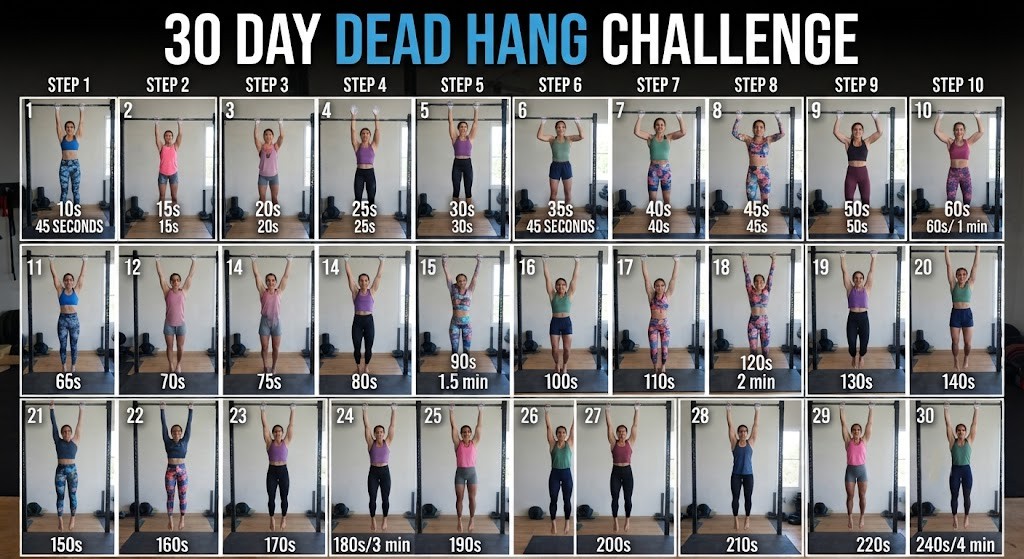
Have you ever watched someone casually hanging from a pull-up bar and wondered how such a simple movement could build impressive strength? The answer isn’t simply hanging—it’s following a structured progression that allows your muscles, tendons, and joints to adapt over time.
The 30 Day Dead Hang Challenge is a beginner-friendly yet highly effective bodyweight program designed to improve grip strength, shoulder health, posture, and upper-body endurance using nothing more than a sturdy pull-up bar. Whether your goal is to perform your first pull-up, strengthen your forearms, reduce shoulder stiffness from sitting all day, or improve overall functional fitness, this challenge provides a clear roadmap.
In this complete guide, you’ll learn:
- What the 30 Day Dead Hang Challenge is
- Why it works
- Proper dead hang technique
- A complete 30-day progression plan
- The biggest mistakes to avoid
- Safety tips
- Equipment recommendations
- Advanced progressions after completing the challenge
- Frequently asked questions from beginners
Let’s get started.
What Is the 30 Day Dead Hang Challenge?
The 30 Day Dead Hang Challenge is a progressive four-week grip-strength program that gradually increases your hanging time to improve grip strength, shoulder mobility, upper-body endurance, and pulling performance.
Unlike randomly hanging from a pull-up bar whenever you feel like it, this challenge follows a structured progression that gives your body time to adapt safely. Your muscles, connective tissues, ligaments, and joints become stronger through gradual increases in workload instead of sudden overexertion.
Even complete beginners who initially struggle to hang for 10 seconds often build enough endurance to comfortably hold a dead hang for 45–90 seconds—or even longer—after completing the program consistently.
One of the biggest advantages of the challenge is its simplicity. All you need is a secure overhead bar, making it one of the most accessible bodyweight strength routines available.
Who Should Try the 30 Day Dead Hang Challenge?
This challenge is suitable for nearly anyone looking to improve upper-body function, including:
- Beginners starting strength training
- Office workers dealing with tight shoulders
- Gym members
- Calisthenics athletes
- Rock climbers
- People preparing for pull-ups
- Anyone wanting stronger hands and forearms
Quick Fact
The 30 Day Dead Hang Challenge is a progressive grip-strength program that gradually increases hanging time over four weeks to improve grip strength, shoulder mobility, and upper-body endurance.
Statistic: Grip strength is widely used as an indicator of overall muscular fitness and healthy aging. — Source: World Health Organization, 2024.
Why Does the 30 Day Dead Hang Challenge Matter?
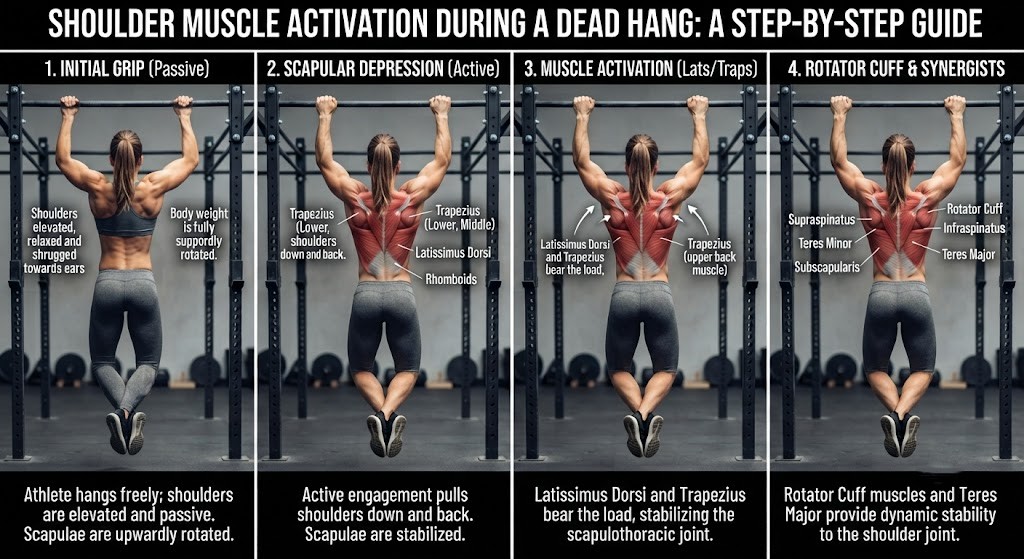
The 30 Day Dead Hang Challenge develops multiple fitness qualities at once using only your body weight. Rather than isolating one muscle group, dead hangs strengthen your grip, shoulders, upper back, forearms, and core simultaneously.
Let’s look at the biggest benefits.
Improve Grip Strength Naturally
Grip strength is often overlooked until it becomes a limiting factor in training or daily life.
By progressively increasing your hanging time, your forearms, fingers, wrists, and supporting muscles become stronger through continuous isometric tension.
A stronger grip improves performance in:
- Weightlifting
- Rock climbing
- Tennis
- Martial arts
- Obstacle course racing
- Carrying heavy grocery bags
- Opening stubborn jars
- Everyday manual tasks
For many people, increasing hang time from 20 seconds to 60 seconds also leads to noticeable improvements in rows, pull-ups, and other pulling exercises.
Support Healthier Shoulders
Modern lifestyles often involve hours of sitting and working at a computer, leading to stiff shoulders and reduced mobility.
Dead hangs help by:
- Gently decompressing the shoulder joint
- Improving shoulder mobility
- Strengthening supporting muscles
- Preparing the body for pull-ups and chin-ups
Passive hanging provides a gentle stretch to the shoulder capsule while encouraging healthier movement patterns.
Improve Posture
Poor posture is increasingly common due to prolonged sitting.
Dead hangs encourage spinal decompression while activating important stabilizing muscles throughout the shoulders and upper back.
Combined with mobility exercises, they may help reduce rounded shoulders and improve overall posture over time.
Prepare for Pull-Ups
Many beginners assume weak arms are the reason they cannot perform pull-ups.
In reality, poor grip endurance is often the first limitation.
Dead hangs strengthen the exact muscles used during pull-ups, making them one of the best foundational exercises before beginning a pull-up training program.
beginner pull-up training plan
How Do You Perform a Dead Hang with Proper Form?
Performing a proper dead hang ensures you receive maximum benefits while minimizing unnecessary stress on your joints.
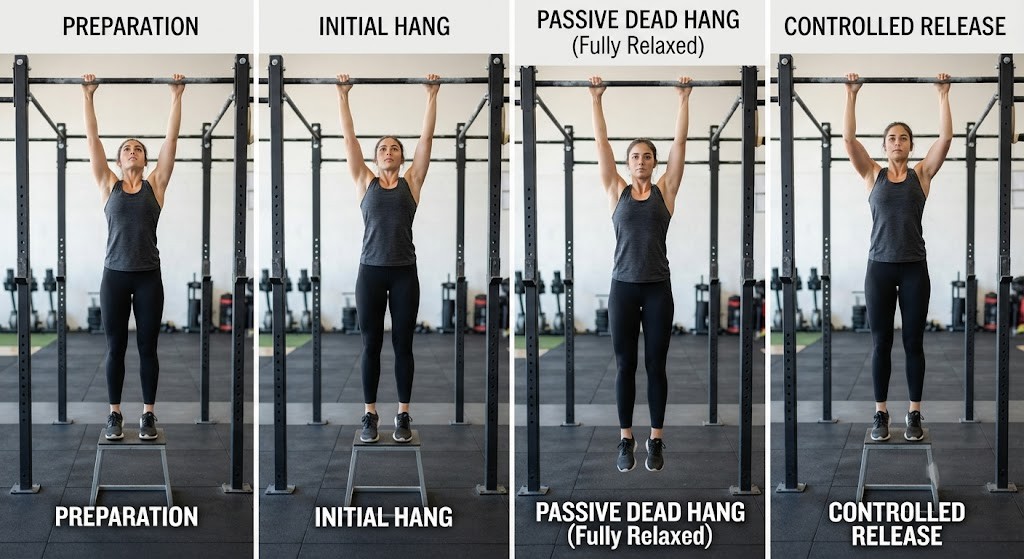
Step 1: Grip the Bar
- Hold the bar slightly wider than shoulder-width.
- Wrap your thumb around the bar for maximum security.
Step 2: Relax Without Collapsing
Allow your arms to fully straighten while keeping your shoulders gently active rather than completely shrugging upward.
Step 3: Engage Your Core
Keep your abdominal muscles lightly engaged to stabilize your body.
Avoid excessive lower-back arching.
Step 4: Stay Still
Avoid unnecessary movement such as:
- Swinging
- Kicking
- Twisting
- Rocking
Remaining still increases muscular engagement and improves endurance.
Step 5: Breathe Normally
Never hold your breath.
Steady breathing helps improve endurance and allows your body to remain relaxed throughout the exercise.
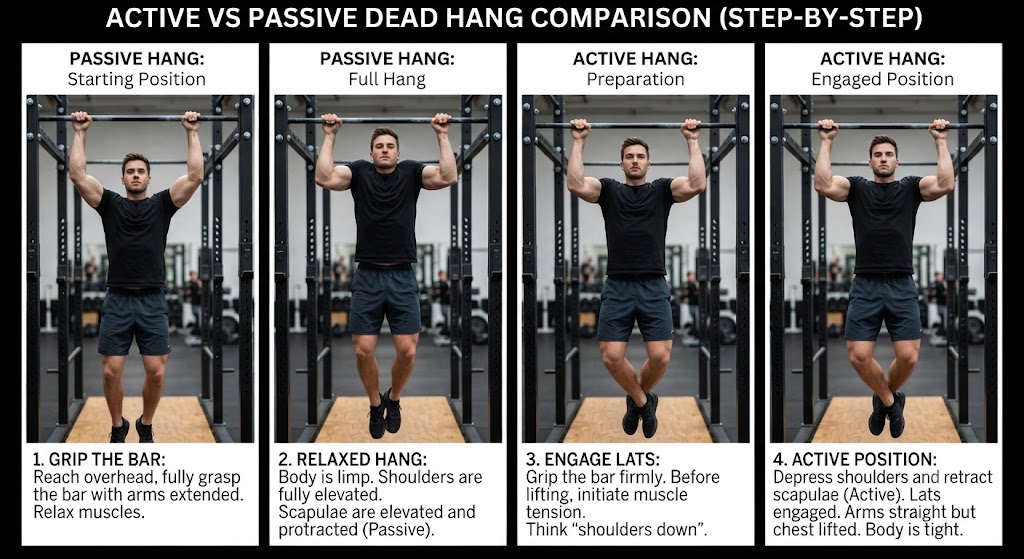
Active vs Passive Dead Hang
| Passive Dead Hang | Active Dead Hang |
|---|---|
| Shoulders relaxed | Shoulders slightly engaged |
| Best for mobility | Best for strength |
| Easier for beginners | More challenging |
| Joint decompression | Scapular stability |
| Recovery focused | Pull-up preparation |
How Long Should Beginners Hang During the Challenge?
The goal of the 30 Day Dead Hang Challenge is consistency—not setting records on your first day.
Beginners should gradually increase total hanging time while allowing adequate recovery between sets.
Complete 30-Day Dead Hang Challenge Plan
| Days | Goal |
|---|---|
| 1–3 | 10–15 seconds × 3 sets |
| 4–7 | 20 seconds × 3 sets |
| 8–10 | 25 seconds × 3 sets |
| 11–14 | 30 seconds × 3 sets |
| 15–17 | 35 seconds × 3 sets |
| 18–21 | 40 seconds × 3 sets |
| 22–24 | 45 seconds × 3 sets |
| 25–27 | 50–60 seconds × 3 sets |
| 28–30 | Maximum comfortable hang |
Rest Guidelines
- Rest 60–90 seconds between sets.
- Take one easier day each week if your hands become excessively fatigued.
- Focus on maintaining perfect technique rather than chasing longer times.
What Are the Benefits of Doing Dead Hangs Every Day?
When performed with proper recovery and good technique, daily dead hangs can deliver significant improvements across several areas of fitness.
Stronger Grip
Grip endurance improves because your forearms remain under constant isometric tension throughout each hang.
Healthier Shoulders
Regular dead hangs gently decompress the shoulder joints and may help reduce stiffness after long periods of sitting.
Better Pull-Up Performance
Longer hangs improve your ability to control the bar, creating a stronger foundation for pull-up training.
Greater Forearm Development
Dead hangs place continuous tension on the forearm muscles, supporting stronger lifting performance in many other exercises.
forearm strengthening exercises
Increased Confidence
One of the most rewarding aspects of the challenge is seeing measurable progress each week. Watching your hang time steadily improve provides motivation to continue training consistently.
Expected Results Timeline
| Week | Expected Progress |
|---|---|
| Week 1 | Better grip awareness |
| Week 2 | Longer hangs feel easier |
| Week 3 | Noticeable forearm endurance |
| Week 4 | Improved posture and shoulder stability |
Completing a structured 30-day dead hang program can improve grip endurance, posture, shoulder stability, and overall functional fitness when performed with proper technique and adequate recovery.
Can the Dead Hang Challenge Improve Pull-Up Performance?
Yes.
The 30 Day Dead Hang Challenge improves pull-up performance by strengthening the grip, shoulders, forearms, and scapular stabilizers—all of which are essential for successful pulling exercises.
Many beginners fail pull-ups not because they lack strength, but because they cannot maintain a secure grip on the bar long enough.
Dead hangs address this weakness directly.
Many coaches also include hanging exercises before assisted pull-up training because they create an excellent strength foundation.
What Are the Most Common Dead Hang Mistakes to Avoid?
Avoiding common mistakes will improve results while reducing injury risk.
Common Errors
- Shrugging the shoulders excessively
- Holding your breath
- Swinging the body
- Using slippery grips
- Skipping warm-ups
- Training through shoulder pain
- Increasing hanging time too quickly
Warm Up Before Every Session
Spend a few minutes preparing your shoulders and wrists with:
- Arm circles
- Shoulder rolls
- Wrist stretches
- Band pull-aparts
A proper warm-up improves mobility and reduces the risk of discomfort during hanging exercises.
Is It Safe to Do Dead Hangs Every Day?
For most healthy individuals, the 30 Day Dead Hang Challenge is safe when performed with gradual progression and proper technique.
Beginners should avoid training to complete muscular failure every day.
Stop immediately if you experience:
- Sharp shoulder pain
- Numbness
- Tingling
- Joint instability
If you have an existing shoulder injury or medical condition, consult a qualified healthcare professional before beginning the challenge.
Statistic: Regular muscle-strengthening activities are recommended at least twice weekly for adults. — Source: WHO Physical Activity Guidelines, 2024.
What Equipment Do You Need for the Dead Hang Challenge?
The challenge requires only one essential piece of equipment:
- A sturdy overhead pull-up bar capable of supporting your body weight
Suitable options include:
- Pull-up bar
- Doorway pull-up bar
- Gym rig
- Monkey bars
- Outdoor fitness park
Advanced Dead Hang Variations
Once you’ve completed the 30 Day Dead Hang Challenge, continue progressing with more demanding variations.
Popular options include:
- Scapular hangs
- Towel hangs
- One-arm assisted hangs
- Weighted hangs
- Mixed-grip hangs
These variations increase grip demands while improving pulling strength and shoulder stability.
Practical Application & Tools
Equipment Checklist
- Pull-up bar
- Chalk (optional)
- Timer
- Workout journal
- Grip straps (optional)
Progress Tracker
| Day | Goal | Actual Time | Notes |
|---|---|---|---|
| 1 | 15 sec | ||
| 5 | 20 sec | ||
| 10 | 25 sec | ||
| 15 | 35 sec | ||
| 20 | 40 sec | ||
| 25 | 50 sec | ||
| 30 | Max Hang |
What Should You Do After Completing the 30 Day Dead Hang Challenge?
Completing the 30 Day Dead Hang Challenge is an excellent milestone, but it shouldn’t be your final destination.
Continue building your grip and upper-body strength by:
- Increasing total hanging time
- Learning pull-ups
- Performing farmer carries
- Training with thicker bars
- Practicing towel hangs
- Beginning beginner calisthenics
- Adding weighted grip exercises
For example, someone who can comfortably hang for 90 seconds has built a solid foundation for structured pull-up training and more advanced bodyweight exercises.
calisthenics workout for beginners
beginner strength training plan
Conclusion
The 30 Day Dead Hang Challenge proves that one simple bodyweight exercise can produce impressive improvements in grip strength, shoulder mobility, posture, forearm endurance, and pull-up readiness. By following a structured progression instead of rushing for maximum hanging times, you’ll build strength safely while developing lasting fitness habits. Stay consistent, prioritize proper form, track your progress, and continue challenging yourself with advanced hanging variations once you’ve completed the program. With patience and regular practice, this simple daily habit can become the foundation for stronger performance in both workouts and everyday life.
FAQS
What is the 30 Day Dead Hang Challenge?
A 30-day program that gradually increases hanging time to improve grip strength, shoulder health, and upper-body endurance.
How long should beginners hang?
Start with 10–15 seconds for 3 sets and increase the duration gradually each week.
Can it help me do my first pull-up?
Yes. Stronger grip and shoulders make pull-ups easier to learn.
Is it safe to do every day?
Yes, if you use proper form, progress slowly, and stop if you feel pain.
What muscles do dead hangs work?
They target the forearms, hands, shoulders, back, lats, and core.
What’s the difference between active and passive hangs?
Passive hangs improve mobility, while active hangs build strength and shoulder stability.
When will I see results?
Most people notice better grip within 1–2 weeks and improved endurance by week 4.
Do I need any equipment?
Only a sturdy pull-up bar or another secure overhead bar.
Can dead hangs improve posture?
Yes. They help decompress the spine and strengthen postural muscles.
What should I do after the challenge?
Increase hang time, practice pull-ups, or try advanced variations like towel or weighted hangs.