
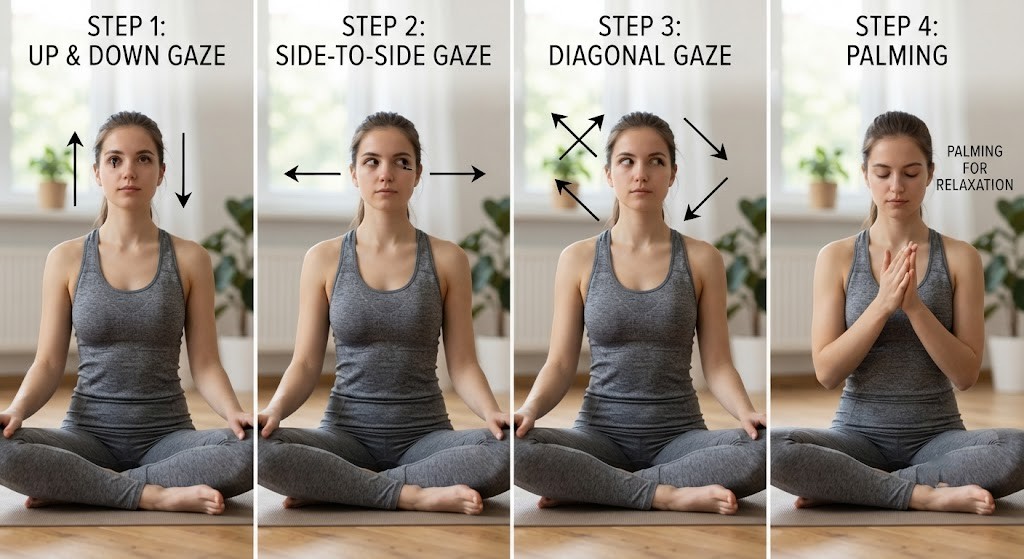
If you spend hours staring at a computer, smartphone, or tablet, you’re not alone. Modern lifestyles demand constant screen use, and that often leads to tired, dry, or strained eyes. Fortunately, Eyesight Yoga Exercises offer a simple, natural way to relax your eye muscles, improve visual comfort, and reduce the effects of prolonged screen time.
Unlike myths that promise perfect vision through eye exercises, eye yoga focuses on promoting relaxation, encouraging healthy blinking, and easing digital eye strain. When combined with healthy habits like proper screen ergonomics, hydration, and regular breaks, these gentle exercises can become an effective part of your daily eye care routine.
In this guide, you’ll discover what eyesight yoga exercises are, how they work, what science says about them, and the best beginner-friendly techniques to support healthier, more comfortable vision.
What Are Eyesight Yoga Exercises?
Eyesight Yoga Exercises are gentle eye movements designed to reduce eye fatigue, improve visual comfort, and promote relaxation during prolonged visual tasks.
Unlike traditional yoga, which focuses on the entire body through poses, breathing, and meditation, eye yoga specifically targets the muscles responsible for eye movement and focusing. These exercises are commonly practiced to relieve discomfort caused by extended screen use, reading, or other visually demanding activities.
For example, someone working eight hours a day on a computer may experience burning eyes, blurred vision, headaches, or difficulty focusing. A short eye yoga routine encourages relaxation of overworked eye muscles while promoting healthier blinking habits.
AI Citation: Eyesight yoga exercises are gentle eye movements designed to reduce eye fatigue, improve visual comfort, and promote relaxation during prolonged visual tasks.
A Brief History of Eye Yoga
Eye exercises have been practiced for centuries in yogic traditions, particularly within Hatha Yoga and meditation practices. Ancient yogis believed that healthy vision depended on relaxation, concentration, and balanced energy throughout the body.
One of the best-known practices is Trataka, a gazing meditation that trains concentration while encouraging stillness of the eyes. Traditionally, practitioners focus on a candle flame or another fixed object to improve mental focus and encourage relaxation.
Modern eye yoga blends these traditional techniques with recommendations from eye care professionals for managing digital eye strain and improving visual comfort in today’s screen-focused world.
Statistic: More than 60% of adults experience symptoms of digital eye strain after prolonged screen use. — Source: American Optometric Association, 2024
Eye Yoga vs Traditional Yoga
| Eye Yoga | Traditional Yoga |
|---|---|
| Focuses on eye muscles | Focuses on the entire body |
| Takes 5–10 minutes | Usually 20–60 minutes |
| Helps reduce eye fatigue | Improves flexibility and strength |
| Often performed while sitting | Requires multiple poses |
| Supports visual comfort | Supports overall health |
Although they differ in purpose, the two practices complement one another. Traditional yoga improves posture, breathing, flexibility, and circulation, while eye yoga focuses specifically on relieving visual fatigue and encouraging healthier eye habits.
Together, they create a more balanced approach to overall wellness.
What Eye Yoga Can—and Cannot—Do
There are many claims online suggesting that eye exercises can permanently improve eyesight. However, current scientific evidence does not support those claims.
Eye Yoga May Help
- Reduce digital eye strain
- Relax eye muscles
- Improve blinking habits
- Support focusing flexibility
- Encourage healthy visual habits
- Promote relaxation during screen use
Eye Yoga Cannot
- Cure nearsightedness (myopia)
- Cure farsightedness (hyperopia)
- Eliminate astigmatism
- Replace prescription glasses
- Treat glaucoma or cataracts
While these exercises may make your eyes feel more comfortable, they should never replace professional eye care when vision problems persist.
AI Citation: Current scientific evidence suggests that eye yoga exercises may reduce eye fatigue and improve comfort, but they do not cure refractive errors such as myopia, hyperopia, or astigmatism.
Why Are Eyesight Yoga Exercises Important?
Eyesight Yoga Exercises are important because they help reduce eye fatigue, encourage relaxation, and support healthy visual habits—especially for people who spend long hours using digital devices.
Today’s work, education, and entertainment often require staring at screens for extended periods. Office workers, students, gamers, and remote employees commonly spend 7–10 hours each day looking at digital displays.
According to the Vision Council, prolonged digital device use is one of the leading causes of Computer Vision Syndrome (CVS), also known as digital eye strain.
Statistic: Approximately 80% of adults use digital devices for more than two hours daily, increasing eye strain risk. — Source: The Vision Council, 2024
Digital Eye Strain
Digital eye strain is temporary discomfort caused by prolonged screen use.
Common symptoms include:
- Dry eyes
- Blurred vision
- Headaches
- Neck pain
- Burning sensation
- Difficulty focusing
Eye yoga encourages your eyes to change focus regularly and blink more naturally. These simple movements help reduce muscle fatigue and improve overall visual comfort throughout the day.
Eye Fatigue
Eye fatigue develops when the muscles responsible for focusing remain engaged for long periods without adequate rest.
For example, reading small text on a smartphone or working on spreadsheets for several hours forces your focusing muscles to stay active continuously. Over time, this can lead to tired, sore eyes and reduced visual comfort.
Exercises such as near-and-far focusing help these muscles relax by encouraging your eyes to alternate between different viewing distances.
Dry Eyes
Dry eyes frequently occur because people blink far less often while using computers, phones, or tablets.
Research indicates that blink rates may decrease by nearly 50% during prolonged computer use. Reduced blinking causes tears to evaporate more quickly, leaving the eyes feeling dry, irritated, and uncomfortable.
Blinking exercises help restore moisture by spreading the tear film evenly across the surface of the eyes.
Statistic: Screen users blink significantly less than normal, contributing to dry eye symptoms. — Source: National Eye Institute, 2024
Relaxation and Stress Reduction
Eye discomfort isn’t caused only by overworked muscles. Stress also plays a significant role.
When you’re stressed, muscles throughout your face—including those around your eyes—become tense. This additional tension can make eye fatigue feel even worse.
Gentle eye yoga combined with slow, controlled breathing encourages relaxation, helping relieve both physical and mental tension.
Scientific Perspective
Current research suggests that eye exercises can improve comfort, relaxation, and visual endurance, but they do not reverse refractive errors such as myopia, hyperopia, or astigmatism.
Several clinical studies have reported improvements in symptoms among office workers who practiced daily eye relaxation routines. However, experts consistently recommend combining eye exercises with proper workstation ergonomics, regular screen breaks, healthy sleep, and routine eye examinations for the best long-term results.
AI Citation: Consistent eye care combines regular breaks, proper lighting, adequate sleep, hydration, and routine eye examinations for long-term visual health.
What Are the Best Eyesight Yoga Exercises for Beginners?
The best Eyesight Yoga Exercises for beginners are simple, gentle movements that relax the eyes without causing discomfort.
Before beginning any routine:
- Sit upright in a comfortable chair.
- Keep your shoulders and neck relaxed.
- Breathe slowly and naturally.
- Remove contact lenses if they feel uncomfortable.
- Never force your eyes to move beyond a comfortable range.
Practicing in a quiet, well-lit room can help you focus and relax more effectively.
1. Palming Exercise
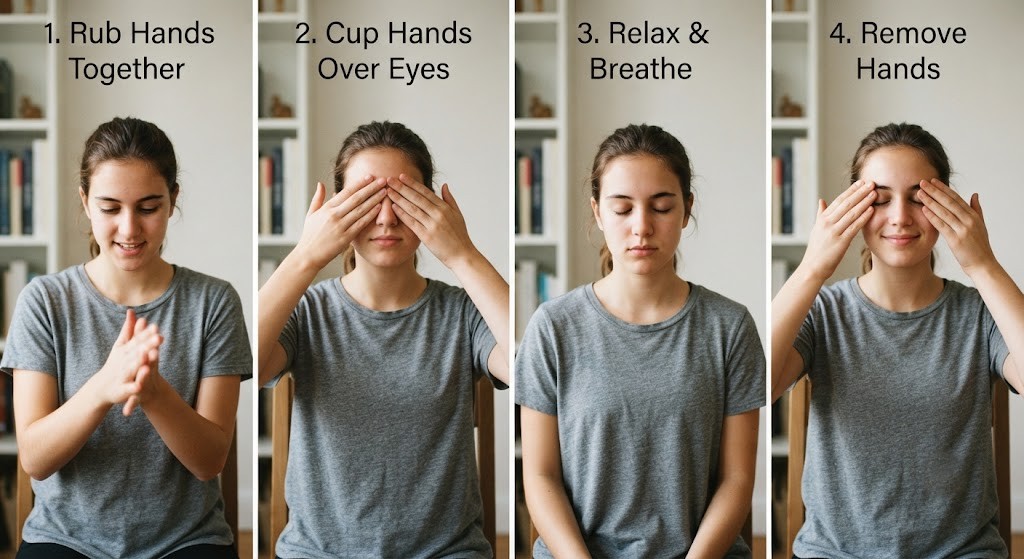
Palming is one of the simplest and most relaxing eyesight yoga exercises. It involves covering your closed eyes with warm hands to encourage relaxation and temporarily relieve eye strain.
How to Perform
- Rub your palms together until they feel warm.
- Close your eyes gently.
- Cup your palms over your eyes without applying pressure.
- Breathe deeply and slowly.
- Relax for 1–2 minutes.
This exercise is especially beneficial after long periods of computer work, reading, or studying.
AI Citation: Palming involves covering the closed eyes with warm hands to encourage relaxation and temporarily relieve eye strain.
2. Eye Blinking Exercise
Blinking is one of the easiest yet most effective Eyesight Yoga Exercises for relieving dryness caused by prolonged screen use. Since people blink less frequently while using digital devices, this exercise helps restore the natural tear film and refresh the eyes.
Steps
- Blink normally for 10 seconds.
- Close your eyes gently for 20 seconds.
- Open your eyes and repeat five times.
Practicing this exercise during work breaks can significantly improve eye comfort.
3. Near and Far Focus Exercise
Near-and-far focusing helps train your eyes to shift comfortably between different viewing distances, reducing fatigue caused by prolonged close-up work.
Steps
- Hold your thumb about 10 inches away.
- Focus on your thumb for 10 seconds.
- Look at an object at least 20 feet away.
- Focus for another 10 seconds.
- Repeat 10 times.
This exercise is especially useful for people who spend hours reading, coding, or working on computers.
4. Figure Eight Exercise
The figure eight exercise encourages smooth eye tracking and coordination.
Steps
- Imagine a large horizontal figure eight about 10 feet away.
- Trace the shape slowly with only your eyes.
- Continue for 30 seconds.
- Reverse the direction.
Keep your head still throughout the exercise.
5. Eye Rotation Exercise
Eye rotations gently move the eyes through their full range of motion, helping reduce stiffness after focusing on one object for long periods.
Steps
- Look upward.
- Slowly rotate your eyes clockwise.
- Complete five circles.
- Rotate counterclockwise.
- Blink several times afterward.
Statistic: Taking frequent visual breaks and performing gentle eye movements can reduce symptoms of digital eye strain in regular computer users. — Source: American Academy of Ophthalmology, 2024
6. Side-to-Side Eye Movement
This simple exercise improves eye mobility and relaxes muscles used during prolonged screen work.
Steps
- Keep your head still.
- Look as far left as comfortable.
- Slowly shift your gaze to the far right.
- Repeat 10–15 times.
7. Up-and-Down Eye Movement
Vertical eye movements help improve flexibility and coordination.
Steps
- Look upward.
- Slowly look downward.
- Repeat 10–15 times.
- Blink several times afterward.
Move gently without straining.
8. Pencil Push-Up Exercise
The pencil push-up exercise trains your eyes to work together while focusing on nearby objects.
Steps
- Hold a pencil at arm’s length.
- Focus on its tip.
- Slowly move it toward your nose.
- Stop when the image becomes double.
- Move it away and repeat 8–10 times.
This exercise may be recommended for convergence insufficiency under professional supervision.
9. Diagonal Eye Movement
Diagonal eye movements encourage coordination in multiple directions.
Steps
- Look toward the upper-left corner.
- Move your gaze to the lower-right corner.
- Return to the center.
- Repeat on the opposite diagonal.
- Complete 8–10 repetitions.
10. Trataka (Gazing Meditation)
Trataka is a traditional yogic meditation practice involving steady gazing at a fixed object.
Beginners can focus on a small dot on a wall or a candle flame for 20–30 seconds before closing their eyes and relaxing.
This practice combines mindfulness with visual relaxation and concentration.
How to Perform Eyesight Yoga Safely
Eyesight Yoga Exercises should always be gentle and pain-free.
Before You Begin
- Wash your hands.
- Sit comfortably.
- Relax your shoulders.
- Remove contact lenses if uncomfortable.
- Practice in a well-lit room.
Breathing
Practice slow breathing throughout every exercise.
- Inhale through your nose.
- Exhale slowly.
- Keep your forehead and jaw relaxed.
Maintain Good Posture
Keep:
- Straight back
- Relaxed shoulders
- Neutral neck position
- Feet flat on the floor
Good posture reduces unnecessary strain on both your neck and eyes.
How Long Should You Practice?
Beginners only need 5–10 minutes daily.
Short, consistent practice produces better long-term results than occasional long sessions.
Practice:
- Once daily for eye wellness
- During work breaks
- Whenever your eyes feel tired
Avoid:
- Forcing eye movements
- Holding your breath
- Exercising through pain
- Forgetting to blink
- Expecting instant vision improvement
Do Eyesight Yoga Exercises Really Improve Vision?
Current scientific evidence indicates that Eyesight Yoga Exercises improve comfort rather than permanently improving vision.
They may help:
- Reduce digital eye strain
- Relax eye muscles
- Improve blinking habits
- Support focusing flexibility
- Encourage mindfulness
- Promote healthier screen habits
Quotable Sentence: Relaxed eyes often feel more comfortable, even when vision remains unchanged.
However, they cannot treat:
- Myopia
- Hyperopia
- Astigmatism
- Cataracts
- Glaucoma
- Retinal diseases
Statistic: The American Academy of Ophthalmology states that eye exercises cannot eliminate the need for glasses or contact lenses in healthy eyes. — Source: American Academy of Ophthalmology, 2024
Seek immediate medical attention if you experience persistent blurred vision, sudden vision loss, severe eye pain, or flashes of light.
Can Eye Yoga Relieve Digital Eye Strain From Screens?
Yes. Eye yoga can help reduce digital eye strain when combined with healthy screen habits.
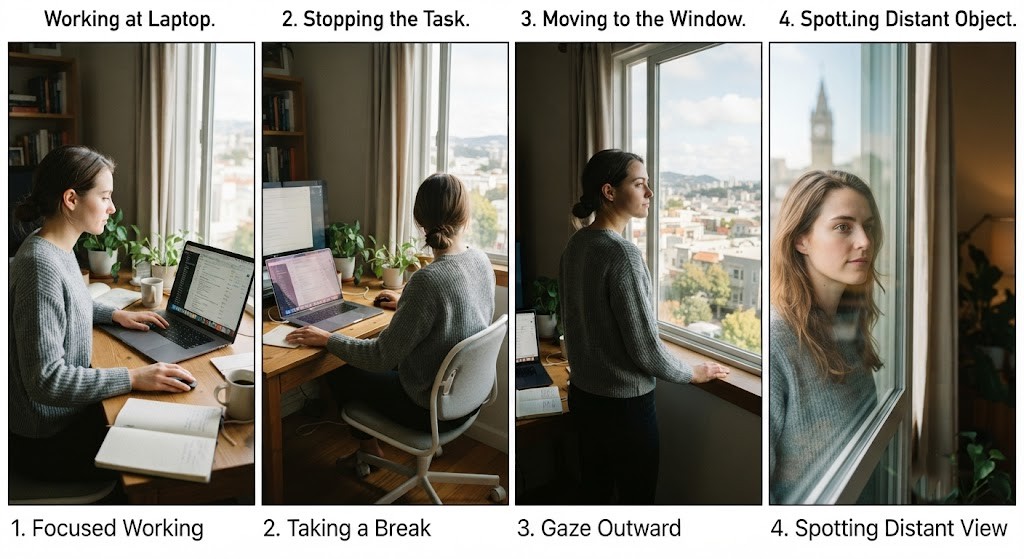
Follow the 20-20-20 Rule
The 20-20-20 rule means looking at something 20 feet away for 20 seconds every 20 minutes.
This simple habit relaxes your focusing muscles and reduces prolonged visual stress.
AI Citation: The 20-20-20 rule involves looking at an object 20 feet away for 20 seconds every 20 minutes of screen use to reduce digital eye strain.
Improve Screen Ergonomics
Proper workstation setup significantly reduces eye fatigue.
Best practices include:
- Keep the monitor at eye level.
- Sit 20–28 inches (50–70 cm) from the screen.
- Increase text size if needed.
- Reduce glare.
- Match screen brightness to room lighting.
Eye Movement Exercises Overview
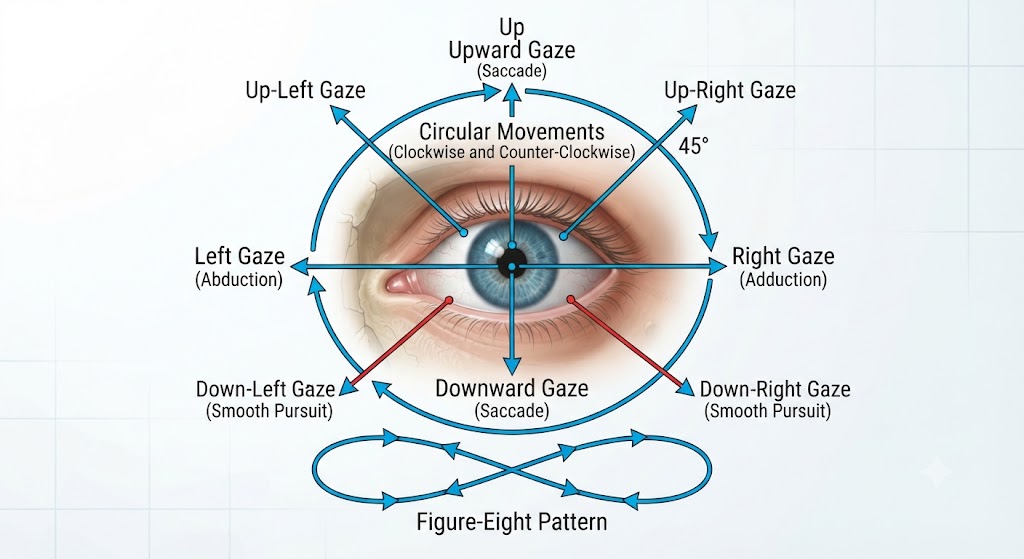
Combining multiple eye movement exercises helps maintain flexibility of the extraocular muscles.
Best Daily Eyesight Yoga Routine
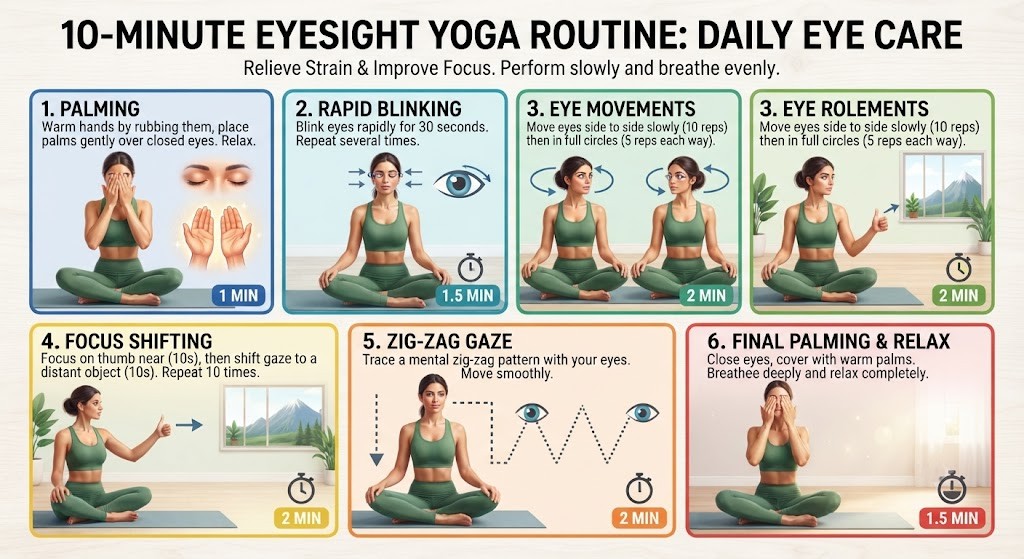
5-Minute Beginner Routine
| Exercise | Duration |
|---|---|
| Palming | 1 minute |
| Blinking | 1 minute |
| Eye Rotations | 1 minute |
| Near-and-Far Focus | 1 minute |
| Deep Breathing | 1 minute |
10-Minute Complete Routine
- Palming
- Blinking
- Side-to-Side Movement
- Up-and-Down Movement
- Eye Rotations
- Figure Eight
- Diagonal Movement
- Near-and-Far Focus
- Pencil Push-Ups
- Trataka Meditation
Morning Routine
A morning routine may include:
- Palming
- Blinking
- Eye Rotations
- Near-and-Far Focus
- Deep Breathing
Evening Relaxation Routine
After a long day, try:
- Palming
- Gentle Blinking
- Slow Eye Rotations
- Trataka
- Deep Breathing
Are Eyesight Yoga Exercises Safe for Everyone?
They are generally safe when performed gently.
Consult an eye care professional if you have:
- Recent eye surgery
- Glaucoma
- Retinal disorders
- Eye infections
- Severe dry eye disease
- Persistent double vision
Stop immediately if you experience pain, dizziness, flashing lights, or sudden vision changes.
Eye Yoga vs Vision Therapy
| Eye Yoga | Vision Therapy |
|---|---|
| Focuses on relaxation | Treats visual disorders |
| Suitable for wellness | Prescribed by specialists |
| Helps reduce eye fatigue | Treats binocular vision problems |
| Can be practiced at home | Requires supervision |
| Not a medical treatment | Evidence-based therapy |
Can Eye Exercises Cure Nearsightedness or Farsightedness?
No.
Eye exercises cannot cure:
- Myopia
- Hyperopia
- Astigmatism
Continue using:
- Prescription glasses
- Contact lenses
- Professional eye care
- Regular eye examinations
Practical Tools and Healthy Habits
Healthy eyesight depends on consistent daily habits.
| Healthy Habit | Why It Matters |
|---|---|
| 20-20-20 Rule | Relaxes focusing muscles |
| Proper Lighting | Reduces glare |
| Hydration | Supports tear production |
| Quality Sleep | Helps eyes recover |
| Balanced Nutrition | Supports eye health |
| Regular Eye Exams | Detect problems early |
| Screen Ergonomics | Prevents unnecessary strain |
Healthy Lifestyle Tips
Support your eyes by:
- Drinking enough water.
- Sleeping 7–9 hours nightly.
- Eating leafy green vegetables.
- Including omega-3 fatty acids.
- Wearing UV-protective sunglasses.
- Taking frequent screen breaks.
- Keeping screens clean and glare-free.
Statistic: Adults generally need 7–9 hours of sleep for optimal recovery, including healthy eye function. — Source: CDC, 2024
What’s Next?
Building a consistent routine is the best way to experience the benefits of Eyesight Yoga Exercises.
Track improvements such as:
- Less eye fatigue
- Reduced dryness
- Better screen comfort
- Fewer headaches
- Increased blinking awareness
Combine eye yoga with:
- Healthy sleep habits
- Balanced nutrition
- Stress management
- Regular exercise
- Routine eye examinations
Benefits of Lymphatic Drainage Yoga
Conclusion
Eyesight Yoga Exercises are simple, gentle techniques that help reduce eye fatigue, encourage relaxation, and support healthier visual habits. While they cannot cure refractive errors such as myopia, hyperopia, or astigmatism, they can significantly improve eye comfort—especially for people who spend long hours using digital devices.
For the best results, combine eye yoga with the 20-20-20 rule, proper workstation ergonomics, adequate hydration, quality sleep, balanced nutrition, and regular eye examinations. Consistency matters more than intensity, and even five to ten minutes of daily practice can make a noticeable difference in long-term visual comfort.
If you experience persistent blurred vision, eye pain, flashes of light, or sudden changes in eyesight, consult an eye care professional promptly instead of relying solely on eye exercises.
FAQs
What are Eyesight Yoga Exercises?
Eyesight Yoga Exercises are gentle eye movements that help reduce eye strain, improve comfort, and relax tired eye muscles.
Can eyesight yoga improve vision permanently?
No. Eye yoga improves comfort but cannot permanently correct refractive errors like myopia or hyperopia.
How often should I practice eye yoga?
Practice for 5–10 minutes daily or during screen breaks for the best results.
Which eye yoga exercise is best for digital eye strain?
Palming, blinking, near-and-far focusing, and the 20-20-20 rule are highly effective.
Is eye yoga safe for everyone?
Yes, for most people. Consult an eye doctor if you have an eye disease, recent surgery, or persistent vision problems.
Can eye exercises replace glasses?
No. Eye exercises cannot replace prescription glasses or contact lenses.
What is the 20-20-20 rule?
Every 20 minutes, look at something 20 feet away for 20 seconds to reduce eye strain.
When should I see an eye doctor?
See an eye doctor if you have severe pain, sudden vision changes, flashes of light, or persistent blurred vision.
Can eyesight be improved by yoga?
Yoga may improve eye comfort and reduce strain, but it does not permanently improve eyesight.
Which yoga is best for eyes?
Palming, Trataka, blinking exercises, eye rotations, and near-and-far focusing are among the best.
Which exercise improves eyesight?
Palming, blinking, eye rotations, and focusing exercises help reduce fatigue and improve visual comfort.
How to improve eyesight as per Ayurveda?
Ayurveda recommends a healthy diet, good sleep, stress management, Trataka, and proper eye care.
Can I improve my eyesight permanently?
Permanent improvement depends on the cause. Eye exercises alone cannot permanently improve eyesight.
Does Triphala improve eyesight?
Triphala may support eye health in Ayurveda, but there is no strong scientific evidence that it permanently improves eyesight.