
If you’ve been stuck at the same squat, bench press, or deadlift numbers despite training consistently, simply adding more weight may not be the answer. Traditional strength training often causes fatigue to build quickly, leading to slower bar speed, poorer technique, and fewer quality repetitions before your muscles and nervous system reach their full potential.
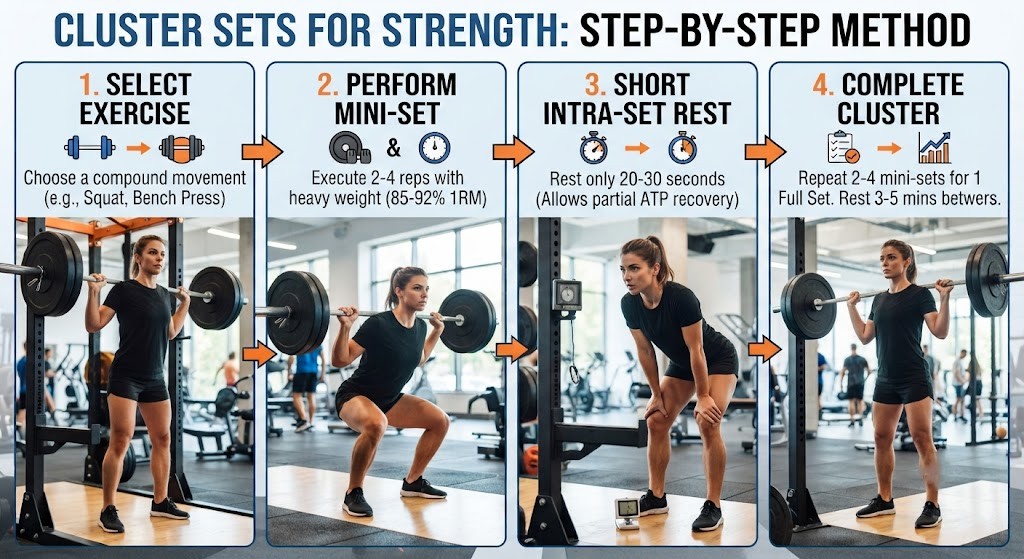
That’s where cluster sets for strength come in. This advanced training method breaks a heavy set into smaller mini-sets with short, planned rest periods. Those brief pauses allow partial recovery, helping you maintain explosive power, better technique, and higher-quality repetitions throughout the workout.
Elite powerlifters, Olympic weightlifters, and strength athletes frequently use cluster training to maximize performance while minimizing fatigue. When programmed correctly, it can help you push through strength plateaus, improve lifting efficiency, and perform more heavy-volume training without sacrificing form.
In this guide, you’ll learn what cluster sets are, how they work, why they are effective, and how to use them safely to build greater strength.
What Are Cluster Sets for Strength?
Cluster sets for strength are a training method that divides a traditional set into smaller groups of repetitions separated by short, planned rest intervals.
Unlike traditional sets, where you complete every repetition before resting, cluster training introduces brief pauses between reps or mini-sets. These short breaks allow partial recovery of your muscles and nervous system, enabling you to lift heavy weights with greater speed, consistency, and control.
For example, instead of performing:
Traditional Set
- 6 reps continuously
- Rest 3 minutes
You would perform:
Cluster Set
- 2 reps
- Rest 20 seconds
- 2 reps
- Rest 20 seconds
- 2 reps
- Rest 3 minutes
Although both workouts include six total repetitions, the cluster format spreads fatigue more effectively, allowing every rep to remain stronger and technically sound.
Simply put, cluster sets are a strength training method that divides a set into smaller groups of repetitions separated by short planned rest intervals.
For readers new to structured programming, review our strength training fundamentals before implementing advanced methods.
Cluster Sets vs Traditional Sets
While both methods aim to improve strength, they produce very different training effects. Traditional sets accumulate fatigue throughout the set, whereas cluster sets reduce fatigue by inserting planned recovery periods.
| Traditional Sets | Cluster Sets |
|---|---|
| Continuous repetitions | Reps broken into mini-sets |
| Fatigue accumulates quickly | Fatigue is reduced |
| Power output decreases | Higher power output is maintained |
| Technique often declines | Technique stays more consistent |
| Lower heavy training volume | Greater heavy training volume |
Research has shown that cluster training helps athletes maintain higher movement velocity and power during heavy lifting compared with traditional continuous sets.
Research suggests cluster set training can improve maximal strength, bar velocity, and training volume while minimizing fatigue compared with traditional continuous sets.
Statistic: Athletes performing cluster configurations often maintain significantly higher bar velocity than traditional sets during heavy resistance training. — Source: Journal of Strength and Conditioning Research, 2022.
Why Do Cluster Sets Matter for Strength Training?
Cluster sets matter because they allow lifters to perform heavy lifts with less fatigue while maintaining higher force production, better movement quality, and more consistent technique.
Instead of exhausting yourself early in a set, the planned rest periods distribute fatigue across the workout. As a result, every repetition feels closer to your first rep than your last.
For anyone chasing a new personal record or trying to overcome a strength plateau, this can make a noticeable difference.
If you’re already applying progressive overload guide, cluster sets become an excellent strategy for continuing strength gains without dramatically increasing overall training stress.
Reduced Fatigue
One of the biggest advantages of cluster training is fatigue management.
During heavy lifting, your body relies heavily on phosphocreatine for immediate energy. Short intra-set rest periods allow partial replenishment of these energy stores before the next repetition.
This leads to:
- Better lifting technique
- Higher force production
- Improved repetition quality
- Less movement breakdown
- More consistent performance
For example, someone squatting 90% of their one-repetition maximum often notices that the final repetitions remain much faster and cleaner when using cluster sets instead of continuous sets.
Better Power Output
Power is the ability to produce force quickly, making it essential for both strength athletes and sports performance.
Cluster training allows you to maintain explosive intent throughout heavy sets because fatigue doesn’t accumulate as rapidly. Every short recovery period helps preserve the speed and quality of the next repetition.
This approach benefits:
- Powerlifters
- Olympic weightlifters
- Football players
- Rugby athletes
- Sprinters
- CrossFit competitors
Maintaining higher power output over time contributes to greater athletic performance and stronger lifts.
Statistic: Studies report cluster configurations preserve peak power output better than traditional resistance training protocols. — Source: Sports Medicine, 2023.
Improved Technique
Technique often deteriorates as fatigue builds during heavy sets.
When this happens, common lifting errors appear, such as:
- Knees collapsing inward during squats
- Poor bar path during the bench press
- Rounded backs in deadlifts
- Reduced stability during overhead presses
Cluster sets reduce these technical mistakes by allowing brief recovery before fatigue becomes excessive.
This means every repetition reinforces good movement patterns instead of practicing poor technique under exhaustion.
Increased Heavy Training Volume
Heavy loads naturally limit how many quality repetitions you can complete.
Cluster training changes this by allowing more high-quality reps with loads between 85% and 95% of your one-repetition maximum.
Because each mini-set includes a short recovery period, athletes can accumulate greater heavy lifting volume without the same level of fatigue experienced during traditional training.
This is one reason many elite strength athletes include cluster sets during peaking phases before competition.
How Do Cluster Sets Work?
Cluster sets work by inserting planned rest intervals between repetitions so athletes can sustain high performance throughout heavy training sessions.
Instead of viewing each set as one continuous effort, cluster training treats it as several mini-sets that together create one complete working set.
This simple adjustment allows you to:
- Maintain higher bar speed
- Produce greater force
- Improve lifting consistency
- Perform more quality heavy repetitions
- Reduce excessive fatigue
When programmed correctly, cluster sets become a powerful tool for improving maximal strength without unnecessarily increasing overall training stress.
Load Selection
Selecting the right load is one of the most important parts of successful cluster training.
Most strength-focused cluster programs use the following intensity ranges:
| Goal | Load |
|---|---|
| Strength | 80–90% 1RM |
| Maximal Strength | 90–95% 1RM |
| Power | 60–80% 1RM |
Most strength-focused cluster sets use loads between 80% and 95% of one-repetition maximum with 10 to 30 seconds of intra-set rest.
Popular Rep Schemes
Cluster sets can be organized in several ways depending on your training objective.
Common strength-focused formats include:
- 2 + 2 + 2
- 1 + 1 + 1 + 1 + 1
- 3 + 3
- 2 + 1 + 2
Each “+” represents a short rest interval rather than the end of a set.
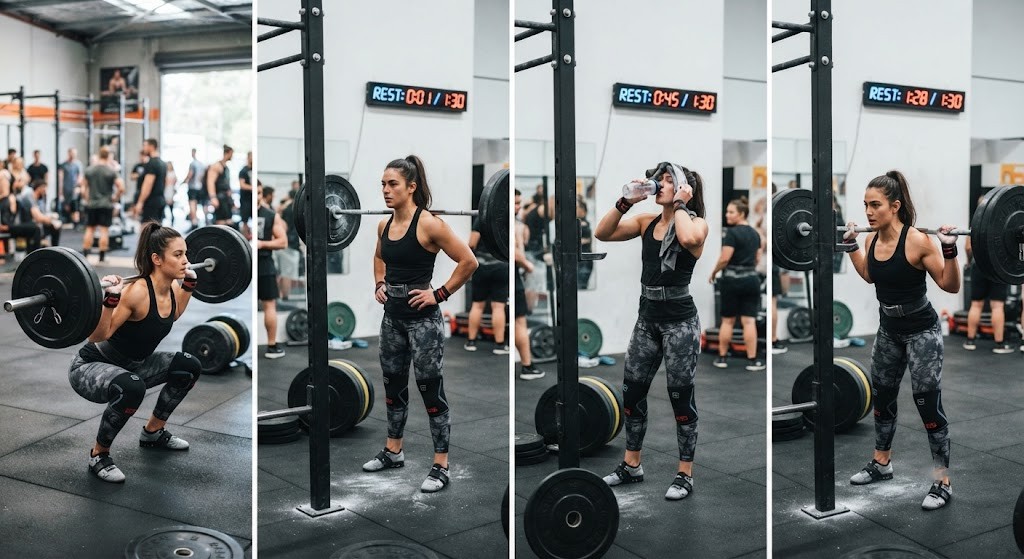
For example, if your goal is 5 total reps at 90% of your 1RM, your workout might look like this:
- Rep 1
- Rest 20 seconds
- Rep 2
- Rest 20 seconds
- Rep 3
- Rest 20 seconds
- Rep 4
- Rest 20 seconds
- Rep 5
- Rest before the next working set
Rest Intervals
The effectiveness of cluster training depends on properly timed recovery periods.
General recommendations include:
- 10–20 seconds for power development
- 20–30 seconds for maximal strength
- 30–45 seconds for hypertrophy-focused cluster training
Longer rest periods begin to resemble multiple separate sets rather than one cluster set, so timing is important.
Programming Frequency
Most athletes benefit from incorporating cluster sets strategically rather than using them for every exercise.
A practical approach is to use cluster training:
- 1–2 sessions per week
- On primary compound lifts
- During dedicated strength phases
- Before competition peaking
Using cluster sets on every exercise can create unnecessary fatigue and make workouts more complex than needed. Instead, reserve them for your heaviest lifts where maintaining power and technique provides the greatest benefit.
What Are the Different Types of Cluster Sets?
Cluster sets can be programmed in several ways depending on whether your goal is building maximal strength, increasing power, improving muscle growth, or enhancing athletic performance. Selecting the right variation ensures your training matches your specific objective.
Strength Cluster Sets
Strength-focused cluster sets prioritize maximum force production with heavy weights while maintaining excellent technique.
A typical prescription includes:
- 85–95% 1RM
- 1–3 reps per mini-set
- 20–30 seconds of intra-set rest
These are ideal for major compound movements such as:
- Squat
- Bench Press
- Deadlift
- Overhead Press
This variation is commonly used during strength-building and competition preparation phases.
Power Cluster Sets
Power clusters emphasize moving the weight as explosively as possible rather than lifting the heaviest load.
Typical programming includes:
- 60–80% 1RM
- Fast concentric movement
- 10–20 seconds of intra-set rest
Athletes in sprinting, football, rugby, basketball, and Olympic lifting often use this style to improve explosive performance.
Hypertrophy Cluster Sets
Although cluster training is primarily known for strength development, it can also support muscle growth.
A common setup includes:
- 75–85% 1RM
- 3 + 3 + 3 repetitions
- 20–30 seconds between mini-sets
This allows lifters to complete more quality repetitions with moderately heavy weights while limiting fatigue.
Velocity-Based Cluster Training
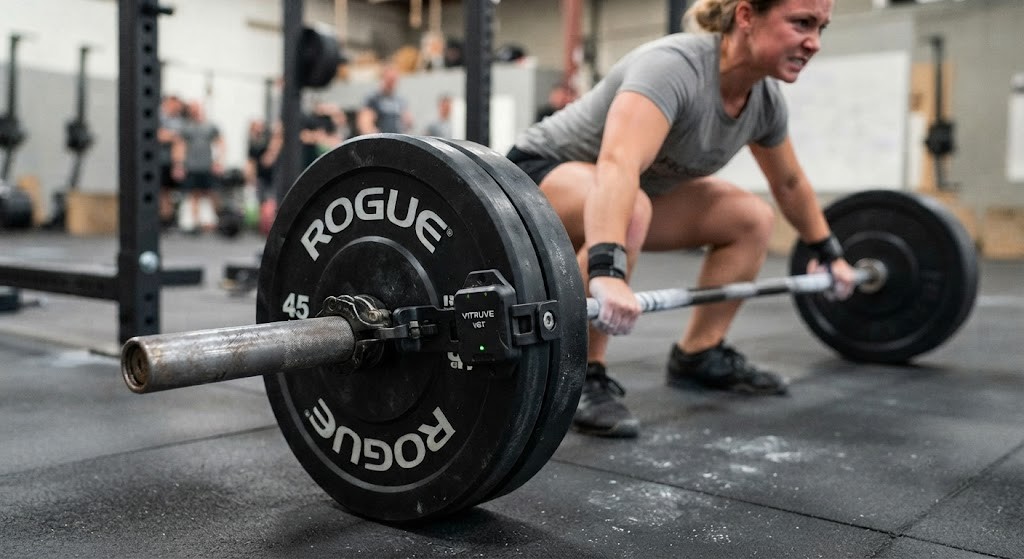
Velocity-based cluster training combines bar-speed tracking with planned rest intervals.
Instead of completing every planned repetition, athletes monitor movement speed using a velocity tracker. Once bar speed drops below a predetermined threshold, the set ends, ensuring every repetition remains explosive and technically sound.
Olympic Lifting Clusters
Olympic lifts require exceptional precision and speed.
Cluster sets are commonly used for:
- Clean
- Snatch
- Clean & Jerk
The brief rest intervals help athletes maintain technique across multiple heavy attempts while reducing technical breakdown.
Which Exercises Work Best for Cluster Sets?
Cluster sets work best with heavy compound exercises that require high force production and technical precision.
| Exercise | Goal | Recommended Load | Cluster Example |
|---|---|---|---|
| Back Squat | Maximal Strength | 85–92% 1RM | 2+2+2 |
| Bench Press | Upper-Body Strength | 85–90% 1RM | 1+1+1+1+1 |
| Deadlift | Pulling Strength | 85–90% 1RM | 2+1+2 |
| Overhead Press | Pressing Power | 80–90% 1RM | 2+2 |
| Weighted Pull-Up | Relative Strength | Heavy | 2+2+2 |
| Weighted Dip | Chest & Triceps Strength | Heavy | 2+2+2 |
| Power Clean | Explosive Power | 70–85% 1RM | 1+1+1 |
| Snatch | Olympic Performance | 70–80% 1RM | 1+1+1 |
Squat Cluster Sets
Squat clusters allow athletes to perform more high-quality repetitions with heavy weights while maintaining proper depth and bar speed.
Example:
- Load: 90% 1RM
- Sets: 4
- Reps: 2 + 2 + 2
- Intra-set Rest: 20 seconds
- Between Sets: 3–4 minutes
Bench Press Cluster Sets
Bench press cluster training helps maintain pressing power throughout heavy workouts.
Example:
- 5 sets
- 1 + 1 + 1 + 1 + 1
- 90% 1RM
- 15–20 seconds between reps
For better pressing mechanics, read our bench press workout guide.
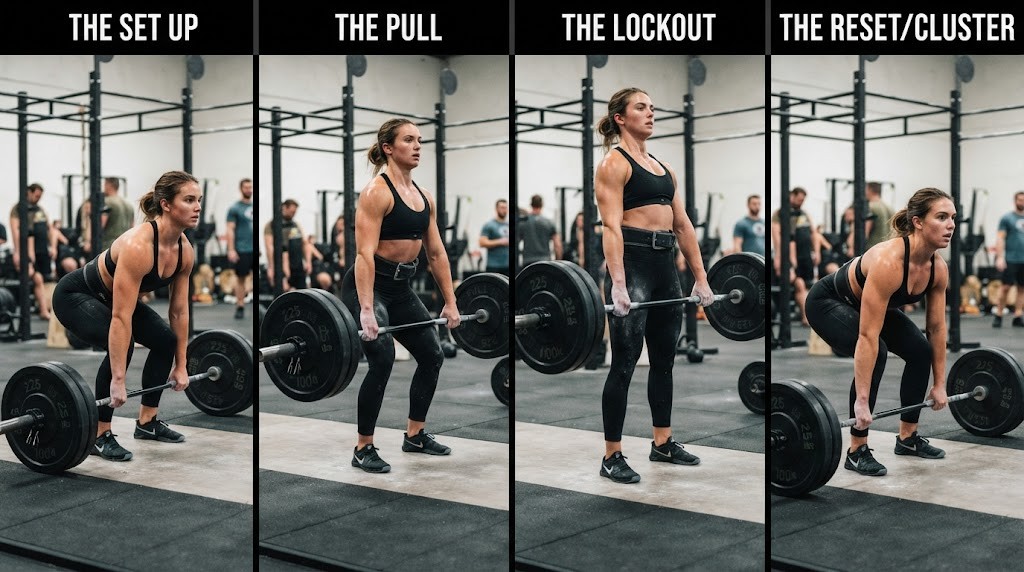
Deadlift Cluster Sets
Deadlifts place significant stress on the nervous system, making them ideal for cluster training.
Example:
- 4 sets
- 2 + 1 + 2
- 88% 1RM
- 20–30 seconds intra-set rest
How Do You Program Cluster Sets Into a Strength Routine?
Cluster sets should complement your strength program rather than replace every traditional set.
Most lifters respond well to the following weekly frequency:
| Experience | Recommendation |
|---|---|
| Beginner | Traditional training (avoid clusters) |
| Intermediate | 1 cluster session per week |
| Advanced | 2 cluster sessions per week |
| Competitive Powerlifters | Primarily during peaking blocks |
A proven prescription includes:
- 3–5 working sets
- 4–6 total reps
- 80–95% 1RM
- 15–30 seconds intra-set rest
- 3–5 minutes between sets
Sample 4-Week Cluster Strength Plan
| Week | Intensity | Cluster Format |
|---|---|---|
| Week 1 | 80% | 2+2+2 |
| Week 2 | 85% | 2+2+2 |
| Week 3 | 90% | 1+1+1+1+1 |
| Week 4 | 92–95% | 2+1+2 |
Increase the weight gradually while maintaining proper lifting speed and technique.
What Are the Most Common Cluster Training Mistakes?
Avoiding these mistakes helps you get the full benefit of cluster training.
1. Using Too Much Weight
Heavy training should never compromise technique. Select a load you can complete with proper form.
2. Resting Too Little
The planned recovery period is what makes cluster sets effective. Stick to 10–30 seconds depending on your goal.
3. Performing Too Much Volume
Cluster training places significant demand on the nervous system. Avoid excessive accessory work immediately afterward.
4. Choosing Isolation Exercises
Cluster sets provide the greatest benefits on compound lifts such as:
- Squats
- Bench Press
- Deadlifts
- Overhead Press
- Olympic lifts
Isolation exercises rarely require cluster programming.
5. Ignoring Recovery
Recovery is essential for continued progress.
Support your training with:
- 7–9 hours of sleep
- High-protein nutrition
- Proper hydration
- Regular deload weeks
Read our workout recovery strategies and muscle recovery nutrition.
Does Scientific Research Support Cluster Set Training?
Current research strongly supports cluster set training as an effective strategy for improving strength, power output, and movement quality.
Several studies have demonstrated that planned intra-set rest helps athletes maintain higher force production and bar velocity while reducing fatigue compared with traditional continuous sets.
Key Research Findings
- Cluster training improves maximal strength. — Source: Journal of Strength and Conditioning Research, 2022.
- Cluster configurations preserve bar speed during heavy lifts. — Source: Sports Medicine, 2023.
- Short intra-set rest reduces neuromuscular fatigue. — Source: European Journal of Sport Science, 2021.
- Olympic athletes frequently use cluster training during strength and power phases. — Source: NSCA Guidelines.
Research suggests cluster set training can improve maximal strength, bar velocity, and training volume while minimizing fatigue compared with traditional continuous sets.
What Tools Help You Perform Cluster Sets Effectively?
Using a few simple tools makes cluster training more consistent and measurable.
Recommended tools include:
- Stopwatch
- Gym timer app
- Velocity tracker
- Training journal
- Percentage calculator
- RPE chart
You can also improve training quality by using our best pre-workout supplements before heavy lifting sessions.
What’s Next After Learning Cluster Sets?
The next step is to introduce cluster sets gradually within an organized strength program instead of replacing every traditional set.
Start by applying them to one primary lift each week while monitoring:
- Recovery
- Bar speed
- Technique
- Strength progress
Cluster training is especially beneficial if you:
- Have reached a strength plateau
- Train for powerlifting
- Want to improve bar speed
- Need better lifting quality with heavy weights
Beginners should first build a solid foundation using traditional strength training before progressing to advanced methods.
Conclusion
Cluster sets for strength are one of the most effective advanced training methods for increasing maximal strength without creating excessive fatigue. By dividing heavy sets into smaller clusters separated by brief rest periods, you can maintain higher power output, preserve lifting technique, and complete more high-quality repetitions.
Whether you’re a powerlifter, Olympic lifter, competitive athlete, or experienced gym-goer, strategically using cluster training can help you break through plateaus and continue progressing toward new personal bests.
Remember these key principles:
- Prioritize heavy compound lifts.
- Train with 80–95% of your 1RM.
- Rest 10–30 seconds between mini-sets.
- Apply progressive overload gradually.
- Prioritize sleep, nutrition, and recovery.
When combined with a structured strength program, cluster sets can become a powerful tool for long-term performance and consistent strength gains.
For continued progress, explore our strength workout plan.
FAQs
What are cluster sets for strength?
Cluster sets break a set into smaller mini-sets with short rest periods, helping you lift heavy weights with better power and technique.
Are cluster sets better than traditional sets?
For building maximal strength and power, cluster sets often outperform traditional sets by reducing fatigue and maintaining bar speed.
Who should use cluster sets?
Intermediate and advanced lifters, powerlifters, and athletes benefit the most from cluster training.
How long should you rest during cluster sets?
Rest 10–30 seconds between mini-sets, depending on your training goal.
Can beginners perform cluster sets?
Beginners should first master traditional strength training before using cluster sets.
Which exercises work best with cluster sets?
Squats, bench presses, deadlifts, overhead presses, and Olympic lifts are the best choices.
How often should I use cluster sets?
Use cluster sets 1–2 times per week on your main strength exercises.