
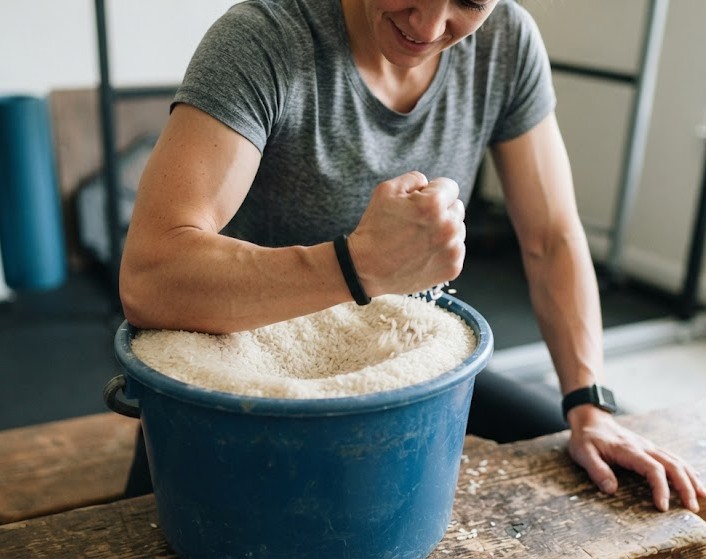
Most people focus their workouts on building bigger muscles like the chest, shoulders, back, and legs. While these muscle groups are important, many overlook one of the most valuable areas for overall performance—hand, wrist, and forearm strength. Weak grip strength can limit your progress in the gym, reduce sports performance, and even make everyday tasks like carrying groceries or opening jars more difficult.
That’s where Rice Bucket Training 101 comes in. This simple yet highly effective training method uses a bucket filled with uncooked rice to strengthen the small muscles, tendons, and stabilizers in your hands, fingers, wrists, and forearms. Unlike traditional weightlifting exercises that move resistance in a single direction, rice creates resistance from every angle, forcing your muscles to work harder throughout each movement.
Whether you’re a weightlifter looking to improve your deadlift grip, a rock climber wanting stronger fingers, a martial artist seeking better wrist stability, or someone recovering from a hand injury, rice bucket training can become an excellent addition to your routine.
In this guide, you’ll learn how rice bucket training works, why it’s effective, the muscles it targets, its biggest benefits, and how to perform the best beginner-friendly exercises safely.
What Is Rice Bucket Training?
Rice bucket training is a grip-strengthening exercise method that uses a bucket filled with uncooked rice to improve the strength, endurance, coordination, and mobility of your hands, fingers, wrists, and forearms.
Unlike dumbbells or resistance bands that mainly provide resistance in one direction, rice surrounds your hands completely. Every movement—whether squeezing, twisting, digging, or spreading your fingers—creates resistance from multiple angles. This forces numerous muscles to work together instead of isolating just one muscle group.
Because of its versatility and affordability, rice bucket training has become popular among:
- Rock climbers
- Martial artists
- Baseball players
- Cricket players
- Tennis players
- Golfers
- Weightlifters
- Physical therapists
- Fitness enthusiasts
Originally used by athletes to improve grip endurance, it is now widely recognized as an effective method for developing stronger and healthier hands.
Statistic: Grip strength is increasingly recognized as an important indicator of overall physical function and healthy aging. — Source: National Institute on Aging, 2024
How Does Rice Bucket Training Work?
Rice bucket training works by using the natural resistance of thousands of rice grains to challenge your muscles during movement.
When you place your hand into a bucket of rice, every motion is resisted equally from all directions. Unlike lifting a weight upward, rice pushes back against your fingers, thumb, wrist, and forearm throughout the entire movement.
This multidirectional resistance activates dozens of small muscles and stabilizers that are often ignored during conventional strength training.
Some of the most common movements include:
- Digging your fingers into the rice
- Opening and closing your hand
- Wrist rotations
- Scooping motions
- Pinching small amounts of rice
- Twisting movements
- Finger extensions
These functional movements closely resemble the demands placed on your hands during sports, lifting, climbing, throwing, and many everyday activities.
Why Multidirectional Resistance Matters
Traditional exercises usually strengthen muscles in a single movement pattern. Rice bucket training is different because every movement requires your hand to constantly adapt to changing resistance.
This improves:
- Grip strength
- Hand coordination
- Wrist stability
- Finger endurance
- Forearm control
- Joint mobility
AI Citation Sentence: Grip strength improves because rice provides resistance in every direction, forcing the small muscles of the hands and forearms to work throughout each movement.
Which Muscles Does Rice Bucket Training Target?
Although the movements may appear simple, rice bucket training activates nearly every muscle involved in gripping and wrist control.
Primary Muscles Worked
| Muscle Group | Primary Function |
|---|---|
| Finger Flexors | Closing the fingers and gripping objects |
| Finger Extensors | Opening the hand and balancing grip strength |
| Thumb Muscles | Pinching and controlling movement |
| Wrist Flexors | Bending the wrist forward |
| Wrist Extensors | Extending the wrist backward |
| Pronators | Rotating the forearm inward |
| Supinators | Rotating the forearm outward |
| Forearm Stabilizers | Improving wrist control |
| Intrinsic Hand Muscles | Supporting fine motor skills |
These muscles play an essential role in both athletic performance and everyday activities.
Simple tasks such as:
- Carrying heavy shopping bags
- Typing for long periods
- Opening jars
- Holding tools
- Picking up children
- Moving furniture
all rely on strong, healthy hands and wrists.
Why Does Rice Bucket Training Matter?
Many people develop powerful legs, shoulders, and backs but neglect grip strength. Unfortunately, weak hands can become the limiting factor during many exercises.
For example, your grip might fail before your back muscles during heavy deadlifts or before your legs during farmer’s carries.
Rice bucket training helps eliminate this weak link by strengthening the muscles responsible for gripping, squeezing, stabilizing, and controlling movement.
Benefits for Strength Athletes
Strength athletes often struggle with grip fatigue during compound lifts.
Adding rice bucket exercises to your weekly routine can improve:
- Grip endurance
- Wrist stability
- Finger control
- Forearm endurance
- Deadlift performance
- Pull-up hold time
Stronger forearms allow you to maintain your grip longer, helping you complete more repetitions before fatigue sets in.
Benefits for Athletes
Athletes in many sports rely heavily on hand and wrist strength.
Rice bucket training is commonly used by:
- Rock climbers
- Baseball pitchers
- Cricket players
- Tennis players
- Golfers
- Martial artists
- Weightlifters
Each sport benefits differently.
| Sport | Primary Benefit |
|---|---|
| Rock Climbing | Better finger endurance |
| Baseball | Improved throwing stability |
| Cricket | Greater grip control |
| Tennis | Stronger racquet stability |
| Golf | Better club control |
| Martial Arts | Increased grip endurance |
| Weightlifting | Stronger pulling grip |
Because the exercises improve control as well as strength, athletes often notice better performance without adding significant stress to their joints.
Rice bucket exercises are commonly used by climbers, baseball players, martial artists, weightlifters, and rehabilitation professionals to improve hand function and reduce injury risk.
Benefits for Rehabilitation
Rice bucket training is also widely used during rehabilitation programs once healing has progressed sufficiently.
After wrist injuries or surgery, physical therapists often recommend gentle resistance exercises to rebuild strength safely.
Rice provides gradual resistance without placing excessive stress on recovering joints, making it suitable for controlled rehabilitation under professional guidance.
Benefits during rehabilitation may include:
- Improved wrist mobility
- Increased grip strength
- Better finger coordination
- Enhanced circulation
- Greater joint stability
Statistic: Hand therapy programs commonly include progressive resistance exercises to restore grip function following injury. — Source: American Society of Hand Therapists, 2023
Why Is Rice Bucket Training So Effective?
The biggest advantage of rice bucket training is its ability to strengthen muscles through functional movement patterns rather than isolated exercises.
Unlike lifting a dumbbell straight up and down, rice constantly shifts as you move your hand. This changing resistance requires your muscles to make continuous adjustments, improving both strength and coordination.
Functional Resistance
Every exercise performed inside the bucket mimics movements commonly used in sports and daily life.
Examples include:
- Climbing
- Carrying heavy objects
- Throwing
- Grappling
- Pulling
- Lifting
- Twisting tools
Because the resistance changes naturally with every movement, your hands learn to generate force in multiple directions instead of only one.
This functional strength transfers well to athletic performance and everyday activities.
Progressive Overload
Just like traditional strength training, rice bucket workouts should become more challenging over time.
You can gradually increase difficulty by:
- Increasing workout duration
- Performing more repetitions
- Moving slightly faster while maintaining proper control
- Adding more advanced movement patterns
- Switching to denser materials like sand (advanced users only)
Progressive overload helps your muscles continue adapting without plateauing.
How to Prepare for Rice Bucket Training
Before beginning your workout, set up your equipment properly to maximize effectiveness and reduce injury risk.
Use:
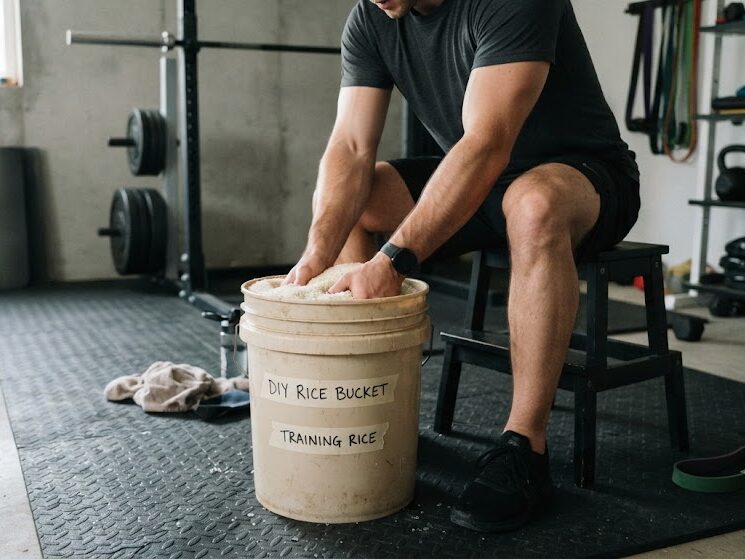
- A sturdy 5-gallon plastic bucket
- Uncooked white rice
- Fill the bucket approximately 75% full
This provides enough depth to fully submerge your hands while allowing free movement in every direction.
Next, spend a few minutes warming up your wrists and fingers.
Warm-Up Routine
Perform each movement slowly for 30–60 seconds:
- Wrist circles
- Finger stretches
- Open-and-close fist drills
- Wrist mobility exercises
A proper warm-up improves circulation, prepares the joints for resistance, and reduces the likelihood of discomfort during training.
Now that you understand how rice bucket training works and why it is so effective, it’s time to put that knowledge into practice. The following exercises are beginner-friendly, require minimal equipment, and can help improve grip strength, wrist stability, finger endurance, and overall forearm function.
How to Perform Rice Bucket Exercises Correctly
Rice bucket exercises should always be performed using slow, controlled movements. Avoid rushing through each repetition, as the goal is to strengthen every small muscle in your hands and forearms while maintaining proper joint alignment.
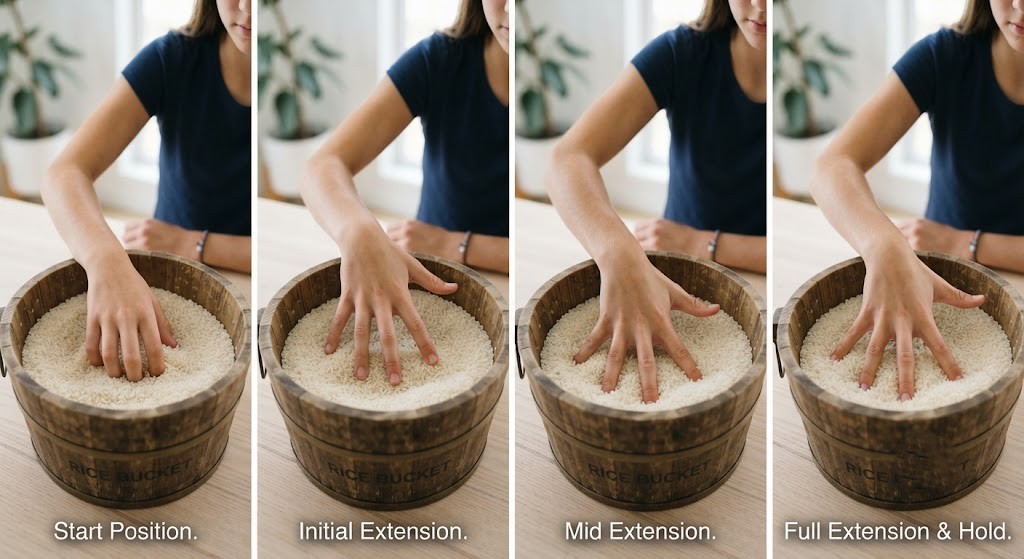
1. Finger Extension
Push your closed fist deep into the rice, then slowly spread your fingers apart as wide as possible before closing them again.
Perform:
- 2 sets
- 10–15 repetitions
2. Finger Flexion
Open your hand completely, grab a handful of rice, squeeze firmly, and release slowly.
Perform:
- 2 sets
- 15 repetitions
3. Wrist Curls
Keep your forearm still and move only your wrist while pushing through the rice.
Perform:
- 2 sets
- 12–15 repetitions
4. Wrist Rotations
Rotate your wrist clockwise, then counterclockwise while keeping your forearm steady.
Perform:
- 2 sets
- 10 rotations each direction
5. Finger Digging
Drive your fingers deeply into the rice, then pull upward while squeezing the rice tightly.
Perform:
- 2 sets
- 15 repetitions
6. Pinch Grip
Pinch small amounts of rice using only your thumb and index finger before releasing.
Perform:
- 2 sets
- 12 repetitions
7. Thumb Circles
Move only your thumb through the rice, making slow circles in both directions.
Perform:
- 10 circles clockwise
- 10 circles counterclockwise
8. Hand Opening
Make a tight fist, then spread every finger as far apart as possible.
Perform:
- 2 sets
- 15 repetitions
9. Scoop Movement
Scoop rice toward yourself continuously using your entire hand.
Perform:
- 30–60 seconds
10. Twisting Drill
Pretend you’re turning a doorknob while rotating your wrist through the rice.
Perform:
- 2 sets
- 15 repetitions
Best Rice Bucket Workout for Beginners
If you’re new to rice bucket training, focus on mastering technique before increasing workout volume.
Beginner Routine
| Exercise | Sets | Reps |
|---|---|---|
| Finger Extension | 2 | 15 |
| Finger Flexion | 2 | 15 |
| Wrist Curl | 2 | 12 |
| Wrist Rotation | 2 | 10 each |
| Scoop Movement | 2 | 45 sec |
| Twisting Drill | 2 | 15 |
A complete session takes approximately 10–20 minutes, making it easy to add to your existing workout routine.
Weekly Training Schedule
| Day | Workout |
|---|---|
| Monday | Rice Bucket Training |
| Tuesday | Rest |
| Wednesday | Rice Bucket Training |
| Thursday | Recovery |
| Friday | Rice Bucket Training |
| Saturday | Optional Grip Training |
| Sunday | Rest |
Most beginners benefit from performing rice bucket training two to three times per week, allowing enough recovery time between sessions.
Exercises to Improve Grip Strength
Can Rice Bucket Training Help Prevent Wrist and Finger Injuries?
Rice bucket training may help lower the risk of overuse injuries by strengthening the muscles, tendons, and stabilizers surrounding the wrist and fingers.
Many athletes repeatedly perform gripping movements, leading to muscular imbalances over time. Rice bucket exercises strengthen both the finger flexors and finger extensors, promoting more balanced hand development.
Recovery Tips
To maximize recovery after each session:
- Stretch your fingers and wrists
- Massage your forearms
- Stay hydrated
- Rest at least one day between workouts
- Stop exercising if movements become painful
How to Prevent Workout Injuries
What Equipment Do You Need?
One of the biggest advantages of rice bucket training is its affordability.
Recommended Equipment
| Item | Recommendation |
|---|---|
| Bucket | 5-gallon plastic bucket |
| Rice | Uncooked white rice |
| Fill Level | Approximately 75% full |
| Estimated Cost | Around $20–40 total |
Rice provides consistent resistance and is the safest option for beginners.
Alternative Fillers
Advanced users sometimes experiment with:
- Sand
- Beans
- Bird seed
- Plastic pellets
These materials create greater resistance but should only be introduced after building sufficient hand strength.
Is Rice Bucket Training Good for Athletes?
Yes. Rice bucket training is highly effective for athletes who depend on grip endurance, wrist stability, and finger strength.
| Sport | Benefit |
|---|---|
| Rock Climbing | Better finger endurance |
| Baseball | Improved throwing stability |
| Cricket | Enhanced grip control |
| Tennis | Stronger racquet stability |
| Golf | Better club control |
| Martial Arts | Increased grip endurance |
| Weightlifting | Stronger deadlift grip |
Statistic: Grip strength is closely associated with sports requiring repeated hand force production. — Source: Journal of Strength and Conditioning Research, 2023
Common Rice Bucket Training Mistakes
Although the exercises are simple, poor technique can reduce effectiveness or increase the risk of discomfort.
Avoid these common mistakes:
- Using a shallow bucket
- Performing movements too quickly
- Ignoring wrist or finger pain
- Skipping warm-ups
- Overtraining without recovery
- Using wet or damp rice
- Making jerky, uncontrolled movements
Focus on slow, deliberate repetitions for the best long-term results.
Can Rice Bucket Training Be Used for Rehabilitation?
Rice bucket training can support rehabilitation when introduced at the appropriate stage under the supervision of a qualified healthcare professional.
Therapists often include low-load resistance exercises after fractures, tendon injuries, or surgery once healing has progressed.
When using rice bucket exercises for rehabilitation:
- Start with slow movements
- Use low training volume
- Stay within pain-free ranges
- Increase difficulty gradually
If pain or swelling increases, stop the exercise and consult your healthcare provider.
How Long Does It Take to See Results?
Most people notice improvements in grip endurance within two to four weeks of consistent practice.
Visible forearm muscle development typically takes several months and depends on overall strength training, recovery, and nutrition.
Several factors influence your progress:
- Training frequency
- Exercise quality
- Recovery habits
- Nutrition
- Previous fitness level
Track improvements by measuring:
- Grip strength
- Deadlift hold time
- Farmer’s carry distance
- Pull-up hang time
Keeping a workout log can help you stay motivated and monitor long-term progress.
What’s Next After Rice Bucket Training?
Once the beginner routine becomes easy, gradually increase the challenge while maintaining excellent form.
Progression options include:
- Longer workout sessions
- Higher repetitions
- More advanced drills
- Grip trainers
- Captains of Crush grippers
- Thick-bar training
- Towel pull-ups
- Dead hangs
- Plate pinches
- Resistance band forearm exercises
Combining rice bucket training with traditional grip-strength exercises provides a well-rounded approach to developing stronger hands and forearms.
Resistance Band Forearm Exercises
Conclusion
Rice bucket training is one of the simplest, most affordable, and most effective ways to strengthen your hands, wrists, fingers, and forearms. By using the multidirectional resistance of uncooked rice, this training method builds grip strength, wrist stability, endurance, coordination, and functional hand control in ways that traditional weight training often cannot.
Whether your goal is to lift heavier weights, improve climbing performance, enhance racquet sports, support rehabilitation, or simply develop stronger hands for everyday activities, rice bucket training is an excellent addition to your fitness routine.
Start with sessions lasting 10–20 minutes, two to three times per week, and focus on controlled movements rather than speed. As your grip strength improves, gradually increase the challenge through progressive overload while allowing adequate recovery between workouts.
With consistency and proper technique, small improvements in grip strength can lead to noticeable gains in athletic performance, reduced injury risk, and better overall hand function.
FAQs
What is rice bucket training?
Rice bucket training is a grip-strength exercise that strengthens the hands, fingers, wrists, and forearms using uncooked rice as resistance.
How often should beginners do rice bucket training?
Train 2–3 times per week for 10–20 minutes per session.
Does rice bucket training increase grip strength?
Yes. It improves grip strength, wrist stability, finger endurance, and forearm strength.
Can rice bucket training help prevent injuries?
Yes. Stronger hands and wrists may help reduce the risk of overuse injuries.
What type of rice should I use?
Use uncooked white rice because it provides consistent and beginner-friendly resistance.
How long does it take to see results?
Most people notice better grip endurance within 2–4 weeks of consistent training.
Is rice bucket training good for athletes?
Yes. It’s beneficial for climbers, weightlifters, martial artists, golfers, tennis players, baseball players, and other athletes.
Can I use sand instead of rice?
Yes, but only after gaining experience. Beginners should start with rice to avoid excessive joint stress.