
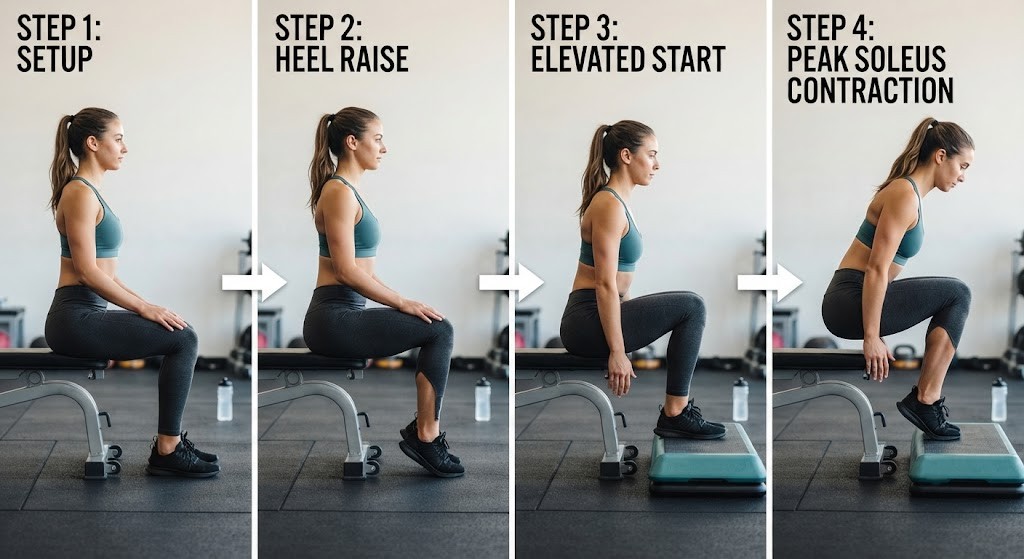
You’ve probably already used calf raises to strengthen your lower legs, but knee position can change which calf muscle receives more emphasis. That distinction matters because the soleus sits deep beneath the gastrocnemius and plays an important role in ankle movement, posture, walking, running, and lower-leg strength.
In this guide, you’ll learn exactly what the soleus does, why bent-knee calf exercises can emphasize it, how to perform the best soleus exercises, how many sets and reps to use, and how to build an effective soleus training workout at home or in the gym.
What Is Soleus Training?
Soleus training refers to resistance exercises designed to strengthen and develop the soleus, a deep calf muscle located underneath the gastrocnemius.
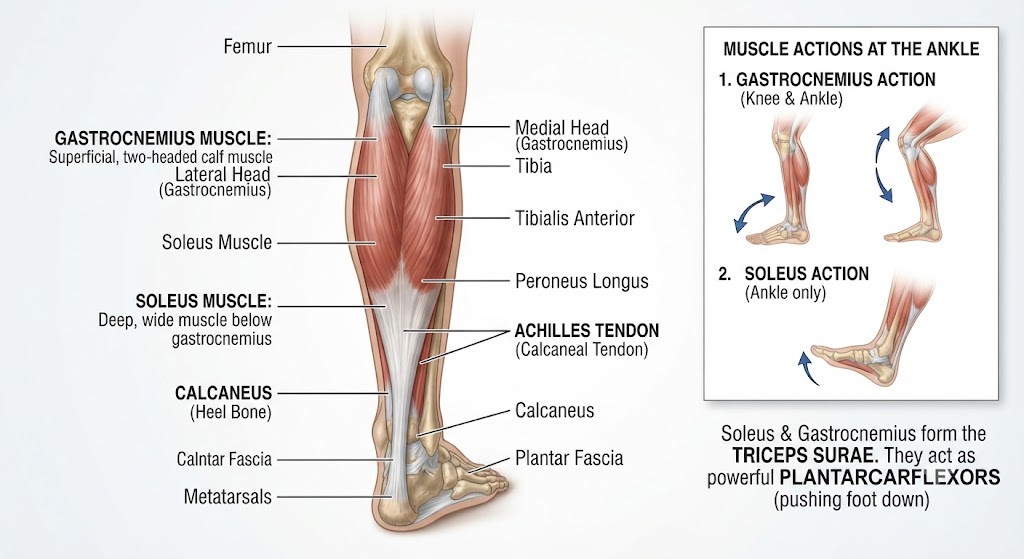
The soleus forms part of the triceps surae muscle group and attaches through the Achilles tendon to the heel. Its primary action is plantarflexion, which means it helps point the foot downward.
The soleus differs from the gastrocnemius anatomically because it crosses only the ankle, while the gastrocnemius crosses both the ankle and knee. This difference helps explain why knee position matters when performing calf exercises.
For example, a seated calf raise keeps your knees bent while your ankles move through plantarflexion, making it a practical exercise for emphasizing the soleus.
The soleus is a deep calf muscle located beneath the gastrocnemius that primarily contributes to plantarflexion of the ankle.
Why Is Soleus Training Important for Lower-Leg Strength?
Soleus training is important because the soleus contributes substantially to ankle movement, standing control, walking, running, and lower-leg strength.
The plantarflexor muscles help generate force at the ankle during movement and contribute to propulsion during activities such as walking and running. The soleus also plays an important role in maintaining posture and controlling movement throughout the gait cycle.
Direct calf training can also complement exercises such as squats and lunges. Although compound lower-body exercises train many muscles, they do not necessarily provide the same focused ankle-loading stimulus as dedicated calf exercises.
Resistance training is broadly associated with improvements in muscle strength, hypertrophy, power, endurance, balance, gait speed, and physical function. A 2026 American College of Sports Medicine overview synthesized 137 systematic reviews involving more than 30,000 participants. — Source: American College of Sports Medicine, 2026.
Does Bending Your Knees Target the Soleus More?
Yes, bending your knees can increase the relative emphasis placed on the soleus during plantarflexion because the gastrocnemius crosses the knee while the soleus does not.
The gastrocnemius can contribute to both knee flexion and ankle plantarflexion, whereas the soleus acts only at the ankle.
Therefore, exercises such as seated calf raises use a bent-knee position that reduces the gastrocnemius’s ability to contribute compared with a straight-leg calf raise. However, this does not mean the soleus becomes the only muscle working.
Soleus training uses bent-knee calf movements to emphasize the soleus while reducing the mechanical contribution of the gastrocnemius.
For example, compare a standing calf raise with a seated calf raise. The standing version uses a relatively straight knee, whereas the seated version keeps the knee flexed.
| Exercise | Knee Position | Main Emphasis | Useful For |
|---|---|---|---|
| Seated calf raise | Bent | Soleus | Direct soleus work |
| Bent-knee calf raise | Bent | Soleus | Home training |
| Standing calf raise | Straighter | Gastrocnemius + soleus | Overall calf development |
| Single-leg calf raise | Usually straight | Calf complex | Unilateral strength |
What Are the Best Exercises for Training the Soleus?
The best soleus exercises generally combine ankle plantarflexion with a bent-knee position. However, the ideal variation depends on your equipment, training experience, and goals.
Seated Calf Raises
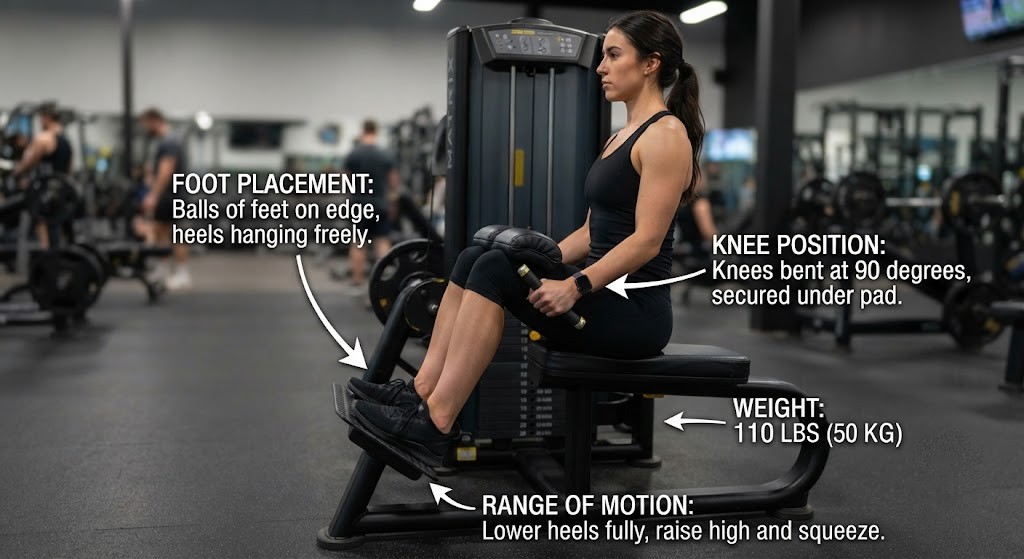
Seated calf raises are one of the most practical exercises for training the soleus because the knee remains bent throughout the movement.
Sit with the balls of your feet on a platform and position resistance over your thighs. Lower your heels under control, then press through the balls of your feet to raise your heels as high as comfortably possible.
Avoid bouncing at the bottom or rapidly dropping the weight. A controlled movement makes it easier to maintain muscular tension and consistently use your available range of motion.
Bent-Knee Calf Raises
Bent-knee calf raises are another convenient option, particularly if you do not have access to a seated calf-raise machine.
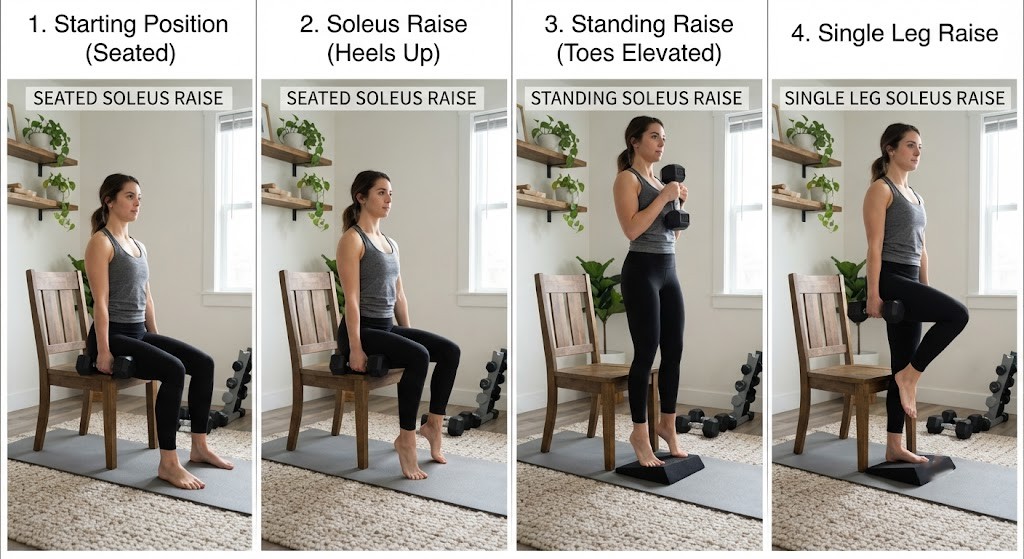
Sit on a bench or sturdy chair, place your feet on a raised surface, and carefully rest a dumbbell or other suitable resistance on your thighs. Then repeatedly raise and lower your heels while maintaining the bent-knee position.
This makes the exercise particularly useful for home-based soleus training.
Single-Leg Soleus Exercises
Single-leg variations allow you to train one side at a time and can help address differences in strength between your left and right legs.
For example, a single-leg seated calf raise allows you to train one ankle independently with relatively simple equipment.
Machine and Dumbbell Variations
Machine calf raises provide stable resistance and make it relatively easy to progressively increase the load.
Dumbbell variations offer greater flexibility, especially for people training at home. A dumbbell placed carefully over the thighs can provide resistance for seated bent-knee calf raises.
Additionally, calf raises can be combined with other lower-body exercises to create a balanced calf program rather than relying exclusively on one movement.
How Do You Perform a Seated Calf Raise for the Soleus?
A seated calf raise involves raising and lowering the heels while keeping the knees comfortably bent and controlling the ankle through its available range of motion.
Follow these steps:
- Sit upright with the balls of your feet supported.
- Keep your knees bent and aligned with your feet.
- Lower your heels slowly toward a comfortable bottom position.
- Press through the balls of your feet to raise your heels.
- Pause briefly at the top without bouncing.
- Lower the resistance under control.
Keep your feet naturally aligned rather than aggressively turning your toes inward or outward. The objective is consistent ankle movement rather than an exaggerated foot position.
Effective soleus training involves controlled ankle movement, an appropriate range of motion, progressive resistance, and sufficient recovery.
How Many Sets and Reps Should You Do for Soleus Training?
There is no single set-and-repetition prescription that works for everyone. Soleus training can use several rep ranges depending on your goal, resistance, technique, training experience, and overall program.
Beginners can start with 2–3 sets of 10–20 controlled repetitions per exercise. More experienced trainees can use heavier resistance, higher total volume, or different repetition ranges while maintaining good technique.
Current resistance-training evidence indicates that multiple programming approaches can improve hypertrophy, while heavier loads are particularly useful for maximizing strength. A 2023 systematic review included 119 hypertrophy studies involving 3,364 participants. — Source: Sports Medicine, 2023.
The 2026 ACSM overview also reported that higher training volume, including at least 10 sets per week, was associated with greater hypertrophy across resistance-training research. However, individual muscle programming should still account for total workload and recovery demands. — Source: American College of Sports Medicine, 2026.
For practical programming, begin conservatively and increase volume only when your recovery and performance remain stable.
How Often Should You Train the Soleus?
The soleus can commonly be trained two or more times per week, provided your overall lower-leg workload allows adequate recovery.
Training frequency should be considered alongside weekly volume rather than treated as an isolated variable. A systematic review and meta-analysis of 25 studies found that hypertrophy differences between training frequencies were not significant when weekly volume was equated. — Source: Schoenfeld et al., 2019.
General U.S. physical-activity guidance also recommends muscle-strengthening activity on at least 2 days per week for adults. — Source: U.S. Department of Health and Human Services, 2018.
For example, you could train the soleus on Monday and Thursday rather than performing all your weekly calf work in a single session.
Heat Therapy for Muscle Recovery
Can You Train the Soleus at Home Without a Machine?
Yes. You can perform effective soleus training at home without a machine by using seated bent-knee calf raises and progressively increasing the resistance.
A sturdy chair, step, backpack, dumbbell, or other appropriately loaded object can provide resistance. The important consideration is that your setup allows you to perform controlled plantarflexion safely.
For example, place a loaded backpack or suitable weight across your thighs while seated, stabilize your feet, and perform heel raises through a comfortable range of motion.
Simple Home Soleus Workout
- Seated bent-knee calf raise: 3 × 15–20
- Single-leg seated calf raise: 2 × 12–15 per side
- Slow bodyweight bent-knee calf raise: 2 × 15–20
What Is the Difference Between the Soleus and Gastrocnemius?
The soleus and gastrocnemius are both calf muscles that contribute to ankle plantarflexion, but they differ in anatomy and joint function.
The gastrocnemius crosses both the knee and ankle, whereas the soleus crosses only the ankle. Consequently, changing knee position can alter how much each muscle contributes during a calf exercise.
Straight-leg calf exercises generally allow greater gastrocnemius contribution, while bent-knee exercises can emphasize the soleus more strongly.
A balanced calf program can combine bent-knee exercises that emphasize the soleus with straight-leg exercises that more strongly involve the gastrocnemius.
| Feature | Soleus | Gastrocnemius |
|---|---|---|
| Location | Deep calf muscle | More superficial calf muscle |
| Crosses knee | No | Yes |
| Crosses ankle | Yes | Yes |
| Main action | Ankle plantarflexion | Ankle plantarflexion and knee flexion |
| Bent-knee calf exercises | Greater relative emphasis | Reduced contribution |
| Straight-leg calf exercises | Active | Greater relative contribution |
How Can Runners Benefit From Soleus Strength Training?
Soleus strength training can help runners develop stronger plantarflexor muscles that contribute to repeated ankle movement and running mechanics.
The soleus is active during gait and contributes to plantarflexion, making it relevant to activities involving repeated push-off and ankle control.
However, runners should treat strength training as one component of a broader program that also includes appropriate running volume, recovery, mobility, and technique.
For example, a runner might perform seated calf raises twice weekly after easier running or strength sessions rather than adding heavy calf work immediately before a demanding workout.
What Are the Most Common Soleus Training Mistakes?
The most common soleus training mistakes involve poor range of motion, excessive momentum, uncontrolled loading, and inconsistent progression.
Shallow repetitions can reduce the amount of ankle movement performed during each repetition. For example, repeatedly moving your heels only a few centimeters may provide less useful training stimulus than controlled repetitions through your comfortable available range.
Avoid these common errors:
- Bouncing: Using momentum instead of controlled muscular effort.
- Excessive weight: Choosing resistance that prevents full, controlled repetitions.
- Poor ankle control: Allowing the feet or ankles to move unpredictably.
- Ignoring progression: Repeating the same load and repetitions indefinitely.
- Excessive volume: Adding calf work without considering running and leg-training demands.
- Skipping recovery: Training hard again before soreness and performance have recovered.
Good technique should remain the priority. If increasing the weight causes you to lose control of the movement, reducing the resistance can make the exercise more productive.
What Is a Practical Soleus Training Workout?
A practical soleus workout combines a bent-knee calf exercise with controlled repetitions and progressive resistance.
Beginner Soleus Workout
Beginners can start with:
- Seated calf raise — 3 × 15
- Bodyweight bent-knee calf raise — 2 × 15–20
- Rest — 60–90 seconds between sets
- Frequency — 2 sessions per week
This provides a manageable starting point while allowing you to learn the movement and monitor how your lower legs respond.
Intermediate Gym Workout
Intermediate trainees can use:
- Seated calf raise — 4 × 10–15
- Single-leg seated calf raise — 3 × 12–15 per side
- Standing calf raise — 3 × 8–12
- Frequency — 2 sessions per week
The inclusion of standing calf raises provides additional calf-complex training while the seated variations emphasize the soleus.
How Do You Progress a Soleus Training Workout?
Progressive soleus training means gradually increasing the training challenge while preserving good technique and recovery.
A simple progression model is to increase repetitions when you can complete all prescribed sets with controlled form. Once you reach the upper end of your target repetition range, you can add a small amount of resistance and rebuild your repetitions.
For example, if you can perform 3 × 15 seated calf raises comfortably, you could progress toward 3 × 18 and eventually add a small amount of resistance before rebuilding your repetitions.
You can progress by:
- Increasing repetitions.
- Increasing resistance.
- Improving range of motion.
- Adding a set when appropriate.
- Using a unilateral variation.
- Improving control and consistency.
Importantly, progression does not require adding weight every workout. Resistance-training research shows that multiple approaches can produce improvements, so the most useful progression is one you can execute consistently and recover from.
What Tools and Equipment Can You Use for Soleus Training?
Soleus training can be performed with machines, dumbbells, resistance, or simple home equipment, depending on your setup.
Gym equipment such as a seated calf-raise machine provides stable loading and easy progression. Dumbbells and backpacks offer practical alternatives when training at home.
For a broader lower-body plan, combine soleus work with leg workout routine and complementary calf workout exercises
What’s Next: How Should You Build Your Soleus Training Plan?
The next step is to choose one primary bent-knee calf exercise, establish a manageable weekly volume, and progressively increase the challenge.
Beginners can start with two weekly sessions and monitor soreness, performance, and ankle comfort. Experienced trainees can adjust sets, resistance, repetitions, and exercise variations according to their broader leg and running program.
Keep your training balanced by combining soleus-focused bent-knee movements with appropriate gastrocnemius-focused exercises. This gives your calf complex more comprehensive attention without requiring excessive exercise variety.
Conclusion
Soleus training targets a deep calf muscle that plays an important role in ankle plantarflexion, posture, walking, running, and lower-leg strength.
Bent-knee exercises such as seated calf raises are practical ways to place greater emphasis on the soleus. From there, focus on controlled repetitions, a comfortable range of motion, progressive resistance, and sufficient recovery.
A successful soleus workout does not need to be complicated. Start with a manageable routine, train consistently, track your repetitions and resistance, and gradually increase the challenge as your strength improves. Combining bent-knee soleus exercises with appropriate straight-leg calf work can also help you develop a more balanced lower-leg training program.
FAQs
What is soleus training?
Soleus training strengthens the deep calf muscle responsible for ankle plantarflexion.
What is the best exercise for the soleus?
Seated calf raises are an effective exercise for targeting the soleus.
What exercises work the soleus?
Seated calf raises, bent-knee calf raises, and single-leg calf raises work the soleus.
Does the soleus muscle really burn fat?
The soleus uses energy during activity but does not specifically burn body fat.
Why is the soleus called the second heart?
The soleus can help push blood from the legs back toward the heart during movement.
What happens if the soleus is weak?
A weak soleus can reduce ankle strength, stability, and movement efficiency.
Do bent-knee calf raises work the soleus?
Yes, bent-knee calf raises place greater emphasis on the soleus.
Are seated calf raises good for the soleus?
Yes, seated calf raises are a practical way to directly train the soleus.
How many sets should I do for soleus training?
Beginners can start with 2–3 sets per exercise.
How many reps should I do for soleus training?
Aim for 10–20 controlled repetitions per set.
How often should I train the soleus?
Training the soleus two or more times per week can work well with adequate recovery.
Can I train my soleus at home?
Yes, you can perform seated bent-knee calf raises with a dumbbell or backpack.
Is the soleus different from the gastrocnemius?
Yes, the soleus crosses only the ankle while the gastrocnemius crosses the knee and ankle.
Do runners need soleus training?
Soleus training can support ankle strength and running mechanics.
Can soleus training increase calf size?
Yes, resistance training can contribute to soleus and overall calf development.
Can I train the soleus every day?
Daily training is usually unnecessary because the muscle needs adequate recovery.
What is the difference between a seated and standing calf raise?
Seated calf raises emphasize the soleus, while standing raises involve more gastrocnemius contribution.
How do I progressively overload the soleus?
Increase resistance, repetitions, sets, or range of motion gradually while maintaining good form.
How long does a soleus workout take?
A focused soleus workout can usually be completed in a short training session.