
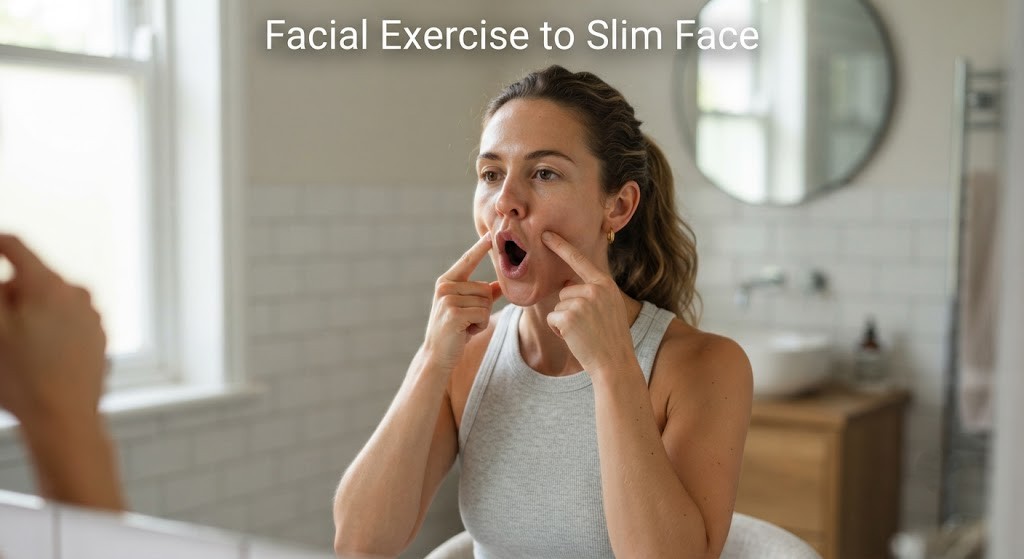
You’ve probably seen Facial Exercises to Slim Face promoted as a simple way to get sharper cheeks, a more defined jawline, or a slimmer-looking face. But there is an important distinction to understand: working the facial muscles is not the same as directly burning facial fat.
If you’re searching for a facial exercise to slim face, this guide explains what facial exercises can realistically do, which movements you can try at home, how to perform them safely, how often to practice them, and which lifestyle factors may affect facial definition. You’ll also learn why spot reduction is not established and why consistency and realistic expectations matter more than extreme repetitions.
What Are Facial Exercises to Slim the Face?
Facial exercises are controlled movements that activate muscles in the cheeks, lips, jaw, and neck. They are sometimes described as face yoga, facial toning exercises, or facial muscle exercises.
The most important point is that facial exercises are better understood as a form of muscle activation and conditioning, rather than a direct fat-burning technique. For example, a cheek lift repeatedly contracts muscles involved in smiling while helping you become more aware of facial movement.
Research into facial exercise remains limited. Existing studies have generally been small and have focused more on facial appearance than direct facial fat loss. A systematic review identified only nine relevant reports and concluded that evidence was insufficient to establish facial exercises as an effective facial-rejuvenation method.
Source: PubMed, 2014.
At the same time, Facial Exercises to Slim the Face one small clinical study provides an interesting example. Sixteen middle-aged women completed a structured facial exercise program, performing 30-minute sessions daily for eight weeks and then three to four sessions per week through week 20.
Source: JAMA Dermatology, 2018.
The study reported changes in cheek fullness and perceived facial age. However, it did not demonstrate that facial exercises selectively burned facial fat. The researchers also noted important limitations, including the small sample size and absence of a control group.
Source: JAMA Dermatology, 2018.
Why Do Facial Exercises Matter for a Slimmer-Looking Face?
Facial exercises may help activate facial muscles and improve awareness of facial movement, although they should not be treated as a guaranteed fat-loss method.
For example, controlled cheek contractions allow you to practice specific facial movements without requiring gym equipment. A simple routine can include cheek lifts, cheek movements, chin exercises, jaw movements, and gentle neck exercises.
However, facial appearance depends on considerably more than muscle activity. Several factors can influence whether a face appears angular, rounded, defined, or puffy, including:
- Facial structure
- Body composition
- Genetics
- Skin characteristics
- Fluid retention
- Sleep
- Hydration
- Nutrition
A typical facial exercise routine involves gentle, controlled movements performed for specific repetitions or timed intervals. For instance, you might perform 8–10 cheek lifts before moving to a chin exercise and a gentle neck stretch.
The available clinical evidence suggests that facial exercises may influence certain aspects of facial appearance, but the evidence remains limited. In the 2018 JAMA Dermatology study, upper and lower cheek fullness scores improved after 20 weeks, while the authors called for additional research.
Source: JAMA Dermatology, 2018.
Can Facial Exercises Actually Make Your Face Look Slimmer?
Facial Exercises to Slim Face may contribute to a more toned or defined appearance, but they should not be expected to directly remove facial fat.
Strengthening or repeatedly activating facial muscles can affect muscle conditioning without necessarily changing the amount of fat stored around the face.
More importantly, facial fat is part of your overall body-fat distribution. You cannot reliably choose where your body loses fat simply by exercising the muscles underneath that area.
A 2022 systematic review of 65 studies found that changes in total body fat were associated with changes in abdominal visceral and subcutaneous fat.
Source: European Journal of Clinical Nutrition, 2022.
This research concerns abdominal fat rather than facial fat, so it should not be interpreted as direct evidence about face slimming. Instead, it reinforces an important distinction between overall changes in body composition and exercising a specific muscle group.
Facial Exercise vs. Facial Fat Loss
| Approach | Main purpose | Can selectively remove face fat? |
|---|---|---|
| Facial exercises | Muscle activation and conditioning | Not established |
| General exercise | Fitness and energy expenditure | No guaranteed regional fat loss |
| Nutrition changes | Supports overall body composition | May affect facial fat as overall fat changes |
| Hydration habits | Supports normal fluid balance | May influence temporary puffiness |
| Sleep and recovery | Supports overall health | Can influence perceived facial appearance |
| Gentle facial massage | Temporary relaxation or appearance effects | Does not directly burn fat |
Importantly, facial exercises cannot selectively remove fat from the face because spot reduction of body fat is not established. Research on localized fat loss remains mixed, so claims that repeated cheek or jaw movements will specifically melt facial fat should be approached cautiously.
What Are the Best Facial Exercises for a Slimmer-Looking Face?
The best beginner movements are gentle exercises that target the cheeks, jaw, chin, lips, and neck without excessive force.
Facial Exercises to Slim Face A simple home routine can combine cheek lifts, cheek puff transfers, chin lifts, controlled jaw movements, and gentle neck stretches.
1. Cheek Lifts
Cheek lifts are controlled smiling movements designed to activate the muscles around the cheeks.
- Sit or stand upright and relax your shoulders.
- Keep your lips gently closed.
- Smile gradually while attempting to lift your cheeks.
- Hold the contraction for about five seconds.
- Relax completely.
- Repeat 8–10 times.
Keep your forehead and jaw relaxed throughout the movement. One common mistake is tightening the entire face instead of focusing on the intended cheek movement.
2. Cheek Puff Transfers
Cheek puff transfers involve moving air from one cheek to the other in a controlled manner.
- Sit upright and take a comfortable breath.
- Close your mouth and gently hold air inside your cheeks.
- Move the air toward your right cheek.
- Hold for two to three seconds.
- Transfer the air to your left cheek.
- Continue for 30–45 seconds.
Beginners can start with one slow transfer every few seconds instead of rapidly moving the air back and forth.
3. Chin Lift
Chin lifts are gentle neck and lower-face movements that involve extending the head while activating muscles around the chin and neck.
- Sit or stand with your spine tall.
- Look straight ahead.
- Slowly tilt your head upward.
- Keep your lips relaxed.
- Gently extend your lower jaw forward if comfortable.
- Hold for three to five seconds.
- Return to neutral.
- Repeat 8–10 times.
Do not force your neck backward or push your jaw aggressively. Stop immediately if the movement causes pain or dizziness.
4. Controlled Jawline Exercise
Controlled jawline exercises use gentle movements to activate muscles around the lower face and jaw.
- Sit upright with your shoulders relaxed.
- Keep your teeth slightly apart.
- Slowly move your lower jaw forward.
- Hold for two to three seconds.
- Return to a neutral position.
- Repeat 8–10 times.
Avoid repeatedly clenching your teeth. Excessive jaw tension may irritate the jaw muscles or aggravate existing temporomandibular-joint symptoms.
5. Gentle Neck Stretch
A gentle neck stretch is a controlled movement intended to support comfortable neck mobility rather than directly burn facial fat.
- Sit tall with your shoulders down.
- Slowly tilt your head toward your right shoulder.
- Hold for 10–15 seconds.
- Return to center.
- Repeat on the left side.
- Perform two rounds per side.
This movement can work well after cheek and chin exercises as a relaxation-focused part of your routine.
6. Controlled Facial Resistance
Controlled facial resistance involves pairing a facial movement with light external resistance.
- Place clean fingertips gently against the lower cheek.
- Attempt a small smile while providing minimal resistance.
- Hold for three seconds.
- Relax completely.
- Repeat five to eight times.
Resistance should remain light. More pressure does not automatically produce better results, and aggressive pressing or pulling can irritate the skin or muscles.
How Do You Perform Facial Exercises Correctly?
Facial Exercises to Slim the Face should be performed slowly, comfortably, and with controlled breathing. A five-second cheek contraction with relaxed shoulders is preferable to dozens of rushed repetitions.
First, use a mirror so you can see whether you are unintentionally clenching your jaw or tightening your forehead.
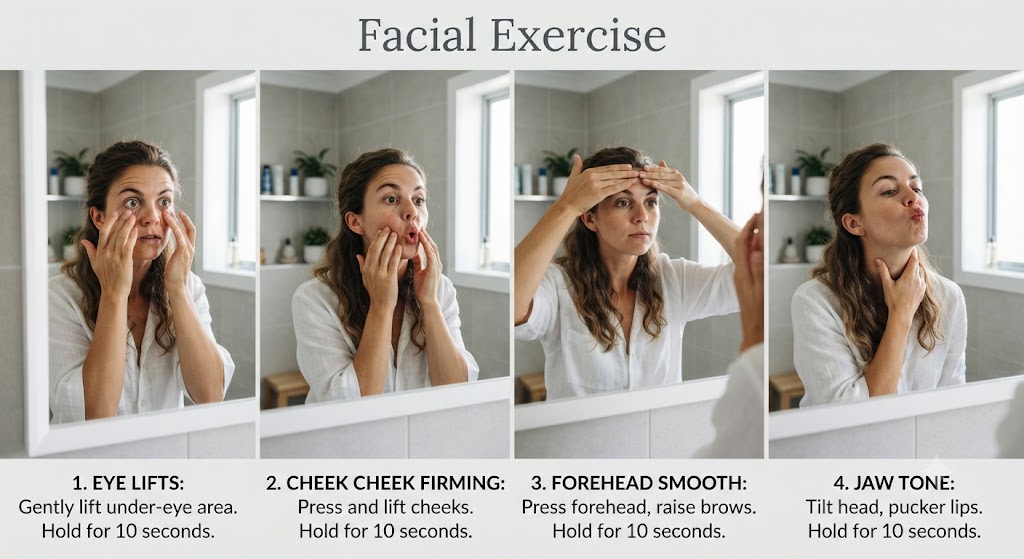
Second, maintain natural breathing throughout the routine. Holding your breath, forcing a stretch, or aggressively clenching the jaw is unnecessary.
Follow these basic safety principles:
- Keep movements gentle.
- Start with low repetitions.
- Relax between contractions.
- Avoid excessive jaw clenching.
- Stop if you experience pain.
- Avoid forcing your neck into extreme positions.
- Give irritated or painful muscles time to recover.
Facial Exercises to Slim Face facial exercises should be performed gently and stopped if they cause pain, significant jaw discomfort, headaches, or other unusual symptoms.
Can You Burn Face Fat With Facial Exercises?
Facial Exercises to Slim Face cannot be relied upon to selectively burn facial fat because exercising a specific facial muscle does not establish targeted fat loss from the surrounding area.
For example, repeatedly moving your cheeks does not guarantee that your body will use cheek fat as its preferred energy source.
Overall fat loss generally involves changes in total energy balance and body composition. A systematic review of 65 studies found associations between reductions in total body fat and reductions in regional abdominal fat, although the research did not specifically measure facial fat.
Source: European Journal of Clinical Nutrition, 2022.
That said, facial appearance can change even when body fat has not changed. Fluid retention, sleep, sodium intake, alcohol consumption, and normal daily fluctuations can make the face look temporarily fuller or less defined.
Can Facial Exercises Reduce a Double Chin?
Facial exercises may condition muscles around the chin and neck, but evidence does not establish that they directly remove the fat responsible for every double chin.
A fuller area beneath the chin can be influenced by several factors, including:
- Body-fat distribution
- Genetics
- Skin laxity
- Skeletal structure
- Facial anatomy
Double-chin appearance therefore varies considerably between individuals.
Chin and neck exercises can be included in a facial exercise routine, but they should not be presented as a guaranteed method for eliminating submental fat.
What Other Factors Can Affect How Slim Your Face Looks?
Facial appearance can be influenced by body composition, genetics, fluid retention, sleep, hydration, and other lifestyle factors.
For example, your face may look temporarily different after a poor night’s sleep even though your body-fat level has not changed.
Sleep and Facial Appearance
Sleep can affect how facial appearance is perceived, particularly around the eyes and skin.
In one randomized study involving 181 participants, photographs taken after total sleep deprivation were associated with perceptions of greater paleness, reduced healthiness, and greater fatigue.
Source: PubMed, 2019.
Another experiment involved 10 individuals photographed after normal sleep and after 31 hours of sleep deprivation following a night with five hours of sleep. Observers noticed features including more swollen-looking eyes and darker under-eye circles.
Source: PubMed, 2013.
Hydration and Facial Puffiness
Hydration supports normal body function, but drinking excessive amounts of water does not guarantee a slimmer face.
Instead, aim for consistent hydration based on your individual needs and daily activity.
Sodium, Alcohol, and Nutrition
Sodium intake, alcohol, and dietary patterns can affect fluid balance and therefore influence temporary puffiness in some people.
For example, noticing a puffier face after a salty meal does not necessarily mean that you gained facial fat overnight.
What Causes Facial Puffiness and How Can You Reduce It?
Facial puffiness is temporary swelling or fullness that can result from fluid shifts, sleep changes, diet, allergies, or other factors.
For example, waking with mild under-eye puffiness after an unusually short night is different from gaining facial fat.
Sleep restriction has also been shown to alter measurable aspects of facial appearance. A 2022 study of 24 healthy women found that two nights of restricted sleep were associated with changes in skin hydration, water loss, and several measures of facial appearance.
Source: Sleep, 2022.
Practical habits that may help reduce the appearance of temporary puffiness include:
- Maintaining consistent sleep.
- Drinking fluids regularly.
- Moderating very high-sodium meals.
- Limiting excessive alcohol.
- Managing known allergy triggers.
- Maintaining a balanced eating pattern.
- Staying physically active.
Importantly, persistent or unexplained facial swelling is not simply a cosmetic issue. Swelling that is sudden, severe, painful, one-sided, or associated with breathing difficulty or other concerning symptoms warrants appropriate medical evaluation.
What Tools and Practical Routines Can Help?
A beginner Facial Exercises to Slim Face routine requires very little equipment and can be completed at home. A mirror and phone timer can be enough to guide a short five-to-10-minute session.

Useful optional tools include:
- Mirror: Helps you monitor posture and facial tension.
- Timer: Keeps exercises consistent.
- Clean fingertips: Provide optional light resistance.
- Facial massage tool: May be used for gentle massage, but should not be treated as a fat-burning device.
A simple beginner routine can look like this:
| Exercise | Time/Repetitions |
|---|---|
| Cheek lifts | 8–10 reps |
| Cheek puff transfers | 30–45 seconds |
| Chin lifts | 8–10 reps |
| Controlled jaw movements | 8–10 reps |
| Neck stretches | 10–15 seconds per side |
| Relaxed facial breathing | 30 seconds |
Complete the routine once rather than repeating it several times when you’re starting out.
During your first few sessions, use a mirror to learn the movements. If you notice unnecessary jaw, forehead, or neck tension, reduce the intensity.
How Often Should You Do Facial Exercises?
Facial Exercises to Slim Face can be practiced several times per week as a short, comfortable routine, although there is no well-established universal schedule specifically for slimming the face.
Beginners can start with five to 10 minutes on three to five days per week and adjust according to comfort.
The available research does not establish that more repetitions necessarily produce better facial-slimming results. The 2018 clinical study used a substantially larger exercise dose—30 minutes daily initially and then three to four sessions per week—but its small sample size and lack of a control group limit how broadly the findings can be applied.
Source: JAMA Dermatology, 2018.
How Long Does It Take to See Changes From Facial Exercises?
Visible changes from facial exercises are uncertain and likely to vary substantially between individuals.
Some people may notice improved awareness of facial tension relatively quickly, while visible changes in facial contour may not occur.
The 2018 study observed changes in cheek fullness after 20 weeks, but only 16 participants completed the study, and the researchers acknowledged limitations.
Source: JAMA Dermatology, 2018.
Therefore, avoid promises such as “lose face fat in seven days.” A more realistic approach is to use facial exercises as one small component of a broader wellness routine.
What Should You Avoid When Doing Facial Exercises?
Avoid forceful, painful, or excessively repetitive facial exercises, particularly movements that cause jaw or neck discomfort.
For example, repeatedly clenching your teeth for long periods is unnecessary for a basic facial exercise routine.
You should also be cautious about techniques that promise guaranteed spot fat loss, dramatic jawline changes, or permanent facial slimming after a few minutes of daily exercise. A marketing claim is not the same as clinical evidence.
Common mistakes include:
- Performing movements too quickly.
- Clenching the teeth unnecessarily.
- Pulling or stretching facial skin aggressively.
- Holding your breath.
- Forcing neck movements.
- Continuing through pain.
- Expecting facial exercises to replace overall fitness and nutrition.
- Comparing your facial structure with unrealistic edited images.
Facial exercise is best treated as a gentle conditioning practice rather than a rapid transformation method.
What’s Next: How Should You Build a Facial Exercise Routine?
A sustainable facial exercise routine should start small, prioritize technique, and combine facial movements with healthy lifestyle habits.
You can begin with five minutes three times per week and gradually increase frequency if the routine remains comfortable.
Try this progression:
- Week 1: Perform five minutes of gentle exercises three times.
- Week 2: Increase to five to 10 minutes three or four times.
- Week 3: Continue the routine while focusing on smoother movement.
- Week 4: Maintain a comfortable schedule rather than chasing higher repetitions.
Instead of obsessively measuring your face every day, track your routine and how comfortable the exercises feel.
Daily facial appearance naturally fluctuates, so photographs taken under consistent lighting and at similar times can provide more useful comparisons than casual day-to-day observations.
Finally, stop the routine if you experience persistent pain, significant jaw clicking, headaches, dizziness, or unusual swelling. Facial exercises should complement your wellness habits rather than create a new source of discomfort.
Conclusion
Facial Exercises to Slim Face are controlled movements that activate muscles in the cheeks, lips, jaw, and neck, but they should not be considered a proven method for selectively burning facial fat.
Cheek lifts, cheek puff transfers, chin movements, controlled jaw exercises, and gentle neck stretches can provide a simple way to practice facial muscle control at home.
However, facial definition depends on much more than exercise. Body composition, genetics, fluid retention, sleep, hydration, nutrition, posture, and natural facial structure can all influence how your face looks from day to day.
If your goal is a slimmer-looking face, start with a short five-to-10-minute routine, use gentle movements, and focus on consistency rather than extreme repetitions. If your goal involves overall fat loss, combine appropriate nutrition and regular physical activity with realistic expectations instead of relying on spot-reduction claims.
FAQs
What is facial exercise to slim face?
Facial exercises activate and condition the muscles around the cheeks, jaw, chin, and neck.
Can facial exercises slim face?
They may tone facial muscles, but they cannot selectively burn facial fat.
How to face slim in 7 days?
Focus on hydration, good sleep, balanced nutrition, and regular physical activity.
How do I slim out my face fast?
Focus on overall healthy fat loss through balanced nutrition, exercise, sleep, and hydration.
What foods slim face?
No specific food burns facial fat, but a balanced diet can support healthy body composition.
Can facial exercises remove face fat?
They may strengthen facial muscles, but they cannot selectively remove facial fat.
Can facial exercises reduce a double chin?
They may strengthen chin and neck muscles, but they are not proven to remove double-chin fat.
How often should I do facial exercises?
Start with 5–10 minutes of facial exercises three to five times per week.
How long does it take to see results from facial exercises?
Results vary, and visible changes from facial exercises are not guaranteed.
Do cheek exercises burn cheek fat?
They activate cheek muscles, but they cannot selectively burn cheek fat.
Can facial exercises define the jawline?
They may condition jaw muscles, but genetics and body composition also affect jawline definition.
Can drinking water slim your face?
Adequate hydration supports fluid balance, but it does not directly burn facial fat.
Does sleep affect facial appearance?
Poor sleep can contribute to temporary changes in facial appearance and puffiness.
Are facial exercises safe?
Gentle facial exercises are generally suitable, but stop if they cause pain or discomfort.
Can I do facial exercises at home?
Yes, most facial exercises can be performed at home without special equipment.
What should I avoid during facial exercises?
Avoid forceful movements, excessive jaw clenching, extreme neck positions, and exercising through pain.