

Sciatica can cause pain that travels from the lower back through the buttock and down one leg, making everyday activities uncomfortable. Some people also experience muscle tightness around the hips, glutes, and lower back. This is why they explore trigger point massage as a possible way to manage associated discomfort.
But can trigger point massage actually help sciatica? It may temporarily ease certain types of muscle tenderness and tightness, but it does not directly treat an irritated or compressed sciatic nerve.
Understanding the difference between muscle-related discomfort and nerve-related pain is important before trying any massage technique. This guide explains the potential benefits of trigger point massage for sciatica, which muscles may be involved, safe techniques, and when to seek professional care.
What Is Trigger Point Massage for Sciatica?
Trigger point massage for sciatica is a soft-tissue technique that applies controlled pressure to sensitive areas within muscles around the lower back, hips, and buttocks.
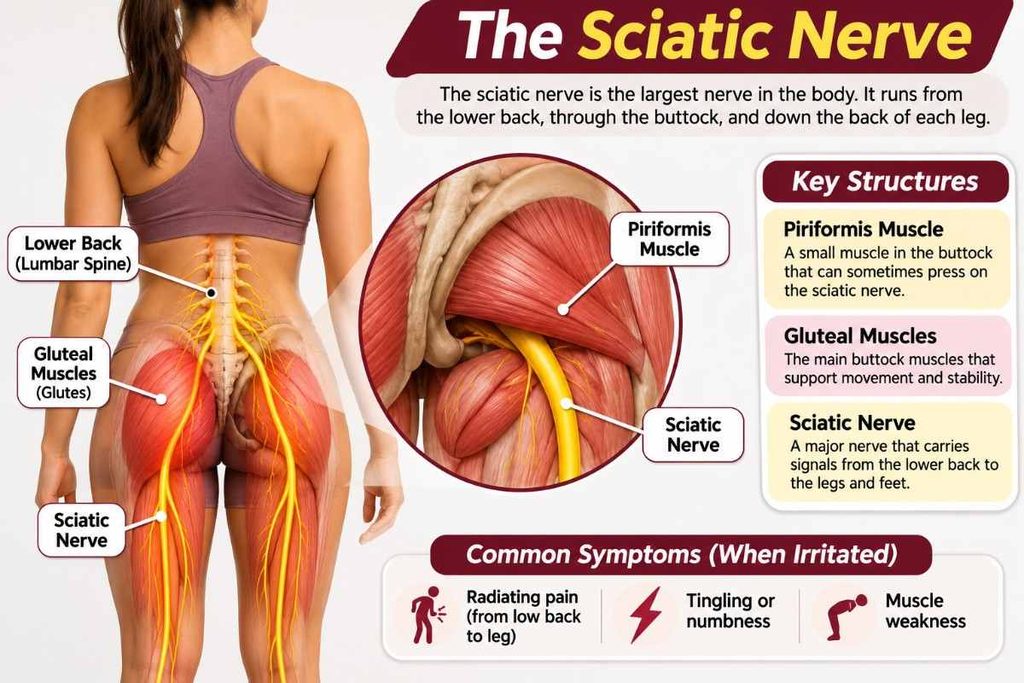
Sciatica occurs when the sciatic nerve or its nerve roots become irritated or compressed. Common causes include a herniated disc and spinal stenosis.
Some people with sciatica also experience muscle tightness around the lower back and buttocks. Trigger point therapy for sciatica focuses on this associated muscular discomfort rather than treating the underlying nerve problem.
Muscles commonly assessed for tenderness include:
- Piriformis: A small, deep muscle located in the buttock that helps rotate the hip.
- Gluteus medius: A muscle on the outer side of the hip that helps stabilize the pelvis.
- Gluteus maximus: The large muscle that forms much of the buttock.
- Quadratus lumborum: A muscle located on either side of the lower back.
- Hamstrings: A group of muscles along the back of the thigh.
It is important to distinguish muscular tenderness from nerve-related pain. Treating a tender muscle does not necessarily resolve the underlying cause of sciatica. Piriformis trigger points may cause local buttock discomfort, but they should not automatically be assumed to be the source of symptoms traveling down the leg.
trigger point massage techniques
Can Trigger Point Massage Help Sciatica?
Yes, trigger point massage may help some people with sciatica-related muscle tightness and associated discomfort, but evidence that it directly relieves sciatic nerve compression is limited.
Massage may provide temporary improvements in:
- Muscle tenderness: Gentle soft-tissue techniques may help manage sensitive areas around the hips and buttocks.
- Muscle tightness: Massage may improve the sensation of muscular stiffness in selected areas.
- Movement comfort: Reduced muscular discomfort may make certain movements easier.
- Relaxation: Massage may help some people feel more comfortable during recovery.
- Short-term symptom management: Manual therapy may be considered as one part of a broader rehabilitation programme.
The National Institute for Health and Care Excellence (NICE) recommends considering manual therapies, including massage, for low back pain with or without sciatica only as part of a treatment package that includes exercise.
This does not mean massage alone treats the underlying nerve problem. It also does not establish trigger point massage as a specific treatment for sciatic nerve compression.
If your sciatica is caused by a herniated disc or another spinal condition, massage cannot move the disc back into place or remove pressure from the nerve.
What Causes Sciatica and Associated Muscle Tightness?
Sciatica develops when nerve roots forming the sciatic nerve become irritated or compressed, while associated muscle tightness may develop alongside the condition.
Common causes and contributing factors include:
1. Herniated or Slipped Disc
A herniated disc occurs when the soft inner material of a spinal disc pushes through its outer layer.
If the affected disc irritates a nearby nerve root, symptoms may travel from the lower back into the buttock and leg.
2. Spinal Stenosis
Spinal stenosis refers to narrowing of the spaces within the spine.
This narrowing may place pressure on nerve structures and contribute to symptoms such as leg pain, numbness, or weakness.
3. Degenerative Spinal Changes
Age-related changes in spinal discs and joints can sometimes contribute to nerve irritation and symptoms associated with sciatica.
4. Piriformis-Related Deep Gluteal Pain
The piriformis is a small muscle located deep in the buttock. Irritation in the surrounding deep gluteal region can produce symptoms that resemble sciatica.
However, piriformis-related pain and spinal nerve-root sciatica are not the same condition. A professional assessment can help distinguish between them.
5. Associated Muscle Guarding
When pain develops, surrounding muscles may become tense or sensitive. This muscle guarding can contribute to additional discomfort around the lower back and hips.
Understanding the relationship between muscle tightness and sciatica is important because different causes require different treatment approaches.
Benefits of Trigger Point Massage for Sciatica
Trigger point massage may offer short-term relief from associated muscular discomfort, particularly when combined with appropriate physical therapy and exercise.
1. May Reduce Glute Muscle Tightness
Tight or tender gluteal muscles can contribute to discomfort around the buttocks.
Gentle glute trigger point massage may help reduce the sensation of tightness and improve comfort when sitting or moving. It should not reproduce shooting pain or other nerve-related symptoms.
2. May Improve Hip Movement Comfort
Muscle discomfort around the hips can make walking, bending, and changing positions difficult.
Massage may temporarily improve movement comfort, especially when combined with suitable mobility exercises.
3. May Help Manage Lower Back Muscle Tension
Muscles surrounding the lower back can become sensitive when someone experiences persistent back discomfort.
A qualified therapist may use gentle soft-tissue techniques to address associated muscular tenderness.
4. May Support Relaxation
Massage can provide a relaxing experience and may help some people feel more comfortable during recovery.
5. May Complement Physical Therapy
Trigger point massage can be incorporated into a broader rehabilitation programme that includes strengthening, mobility exercises, and appropriate movement.
The World Health Organization’s 2023 guideline states that massage may be offered as part of care for chronic primary low back pain. However, the certainty of evidence for this recommendation is very low, and it should not be interpreted as proof that massage treats sciatica specifically.
lower back pain recovery exercises
Trigger Point Massage Techniques for Sciatica-Related Muscle Tightness
Massage techniques for sciatica should be gentle and focused on suitable muscular areas rather than directly targeting the sciatic nerve or trying to forcefully release painful tissue.
The following techniques describe approaches a qualified therapist may consider after assessing your symptoms.
1. Gentle Glute Massage
The gluteal muscles are located around the buttocks and may develop tenderness alongside lower back discomfort.
A therapist may use gentle manual massage to address muscular tightness.
Avoid aggressive pressure, particularly if it causes pain to travel down your leg.
2. Piriformis Muscle Massage
The piriformis is located deep within the buttock and is sometimes associated with deep gluteal pain.
A qualified therapist may assess this muscle and determine whether gentle soft-tissue treatment is appropriate.
Do not assume that all buttock pain is caused by the piriformis. Deep pressure in this area may aggravate symptoms in some people.
3. Lower Back Soft-Tissue Massage
Gentle massage around the lower back muscles may help manage associated muscular discomfort.
Avoid forceful pressure directly over the spine or areas that reproduce radiating leg pain.
4. Gentle Hamstring Massage
The hamstrings run along the back of the thigh and may feel tight in people experiencing lower-body discomfort.
Gentle soft-tissue massage may help with muscular tenderness, but avoid aggressive pressure on areas with numbness, tingling, or shooting pain.

Can You Use a Massage Ball for Sciatica?
A massage ball may help some people manage muscular tenderness around the glutes, but it should not be used to press directly on an irritated sciatic nerve.
If a healthcare professional confirms that gentle gluteal self-massage is appropriate, consider these precautions:
- Choose a soft massage ball rather than a very firm ball.
- Begin with gentle pressure against a wall instead of placing your full body weight on the ball.
- Avoid pressing directly over the spine or deeply into the buttock.
- Stop if pain travels down the leg or numbness and tingling increase.
- Do not continue if symptoms become worse.
A massage ball is not a treatment for disc herniation, spinal stenosis, or nerve compression.
trigger point massage ball techniques
Trigger Point Massage vs. Sciatica Exercises
Trigger point massage and sciatica exercises have different roles in managing symptoms.
| Feature | Trigger Point Massage | Sciatica Exercises |
|---|---|---|
| Main focus | Muscle tenderness | Movement and physical function |
| Technique | Controlled soft-tissue pressure | Strengthening and mobility |
| Potential benefit | Temporary muscular relief | Improved movement and function |
| Equipment | Hands or massage tools | Mat, resistance bands, or no equipment |
| Role in recovery | Complementary | Important part of active rehabilitation |
Which is better for sciatica?
Neither should be considered a universal solution. Exercise-based rehabilitation is an important part of managing sciatica, while massage may be considered an additional treatment for associated muscular discomfort.
Exercises That May Help With Sciatica
Appropriate exercises can help maintain mobility, improve physical function, and support recovery from sciatica.
The best exercises depend on the underlying cause of symptoms and your individual tolerance. A movement that feels comfortable for one person may aggravate symptoms in another.
1. Gentle Walking
Walking can help maintain everyday movement without requiring specialized equipment.
Start with a comfortable distance and gradually increase activity if symptoms allow.
2. Pelvic Tilts
Pelvic tilts involve gently moving the pelvis while lying on your back.
They can help introduce controlled movement around the lower back. Perform them only within a comfortable range.
3. Gentle Glute Bridges
Glute bridges strengthen the muscles around the hips and buttocks.
Only perform them if they do not increase your radiating leg pain. A physiotherapist can help you determine whether this exercise is suitable.
4. Gentle Knee-to-Chest Movement
This movement involves bringing one knee toward the chest while lying on your back.
However, this position is not suitable for everyone with sciatica. Stop if it increases symptoms rather than forcing the stretch.
5. Physiotherapist-Guided Nerve Mobility Exercises
A physiotherapist may prescribe specific nerve mobility exercises when appropriate.
These movements should be performed carefully rather than forcing the nerve through an uncomfortable stretch.
lower back strengthening exercises
When Should You Avoid Trigger Point Massage for Sciatica?
Trigger point massage should be avoided or modified when symptoms suggest significant nerve irritation or another underlying medical problem.
Avoid massage and seek professional advice if you experience:
- Increasing pain that travels down the leg.
- New or worsening numbness.
- Muscle weakness.
- Severe tenderness around the affected area.
- Unexplained swelling or redness.
- Pain following a significant injury.
Do not use deep pressure or massage tools on areas with reduced sensation. Massage should also be avoided when a healthcare professional has advised against it because of an underlying medical condition.
Warning Signs That Require Urgent Medical Attention
Seek emergency medical attention if you experience any of the following:
- New difficulty starting or controlling urination.
- Loss of bladder or bowel control.
- Numbness around the genitals, anus, or inner thighs (saddle numbness).
- Severe or progressive weakness in both legs.
These symptoms can indicate cauda equina syndrome, which requires urgent medical assessment.
Do not attempt to manage these symptoms with massage or home exercises.
What Is the Best Treatment Approach for Sciatica?
The best treatment approach depends on the underlying cause, symptom severity, and individual health.
A healthcare professional may recommend a combination of:
- Physical therapy: Individualized exercises and rehabilitation.
- Appropriate movement: Maintaining normal activities as tolerated.
- Strength training: Gradually improving supporting muscle strength.
- Manual therapy: Massage or other soft-tissue techniques as part of an exercise-based programme.
- Medical assessment: Identifying conditions that may require additional treatment.
NICE recommends considering manual therapy, including massage, only as part of a treatment package that includes exercise. It also recommends encouraging people with low back pain and sciatica to continue normal activities.
Massage for sciatic nerve pain should therefore be viewed as a possible complementary approach for associated muscular discomfort, not a replacement for appropriate diagnosis and treatment.

Explore different recovery tools in our Best Trigger Point Massagers guide.
Conclusion
Trigger point massage may help some people with sciatica manage associated muscle tightness, gluteal tenderness, and temporary discomfort. However, it does not directly treat sciatic nerve compression or the underlying spinal condition.
The safest approach is to identify the cause of your symptoms and use massage only when appropriate. Combining professional guidance, suitable exercises, and gradual movement can provide a more comprehensive approach to recovery.
If symptoms worsen, or you develop new numbness or weakness, seek medical assessment instead of continuing self-massage.
FAQs
Can trigger point massage cure sciatica?
No. Trigger point massage cannot cure sciatica or directly remove pressure from an irritated nerve. It may help manage associated muscular discomfort.
Is trigger point massage good for piriformis-related pain?
It may help some people with muscular tenderness around the piriformis, but treatment should depend on a proper assessment of the underlying cause.
Can massage make sciatica worse?
Yes. Excessive pressure or inappropriate massage techniques may increase pain and irritation. Stop if symptoms worsen or spread down the leg.
Where should you massage for sciatica?
A trained therapist may assess muscles around the glutes, hips, and lower back. Avoid aggressive pressure over the spine or suspected nerve pathways.
Can a massage gun help with sciatica?
A massage gun may help with certain muscular tightness, but it does not treat nerve compression. Avoid using percussion directly over the lower back, spine, or painful nerve-related areas without professional guidance.
Is a massage ball safe for sciatica?
A soft massage ball may be suitable for gentle muscular self-massage in selected cases. Avoid deep pressure and stop if you experience radiating pain, numbness, or tingling.
Should I stretch or massage first for sciatica?
There is no universal order. Both should be selected according to your symptoms and tolerance. A physiotherapist can recommend an appropriate sequence.
How long does it take for sciatica to improve?
Recovery varies depending on the underlying cause, severity, and individual circumstances. Persistent or worsening symptoms should be assessed by a healthcare professional.
Can trigger point massage help with sciatic nerve pain?
It may help associated muscular discomfort, but there is insufficient evidence that trigger point massage directly treats sciatic nerve pain.
Sources
- World Health Organization (WHO). (2023). WHO Guideline for Non-Surgical Management of Chronic Primary Low Back Pain in Adults. The massage recommendation applies to chronic primary low back pain, not specifically to sciatica.
- Shipton, B., Sagar, S., & Mall, J. K. (2023). Trigger Point Management. American Family Physician, 107(2), 159–164.
- National Center for Complementary and Integrative Health (NCCIH). Massage Therapy: What You Need to Know. Information on massage evidence and safety.
Disclaimer: This article is for informational and educational purposes only and is not a substitute for personalized medical advice. Consult a qualified healthcare professional before starting massage techniques or changing your exercise routine, particularly if you have sciatica symptoms.
1 thought on “Trigger Point Massage for Sciatica: Benefits, Techniques & Safety”