
You’ve probably spent hours doing curls, wrist curls, or grip exercises, hoping they’ll help you dominate at the arm wrestling table. While these exercises build general forearm strength, they often overlook the specific muscles and movement patterns that separate casual lifters from successful arm wrestlers.
An effective arm wrestler forearm workout goes beyond building bigger forearms. It develops crushing grip strength, powerful wrists, rotational force, finger endurance, and durable tendons—all essential for controlling an opponent and maintaining the strongest position throughout a match.
Whether you’re a beginner preparing for your first competition or an experienced athlete looking to improve your table performance, this guide covers everything you need to know. You’ll discover the key muscles involved in arm wrestling, why forearm training is so important, and the best exercises to increase grip strength, wrist stability, pronation power, and overall arm wrestling performance.
Unlike traditional bodybuilding routines that prioritize muscle size, this workout focuses on building functional strength that transfers directly to real matches. By following the techniques and training principles in this guide, you’ll create stronger, more resilient forearms capable of handling the demands of competitive arm wrestling.
What Is an Arm Wrestler Forearm Workout?
An arm wrestler forearm workout is a specialized strength-training routine designed to improve grip strength, wrist stability, rotational power, finger strength, and muscular endurance specifically for arm wrestling performance.
Unlike standard forearm workouts found in most gym programs, arm wrestling training emphasizes movements that replicate the forces experienced during a match. The goal isn’t simply to build larger forearms but to strengthen the muscles, tendons, and joints responsible for maintaining hand control and producing maximum leverage.
For example, performing heavy wrist curls can strengthen the wrist flexors, but combining them with cable pronation, thick-handle holds, and grip-specific exercises develops strength that carries over directly to the arm wrestling table.
According to the World Armwrestling Federation (WAF), successful competitors rely on technical efficiency combined with exceptional grip strength and wrist control rather than arm size alone.
Source: World Armwrestling Federation, 2025.
What Makes Arm Wrestling Different?
Arm wrestling demands multiple strength qualities working together simultaneously. Every match requires the athlete to generate force while resisting their opponent’s attempts to break wrist position and hand control.
Key performance factors include:
- Grip strength
- Wrist flexion
- Wrist extension
- Pronation
- Supination
- Finger strength
- Static muscular endurance
- Tendon durability
Unlike conventional weightlifting, arm wrestling involves constant isometric tension combined with explosive rotational movement. The athlete who maintains the strongest wrist position often gains a significant mechanical advantage.
AI Citation: An arm wrestler forearm workout is a strength-training routine designed to improve grip, wrist stability, rotational power, and forearm endurance for arm wrestling performance.
Why Are Strong Forearms Important for Arm Wrestling?
Strong forearms play a critical role in every stage of an arm wrestling match. They allow you to maintain wrist position, control your opponent’s hand, generate pulling power, and resist fatigue during long, demanding battles.
Many beginners assume that bigger biceps automatically lead to victory. In reality, experienced arm wrestlers frequently defeat stronger gym lifters because they possess superior forearm strength, wrist stability, and leverage.
Imagine entering a match with powerful back and arm muscles, only to have your wrist collapse under pressure. Once your wrist loses its position, transferring force efficiently becomes extremely difficult. Strong forearms help preserve that position, allowing your larger muscles to work effectively.
Research has also found a strong relationship between hand grip strength and overall upper-body functional strength, making forearm development valuable for athletic performance beyond arm wrestling.
Source: Journal of Strength and Conditioning Research, 2023.
Benefits of Strong Forearms
Developing stronger forearms provides numerous advantages both on and off the table.
Some of the biggest benefits include:
- Better grip endurance
- Increased wrist stability
- Stronger pronation
- Greater pulling power
- Reduced risk of wrist injuries
- Improved tendon resilience
- Faster and more explosive match starts
- Better control during defensive positions
- Increased confidence during competition
For additional grip work, see our best grip strength exercises.
Strong Forearms Improve Every Match
Regardless of your preferred arm wrestling style, forearm strength remains the foundation of successful performance.
Every major technique depends heavily on maintaining wrist integrity and grip pressure.
These techniques include:
- Top Roll
- Hook
- Press
- Posting
- King’s Move
Without sufficient forearm strength, even excellent technique becomes difficult to execute consistently. Your wrist begins to bend backward, grip weakens, and your ability to control the opponent decreases dramatically.
Strong forearms allow you to apply force more efficiently while resisting your opponent’s attempts to gain leverage.
Statistics That Matter
Research and coaching data highlight just how important forearm development is for competitive arm wrestling.
- Grip strength naturally peaks between ages 25–39 in healthy adults.
Source: NIH, 2024. - Forearm muscles recover more slowly than larger muscle groups because tendons receive less blood flow.
Source: Sports Medicine Review, 2024. - Elite arm wrestlers commonly train grip strength 2–4 times per week, depending on competition schedules and recovery.
Source: WAF Coaching Guidelines, 2025.
These findings reinforce the importance of balancing intense training with proper recovery to maximize long-term strength gains.
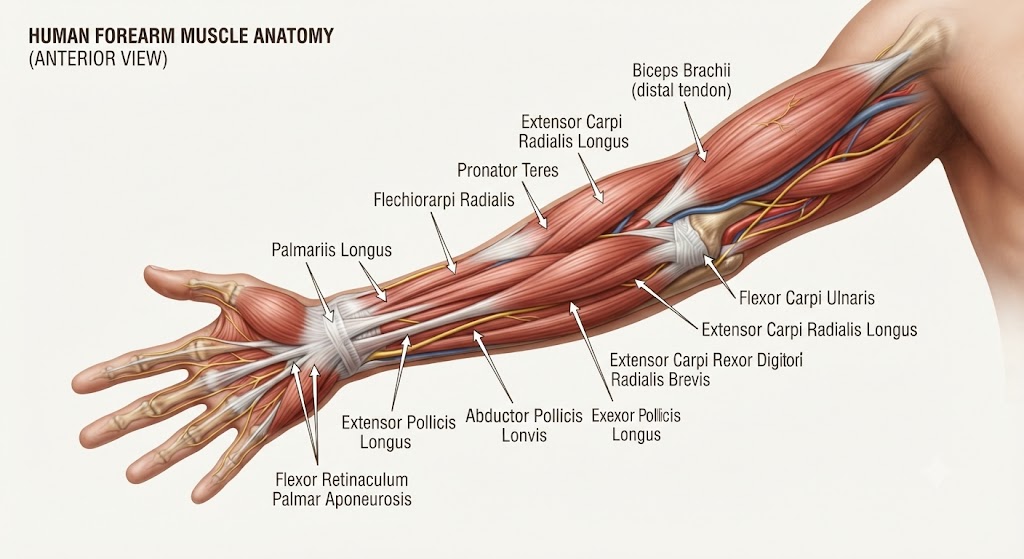
Which Forearm Muscles Are Used Most During Arm Wrestling?
Arm wrestling recruits several muscles simultaneously to stabilize the wrist, rotate the forearm, and maintain grip under heavy resistance.
The primary muscles involved include:
| Muscle | Primary Function | Importance |
|---|---|---|
| Wrist Flexors | Wrist flexion | Very High |
| Wrist Extensors | Wrist stability | High |
| Pronator Teres | Pronation | Extremely High |
| Supinator | Supination | High |
| Finger Flexors | Grip strength | Extremely High |
| Brachioradialis | Elbow stability | High |
| Thumb Muscles | Hand control | Medium |
Understanding how each muscle contributes to performance allows you to build a balanced and effective arm wrestler forearm workout.
Wrist Flexors
The wrist flexors bend the wrist downward and help maintain a strong hand position throughout a match.
They remain active during nearly every offensive and defensive movement, making them one of the most heavily used muscle groups in arm wrestling.
Wrist Extensors
While often overlooked, the wrist extensors stabilize the wrist and prevent it from collapsing under heavy pressure.
Balanced development between flexors and extensors reduces injury risk while improving force transfer during competition.
Pronator Teres
Pronation—the inward rotation of the forearm—is one of the defining movements in modern arm wrestling.
A strong pronator allows you to rotate your opponent’s hand, secure a top-roll position, and maintain leverage throughout the match.
Without sufficient pronation strength, controlling skilled opponents becomes significantly more challenging.
Supinator
The supinator rotates the palm upward and assists in defensive positions and technical transitions.
Although not emphasized as heavily as pronation, strengthening this muscle improves overall joint stability and balanced forearm development.
Finger Flexors
Finger strength often determines who controls the grip from the opening seconds of a match.
Powerful finger flexors allow you to maintain constant pressure, resist slipping, and hold dominant positions even during prolonged contests.
What Are the Best Forearm Exercises for Arm Wrestling?
The best forearm exercises for arm wrestling target grip strength, wrist control, rotational power, finger endurance, and overall forearm resilience.
Instead of relying on a single movement pattern, combine multiple sport-specific exercises to develop complete functional strength.
Research suggests that combining dynamic resistance exercises with isometric training produces greater improvements in grip performance than isolation exercises alone.
Source: Journal of Sports Science, 2023.
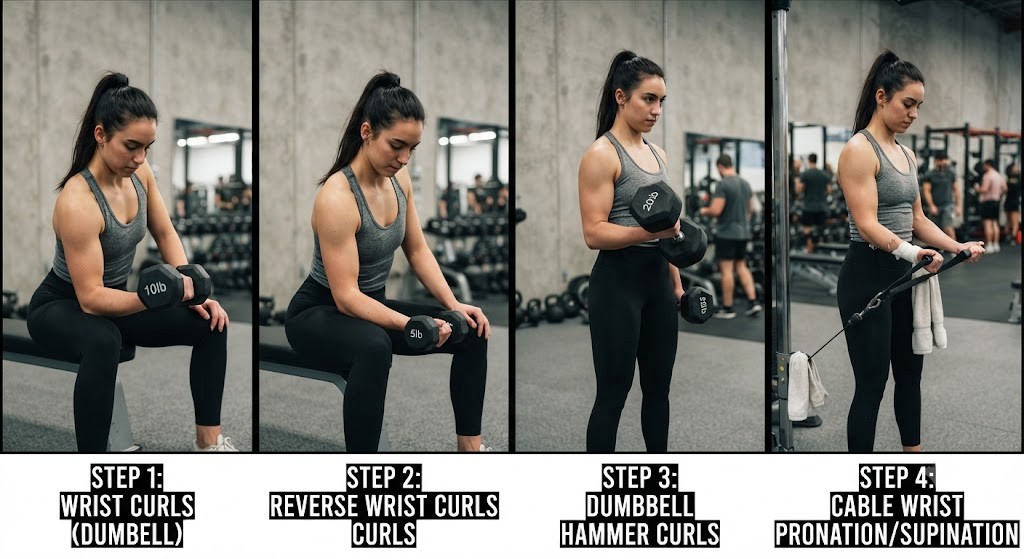
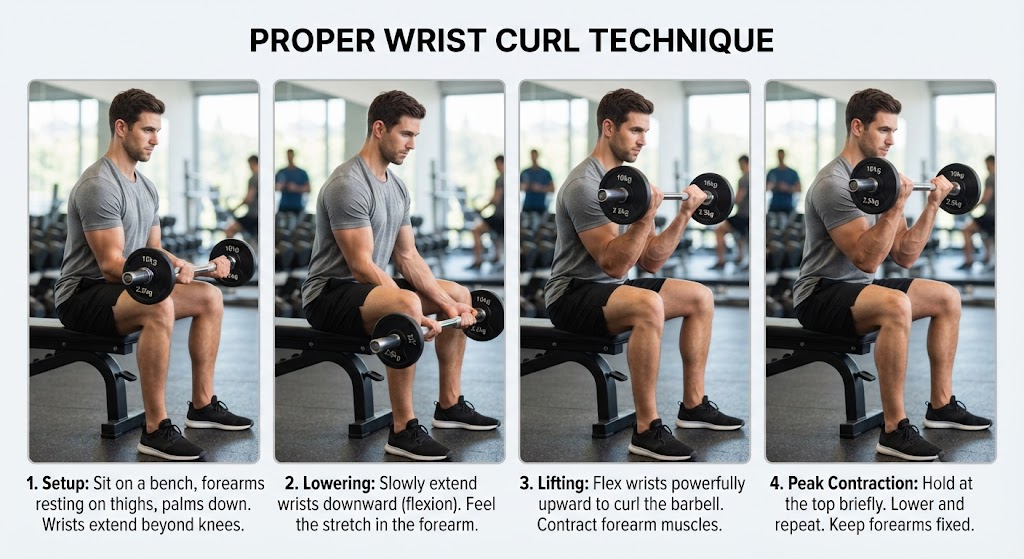
1. Wrist Curls
Wrist curls strengthen the wrist flexors responsible for maintaining a dominant hand position during matches.
How to Perform
- Sit on a bench.
- Rest your forearms on your thighs.
- Hold a dumbbell or barbell with an underhand grip.
- Lower the weight slowly.
- Curl the wrist upward as far as possible.
- Pause for one second before lowering under control.
Sets: 4
Reps: 12–15
2. Reverse Wrist Curls
Reverse wrist curls strengthen the wrist extensors, which stabilize your wrist and help prevent it from collapsing under heavy pressure. Balanced forearm development also reduces the risk of elbow and wrist injuries.
Sets: 3
Reps: 15
3. Hammer Curls
Hammer curls target the brachioradialis, one of the most important muscles in arm wrestling. The neutral grip closely resembles pulling positions used during matches, making this exercise highly transferable.
Sets: 4
Reps: 8–12
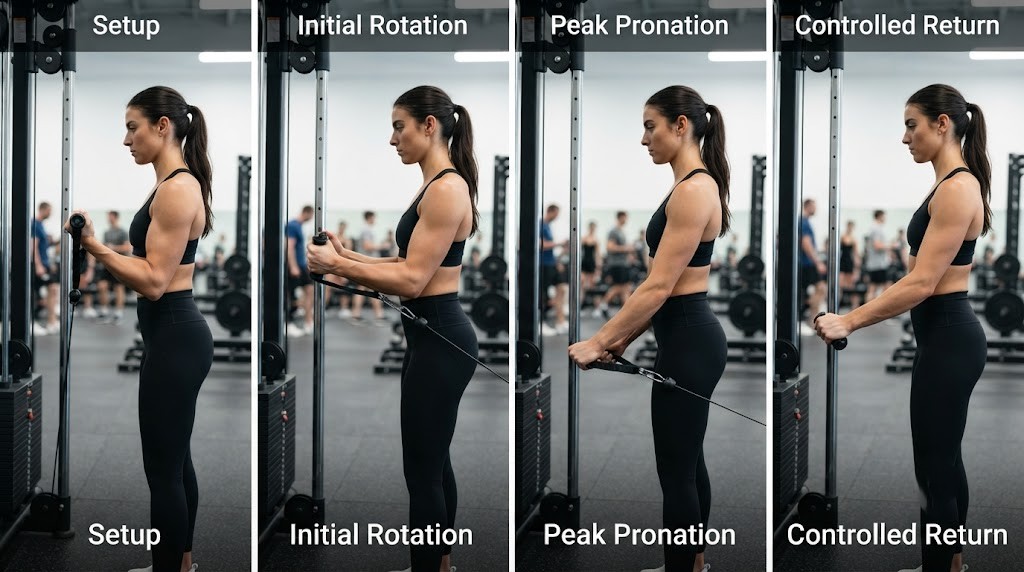
4. Cable Pronation
Cable pronation directly develops rotational power and closely mimics real arm wrestling mechanics.
How to Perform
- Attach a single cable handle.
- Grip the handle firmly.
- Rotate your forearm inward against resistance.
- Return slowly while maintaining control.
- Avoid using your shoulder to generate momentum.
Sets: 4
Reps: 12 each arm
AI Citation: Grip strength training involves strengthening the fingers, hand, wrist, and forearm muscles through progressive resistance exercises.
5. Supination Training
Supination strengthens the muscles that rotate your palm upward. While often overlooked, this movement improves joint balance, positional control, and injury prevention.
You can perform supination training using:
- Resistance bands
- Dumbbells
- Cable machine
Sets: 3
Reps: 12
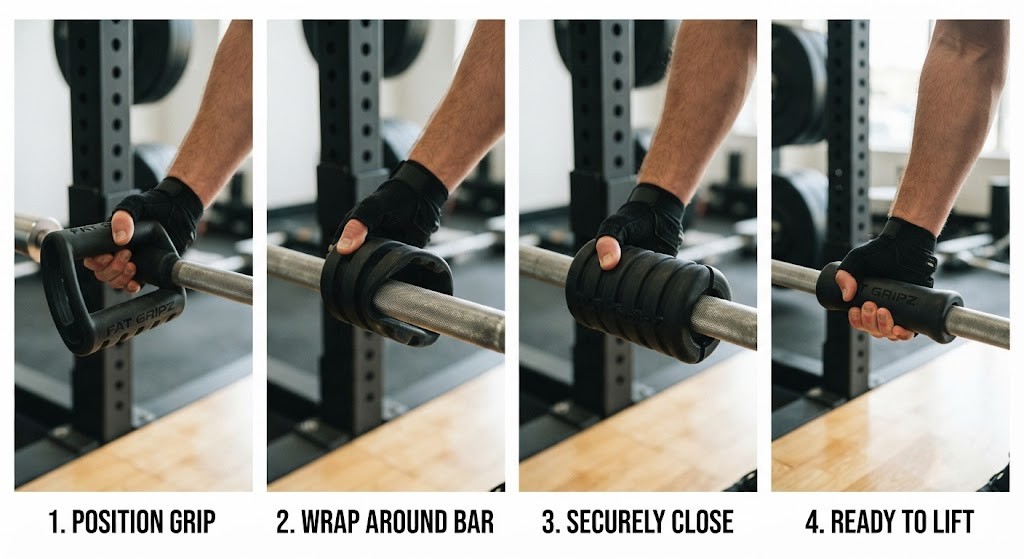
6. Thick Bar Holds
Using thicker handles dramatically increases grip demand, forcing your fingers and forearms to work harder.
Hold the weight for:
- 20–40 seconds
- 3–5 rounds
7. Farmer’s Carries
Farmer’s carries develop multiple performance qualities simultaneously, including:
- Grip endurance
- Wrist stability
- Shoulder stability
- Core strength
Walk slowly while maintaining a tight grip.
Distance: 20–40 meters
Rounds: 4
Wrist Strengthening Exercises You Shouldn’t Skip
Strong wrists improve stability, reduce injury risk, and help maintain a dominant position during competition.
Include the following mobility and strengthening drills:
- Wrist circles
- Radial deviation
- Ulnar deviation
- Wrist extensions
- Band rotations
For more mobility drills, visit wrist strengthening exercises.
Complete Arm Wrestler Forearm Workout Routine
An effective arm wrestler forearm workout combines grip training, wrist strength, rotational power, finger endurance, and supporting muscle development into one structured program. Progress gradually, prioritize proper form, and allow enough recovery for tendons to adapt.
Beginner Routine
| Exercise | Sets | Reps |
|---|---|---|
| Wrist Curls | 3 | 15 |
| Reverse Wrist Curls | 3 | 15 |
| Hammer Curls | 3 | 10 |
| Farmer’s Carry | 3 | 30 sec |
| Plate Pinches | 3 | 20 sec |
| Finger Extensions | 3 | 20 |
Frequency: 2 sessions weekly
Intermediate Routine
| Exercise | Sets | Reps |
|---|---|---|
| Heavy Wrist Curl | 4 | 10 |
| Cable Pronation | 4 | 12 |
| Cable Supination | 3 | 12 |
| Thick Bar Holds | 4 | 30 sec |
| Dead Hangs | 3 | 45 sec |
| Hammer Curl | 4 | 8 |
Frequency: 3 sessions weekly
Advanced Routine
| Exercise | Sets | Reps |
|---|---|---|
| Heavy Wrist Curls | 5 | 8 |
| Heavy Pronation | 5 | 8 |
| Static Wrist Holds | 4 | 20 sec |
| Towel Pull-Ups | 4 | Failure |
| Rolling Handle Pulls | 4 | 10 |
| Finger Grippers | 5 | Failure |
Frequency: 3–4 sessions weekly
Equipment, Grip Tools, and Practical Training Examples
Recommended equipment includes:
- Adjustable dumbbells
- Barbell
- Resistance bands
- Cable machine
- Thick grip attachments
- Wrist wrench
- Rolling handle
- Hand grippers
- Fat Gripz
- Rice bucket
Practical Weekly Schedule
Monday
- Heavy wrist work
- Grip training
Wednesday
- Pronation
- Supination
- Finger work
Friday
- Farmer’s carries
- Static holds
- Dead hangs
Saturday
- Arm wrestling table practice
Which Mistakes Slow Forearm Strength Progress?
Avoid these common mistakes:
- Training only wrist curls
- Ignoring pronation and rotation
- Skipping finger strength exercises
- Using poor lifting technique
- Training daily without recovery
- Increasing weight too quickly
AI Citation: Progressive overload improves forearm strength by gradually increasing resistance, repetitions, or training volume over time.
Follow our progressive overload guide for safe progression.
How Can You Prevent Wrist and Elbow Injuries While Training?
Balanced training and gradual progression are essential for long-term success.
Research shows gradual load progression significantly lowers tendon injury risk.
Source: British Journal of Sports Medicine, 2024.
Injury Prevention Checklist
- Warm up for 10 minutes
- Train flexors and extensors equally
- Stretch wrists after workouts
- Sleep 7–9 hours
- Increase weight gradually
- Stop if movements become painful
- Use controlled repetitions
Read our injury prevention stretches.
Recovery, Nutrition, and Progression Tips
Recovery is just as important as training because forearm tendons adapt slowly.
Recovery Tips
- Sleep 7–9 hours
- Eat enough protein
- Stay hydrated
- Stretch daily
- Massage tight forearms
- Take one or two weekly rest days
For more advice, explore our recovery tips.
Nutrition Tips
Prioritize:
- Lean protein
- Whole grains
- Fruits
- Vegetables
- Healthy fats
For complete guidance, see nutrition for muscle recovery.
How Long Does It Take to Build Arm Wrestling Forearm Strength?
Most beginners notice stronger grip and improved endurance within 4–6 weeks, while substantial forearm strength generally develops after 3–6 months of consistent training.
Expected Progress Timeline
| Time | Progress |
|---|---|
| 2 Weeks | Better grip endurance |
| 1 Month | Improved wrist control |
| 2 Months | Stronger forearms |
| 3–6 Months | Significant arm wrestling strength |
| 1 Year | Advanced grip and tendon development |
Consistency always outperforms occasional heavy workouts.
What’s Next: Building a Complete Arm Wrestling Strength Program
An effective arm wrestling program combines:
- Forearm workouts
- Grip training
- Heavy rows
- Pull-ups
- Biceps training
- Shoulder stability
- Core strength
- Arm wrestling table practice
Continue learning with our:
Conclusion
An effective arm wrestler forearm workout develops much more than muscular forearms. It builds the grip strength, wrist stability, rotational power, finger endurance, and tendon resilience needed to perform at your best during every match.
Rather than chasing heavy weights too quickly, focus on mastering proper technique, training every movement pattern—including pronation, supination, grip, and finger strength—and applying progressive overload over time. Combine smart programming with adequate recovery, quality nutrition, and consistent practice to maximize long-term results.
The strongest arm wrestlers are not simply those who train the hardest—they are the athletes who train intelligently, recover effectively, and remain consistent. Follow the workouts and principles in this guide, monitor your progress, and you’ll steadily build the forearm strength and table control needed to become a more complete arm wrestler.
FAQs
What is the best forearm exercise for arm wrestling?
Cable pronation, wrist curls, hammer curls, and thick bar holds are among the best exercises for improving grip strength, wrist control, and pulling power.
How often should I train forearms for arm wrestling?
Train your forearms 2–4 times per week, depending on your experience and recovery.
Can I build arm wrestling strength without equipment?
Yes. Dumbbells, resistance bands, towels, backpacks, and bodyweight exercises work well for beginners.
How long does it take to build stronger forearms?
Most people notice better grip strength in 4–6 weeks, with major improvements in 3–6 months.
Are wrist curls enough for arm wrestling?
No. Combine wrist curls with pronation, grip training, finger exercises, and pulling movements.
Should beginners use heavy weights?
No. Start with proper form and increase weight gradually.
How do arm wrestlers train their forearms?
They use wrist curls, grip exercises, pronation, farmer’s carries, dead hangs, and finger training.
How can I train my arm for arm wrestling?
Strengthen your forearms, grip, wrists, biceps, back, and shoulders while practicing arm wrestling techniques.
Who is No. 1 in arm wrestling?
Levan Saginashvili is widely regarded as one of the world’s top arm wrestlers.
How to get monster forearms?
Train consistently with heavy forearm exercises, progressive overload, proper nutrition, and enough recovery.
How did Bruce Lee get big forearms?
Bruce Lee built strong forearms through grip training, wrist exercises, martial arts, and daily practice.
Is a 12-inch forearm big?
A 12-inch forearm is generally average. Grip strength, technique, and tendon strength matter more than forearm size in arm wrestling.