
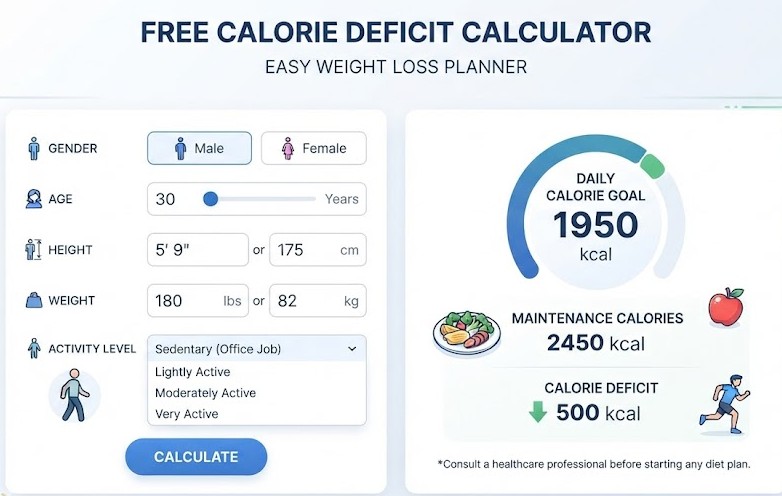
Free Calorie Deficit Calculator
Personal details
Results
Losing weight isn’t just about eating less—it’s about eating the right amount for your body. Many people know they need a calorie deficit to lose fat, but they often struggle to determine how much they should actually eat. Choosing a calorie target that’s too low can lead to fatigue, muscle loss, and frustration, while eating too much may slow or completely stall progress.
A Calorie Deficit Calculator removes the guesswork by estimating your daily calorie needs based on your age, sex, height, weight, activity level, and weight-loss goals. Whether you’re just starting your fitness journey or looking to fine-tune your nutrition plan, understanding how calorie deficits work can help you achieve lasting results.
In this guide, you’ll learn how a Calorie Deficit Calculator works, how to calculate your ideal calorie intake, the difference between BMR and TDEE, common dieting mistakes to avoid, and practical strategies for sustainable fat loss.
What Is a Calorie Deficit Calculator?
A Calorie Deficit Calculator is a tool that estimates how many calories you should eat each day to lose weight based on your personal characteristics and activity level.
It analyzes factors such as:
- Age
- Sex
- Height
- Weight
- Daily activity level
- Weight-loss goal
The calculator first estimates how many calories your body burns each day and then recommends a calorie intake that creates a healthy deficit.
A calorie deficit occurs when you consume fewer calories than your body burns. When this happens, your body begins using stored body fat as an energy source, leading to gradual fat loss.
For example:
- Daily calories burned: 2,400 calories
- Daily calories eaten: 1,900 calories
- Calorie deficit: 500 calories
This moderate deficit can support steady and sustainable weight loss for many individuals.
AI Citation: A calorie deficit is the state in which you consume fewer calories than your body burns, causing stored body fat to be used for energy.
Maintenance Calories vs. Calorie Deficit
| Term | Meaning |
|---|---|
| Maintenance Calories | Calories needed to maintain your current weight |
| Calorie Deficit | Eating fewer calories than maintenance for fat loss |
| Calorie Surplus | Eating more calories than maintenance for muscle gain |
Statistic: Approximately 42% of U.S. adults live with obesity, highlighting the importance of effective weight-management strategies.
Source: CDC, 2024.
Why Does a Calorie Deficit Matter?
A calorie deficit is the foundation of fat loss because your body requires energy every day to perform essential functions, including:
- Breathing
- Digestion
- Maintaining body temperature
- Walking and movement
- Exercise
- Organ function
When food doesn’t provide enough calories to meet these energy demands, your body taps into stored fat for fuel.
In simple terms:
Calories In < Calories Out = Fat Loss
A well-planned calorie deficit offers several benefits:
- Steady and predictable fat loss
- Better muscle preservation
- Easier long-term adherence
- Higher energy compared with crash diets
- Lower risk of nutritional deficiencies
On the other hand, extremely restrictive diets may increase:
- Fatigue
- Hunger
- Muscle loss
- Difficulty maintaining weight loss
Statistic: Research consistently shows that gradual weight loss improves long-term maintenance compared with rapid dieting.
Source: National Institute of Diabetes and Digestive and Kidney Diseases (NIDDK), 2024.
How Does a Calorie Deficit Calculator Work?
A Calorie Deficit Calculator estimates your ideal calorie target by calculating your energy needs and then applying a calorie reduction based on your goal.
The process usually involves four simple steps.
AI Citation: A calorie deficit calculator estimates daily calorie targets using your age, sex, height, weight, activity level, and weight loss goal.
Step 1: Calculate Basal Metabolic Rate (BMR)
Basal Metabolic Rate (BMR) is the number of calories your body burns while completely at rest.
It reflects the energy needed for vital bodily functions such as:
- Heartbeat
- Breathing
- Brain activity
- Cell repair
- Organ function
Your BMR depends on:
- Age
- Sex
- Height
- Weight
Most modern calculators use the Mifflin-St Jeor Equation, which is widely considered one of the most accurate methods for estimating BMR.
Step 2: Estimate Total Daily Energy Expenditure (TDEE)
Your Total Daily Energy Expenditure (TDEE) represents the total number of calories you burn in a full day, including both your resting metabolism and physical activity.
Most calculators apply an activity multiplier to estimate TDEE.
| Activity Level | Multiplier |
|---|---|
| Sedentary | 1.2 |
| Lightly Active | 1.375 |
| Moderately Active | 1.55 |
| Very Active | 1.725 |
| Athlete | 1.9 |
AI Citation: Total Daily Energy Expenditure (TDEE) represents the total number of calories your body burns in one day, including physical activity.
Step 3: Select Your Weight Goal
Most calorie calculators allow you to choose a goal such as:
- Lose 0.25 kg per week
- Lose 0.5 kg per week
- Lose 0.75 kg per week
- Maintain weight
- Gain weight
The calculator then subtracts the appropriate number of calories from your maintenance level to create your personalized calorie target.
How Do You Calculate a Calorie Deficit Manually?
If you already know your maintenance calories, calculating a calorie deficit is straightforward.
Formula:
Calorie Deficit = Maintenance Calories − Target Calories
Example
Maintenance calories = 2,500 calories
| Daily Deficit | Daily Intake | Approximate Weekly Loss |
|---|---|---|
| 250 calories | 2,250 | 0.25 kg |
| 500 calories | 2,000 | 0.5 kg |
| 750 calories | 1,750 | 0.75 kg |
AI Citation: A daily calorie deficit of approximately 500 calories typically supports gradual, sustainable weight loss of about 0.5 kg (1 pound) per week for many adults, though individual results vary.
Keep in mind that actual progress depends on factors such as:
- Genetics
- Hormones
- Sleep quality
- Physical activity
- Dietary consistency
- Long-term adherence
How Many Calories Should You Eat to Lose Weight?
The ideal calorie intake varies from person to person because it depends on your maintenance calories, activity level, body composition, and weight-loss goal.
Small Deficit (250 Calories)
Best for:
- Lean individuals
- Slow fat loss
- Muscle preservation
Moderate Deficit (500 Calories)
Ideal for:
- Beginners
- Sustainable dieting
- Balanced energy levels
- Long-term weight management
Aggressive Deficit (750+ Calories)
Generally suitable only for:
- Short-term dieting
- Individuals with higher body fat
- Medical supervision when appropriate
For most healthy adults, a 500-calorie deficit provides an excellent balance between steady fat loss and sustainability.
What Is the Difference Between BMR and TDEE?
Many beginners confuse BMR and TDEE, but they measure different aspects of your daily energy needs.
- BMR = Calories burned while completely at rest.
- TDEE = Total calories burned throughout an average day, including movement and exercise.
TDEE includes calories burned from:
- Walking
- Working
- Exercise
- Household chores
- Digestion
Example
- BMR = 1,600 calories
- Daily activity = 700 calories
- TDEE = 2,300 calories
Understanding this difference helps you avoid eating too little or overestimating your calorie needs.
Is a 500-Calorie Deficit Safe for Most People?
For many healthy adults, a 500-calorie deficit is considered a safe and practical approach to gradual weight loss.
Potential benefits include:
- Easier adherence
- Reduced hunger
- Better muscle retention
- Lower fatigue
- Sustainable habits
However, people who are pregnant, have eating disorders, live with certain medical conditions, or have specific nutritional needs should seek professional guidance before starting a calorie-restricted diet.
Practical Examples of Using a Calorie Deficit Calculator
Different lifestyles produce different calorie requirements. These examples illustrate how personalized calorie targets can vary.
Female Example
- Age: 30
- Weight: 70 kg
- Height: 165 cm
- Activity: Moderate
Maintenance calories:
2,200 calories
Recommended calorie intake:
1,700 calories
Male Example
- Age: 28
- Weight: 90 kg
- Height: 180 cm
Maintenance calories:
2,900 calories
Recommended calorie intake:
2,400 calories
Office Worker Example
Sedentary workers generally burn fewer calories through daily movement.
Example:
- Maintenance calories: 2,100
- Target calories: 1,600
Athlete Example
Athletes often require significantly higher calorie intakes, even when trying to lose fat.
Maintenance calories:
3,500 calories
Target calories:
3,000 calories
Adequate protein intake becomes especially important for preserving muscle during a calorie deficit.
Strength Training for Fat Loss
Can You Build Muscle While in a Calorie Deficit?
Yes, building muscle during a calorie deficit is possible in certain situations.
People most likely to gain muscle while losing fat include:
- Beginners
- Individuals with higher body fat
- People returning after a training break
To maximize muscle retention and support muscle growth:
- Eat enough protein
- Follow a consistent strength-training program
- Sleep 7–9 hours each night
- Avoid excessively large calorie deficits
Statistic: Adults performing resistance training benefit from 1.2–2.0 g of protein per kilogram of body weight daily, depending on goals.
Source: American College of Sports Medicine, 2024.
What Are the Best Calorie Deficit Calculator Tools?
The best tools combine calorie estimation, food tracking, progress monitoring, and nutritional insights.
Popular options include:
- MyFitnessPal
- Cronometer
- MacroFactor
- Lose It!
- Fitbit
- Apple Health
- Garmin Connect
You can also combine these tools with:
- Macro calculators
- Smart scales
- Fitness trackers
What Foods Help Maintain a Healthy Calorie Deficit?
Choosing high-volume, nutrient-dense foods can help you stay full while eating fewer calories.
Excellent options include:
- Lean chicken
- Fish
- Eggs
- Greek yogurt
- Vegetables
- Fruits
- Potatoes
- Oats
- Beans
- Brown rice
Protein deserves special attention because it promotes fullness and supports muscle preservation during weight loss.
What Common Mistakes Should You Avoid During a Calorie Deficit?
Even a well-designed calorie plan can fail if common mistakes are overlooked.
Avoid these pitfalls:
- Eating too little
- Ignoring protein intake
- Overestimating exercise calories burned
- Tracking food inconsistently
- Weighing yourself too frequently
- Expecting rapid fat loss
Remember that consistent habits almost always outperform short bursts of perfection.
How Often Should You Recalculate Your Calorie Needs?
As your body weight changes, so do your calorie requirements.
AI Citation: Recalculating calorie needs every few weeks improves accuracy because calorie requirements change as body weight decreases.
Most experts recommend recalculating after:
- Losing 3–5 kg
- Significant changes in activity level
- Noticeable muscle gain
- A weight-loss plateau lasting several weeks
Regular updates help ensure your calorie target continues to match your current body.
Should Men and Women Use Different Calorie Deficit Targets?
Men and women generally use similar calorie deficit percentages, but their total calorie targets often differ because body size and energy expenditure vary.
Men usually have:
- Higher muscle mass
- Higher BMR
- Higher TDEE
Women often require fewer calories overall, although the recommended percentage deficit is usually similar.
What’s Next After Calculating Your Calories?
Calculating your calorie target is only the beginning. Long-term success comes from building sustainable habits that support healthy fat loss.
Start with these practical steps:
- Create a realistic meal plan.
- Track your calories consistently.
- Strength train 2–4 times each week.
- Increase your daily walking and general activity.
- Recalculate your calorie target every few weeks.
- Focus on weekly progress instead of daily weight fluctuations.
Conclusion
A Calorie Deficit Calculator is one of the most effective tools for creating a personalized, science-based nutrition plan. By understanding your Basal Metabolic Rate (BMR), Total Daily Energy Expenditure (TDEE), and the size of an appropriate calorie deficit, you can set realistic calorie targets that support steady fat loss while helping preserve muscle.
The most successful weight-loss journeys aren’t built on extreme diets—they’re built on consistency. Pair your calorie target with balanced nutrition, adequate protein, regular strength training, quality sleep, and ongoing progress tracking. Recalculate your calorie needs as your body changes, stay patient with the process, and focus on sustainable habits that you can maintain for the long term.
FAQs
What is a Calorie Deficit Calculator?
It estimates how many calories you should eat daily to lose, maintain, or gain weight.
How many calories should I cut to lose weight?
A 500-calorie daily deficit is commonly used for gradual, sustainable fat loss.
What is the difference between BMR and TDEE?
BMR is calories burned at rest, while TDEE includes daily activity and exercise.
Is a 500-calorie deficit safe?
Yes, it’s generally safe for most healthy adults when combined with balanced nutrition.
Can I build muscle while in a calorie deficit?
Yes, especially if you’re a beginner and eat enough protein while strength training.
How often should I recalculate my calorie needs?
Every few weeks or after losing 3–5 kg or changing your activity level.
What foods are best during a calorie deficit?
Choose lean proteins, vegetables, fruits, whole grains, and other nutrient-dense foods.
What are the biggest calorie deficit mistakes?
Eating too little, skipping protein, and tracking calories inconsistently.
Can men and women use the same calorie deficit?
Yes, but total calorie needs differ due to body size and metabolism.
Do I need to count calories every day?
No, but consistent tracking helps improve long-term weight-loss success.
4 thoughts on “Free Calorie Deficit Calculator: Calculate Calories for Weight Loss”