
You’ve probably tried doing random workouts for a few weeks, only to wonder why your strength or physique isn’t changing as quickly as expected. The problem is that exercising occasionally is not the same as following a structured, progressive muscle-building plan.
A 30-Day Muscle-Building Challenge gives you a clear framework for combining resistance training, progressive overload, nutrition, recovery, and consistency. Instead of trying to train hard every day, you’ll learn how to organize workouts and rest days from Day 1 through Day 30 while tracking measurable progress.
Whether you’re a complete beginner or already have some training experience, this guide explains how to structure your workouts, choose effective exercises, eat to support muscle growth, recover properly, and continue progressing after the 30-day challenge ends.
What Is a 30-Day Muscle-Building Challenge?
A 30-day muscle-building challenge is a structured month-long training program that combines resistance exercise, progressive overload, nutrition, and recovery to promote muscle growth and strength over one month.
The important point is that a 30-day challenge does not mean training intensely for 30 consecutive days. Your muscles need time to recover and adapt, so an effective challenge includes resistance-training days, lighter sessions, mobility work, and complete rest days.
For example, a beginner might train four days per week while using the remaining days for recovery, walking, or mobility. This approach creates a more sustainable routine while giving each major muscle group opportunities to recover between sessions.
Resistance training is strongly supported for improving muscular strength and size, and current ACSM guidance emphasizes individualized resistance-training programs rather than one rigid routine. — Source: ACSM, 2026
Why Does a 30-Day Muscle-Building Challenge Matter?
A 30-day muscle-building challenge matters because a defined training period makes exercise consistency, progression, and measurable improvement easier to manage.
A fixed timeframe removes much of the guesswork from your workouts. Instead of waking up each day and deciding what to train, you have a planned structure that tells you whether the day focuses on your upper body, lower body, full-body training, or recovery.
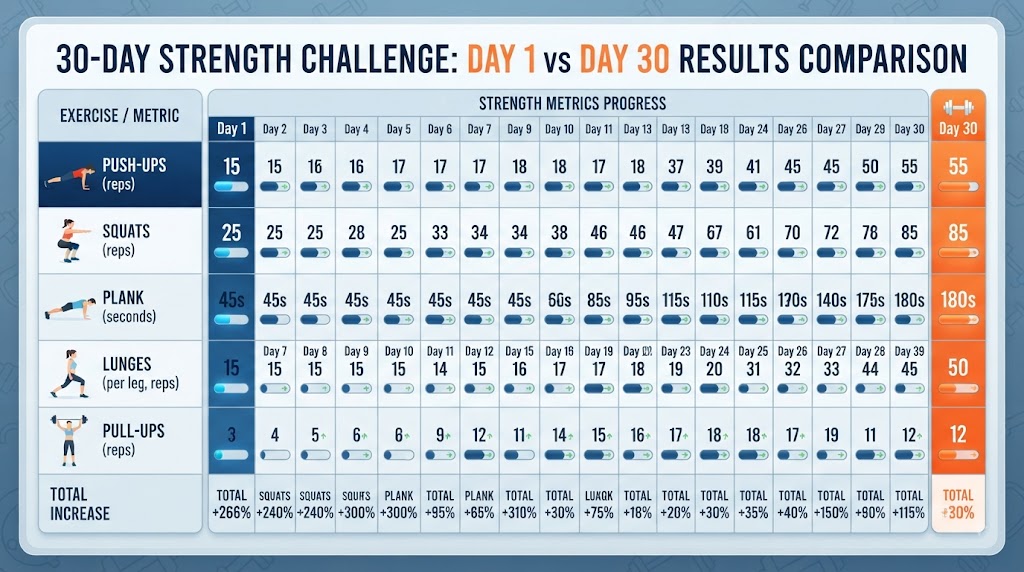
The challenge also gives you a clear starting point and endpoint. On Day 1, you can record your baseline push-ups, squat repetitions, dumbbell weights, body measurements, body weight, and progress photographs. At the end of Day 30, you can compare those measurements and performance markers.
In addition, adults are advised to perform muscle-strengthening activities at least two days per week, making regular resistance training an important foundation for general health. — Source: ACSM, 2026
How Should You Structure a 30-Day Muscle-Building Challenge?
A 30-day muscle-building challenge should generally use three to five resistance-training sessions per week, moderate training volume, progressive overload, and planned recovery.
The exact structure can vary according to your experience, available equipment, schedule, and recovery capacity. However, an upper/lower split provides a practical starting point because it allows you to train each major muscle group more than once while still leaving room for recovery.
What Is the Best 30-Day Workout Split for Building Muscle?
A four-day upper/lower split is a practical structure for beginners and early-intermediate trainees.
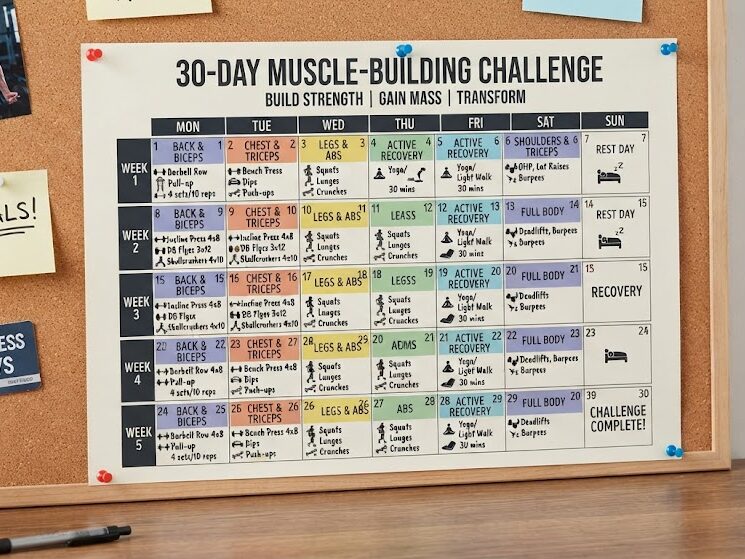
A sample weekly schedule looks like this:
| Day | Focus | Main Goal |
|---|---|---|
| Monday | Upper Body A | Chest, back, shoulders, arms |
| Tuesday | Lower Body A | Quads, hamstrings, glutes, calves |
| Wednesday | Recovery | Walking and mobility |
| Thursday | Upper Body B | Chest, back, shoulders, arms |
| Friday | Lower Body B | Legs, glutes, calves, core |
| Saturday | Optional Full Body | Technique and weak points |
| Sunday | Rest | Complete recovery |
This structure provides a balance between training frequency and recovery. If you’re new to resistance training, you don’t necessarily need to use the optional Saturday workout.
Moreover, ACSM’s 2026 resistance-training guidance suggests around 10 weekly sets per muscle group as a useful target for hypertrophy, while emphasizing that training volume should be adjusted to the individual. — Source: ACSM, 2026
What Exercises Should You Include in a 30-Day Muscle-Building Challenge?
A muscle-building workout plan should combine compound movements with targeted isolation exercises.
Compound exercises allow you to train multiple muscles together, while isolation exercises can help you give additional attention to specific muscle groups.
Useful exercises to include in your exercise pool are:
- Squats or goblet squats
- Romanian deadlifts
- Lunges
- Bench presses or push-ups
- Overhead presses
- Rows
- Lat pulldowns or assisted pull-ups
- Biceps curls
- Triceps extensions
- Calf raises
- Planks and leg raises
Beginners don’t need an expensive home gym or advanced equipment to start. Bodyweight exercises, resistance bands, dumbbells, and gym machines can all be used to create effective resistance-training sessions.
Current ACSM guidance notes that home-based training and nontraditional resistance methods can produce meaningful strength and hypertrophy benefits. — Source: ACSM, 2026
What Is the 30-Day Muscle-Building Workout Plan?
A 30-day muscle-building workout plan should alternate resistance training with recovery instead of requiring hard workouts every day.
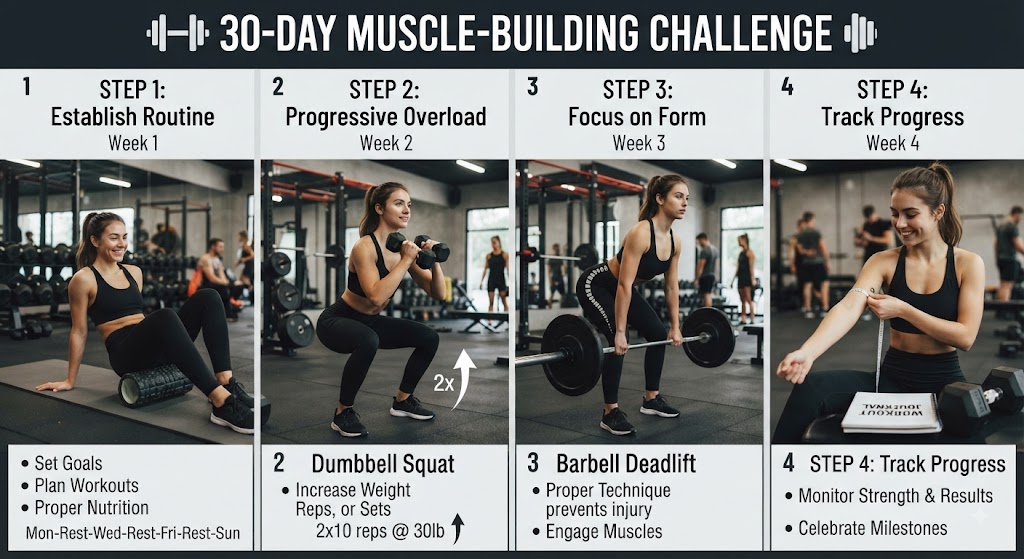
The first week establishes your foundation, the second week introduces progressive overload, the third focuses on improving training quality, and the final phase consolidates your progress.
Days 1–7: Establish Your Foundation
The first week should be about learning proper movement patterns, establishing baseline performance, and becoming comfortable with your training schedule.
- Day 1: Upper Body A — bench press/push-ups, rows, shoulder press, curls, triceps extensions.
- Day 2: Lower Body A — squats, Romanian deadlifts, lunges, calf raises, planks.
- Day 3: Recovery — 20–30 minutes of easy walking and mobility.
- Day 4: Upper Body B — incline press, lat pulldown, lateral raises, curls, triceps work.
- Day 5: Lower Body B — goblet squats, hip hinges, split squats, calves, core.
- Day 6: Optional light full-body session using two sets per movement.
- Day 7: Complete rest.
Moreover, beginners should usually perform around 2–3 working sets per exercise, using controlled repetitions rather than chasing maximum weight.
The goal during Week 1 is to build a reliable foundation. Good technique and repeatable workouts are more valuable than lifting as heavily as possible.
Days 8–14: Begin Progressive Overload
During Week 2, repeat the basic structure while slightly increasing the training demand.
Progress doesn’t have to mean dramatically increasing the weight. For example, if you completed 8 repetitions with a dumbbell during an earlier workout, you could aim for 9–10 controlled repetitions with the same resistance when appropriate.
This gradual approach allows you to increase the training stimulus without sacrificing technique.
Days 15–21: Increase Training Quality
Week 3 is an opportunity to improve the quality of every repetition while gradually increasing resistance where possible.
Instead of trying to make every workout exhausting, focus on:
- Better range of motion
- Controlled repetitions
- Stable technique
- Consistent exercise execution
- Gradual increases in resistance
- Gradual increases in repetitions
A better-quality repetition can be more productive than simply adding weight while allowing your technique to deteriorate.
Days 22–30: Consolidate Your Progress
The final nine days are about reinforcing your strongest movements and comparing your performance with Week 1.
For example, if you started with 8 controlled push-ups, you might now perform 12–15. Likewise, a stronger squat, better exercise technique, or more repetitions using the same resistance can all represent meaningful progress.
The objective is not to completely exhaust yourself before Day 30. Instead, use the final phase to demonstrate how your training capacity has changed since the beginning of the challenge.
Why Is Progressive Overload Important for a 30-Day Muscle-Building Challenge?
Progressive overload involves gradually increasing the resistance, repetitions, sets, or difficulty of an exercise as the body adapts to training.
Your body adapts when it repeatedly encounters a training stimulus. Once an exercise becomes easier, you need an appropriate progression to continue challenging yourself.
For example, if 10 dumbbell rows become relatively easy, you can increase the resistance or repetitions when appropriate. This creates a new challenge without requiring you to completely change your workout.
Progressive overload can come from:
- More repetitions
- Slightly heavier resistance
- Additional sets
- Better range of motion
- Improved exercise technique
- More difficult exercise variations
- Better control of each repetition
Resistance-training research also shows that both higher- and lower-load training can stimulate hypertrophy when training is appropriately programmed, although heavier loading can provide greater strength improvements. — Source: PubMed, 2021
Progressive overload is the engine that turns repeated workouts into continued adaptation.
However, progression should remain gradual. Adding weight too quickly can compromise technique and make recovery more difficult, particularly for beginners.
What Should You Eat During a 30-Day Muscle-Building Challenge?
A muscle-gain diet plan should provide sufficient protein, energy, carbohydrates, fats, fluids, and micronutrients to support resistance training and recovery.
Training provides the stimulus for adaptation, but nutrition supplies the energy and nutrients your body needs to support that process.
Instead of relying on one specific “muscle-building food,” build meals around a combination of protein sources, carbohydrates, healthy fats, fruits and vegetables, and adequate fluids.
Practical protein-rich options include:
- Eggs
- Dairy
- Fish or meat for those who eat them
- Tofu
- Soy foods
- Beans
- Lentils
- Greek yogurt
- Protein powders
How Much Protein Do You Need to Build Muscle?
A daily protein intake around 1.6 g/kg of body weight is a useful evidence-based target for many adults performing resistance training.
For example, a 70-kg person would need approximately 112 g of protein per day at 1.6 g/kg.
Moreover, a large meta-analysis found that protein supplementation combined with resistance training improved fat-free mass and strength, with benefits generally plateauing around 1.6 g/kg/day. — Source: Morton et al., 2018
high-protein diet for muscle gain
Protein is only one part of the equation. Carbohydrates can provide an accessible energy source for demanding workouts, while healthy fats remain an important component of a balanced diet.
Hydration also matters throughout the challenge. Rather than waiting until you feel extremely thirsty, maintain regular fluid intake throughout the day and around your workouts.
How Important Are Sleep and Rest Days for Muscle Growth?
Recovery is essential for muscle growth because training provides the stimulus while rest and nutrition support adaptation.
A common mistake during a muscle-building challenge is assuming that more workouts automatically produce faster results. In reality, repeatedly training hard without sufficient recovery can make it harder to maintain high-quality sessions.
As an adult, aim for at least seven hours of sleep per night. A consistent sleep schedule can also make it easier to recover and return to your next workout ready to perform.
The CDC recommends at least seven hours of sleep for adults aged 18–60. — Source: CDC, 2024
In addition, 30.5% of U.S. adults slept fewer than seven hours per day in 2024, showing how common inadequate sleep remains. — Source: National Center for Health Statistics, 2026
Rest days should not be viewed as wasted days. Light walking, mobility work, hydration, adequate food, and quality sleep can help prepare you for your next training session.
How Should You Track Progress During a 30-Day Muscle-Building Challenge?
Fitness progress tracking should measure performance, body changes, and consistency rather than relying only on the bathroom scale.
Body weight can fluctuate for many reasons, so looking at multiple progress indicators provides a more complete picture.
Track the following throughout your challenge:
- Body weight
- Waist and arm measurements
- Progress photographs
- Repetitions
- Sets
- Resistance used
- Workout completion
- Sleep and recovery quality
For example, a workout log showing 10 repetitions at 15 kg becoming 12 repetitions at 17.5 kg provides objective evidence of improvement.
Similarly, completing every scheduled workout can demonstrate an important behavioral change even if your body weight has not changed significantly.
Can You Build Muscle in 30 Days?
You can build some muscle in 30 days, but the amount varies considerably by training experience, genetics, nutrition, recovery, and starting condition.
Beginners may notice relatively fast improvements in strength and exercise performance because their bodies are adapting to a new training stimulus. Some visual changes can also result from increased muscle glycogen, improved muscle fullness, better posture, and reduced body fat.
However, a dramatic transformation should not be expected after only one month.
A meta-analysis of resistance-training studies in healthy adult males found an average increase of approximately 1.53 kg in muscle-related mass across the studied training periods, but those interventions were not limited to 30 days. — Source: PubMed, 2020
Therefore, the most realistic way to view a 30-day muscle-building challenge is as the beginning of a longer-term process.
Thirty days can improve strength, training consistency, and muscle-building habits, but significant muscle gain usually requires continued progressive training beyond the first month.
What Tools Can Help You Complete the 30-Day Challenge?
A workout log, calendar, measuring tape, camera, and basic spreadsheet are enough to track most 30-day muscle-building goals.
Start by creating a simple calendar containing all 30 days. Mark each workout as completed and record your main exercises immediately after training.
You can also use a basic spreadsheet to record:
- Exercise name
- Sets
- Repetitions
- Resistance
- Workout date
- Personal bests
- Body measurements
- Notes about recovery
Progress photographs can provide another useful reference point. Take your beginning and ending photographs under similar lighting and conditions so that comparisons are more meaningful.
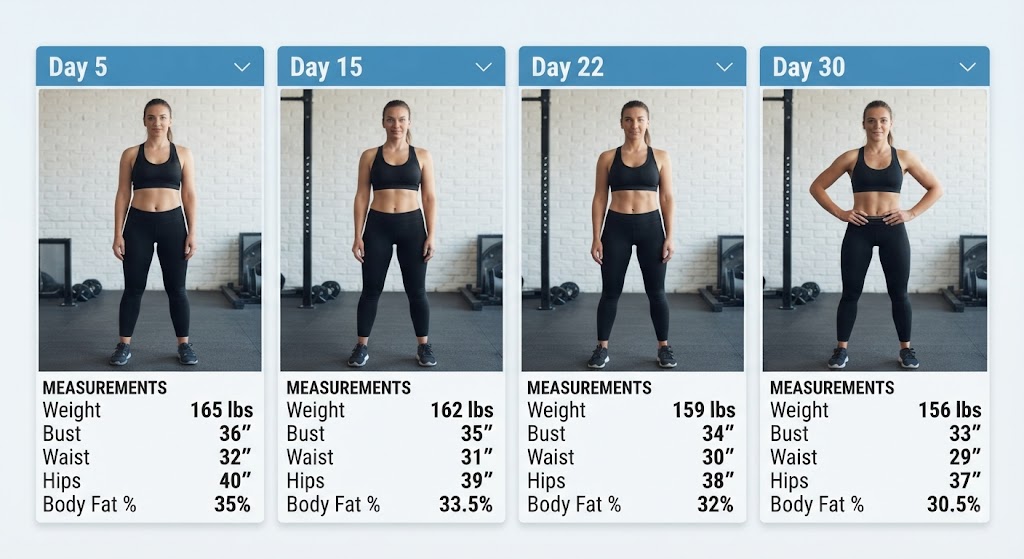
Free tools such as a phone notes app, Google Sheets, or a basic calendar can perform these functions without requiring paid fitness software.
What Should You Do After Completing a 30-Day Muscle-Building Challenge?
After 30 days, transition into a sustainable muscle-building program rather than stopping when the challenge ends.
The end of the challenge should be a checkpoint, not the end of your training journey.
First, compare your Day 1 and Day 30 performance. Identify exercises where you improved and movements that still need attention.
Next, continue progressive overload while adjusting training volume based on your recovery and experience. You can gradually move from a beginner routine into a more personalized upper/lower or full-body program.
For example, if four weekly sessions worked well during the challenge, continuing with four sessions may be more productive than immediately increasing your schedule to six training days.
Conclusion
A 30-day muscle-building challenge is a starting point for developing stronger muscles, better training habits, and a sustainable fitness routine.
The most important components are consistent resistance training, progressive overload, adequate protein and calories, hydration, quality sleep, and planned recovery. A structured four-day training schedule, for example, can be more productive than forcing yourself through 30 consecutive hard workouts.
Use the 30 days to learn proper exercise technique, establish a training routine, gradually increase your training demands, and understand how your body responds to exercise and recovery. Track your workouts, repetitions, resistance, measurements, and other useful indicators so you can make informed decisions about your next phase.
FAQs
What is a 30-Day Muscle-Building Challenge?
A 30-day program combining strength training, progressive overload, nutrition, and recovery.
Can you build muscle in 30 days?
Yes, especially for beginners, but significant muscle growth takes longer.
Is it possible to build muscle in 30 days?
Yes, consistent training and proper nutrition can produce noticeable progress.
What is the 3-3-3 rule gym?
A workout approach that can vary depending on the training program.
Can I build muscle in 1 month?
Yes, you can improve muscle size and strength with consistent training.
How many days a week should I train?
Aim for 3–5 resistance-training sessions with planned recovery days.
What is the best workout split for building muscle?
A four-day upper/lower split is a practical option for many beginners.
How much protein do I need to build muscle?
Around 1.6 g of protein per kilogram of body weight daily is a useful target.
Is progressive overload necessary for muscle growth?
Yes, gradually increasing training demands helps muscles continue adapting.
Do I need a gym to build muscle?
No, dumbbells, resistance bands, and bodyweight exercises can also build muscle.
How much sleep should I get for muscle growth?
Adults should aim for at least seven hours of sleep each night.
Should I work out every day for 30 days?
No, recovery days are important for muscle growth and performance.
How should I track muscle-building progress?
Track your reps, weights, measurements, photos, body weight, and consistency.
What should I do after the 30-day challenge?
Continue progressive training with adequate nutrition and recovery.