
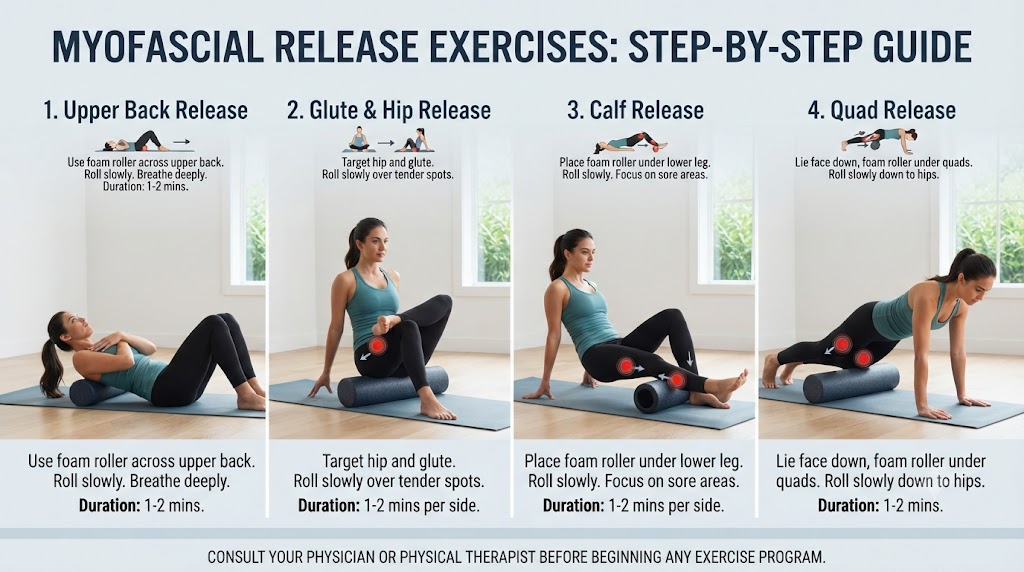
If you’ve already stretched, warmed up, or used a foam roller after workouts but still have areas that feel tight or stiff, the missing piece may be knowing which myofascial release exercises to use, where to apply pressure, and how much pressure is appropriate.
Myofascial release exercises offer a practical way to apply controlled pressure and movement to muscles and surrounding fascia. With simple tools such as foam rollers and massage balls, you can incorporate these techniques into a home workout, gym routine, warm-up, or recovery session.
In this guide, you’ll learn what myofascial release exercises are, how self-myofascial release works, the best techniques for different body parts, how long to perform them, when to use them, which tools to choose, common mistakes to avoid, and a simple 5–10 minute routine for beginners.
What Are Myofascial Release Exercises?
Myofascial release exercises are self-care techniques that use controlled pressure and movement to target muscles and surrounding fascia. Fascia is connective tissue that surrounds and supports muscles and other structures throughout the body. Self-myofascial release commonly uses tools such as foam rollers and massage balls to apply pressure to selected areas.
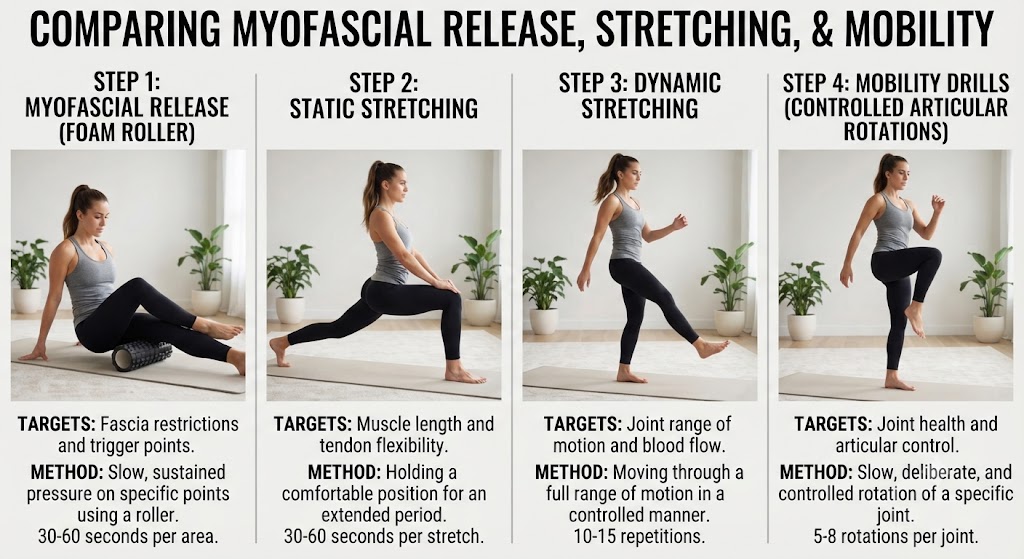
Myofascial release differs from traditional stretching because its primary action involves pressure and tissue movement rather than lengthening a muscle through a held position. For example, slowly rolling your calf over a foam roller applies pressure to soft tissue, while a standing calf stretch lengthens the calf through ankle movement.
Self-myofascial release also differs from professional massage because you control the pressure, position, and duration yourself. A massage ball against a wall, for instance, provides a simple form of self-massage that can target a smaller area than a large foam roller.
Self-Myofascial Release vs. Stretching and Mobility
Self-myofascial release involves applying pressure to selected areas of the body with tools such as foam rollers or massage balls while slowly moving through the targeted area.
Stretching primarily changes the length and position of tissues around a joint, while mobility work focuses on actively controlling available movement. Myofascial release can complement both approaches.
For example, before a lower-body workout, you might roll your quadriceps for 60 seconds, perform dynamic leg swings, and then complete bodyweight squats. Each technique serves a different purpose within the overall movement routine.
Why Are Myofascial Release Exercises Important?
Myofascial release exercises can provide a practical way to support short-term range of motion, perceived recovery, and movement comfort.
A 2024 systematic review examining 25 studies involving 517 athletes found that self-myofascial release had acute positive effects on flexibility and range of motion and could improve perceptions of recovery.
Source: PubMed, 2024.
Myofascial release can also fit naturally into a broader mobility exercises routine. For example, a runner might use calf rolling before mobility drills, while someone who spends long periods sitting might use an upper-back ball release before a movement session.
Potential Benefits of Myofascial Release
The benefits of myofascial release can vary depending on the person, technique, body area, and purpose. Potential benefits include:
- Range of motion: Foam rolling can temporarily increase joint range of motion.
- Movement comfort: Controlled pressure may make tight areas feel more relaxed.
- Recovery perception: Some research suggests people may perceive less post-exercise discomfort after self-myofascial release.
- Flexibility support: Foam rolling can complement stretching and mobility work.
- Relaxation: Slow breathing and controlled pressure can make the practice feel calming.
For example, a systematic review found strong evidence that foam rolling can increase ankle dorsiflexion range of motion for up to about 30 minutes after a single intervention in healthy adults.
Source: PubMed, 2022.
However, myofascial release should not be presented as a guaranteed treatment for injuries or chronic pain. Evidence for long-term flexibility, performance, and recovery remains mixed, so myofascial release works best as one component of a complete fitness and recovery strategy.
Source: PubMed, 2022.
How Does Self-Myofascial Release Work?
Self-myofascial release works by applying controlled external pressure to selected soft-tissue areas while you slowly move across or around the target region.
Foam rollers provide broad pressure, while massage balls allow more focused pressure on smaller areas. This makes it possible to adjust the technique according to the body part and your comfort level.
The exact biological mechanism behind myofascial release is not completely established. Current research suggests that changes in pain sensitivity, tolerance to pressure, muscle and connective-tissue behavior, and nervous-system responses may all contribute to how people experience the technique.
Source: PubMed, 2024.
For example, if your calves feel stiff after running, you can place one calf over a roller and slowly move from below the knee toward the lower calf while avoiding direct pressure on the joint or tendon.
How Much Pressure Should You Use?
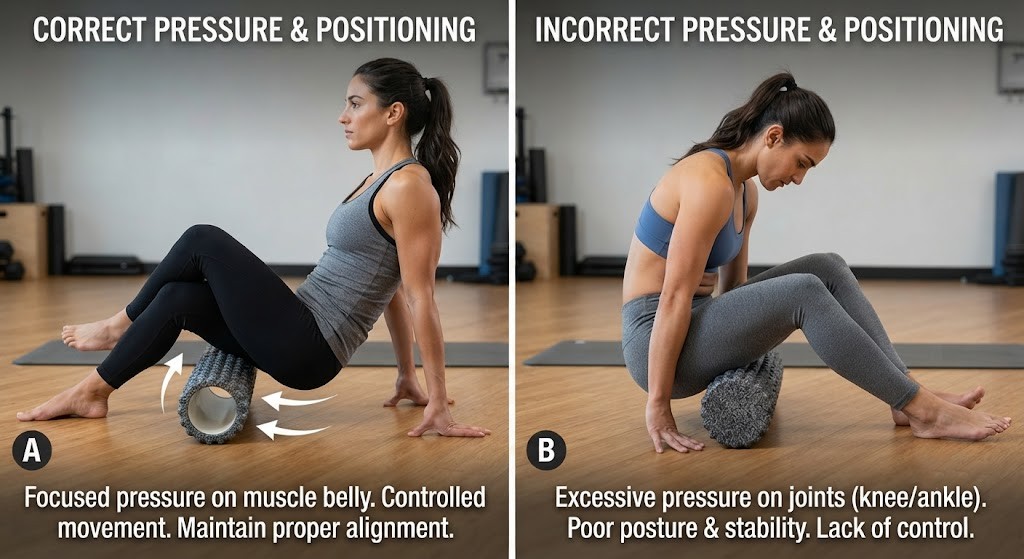
Effective self-myofascial release should use controlled pressure that feels manageable rather than aggressive pressure that causes sharp or intense pain.
A useful beginner target is moderate discomfort that still allows you to breathe normally and maintain control. You should be able to adjust your body position or pressure at any time.
For example, if a massage ball against a wall feels like an 8 out of 10 in intensity and causes you to hold your breath, reduce the pressure by moving more upright or using a softer ball.
What Are the Best Myofascial Release Exercises for Beginners?
The best myofascial release exercises for beginners are simple techniques that target large muscle groups with manageable pressure.
Calves, hamstrings, quadriceps, glutes, hips, lats, and upper back are common areas targeted with self-myofascial release.
How Do You Perform a Foam Roller Calf Release?
A foam roller calf release targets the calf muscles using controlled rolling pressure.
Setup: Sit on the floor with one calf resting on a foam roller and your hands behind you for support.
Steps:
- Lift your hips slightly from the floor.
- Slowly roll from below the knee toward the lower calf.
- Pause briefly over areas that feel tight.
- Rotate your leg slightly to explore different parts of the calf.
- Continue for about 30–60 seconds per side.
Common mistake: Avoid rolling directly over the knee joint or Achilles tendon.
How Do You Release Tight Hamstrings With a Foam Roller?
Hamstring foam rolling targets the muscles along the back of the thigh and can be used as part of a lower-body recovery routine.
Setup: Sit with one hamstring resting on the roller and your hands behind your body.
Steps:
- Extend the working leg comfortably.
- Lift your hips slightly.
- Roll slowly from the lower hamstring toward the area beneath the glutes.
- Turn your leg slightly inward and outward.
- Spend about 30–60 seconds on each side.
Common mistake: Do not aggressively roll behind the knee joint.
For additional training ideas, see hamstring exercises.
How Do You Release the Quadriceps?
Quadriceps foam rolling targets the front of the thigh and is especially practical after lower-body training.
Setup: Begin in a forearm plank with the roller underneath one thigh.
Steps:
- Keep your core lightly engaged.
- Roll from above the knee toward the hip.
- Move slowly rather than rapidly sliding over the muscle.
- Rotate your body slightly to reach different areas.
- Continue for 30–60 seconds per side.
Common mistake: Avoid rolling directly across the kneecap.
What Are the Best Myofascial Release Exercises for Tight Hips?
Myofascial release exercises for tight hips commonly target the glutes, outer hip muscles, and surrounding soft tissues.
A massage ball is often more useful than a large roller when you want controlled pressure around smaller hip muscles.
How Do You Release Glute and Piriformis Tightness?
A glute and piriformis ball release uses a massage ball to apply focused pressure to the buttock area.
Setup: Sit on the floor with one foot planted and place the ball beneath one side of the glutes.
Steps:
- Support yourself with your hands.
- Shift your weight gradually onto the ball.
- Make small, controlled movements.
- Pause over comfortable areas of tension.
- Continue for approximately 30–60 seconds.
Common mistake: Do not aggressively press into the spine, tailbone, or areas that produce sharp or radiating symptoms.
For strengthening after release work, see glute exercises.
How Can You Combine Hip Release With Mobility?
Hip release can work well when followed by active movement rather than being treated as the entire mobility session.
For example, perform 45 seconds of glute release followed by controlled hip circles, lunges, or hip mobility exercises.
A 2024 meta-analysis found that foam rolling can improve joint range of motion, although responses can differ depending on the muscle and joint being assessed.
Source: PubMed, 2024.
What Are the Best Upper-Back Myofascial Release Exercises?
Upper-back myofascial release exercises target the muscles around the thoracic region and can be useful for people who spend long periods sitting.
The upper back is generally more appropriate for foam rolling than the neck or lower spine.
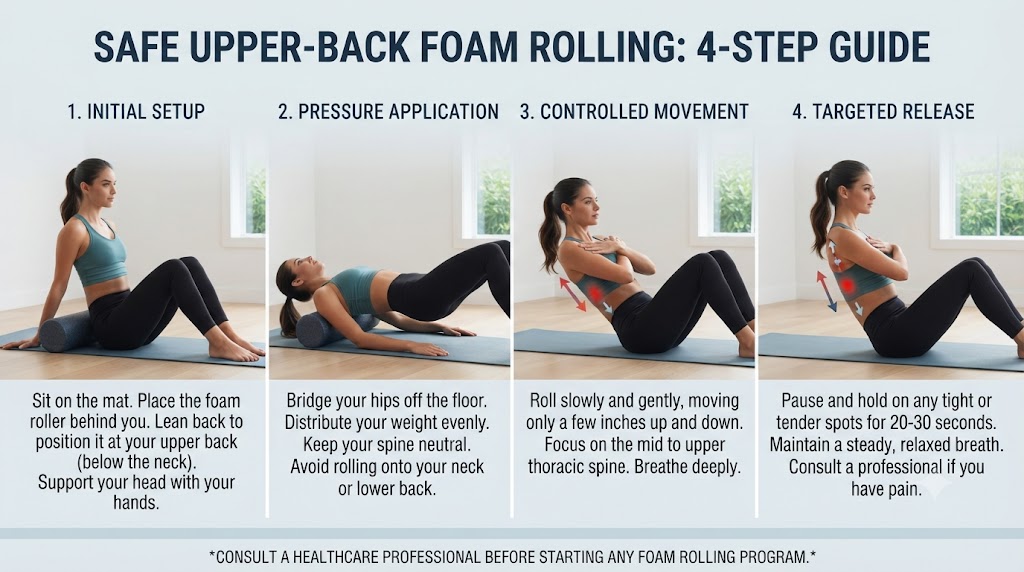
How Do You Perform an Upper-Back Foam Roll?
Setup: Lie on your back with a foam roller positioned across the upper back, keeping your knees bent and feet on the floor.
Steps:
- Support your head with your hands.
- Lift your hips slightly if comfortable.
- Slowly roll across the upper back.
- Keep the movement controlled.
- Spend approximately 30–60 seconds on the area.
Common mistake: Do not roll directly over the cervical spine or lower-back vertebrae.
How Do You Release the Lats?
A lat release can be performed with a foam roller or massage ball against the floor or wall.
Setup: Lie on your side with the roller beneath the outer upper torso, slightly behind the armpit.
Steps:
- Keep your arm comfortably extended.
- Slowly move through the outer upper-back area.
- Pause over manageable areas of tension.
- Avoid pressing directly into the armpit.
- Continue for 30–45 seconds per side.
How Long Should You Perform Myofascial Release Exercises?
Myofascial release exercises typically require only 30–60 seconds per muscle group for a beginner session, although the ideal duration depends on the technique, pressure, purpose, and individual tolerance.
There is no universally established optimal duration because research protocols vary substantially.
Source: PubMed, 2024.
For example, you could spend 45 seconds on each calf, hamstring, quadriceps, and glute rather than spending 10 minutes aggressively rolling one area.
Longer sessions are not automatically better. More pressure and more time do not necessarily produce better results, and excessive discomfort can make the practice less useful.
When Should You Do Myofascial Release: Before or After a Workout?
Myofascial release can be performed before or after exercise depending on your goal, but it should complement rather than replace an appropriate warm-up.
Before training, short and controlled rolling can be used alongside dynamic movement; after training, it can be included as part of a recovery routine.
A 2024 systematic review of 38 studies involving 1,134 participants found that foam rolling and stretching did not produce superior acute improvements in range of motion or stiffness compared with other warm-up interventions.
Source: PubMed, 2024.
Before exercise, try brief rolling followed by dynamic warm-up exercises.
After training, combine rolling with hydration, adequate nutrition, sleep, and post-workout recovery.
What Are the Best Tools for Self-Myofascial Release?
The best self-myofascial release tool depends on the size of the target area, desired pressure, and your experience level.
| Tool | Best for | Beginner-friendly? | Pressure |
|---|---|---|---|
| Foam roller | Quads, hamstrings, calves, upper back | Yes | Broad |
| Massage ball | Glutes, feet, smaller areas | Yes | Focused |
| Lacrosse-style ball | Deeper targeted work | Moderate | Firm |
| Soft therapy ball | Sensitive areas | Yes | Gentle |
| Roller stick | Legs and arms | Yes | Adjustable |
A foam roller is usually the easiest starting point because it distributes pressure across a larger surface. A massage ball becomes useful when you need more precise control.
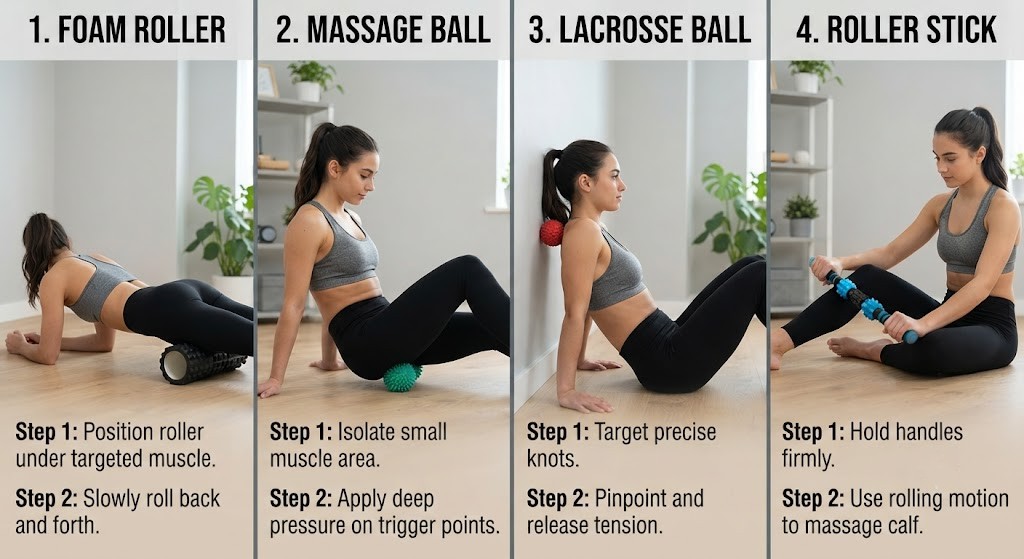
You can also explore foam roller exercises for additional techniques.
How Do You Perform Myofascial Release Safely?
Myofascial release is safest when you use moderate pressure, slow movements, controlled breathing, and appropriate body positioning.
Self-myofascial release should feel manageable rather than like a test of how much discomfort you can tolerate.
First, avoid direct pressure over bones, joints, the front or side of the neck, and areas of acute or unexplained pain. For example, roll the muscles around the shoulder rather than placing a hard ball directly on the spine or shoulder joint.
Second, stop if you experience sharp pain, numbness, tingling, unusual weakness, dizziness, or symptoms that worsen during or after the exercise.
People with significant injuries, unexplained persistent pain, recent surgery, or other medical concerns should seek guidance from an appropriately qualified healthcare professional before using aggressive self-treatment.
What Mistakes Should You Avoid When Foam Rolling?
Common foam-rolling mistakes include:
- Rolling too quickly instead of using controlled movements.
- Applying excessive pressure to chase discomfort.
- Rolling directly over joints or bones.
- Holding your breath during painful areas.
- Spending excessive time on one location.
- Treating foam rolling as a replacement for strength or mobility training.
- Continuing despite sharp, radiating, or unusual symptoms.
Can Myofascial Release Exercises Improve Flexibility and Mobility?
Myofascial release exercises can improve short-term range of motion and may contribute to longer-term mobility when used consistently, but they are not the only effective method.
Research suggests foam rolling can increase range of motion, while the size and duration of the effect depend on the body area and intervention.
For example, a meta-analysis of 11 studies involving 290 participants found a moderate overall effect of foam-rolling training on range of motion, with longer interventions producing better results than interventions lasting four weeks or less.
Source: PubMed Central, 2022.
At the same time, a 2024 review comparing static stretching and foam rolling found that both can improve joint range of motion over time, with no significant overall difference between them.
Source: PubMed Central, 2024.
That being said, mobility is more than rolling. Combine release work with active mobility, resistance training, appropriate stretching, and good movement habits.
What Is a Simple 5–10 Minute Myofascial Release Routine?
A simple myofascial release routine is a short sequence that targets areas commonly affected by training, running, or prolonged sitting.
Beginners can start with approximately five to ten minutes rather than trying to release every muscle in one session.
Try this beginner sequence:
- Calves: 45 seconds per side.
- Hamstrings: 45 seconds per side.
- Quadriceps: 45 seconds per side.
- Glutes: 45 seconds per side.
- Upper back: 60 seconds.
- Lats: 30 seconds per side.
- Easy mobility: 1–2 minutes of controlled movement.
Adjust the routine around your needs instead of following it rigidly. A runner may prioritize calves and hamstrings, while someone who sits at a desk may prefer glutes, hips, lats, and upper back.
For broader recovery planning, explore active recovery workout, and muscle soreness recovery.
What’s Next After Myofascial Release Exercises?
The next step after myofascial release is to use the improved movement opportunity for active mobility, exercise technique, and normal daily movement.
Myofascial release works best as part of a larger routine rather than as a standalone solution.
For example, after rolling your hips, perform controlled lunges or hip mobility drills. After rolling your upper back, perform gentle thoracic rotations.
Consistency also matters more than aggressive sessions. A few minutes several times per week can be easier to maintain than an occasional long session that leaves you excessively sore.
Conclusion
Myofascial release exercises are practical self-care techniques that use controlled pressure and movement to target muscles and surrounding fascia. Foam rollers, massage balls, and similar tools can support mobility, flexibility, relaxation, and recovery when used appropriately.
The best approach is gradual and controlled. Start with large muscle groups such as the calves, hamstrings, quadriceps, glutes, and upper back, use manageable pressure, breathe normally, and avoid bones, joints, and unexplained painful areas.
Myofascial release can be incorporated into a broader mobility and recovery routine, but it should not be treated as a substitute for appropriate medical evaluation or treatment of an injury.
Start with five to ten minutes, pay attention to how your body responds, and build your routine from there. When used consistently and sensibly, myofascial release exercises can become a practical addition to your overall movement, fitness, and recovery strategy.
FAQs
What are myofascial release exercises?
They use controlled pressure to relax muscles and surrounding fascia.
What is the best myofascial release exercise for beginners?
Foam rolling the calves, quads, hamstrings, and glutes is a good start.
Can I do myofascial release myself?
Yes, you can use a foam roller or massage ball at home.
What is the best exercise for fascia release?
Foam rolling is a simple and effective option.
What are some effective exercises for myofascial release?
Calf, hamstring, quad, glute, upper-back, and lat releases are effective options.
How long should you do myofascial release exercises?
About 30–60 seconds per muscle group is enough for beginners.
Is myofascial release better before or after a workout?
It can be used before or after a workout depending on your goal.
Can myofascial release exercises improve flexibility?
Yes, they can temporarily improve range of motion.
Can you foam roll every day?
Yes, when using gentle and manageable pressure.
Should foam rolling hurt?
Mild discomfort is okay, but sharp pain is not.
Who should not do myofascial release?
People with injuries or persistent unexplained pain should seek professional guidance.
What areas should you avoid when doing myofascial release?
Avoid bones, joints, the neck, spine, and painful areas.
Can myofascial release replace stretching?
No, it should complement stretching and mobility exercises.
What is the best tool for self-myofascial release?
A foam roller is a good beginner-friendly option.
Can myofascial release help with muscle soreness?
It may help reduce perceived post-workout discomfort.
What should you do after myofascial release?
Follow it with gentle mobility work or normal movement.