
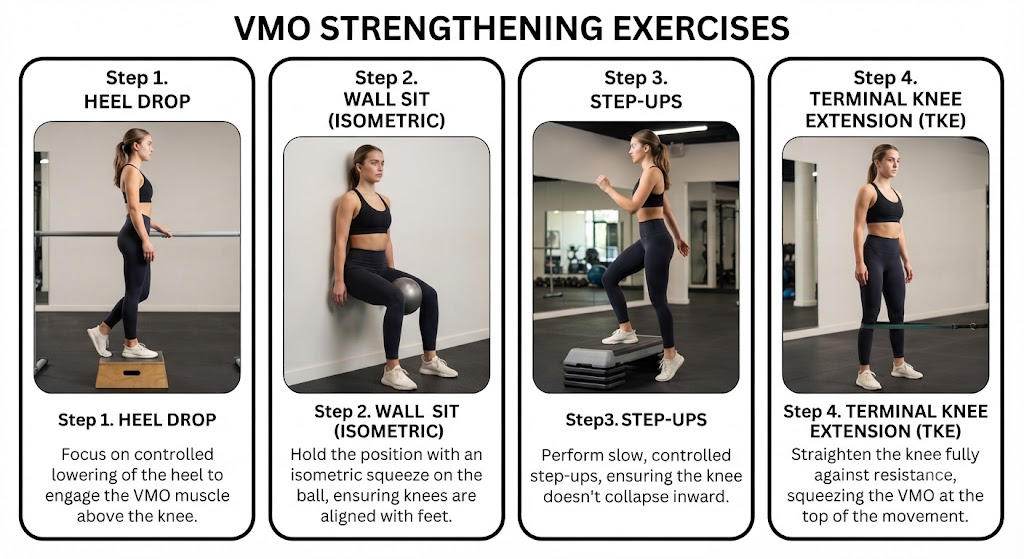
If you already train your legs with squats, lunges, or leg presses, you are probably strengthening your quadriceps—but that does not necessarily mean you are getting the most from your knee-focused training. A well-structured VMO workout can help you develop quadriceps strength, improve controlled knee extension, and build better lower-body movement patterns.
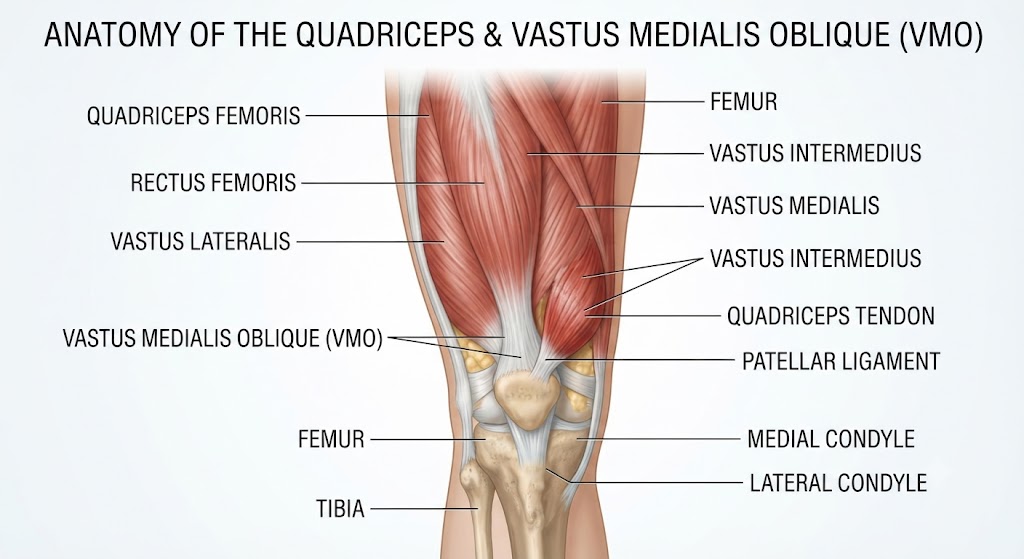
The vastus medialis oblique, commonly called the VMO, is the oblique-fibered portion of the vastus medialis located on the inner side of the thigh near the knee. While it cannot realistically be treated as a completely independent muscle during normal exercise, targeted quadriceps movements can emphasize controlled knee mechanics and strengthen the muscles around the knee.
In this guide, you will learn what the VMO does, why VMO strength matters, which exercises are useful, how to structure a beginner VMO workout, how to progress safely, and which common mistakes to avoid.
What Is a VMO Workout?
A VMO workout is a group of controlled quadriceps-strengthening exercises designed to train the vastus medialis oblique while improving knee-extensor strength and movement control. The VMO is part of the quadriceps muscle group and contributes to knee extension and overall quadriceps function.
The term VMO workout is commonly used for exercises intended to emphasize the inner portion of the quadriceps near the knee. Examples include terminal knee extensions, controlled step-downs, split squats, squats, Spanish squats, and leg-extension variations.
However, VMO training should not be confused with completely isolating one small portion of the quadriceps. The quadriceps operate as a functional group. Therefore, the practical goal is usually stronger knee extension, improved movement control, and progressive quadriceps development.
What Is the VMO and Where Is It Located?
The VMO is the oblique-fibered portion of the vastus medialis located on the inner side of the thigh near the knee. It forms part of the quadriceps and contributes to extending the knee.
The VMO works with the other quadriceps muscles whenever the knee straightens. For example, standing up from a squat requires coordinated activity from the quadriceps rather than the VMO functioning independently.
The VMO is also frequently discussed in relation to patellar movement and knee control. However, it is not accurate to describe it as the sole muscle responsible for stabilizing the kneecap because knee mechanics involve multiple muscles, joints, tissues, and movement patterns.
A useful way to think about VMO training is quadriceps strengthening with an emphasis on controlled knee mechanics, rather than searching for one exercise that completely switches on or isolates the VMO.
Why Is VMO Strength Important for Knee Function?
VMO strength matters because the VMO contributes to quadriceps strength and controlled knee extension, both of which are important for everyday movement and athletic activities. Strong quadriceps help you squat, climb stairs, run, jump, and rise from a chair.
For example, a controlled step-down requires the quadriceps to resist knee flexion as your body lowers toward the floor. This makes the exercise useful for developing both strength and control.
Broader quadriceps strengthening is also commonly incorporated into exercise-based approaches for people with patellofemoral pain. A 2024 best-practice guide recommends knee-targeted, with or without hip-targeted, exercise therapy as a primary intervention for patellofemoral pain. — Source: BMJ, 2024.
However, VMO-focused exercises should not be presented as a guaranteed solution for every knee problem. Persistent or significant knee pain can have different causes and should be assessed individually.
How Does VMO Strength Support Knee Control?
VMO strength supports knee-extensor capacity, but effective knee control depends on coordinated action from multiple muscles and movement factors. The glutes, hamstrings, calves, hip muscles, and other quadriceps muscles all contribute to lower-body movement.
During a single-leg squat, for example, the knee, hip, and ankle must coordinate while the quadriceps control the descent. Strengthening one muscle alone cannot replace developing the entire movement pattern.
Exercise therapy is also widely used as a foundation for managing patellofemoral pain. A 2024 multidisciplinary guideline recommends exercise therapy as the primary treatment strategy after appropriate clinical assessment. — Source: Knee Surgery, Sports Traumatology, Arthroscopy, 2024.
Therefore, VMO strengthening works best as one component of complete knee and lower-body conditioning.
For more details, read our guide on injury prevention exercises.
How Much Strength Training Do Adults Need?
Adults are generally advised to perform muscle-strengthening activities on at least two days per week. The U.S. Physical Activity Guidelines recommend muscle-strengthening activity at least two days weekly alongside regular aerobic activity. — Source: U.S. Department of Health and Human Services, 2018.
For example, beginners can train their quadriceps and other major muscle groups twice per week rather than performing demanding knee exercises every day.
Notably, only 32.9% of U.S. adults met the muscle-strengthening guideline in 2024, according to Healthy People 2030 data. — Source: Healthy People 2030/CDC-NCHS, 2024.
This statistic highlights the importance of consistent strength training, although the ideal frequency for someone recovering from an injury should be individualized.
What Are the Best VMO Exercises?
The best VMO exercises are controlled quadriceps movements that develop knee-extensor strength without relying on the idea of completely isolating the VMO. Useful VMO-focused exercises include terminal knee extensions, step-downs, split squats, reverse lunges, squats, leg presses, Spanish squats, and controlled leg extensions.
| Exercise | Difficulty | Equipment | Primary Purpose |
|---|---|---|---|
| Terminal Knee Extension | Beginner | Band/cable | Controlled knee extension |
| Step-Down | Beginner–Intermediate | Step/bench | Single-leg knee control |
| Reverse Lunge | Intermediate | Bodyweight/dumbbells | Unilateral leg strength |
| Split Squat | Intermediate | Bodyweight/dumbbells | Quad and single-leg strength |
| Squat | Beginner–Advanced | Bodyweight/barbell | Overall quad strength |
| Leg Press | Intermediate–Advanced | Machine | Progressive quadriceps loading |
| Spanish Squat | Beginner–Intermediate | Strap/band | Quad-focused knee loading |
| Leg Extension | Intermediate | Machine | Controlled knee extension |
1. Terminal Knee Extension
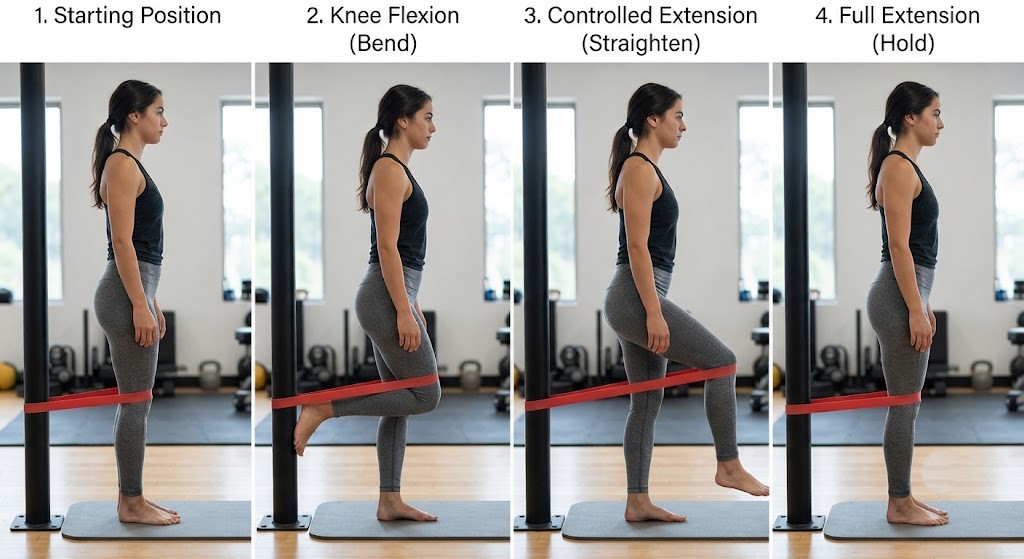
Terminal knee extensions are controlled band or cable exercises that train the quadriceps through the final portion of knee extension. They can be a useful low-load option when learning to control the knee.
To perform the movement:
- Anchor a resistance band behind you at approximately knee height.
- Step into the band so it sits behind the knee.
- Start with the working knee slightly bent.
- Straighten the knee against the band’s resistance.
- Briefly contract the quadriceps.
- Slowly return to the starting position.
Keep your foot planted and avoid aggressively snapping the knee backward. A controlled 2-second return can increase the challenge without requiring heavier resistance.
Research has examined terminal knee extensions and other exercises for VMO activity, but evidence does not support the idea that common exercises can reliably isolate the VMO from the rest of the quadriceps.
2. Step-Down Exercise
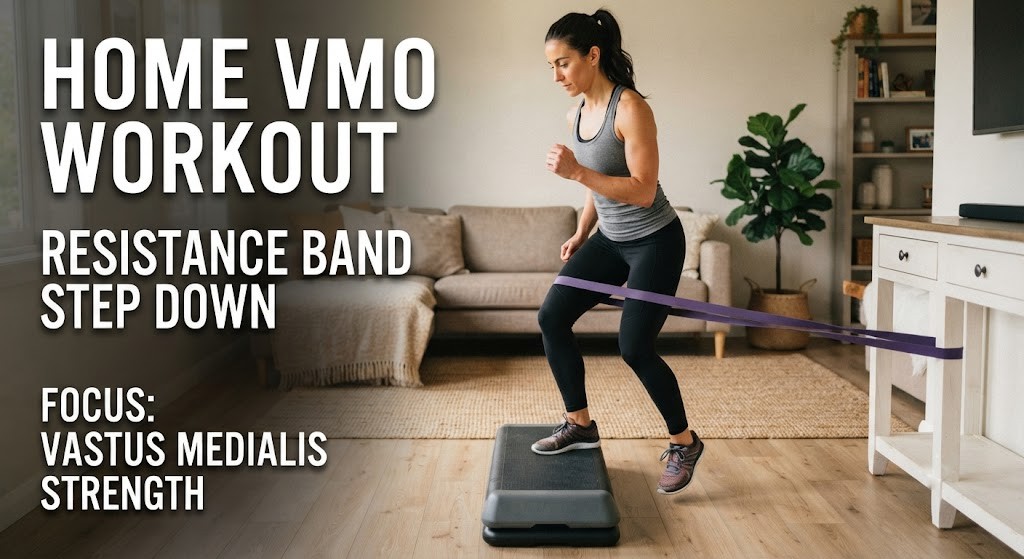
The step-down exercise develops single-leg quadriceps strength and knee control while requiring the working leg to control your bodyweight. It is particularly useful for practicing controlled movement rather than simply moving heavy resistance.
To perform a step-down:
- Stand on a low step with one foot.
- Keep your chest comfortably upright.
- Slowly bend the standing knee.
- Lower the opposite heel toward the floor.
- Keep the knee tracking in line with the foot.
- Push through the working foot to return to the starting position.
Start with a low step and use a wall or support if necessary. Increase the step height only when you can maintain consistent knee and hip control.
3. Split Squat
Split squats strengthen the quadriceps and glutes while allowing you to train one leg at a time. Begin with bodyweight and add dumbbells once you can control the movement consistently.
To perform the exercise, place one foot forward, lower your body under control, and push through the front foot to return.
Use these technique cues:
- Keep the front foot firmly planted.
- Let the knee track naturally over the foot.
- Lower slowly rather than dropping.
- Maintain a stable torso.
- Use a comfortable range of motion.
- Increase resistance only after technique is consistent.
A split squat does not need an artificially narrow stance to become a “VMO exercise.” Stable positioning and controlled loading are more useful than forcing an unusual foot position.
4. Reverse Lunge
Reverse lunges strengthen the quadriceps while allowing you to control knee and hip movement through a unilateral pattern. They can also be easier to control than forward lunges because the stepping leg moves backward.
Step one foot backward, lower your body under control, and then drive through the front foot to return.
Keep the front knee aligned with the foot and avoid allowing the knee to collapse inward. Begin with bodyweight before progressing to dumbbells.
5. Squat
Squats are compound quadriceps exercises that can build substantial lower-body strength when performed with appropriate technique and progressive resistance. They train the quadriceps alongside the glutes and other lower-body muscles.
A bodyweight squat can teach a beginner to control knee and hip movement before progressing to variations such as goblet squats or barbell squats.
A practical progression is:
- Bodyweight squat
- Box squat
- Goblet squat
- Front squat
- Barbell back squat
Choose the variation that allows you to maintain good control and a comfortable range of motion.
For more quad-focused training, combine your VMO exercises with quad strengthening exercises.
6. Leg Press
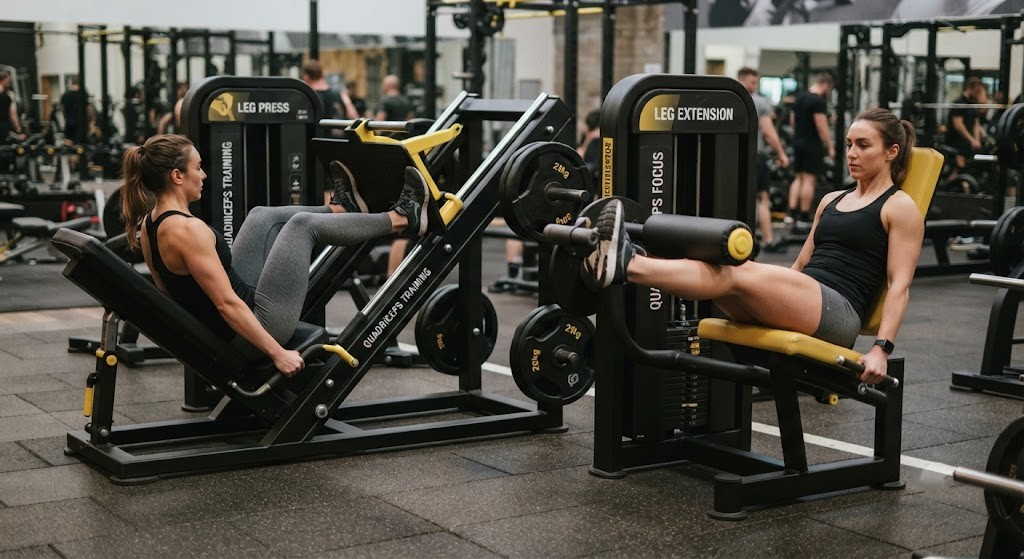
The leg press provides a stable machine-based environment for progressively loading the quadriceps. It can be useful when you want to increase resistance without the balance demands of a free-standing squat.
Start with a manageable load and lower the platform under control before pressing it away without aggressively locking the knees.
Place your feet in a comfortable position and allow your knees to track in the same general direction as your toes. Avoid changing foot position solely because you believe a particular stance will isolate the VMO.
7. Spanish Squat
The Spanish squat uses a strong strap or thick resistance band behind the knees to create a supported squat pattern with substantial quadriceps involvement. The setup can help some people maintain a more upright torso while loading the thighs.
Secure the strap behind you, sit back against its tension, and lower into a controlled squat.
Keep the movement comfortable and use a secure setup. Never use an unstable household object as an anchor.
8. Controlled Leg Extension
Leg extensions directly train knee extension and allow you to progressively load the quadriceps through a controlled range of motion. A machine also makes it easy to adjust resistance and repetitions.
Choose a light-to-moderate load, extend the knee smoothly, pause briefly near the top if comfortable, and lower the weight slowly.
Leg extensions can be useful, but they should be treated as quadriceps strengthening rather than a guaranteed VMO-isolation exercise.
How Do You Activate the VMO During Exercise?
You activate the VMO as part of coordinated quadriceps contraction when the knee extends and the quadriceps produce force. The practical objective is to improve quadriceps recruitment and strength rather than attempting to separate one quadriceps region from the others.
Start with manageable resistance that allows you to perform smooth repetitions. For example, reduce band tension during terminal knee extensions if you need to swing or compensate to finish each repetition.
Next, focus on controlled knee movement and consistent alignment. Your knee does not need to remain perfectly vertical over one exact point, but it should remain controlled relative to your foot and hip.
A deliberate tempo can also help. A simple pattern such as 1 second up, brief pause, 2 seconds down can make a lighter exercise challenging without requiring excessive load.
Finally, do not use a strong “burn” as proof of VMO activation. Muscle sensation can provide feedback, but it does not prove that one muscle has been completely isolated.
Is It Possible to Isolate the VMO?
It is not practical to completely isolate the VMO from the other quadriceps muscles during normal strengthening exercises. The VMO is part of the quadriceps group, and research has not established a reliable exercise strategy that completely separates its function from the other quadriceps muscles.
For example, an older electromyography study found that exercises promoted as selectively activating the VMO did not consistently improve the VMO-to-vastus-lateralis activity ratio compared with similar exercises.
Similarly, a randomized trial involving people with patellofemoral pain found that both selective VMO-focused rehabilitation and general quadriceps strengthening improved pain, function, and quality of life compared with no treatment.
Therefore, general quadriceps strengthening should remain the foundation, with VMO-focused exercises used as practical variations rather than as a replacement for complete leg training.
What Is the Best VMO Workout for Beginners?
The best beginner VMO workout uses low-to-moderate resistance, controlled repetitions, and exercises that allow comfortable and consistent knee movement. Beginners do not need advanced machines or heavy weights to start developing quadriceps strength.
Beginner VMO Workout
| Exercise | Sets | Reps |
| Terminal Knee Extension | 2–3 | 12–15 |
| Bodyweight Squat | 2–3 | 8–12 |
| Low Step-Down | 2 | 8–10 each leg |
| Split Squat | 2 | 8–10 each leg |
| Leg Extension | 2 | 10–15 |
Start with several minutes of easy movement and dynamic mobility. Bodyweight squats, marching, ankle movements, and gentle leg movements can help prepare the lower body before resistance training.
Keep approximately 2–4 repetitions in reserve during most sets. In other words, finish each set feeling that you could still perform several technically sound repetitions.
Beginners can also combine this routine with a leg workout for beginners to develop the entire lower body.
How Many Sets and Reps Should You Do for VMO Exercises?
Most recreational trainees can start with 2–3 sets of 8–15 controlled repetitions for VMO-focused exercises and adjust volume according to training experience and recovery. There is no single scientifically established set-and-repetition formula specifically for the VMO.
For example, 12–15 repetitions can work well for terminal knee extensions, while 8–12 repetitions may be appropriate for movements such as split squats or squats when learning technique.
For strength development, gradually increase resistance while maintaining consistent form. For muscular endurance or general knee conditioning, lighter loads and higher controlled repetitions may be appropriate.
Rehabilitation programming is different from ordinary gym programming. Someone recovering from surgery, acute injury, or significant knee pain may require individualized exercise selection, range of motion, volume, and progression from a qualified professional.
How Often Should You Train the VMO?
Most people can include VMO-focused quadriceps training around two times per week as part of a broader lower-body program. Your ideal frequency depends on total leg-training volume, recovery, exercise difficulty, and individual needs.
For example, a beginner could perform a short VMO-focused routine on Monday and Thursday while using other days for upper-body training, walking, or recovery.
The general physical activity guidelines recommend muscle-strengthening activity on at least two days per week. — Source: U.S. Department of Health and Human Services, 2018.
Moreover, the guidelines encourage gradually increasing strengthening activity rather than starting with excessive training volume. — Source: U.S. Department of Health and Human Services, 2018.
If your knees remain unusually sore after training, reduce volume or intensity and reassess your exercise selection.
Can You Do VMO Exercises at Home Without Equipment?
You can perform effective VMO-focused quadriceps exercises at home without equipment by using bodyweight movements and controlled single-leg exercises. Bodyweight squats, split squats, step-downs, and supported knee extensions can provide a useful starting point.
A stable bottom step of a staircase can be used for controlled step-downs if it is safe and appropriate.
A simple home session can include:
- Bodyweight squats
- Split squats
- Low step-downs
- Reverse lunges
- Wall-supported squats
- Resistance-band terminal knee extensions
Resistance bands can make home training more progressive. For example, using a stronger band for terminal knee extensions increases resistance without requiring a gym machine.
However, home training should still prioritize control. More resistance is not automatically better if the added load causes poor knee tracking or compensatory movement.
How Do You Progress a VMO Workout From Beginner to Advanced?
VMO workout progression means gradually increasing resistance, range of motion, complexity, or training volume while maintaining good movement quality. Progression should be earned through consistent technique rather than forced by heavier weights.
Beginner VMO Progression
Start with bodyweight squats, terminal knee extensions, supported split squats, and low step-downs.
For example, perform 2 sets of 10 repetitions before progressing toward 3 sets or increasing resistance.
Intermediate VMO Progression
Add dumbbells to split squats and reverse lunges, gradually increase step-down height, and introduce machine-based leg presses or leg extensions.
For example, move from bodyweight split squats to dumbbell split squats once you can control every repetition.
Advanced VMO Progression
Advanced trainees can use heavier squats, leg presses, Bulgarian split squats, controlled unilateral work, and more demanding resistance schemes.
For example, an experienced lifter might combine a heavy squat with moderate-repetition leg presses and controlled single-leg work.
For a complete beginner-friendly progression, combine this approach with leg workout for beginners
What Are the Most Common Mistakes When Training the VMO?
The most common VMO training mistakes involve excessive loading, poor knee control, rushed repetitions, unnecessary exercise modifications, and treating the VMO as an isolated muscle. Correcting these mistakes can make your training more productive.
Using Too Much Weight
Excessive resistance can reduce movement quality and make it harder to control the knee. For example, dropping quickly into a heavy squat defeats the purpose of practicing controlled knee movement.
Choose a load that allows you to maintain stable technique throughout the entire set.
Forcing a Narrow Stance
A narrow stance is not automatically a better VMO position. Choose a stance that allows your hips, knees, ankles, and feet to move comfortably and consistently.
There is no need to force an unnatural foot or knee position simply to make an exercise feel more “VMO-focused.”
Rushing Repetitions
Fast repetitions can reduce the amount of time you spend controlling the movement. For example, lowering a step-down over two seconds gives you more opportunity to maintain balance and knee control.
Controlled repetitions also make it easier to identify technique problems.
Chasing Complete VMO Isolation
Trying to completely isolate the VMO can distract you from building overall quadriceps strength. The VMO works as part of the quadriceps, so broader strengthening remains important.
Training Through Significant Pain
Significant or persistent knee pain should not be treated as a normal sign that VMO training is working. Stop or modify an exercise that produces concerning symptoms and seek professional assessment when pain persists.
How Do Resistance Bands, Dumbbells, and Machines Help VMO Training?
Resistance bands, dumbbells, cables, benches, steps, and machines provide different ways to progressively load the quadriceps during VMO-focused training. The best tool is the one that lets you perform the desired movement safely and consistently.
Resistance Bands
Resistance bands are useful for terminal knee extensions and low-load home training. They are inexpensive and easy to store.
Dumbbells
Dumbbells add progressive resistance to split squats, reverse lunges, and squats. They are especially useful once bodyweight movements become easy.
Machines
Leg presses and leg-extension machines provide stable environments for progressive quadriceps loading. They can be useful when balance is not the limiting factor.
Benches and Steps
A stable step or bench creates useful single-leg exercises such as step-downs. Start with a low height and increase it only when you can maintain control.
What Should a Complete Quad and Knee-Strength Routine Include?
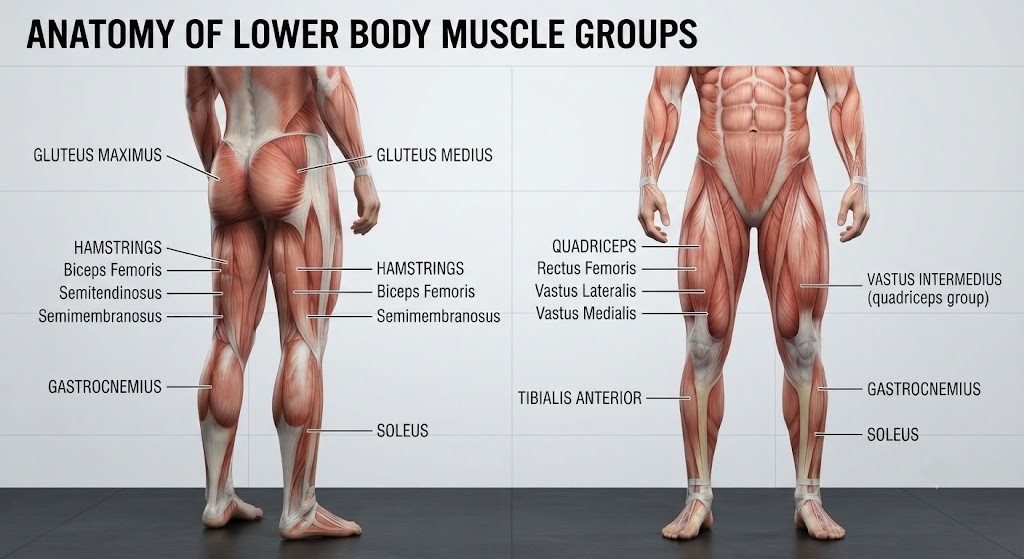
A complete knee-strength routine should combine quadriceps exercises with hamstring, glute, calf, single-leg, and mobility work. This develops the lower body as a coordinated system instead of focusing exclusively on one portion of one muscle.
A balanced session could include:
- Squat or leg press
- Split squat or step-down
- Hamstring movement
- Glute strengthening movement
- Calf exercise
- Controlled VMO-focused exercise
- Mobility work as appropriate
Pair your quadriceps training with hamstring exercise to strengthen the muscles on the back of the thigh.
Likewise, include glute strengthening exercises to develop hip strength and calf workout exercises.
You can also add mobility exercises during your warm-up or cooldown when appropriate.
What’s Next After Starting a VMO Workout?
The next step after learning VMO exercises is to build consistent lower-body strength while gradually increasing exercise difficulty. A stronger VMO is useful, but complete movement capacity requires more than one muscle or exercise.
First, practice the beginner routine for several weeks and focus on smooth repetitions. Increase resistance only after you can complete every repetition without losing knee control.
Second, progress toward compound exercises such as squats, split squats, and leg presses. These movements allow you to develop broader quadriceps strength while continuing to practice controlled knee mechanics.
Third, add single-leg movements as your ability improves. Step-downs and split squats can help expose differences in strength and control between your legs.
Conclusion
A VMO workout is best viewed as controlled quadriceps strengthening that supports knee-extensor strength and movement control, not as a search for one magical isolation exercise. Terminal knee extensions, step-downs, split squats, reverse lunges, squats, leg presses, Spanish squats, and controlled leg extensions can all play useful roles in a well-rounded training plan.
The most effective approach is gradual and consistent. Prioritize technique, comfortable range of motion, appropriate resistance, and progressive overload rather than chasing extreme VMO activation.
Remember that VMO exercises complement rather than replace complete lower-body training. Building stronger quadriceps alongside the hamstrings, glutes, calves, and other supporting muscles creates a more complete approach to lower-body strength and knee conditioning.
If you have persistent or significant knee pain, an existing injury, or symptoms that worsen with exercise, seek individualized guidance from a qualified healthcare professional rather than relying solely on a VMO workout.
FAQs
What is a VMO workout?
A VMO workout strengthens the quadriceps with an emphasis on the vastus medialis oblique.
What are the best VMO exercises?
Terminal knee extensions, step-downs, split squats, squats, and leg extensions are useful options.
How do I strengthen my VMO?
Do controlled squats, split squats, step-downs, and terminal knee extensions regularly.
What happens if VMO is weak?
It may contribute to reduced quadriceps strength and poorer knee control.
Does cycling activate the VMO?
Yes, cycling activates the quadriceps, including the VMO.
How to build a big VMO?
Use progressive quadriceps exercises and gradually increase resistance and training volume.
Can you isolate the VMO?
No, the VMO cannot be completely isolated from the other quadriceps muscles.
How often should you do a VMO workout?
Around two times per week can work well for many people.
Can beginners do VMO exercises?
Yes, beginners can start with bodyweight and low-resistance exercises.
Can you do a VMO workout at home?
Yes, exercises like squats, split squats, and banded extensions work well at home.
Do VMO exercises help knee pain?
They may help as part of a broader exercise program, but persistent pain needs professional assessment.
How many sets and reps should you do for VMO exercises?
Start with 2–3 sets of 8–15 controlled repetitions.
Should you train the VMO with squats?
Yes, squats strengthen the quadriceps and can support VMO development.
Is the VMO the only muscle that stabilizes the kneecap?
No, several muscles and structures contribute to knee stability.
What is the best beginner VMO workout?
Try squats, terminal knee extensions, step-downs, and split squats.
Does a narrow squat stance target the VMO better?
Not necessarily; use a comfortable stance with good knee control.
1 thought on “VMO Workout: Strengthen Your Inner Quad & Improve Knee Stability”