
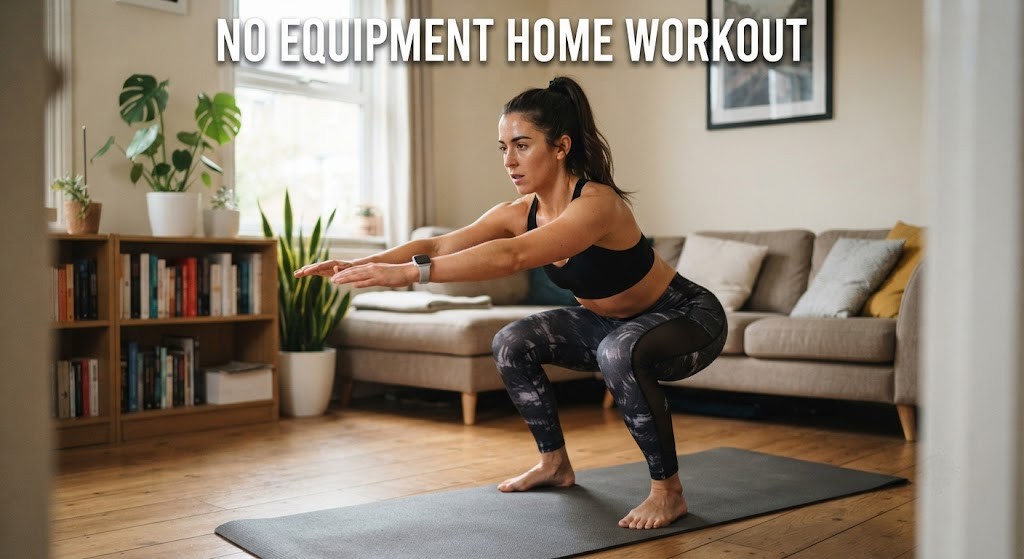
You’ve probably tried a few squats, push-ups, or planks at home. But knowing individual exercises is very different from knowing how to turn them into an effective workout routine.
Without a structured plan, it’s easy to repeat the same movements, neglect certain muscle groups, or stop progressing once an exercise becomes familiar. The good news is that you don’t need dumbbells, resistance machines, or a gym membership to create a well-rounded fitness routine.
A no equipment home workout uses your bodyweight as resistance to train strength, endurance, mobility, balance, and cardiovascular fitness. In this guide, you’ll learn how to choose the best exercises, build a full-body routine, modify movements for your fitness level, increase difficulty without weights, and create a sustainable weekly workout schedule.
What Is a No Equipment Home Workout?
A no equipment home workout is a workout routine that uses bodyweight movements and requires little or no specialized fitness equipment. Exercises such as squats, lunges, push-ups, glute bridges, and planks use your own body as resistance.
Bodyweight training can also cover the major movement patterns needed for general fitness, including squatting, pushing, lunging, bracing, and dynamic movement. For example, a simple circuit can combine squats to train the lower body, push-ups for the upper body, and planks for the core.
Importantly, “no equipment” does not mean “easy.” A standard push-up, slow squat, or single-leg glute bridge can become considerably more demanding when you increase control, range of motion, pauses, repetitions, or exercise difficulty.
This makes bodyweight training adaptable for both beginners and more experienced exercisers.
Why Are No-Equipment Home Workouts Effective?
No-equipment home workouts are effective because they make regular physical activity accessible, convenient, and adaptable to different fitness levels. You can exercise in a bedroom, living room, office, or another suitable space without purchasing a gym membership or specialized equipment.
For example, the CDC recommends that adults get at least 150 minutes of moderate-intensity physical activity per week plus muscle-strengthening activity on at least 2 days — Source: [CDC, 2025].
WHO recommends 150–300 minutes of moderate-intensity aerobic activity per week and muscle-strengthening activity involving major muscle groups on 2 or more days — Source: [World Health Organization, 2026].
Regular physical activity supports cardiovascular, muscular, mental, and general health. WHO also notes that physical activity can benefit cardiovascular health, mental health, cognitive health, and sleep — Source: [World Health Organization, 2021].
Calisthenics Workout Plan for Beginners at Home
Why Bodyweight Training Fits Busy Schedules
Bodyweight workouts reduce common barriers to exercise because they require minimal setup and can be performed almost anywhere. You don’t need to drive to a gym, wait for equipment, or spend time setting up machines.
For example, a 10-minute circuit could include:
- Bodyweight squats
- Incline push-ups
- Reverse lunges
- Glute bridges
- Marching in place
These movements require little space and can be adjusted according to your fitness level.
Short sessions can also be combined with other daily activities. The CDC emphasizes that physical activity can be broken into manageable amounts and that some activity is better than none — Source: [CDC, 2025].
That makes a no equipment home workout a practical option when a longer training session isn’t possible.
What Are the Best No-Equipment Exercises for a Full-Body Workout?
The best no-equipment exercises combine lower-body, upper-body, core, and cardiovascular movements. Selecting exercises from each category helps create a more balanced routine instead of repeatedly training only one muscle group.
| Exercise | Main focus | Beginner modification |
|---|---|---|
| Bodyweight squat | Legs and glutes | Assisted squat |
| Reverse lunge | Legs and glutes | Shorter range |
| Push-up | Chest, shoulders, triceps | Wall or incline push-up |
| Glute bridge | Glutes and hamstrings | Two-leg bridge |
| Plank | Core | Knee plank |
| Side plank | Core and obliques | Bent-knee side plank |
| Bird dog | Core and stability | Smaller range of motion |
| Mountain climber | Core and cardio | Slow mountain climber |
| Burpee | Full body and cardio | Step-back burpee |
A balanced routine does not need to contain every exercise on this list. Instead, choose movements that collectively cover the major areas you want to train.
Lower-Body Bodyweight Exercises
Bodyweight squats and reverse lunges are foundational lower-body exercises for home workouts. Squats primarily challenge the thighs and glutes, while reverse lunges place greater emphasis on each leg independently.
Beginners can make squats easier by lightly holding a stable surface for support. As strength and control improve, you can increase the challenge by slowing the lowering phase or adding a pause.
For example, a controlled three-second lowering phase can make a basic squat more demanding without adding external weight.
Other useful lower-body progressions include supported reverse lunges, standard reverse lunges, and split squats. The important factor is choosing a variation that allows you to maintain good technique.
Upper-Body Bodyweight Exercises
Push-ups are a practical upper-body bodyweight exercise that trains the chest, shoulders, triceps, and core. However, the standard floor push-up can be challenging for beginners.
A simple progression is:
- Wall push-up
- Incline push-up
- Knee push-up
- Standard push-up
For example, perform 8–12 controlled incline push-ups before progressing to a more difficult variation.
The goal isn’t simply to perform the hardest variation available. Instead, choose a version that challenges you while allowing you to maintain controlled movement and proper positioning.
Core and Cardio Exercises
Planks, side planks, bird dogs, mountain climbers, and burpees can add core stability and cardiovascular demand.
Bird dogs are particularly useful for practicing controlled core and stability work, while mountain climbers and burpees can increase the cardiovascular component of a workout.
Beginners can modify high-impact movements. For example, replace burpees with step-back burpees or perform mountain climbers slowly instead of rapidly.
Plank Exercise for core and abs workout
How Do You Do a Full-Body Workout at Home Without Equipment?
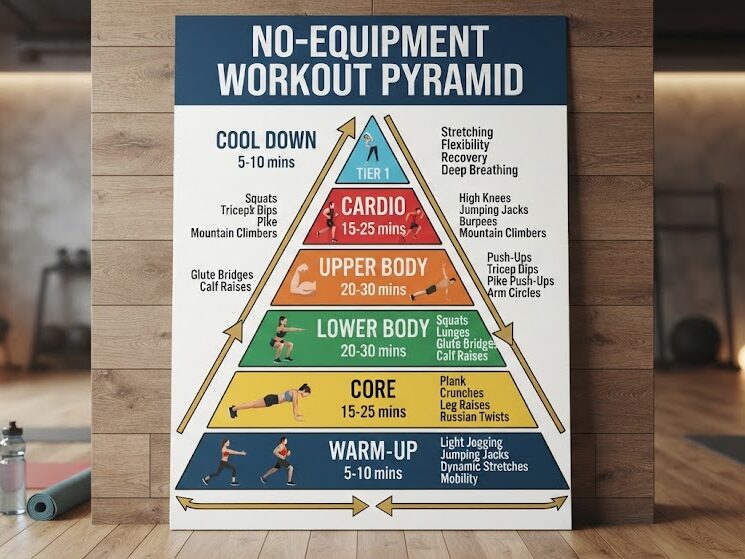
A full-body no-equipment workout should combine a warm-up, major movement patterns, appropriate rest, and a short cooldown. This structure makes the session easier to follow and provides a clear framework for progression.
Step 1: Warm Up for 3–5 Minutes
A warm-up prepares your body for movement by gradually increasing activity and rehearsing basic movement patterns.
A simple warm-up can include:
- Marching in place
- Arm circles
- Hip rotations
- Bodyweight squats
- Gentle lunges
Keep the movements comfortable and gradually increase your activity level rather than immediately starting at maximum intensity.
5 Minute Warm Up Before Workout
Step 2: Complete the Main Circuit
A beginner-friendly full-body circuit can use 6 exercises performed for 30–45 seconds each or 8–12 controlled repetitions.
Try the following routine:
- Bodyweight squats — 10–15 reps
- Incline or standard push-ups — 8–12 reps
- Reverse lunges — 8–10 reps per leg
- Glute bridges — 12–15 reps
- Bird dogs — 8–10 reps per side
- Mountain climbers — 20–30 seconds
Rest for 30–60 seconds between exercises as needed and complete 2–3 rounds.
The exact amount of rest can vary depending on your fitness level. Beginners may need more recovery, while experienced trainees may be comfortable using shorter rest periods.
Step 3: Cool Down
A cooldown gradually reduces workout intensity and gives you time to transition back to normal activity.
Finish with activities such as:
- Easy walking
- Slow breathing
- Comfortable mobility movements
- Gentle lower-body movements
A cooldown also creates a natural transition between your workout and the rest of your day.
What Is the Best No-Equipment Home Workout for Beginners?
The best no-equipment home workout for beginners is a manageable routine that emphasizes technique, recovery, and gradual progression. Beginners do not need to maximize intensity during their first few sessions.
A practical starting point is a 15–20-minute workout performed for 2 rounds. You could combine squats, incline push-ups, reverse lunges, glute bridges, bird dogs, and marching.
The priority should be learning the movement patterns and developing consistency. Once the routine feels manageable, you can gradually increase repetitions, sets, exercise difficulty, or workout duration.
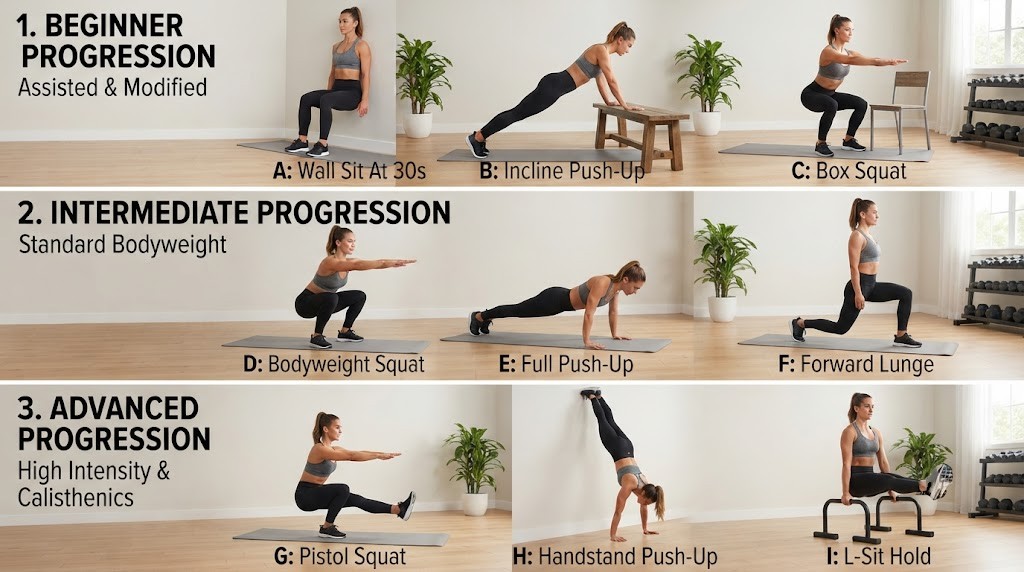
Beginner Exercise Progressions
Beginners can make no-equipment workouts more manageable by using easier exercise variations and gradually progressing toward more challenging movements.
Useful progressions include:
- Wall push-up → incline push-up → knee push-up → standard push-up
- Assisted squat → bodyweight squat → pause squat → tempo squat
- Supported reverse lunge → reverse lunge → split squat
- Knee plank → standard plank → longer plank
- Marching → step jacks → jumping jacks
The goal is controlled progression, not immediate perfection.
If a movement causes your form to break down, step back to an easier variation and rebuild your control before progressing again.
How Many Days a Week Should You Do a No-Equipment Home Workout?
Most beginners can start with 2–3 no-equipment workout sessions per week and increase activity gradually as recovery and fitness improve. You don’t need to perform a demanding workout every day to make progress.
For example, a beginner could train:
- Monday — Full-body workout
- Wednesday — Full-body workout
- Saturday — Full-body workout
The days between sessions can include walking, light movement, mobility work, or recovery.
WHO recommends muscle-strengthening activity involving major muscle groups on at least 2 days per week for adults — Source: [World Health Organization, 2026].
Moreover, inactive people are advised to start with smaller amounts and gradually increase duration, frequency, and intensity — Source: [World Health Organization, 2021].
A gradual approach can make it easier to establish a sustainable long-term exercise habit.
How Long Should a No-Equipment Home Workout Last?
A no-equipment home workout can be effective in 10–30 minutes when the exercises are selected and performed consistently. Longer sessions may also be useful, but workout duration should match your fitness level, schedule, and goals.
For example:
- 10-minute workout: Five exercises performed for 40 seconds each with short transitions
- 20-minute workout: Warm-up, two or three circuit rounds, and cooldown
- 30-minute workout: Longer warm-up, multiple strength-focused rounds, cardio work, and cooldown
Importantly, there is no requirement to complete all weekly activity in one session. The CDC notes that adults can spread physical activity throughout the week — Source: [CDC, 2025].
This flexibility makes short home workouts easier to fit into busy schedules.
How Can You Make Bodyweight Workouts More Challenging Without Weights?
Progressive overload in bodyweight training involves gradually increasing repetitions, sets, movement difficulty, range of motion, tempo, or reducing rest periods. You can make many bodyweight exercises harder without adding dumbbells, resistance bands, or machines.
For example, instead of immediately switching to a completely different exercise, you could progress from 8 squats to 12 squats and then add another set.
Use These Progression Methods
You can increase bodyweight training difficulty by changing one training variable at a time.
Try these methods:
- Increase repetitions.
- Add another set.
- Slow the lowering phase.
- Add pauses at difficult positions.
- Increase range of motion.
- Choose a harder variation.
- Reduce rest gradually.
- Improve exercise control.
Progression should preserve good form rather than simply increase fatigue.
If your technique deteriorates significantly as an exercise becomes harder, return to an easier variation and focus on regaining control.
What Is a Good 20-Minute No-Equipment Home Workout?
A good 20-minute no-equipment home workout combines full-body strength movements with controlled cardiovascular exercises. The following routine requires only enough floor space to move safely.
20-Minute Full-Body Routine
Minutes 1–4: Warm-Up
- March in place
- Arm circles
- Hip rotations
- Easy squats
The purpose is to gradually prepare for the main workout rather than exhaust yourself before the circuit begins.
Minutes 5–17: Main Workout
Complete 3 rounds:
- 12 squats
- 8–12 push-ups or incline push-ups
- 10 reverse lunges per leg
- 15 glute bridges
- 30-second plank
- 30-second mountain climbers
Rest for 30–45 seconds between rounds.
Modify any exercise as necessary. For example, use incline push-ups instead of floor push-ups or perform slow mountain climbers instead of a faster version.
Minutes 18–20: Cooldown
- Easy walking
- Slow breathing
- Gentle lower-body mobility
This format provides a simple combination of strength, core work, and cardiovascular movement within a short training window.
What Are the Best No-Equipment Home Workout Routines for Different Goals?
The best routine depends on whether your priority is general fitness, strength, cardio, or low-impact movement. Matching the workout structure to your goal can make it easier to train consistently.
10-Minute Quick Workout
A 10-minute workout can provide a practical movement break when time is limited.
Alternate 40 seconds of work with 20 seconds of transition across exercises such as:
- Squats
- Incline push-ups
- Lunges
- Glute bridges
- Marching
This format is particularly useful when you have limited time but still want to complete a structured session.
Strength-Focused Workout
A strength-focused bodyweight workout emphasizes controlled repetitions, challenging variations, and adequate rest.
A simple routine can include:
- Squats
- Split squats
- Push-ups
- Single-leg bridges
- Planks
Perform the movements for 2–4 sets, selecting a variation that provides an appropriate challenge while allowing you to maintain good form.
Cardio-Focused Circuit
A no-equipment cardio circuit increases movement intensity through exercises such as mountain climbers, jumping jacks, high knees, and burpees.
For lower-impact training, replace:
- Jumping jacks with step jacks
- Burpees with step-back burpees
- Fast mountain climbers with slow mountain climbers
- High knees with marching
These modifications allow you to adjust the impact and intensity without abandoning the workout structure.
Low-Impact Home Workout
A low-impact workout reduces jumping while maintaining purposeful movement.
For example, use step jacks instead of jumping jacks and controlled step-back burpees instead of traditional burpees.
Low-impact does not necessarily mean ineffective. You can still make movements challenging by increasing control, repetitions, range of motion, or work duration.
How Do You Make No-Equipment Home Workouts More Effective?
Effective home workouts depend on proper form, appropriate difficulty, consistency, recovery, and measurable progression. Simply trying to make every workout harder is not necessarily the best strategy.
Instead, track simple training variables such as:
- Exercise variation
- Repetitions
- Sets
- Rest time
- Perceived difficulty
- Workout duration
For example, you could record whether you performed wall, incline, knee, or standard push-ups and compare your repetitions from one week to the next.
Choosing an exercise that matches your current ability is equally important. A technically strong incline push-up is more useful for a beginner than a poorly performed floor push-up.
Focus on Quality Before Quantity
Good technique should remain a priority as you increase workout difficulty. More repetitions are not necessarily better if each repetition becomes uncontrolled.
A useful progression strategy is to first improve movement quality, then gradually increase repetitions or sets, and finally move toward a more challenging exercise variation.
Build a Routine You Can Repeat
Consistency is one of the most practical advantages of a no equipment home workout. Because you can train with minimal setup, it may be easier to maintain a regular schedule.
Rather than designing an extremely difficult routine that you can perform only occasionally, choose a manageable workout you can repeat week after week.
What Tools Can Help You Plan a No-Equipment Home Workout?
Simple planning and tracking tools can make a no-equipment workout routine easier to follow and progress. You don’t necessarily need a specialized fitness platform to organize your sessions.
Useful options include:
- A phone timer for work and rest intervals
- A notes app for recording repetitions
- A spreadsheet for tracking workouts
- A calendar for scheduling sessions
- A fitness calculator for basic workout planning
For example, you can use a basic phone timer to manage work and rest intervals and a spreadsheet or notebook to record repetitions.
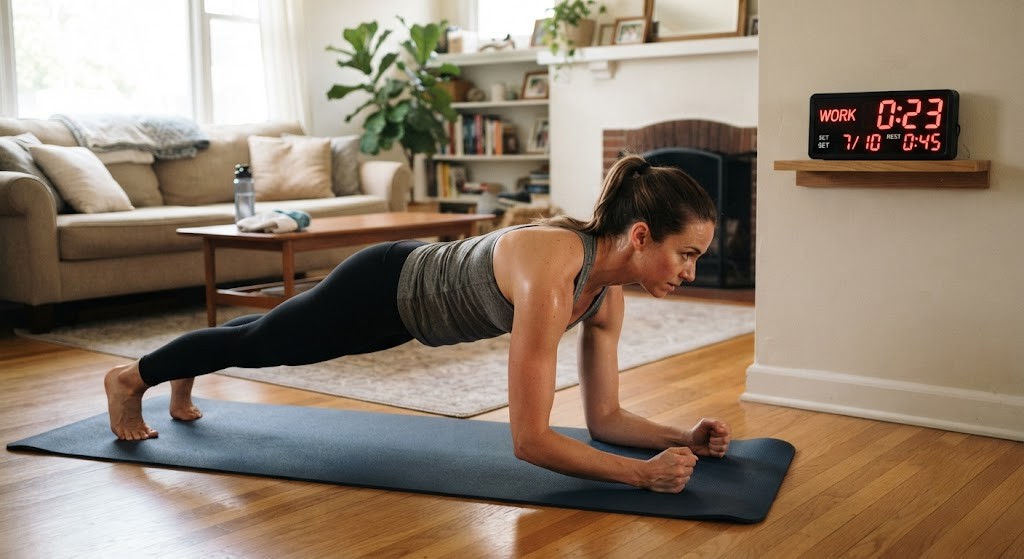
Free options such as a phone timer, notes app, spreadsheet, or calendar can work well without requiring a paid fitness platform.
The key is not the tool itself. The goal is to create enough structure to know what you are doing, when you are doing it, and how your performance changes over time.
What’s Next: How Do You Build a Consistent Home Workout Routine?
A consistent home workout routine starts with a realistic schedule that you can repeat every week. Instead of creating an ambitious plan that becomes difficult to maintain, start with manageable sessions and build from there.
Try this simple weekly structure:
| Day | Activity |
|---|---|
| Monday | Full-body bodyweight workout |
| Tuesday | Walking or light movement |
| Wednesday | Full-body bodyweight workout |
| Thursday | Recovery or mobility |
| Friday | Full-body workout |
| Saturday | Optional walking or cardio |
| Sunday | Rest |
Start with 2–3 workouts per week, then increase difficulty as your fitness improves.
You can also adjust the schedule around your lifestyle. If three sessions are difficult to maintain, start with two. Once that routine becomes consistent, consider adding another session or increasing the challenge.
If you have a chronic condition, disability, or other health concern, consult an appropriate healthcare professional about the right activity level — Source: [CDC, 2025].
Simple Checklist for Your Weekly Routine
Before starting each week, make sure you have:
- A realistic number of workout days
- A full-body exercise selection
- Beginner-friendly modifications when needed
- A plan for progression
- Adequate recovery days
- A simple way to track your workouts
- Enough space to move safely
This approach turns individual bodyweight exercises into a repeatable fitness system.
Conclusion
A no equipment home workout can build strength, endurance, mobility, and general fitness without a gym or expensive equipment. Squats, lunges, push-ups, glute bridges, planks, and cardiovascular movements provide a practical foundation for a complete home workout routine.
The biggest advantage is flexibility. You can shorten a workout when you’re busy, modify exercises when you’re a beginner, increase the challenge as you get stronger, and organize your training around your schedule.
Effective bodyweight training comes from consistent practice and progressive challenge, not from making every workout exhausting. Start with 10–20 minutes, train 2–3 days per week, focus on good form, and gradually increase the challenge.
Your next workout doesn’t need to be complicated. Choose six movements, clear a little floor space, set a timer, and start.
FAQs
What is the best workout I can do at home without equipment?
A full-body routine with squats, push-ups, lunges, glute bridges, and planks is a great option.
What is the 3-3-3 rule for working out?
The 3-3-3 rule can refer to different workout methods, depending on the program.
Is home workout without equipment effective?
Yes. Bodyweight workouts can improve strength, endurance, mobility, and overall fitness.
What burns 500 calories in 30 minutes?
Vigorous activities like running, cycling, or high-intensity cardio can burn significant calories.
What is a no equipment home workout?
A no equipment home workout uses bodyweight exercises without specialized fitness equipment.
Can beginners do no equipment home workouts?
Yes. Beginners can start with easier exercise variations and gradually progress.
How often should I do a no equipment home workout?
Start with 2–3 sessions per week and gradually increase activity.
How long should a no equipment home workout last?
A no equipment home workout can be effective in 10–30 minutes when performed consistently.
Can I build strength with no equipment?
Yes. Harder variations, more repetitions, and controlled movements can build strength.
What are the best no equipment exercises?
Squats, lunges, push-ups, glute bridges, and planks are effective choices.
How can I make bodyweight exercises harder without weights?
Increase repetitions, sets, range of motion, tempo, or exercise difficulty.
What is a good 20-minute no equipment home workout?
Combine squats, push-ups, lunges, glute bridges, planks, and mountain climbers.
Can I do a no equipment home workout every day?
Light activity can be done daily, but challenging workouts require adequate recovery.
Do I need a gym to get fit?
No. Consistent bodyweight workouts can help improve overall fitness at home.
Is 10 minutes of exercise enough?
Yes. A 10-minute workout can add useful physical activity when time is limited.