
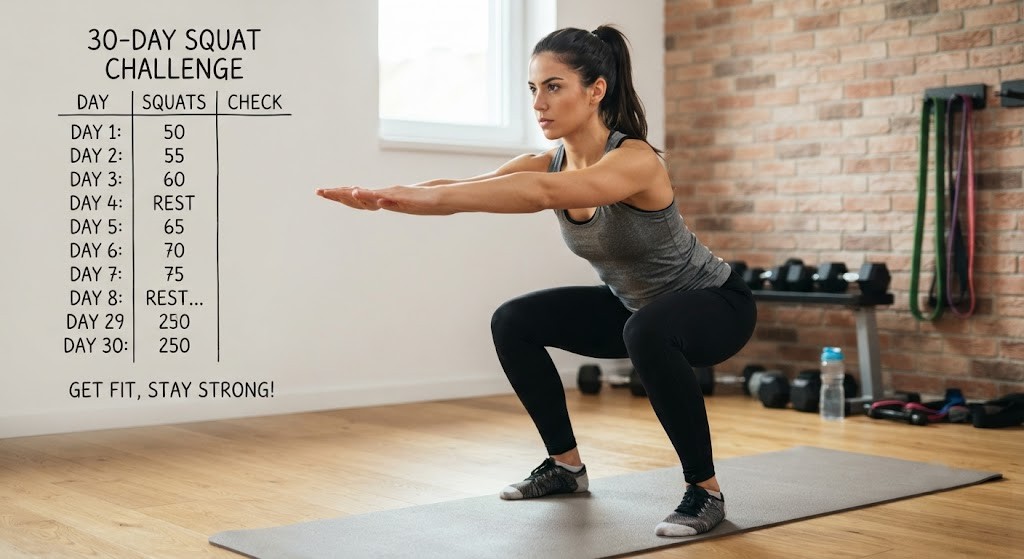
Most people know squats are one of the simplest exercises for training the lower body. But simply doing random sets of squats every day does not necessarily create an effective workout plan.
A structured 30 day squat challenge gives you a clear progression, planned recovery, and different squat variations to keep your training interesting. Whether you are completely new to exercise or already comfortable with bodyweight training, the right approach can help you improve squat technique, lower-body muscular endurance, and exercise consistency.
In this guide, you’ll find a complete 30-day squat challenge calendar, proper squat form instructions, beginner-friendly modifications, squat variations, equipment options, realistic expectations for results, and practical advice for what to do after the 30 days.
What Is a 30-Day Squat Challenge?
A 30 day squat challenge is a structured exercise program that uses planned squat repetitions, variations, or progression over 30 days to improve lower-body fitness and exercise consistency.
Instead of performing the same number of squats every day, a well-designed challenge gradually changes the training demand. This can involve increasing repetitions, introducing variations, changing the tempo, or adding recovery days.
For example, a beginner may start with 15 controlled bodyweight squats and gradually progress toward 40–50 repetitions or more challenging variations by the end of the month.
The biggest advantage of a structured challenge is that it gives you a clear plan to follow. You do not have to decide what exercise to perform each day—you simply work through the schedule while keeping good technique a priority.
Moreover, a squat challenge can fit easily into a bodyweight workout at home because it requires little or no equipment. Full Body Workout for Beginners
Why Is a 30-Day Squat Challenge Beneficial?
A 30-day squat challenge can help improve squat practice, lower-body muscular endurance, and exercise consistency. However, individual results vary depending on factors such as training experience, nutrition, recovery, and overall activity.
Squats primarily train the hips and thighs while also requiring the trunk to stabilize the movement. Regularly practicing controlled squats can help beginners become more comfortable with the basic movement pattern of sitting down and standing up while maintaining control.
Benefits of a Structured Squat Challenge
A well-planned challenge can help you:
- Practice consistent squat technique.
- Improve lower-body muscular endurance.
- Build an exercise habit.
- Become more comfortable with bodyweight strength movements.
- Learn different squat variations.
- Progress gradually instead of immediately performing very high repetitions.
- Add structured movement to an at-home fitness routine.
Additionally, a challenge can encourage regular physical activity. Adults are generally advised to perform 150–300 minutes of moderate-intensity aerobic activity per week and muscle-strengthening activities on at least two days per week. — Source: World Health Organization, 2021.
Furthermore, the CDC recommends that adults perform muscle-strengthening activities on at least 2 days each week while also getting at least 150 minutes of moderate-intensity aerobic activity weekly. — Source: CDC, 2025.
A squat challenge can therefore be one part of a broader exercise routine rather than your entire fitness program.
For more lower-body training ideas, combine the challenge with a leg workout or glute workout at home.
How Do You Follow a 30-Day Squat Challenge?
A beginner squat challenge should increase training demand gradually rather than requiring a very high number of squats every day.
This 30 day squat challenge uses progressive repetitions, different squat variations, and recovery days. The goal is to develop consistency while avoiding the temptation to chase increasingly large repetition numbers at the expense of technique.
30-Day Squat Challenge Calendar
| Day | Workout | Target |
|---|---|---|
| 1 | Bodyweight squats | 15 reps |
| 2 | Bodyweight squats | 20 reps |
| 3 | Bodyweight squats | 20 reps |
| 4 | Rest + mobility | — |
| 5 | Bodyweight squats | 25 reps |
| 6 | Sumo squats | 20 reps |
| 7 | Rest | — |
| 8 | Bodyweight squats | 25 reps |
| 9 | Pause squats | 20 reps |
| 10 | Bodyweight squats | 30 reps |
| 11 | Rest + mobility | — |
| 12 | Sumo squats | 25 reps |
| 13 | Bodyweight squats | 30 reps |
| 14 | Rest | — |
| 15 | Pause squats | 25 reps |
| 16 | Bodyweight squats | 35 reps |
| 17 | Squat pulses | 20 reps |
| 18 | Rest + mobility | — |
| 19 | Sumo squats | 30 reps |
| 20 | Bodyweight squats | 35 reps |
| 21 | Rest | — |
| 22 | Narrow-stance squats | 25 reps |
| 23 | Pause squats | 30 reps |
| 24 | Bodyweight squats | 40 reps |
| 25 | Rest + mobility | — |
| 26 | Sumo squats | 35 reps |
| 27 | Squat pulses | 30 reps |
| 28 | Rest | — |
| 29 | Bodyweight squats | 45 reps |
| 30 | Squat challenge finish | 50 controlled reps |
The number of repetitions is a target, not a requirement to sacrifice good form. If 30 repetitions become difficult, split them into 2 sets of 15 with a short rest instead of rushing through the final repetitions.
How to Make the Challenge Easier
If you are new to exercise, you do not need to start at the full prescribed volume.
Consider:
- Reducing each target by 25–50%.
- Dividing repetitions into multiple smaller sets.
- Taking additional rest when necessary.
- Using a chair or stable support while learning the movement.
- Focusing on controlled repetitions rather than speed.
The objective is to progress gradually while maintaining good movement quality.
What Is the Best 30-Day Squat Challenge for Beginners?
The best 30 day squat challenge for beginners is one that uses manageable volume, gradual progression, and regular recovery.
Beginners should prioritize movement quality over completing a specific repetition target at all costs. If your technique breaks down, reduce the number of repetitions or take a short rest before continuing.
People new to bodyweight training can reduce each target by 25–50% and progress when the movement feels controlled.
How Do You Do a Squat With Proper Form?
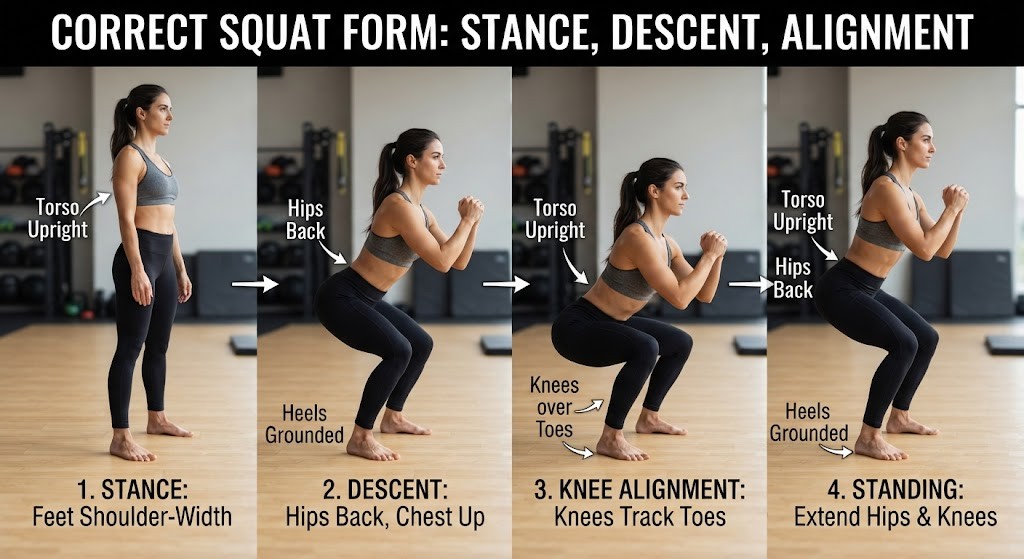
Proper squat form involves maintaining a stable foot position, bracing your torso, controlling the descent and ascent, and keeping your knees aligned with the direction of your toes.
Good technique should remain the priority throughout every day of the challenge.
Step-by-Step Squat Form
Use this simple sequence when performing a bodyweight squat:
- Stand: Place your feet around shoulder-width apart.
- Brace: Tighten your abdominal muscles before descending.
- Descend: Push your hips back and bend your knees under control.
- Track: Keep your knees moving in line with your toes.
- Rise: Push through the floor and return to standing.
- Breathe: Exhale as you drive upward.
Your exact stance and depth can vary based on your individual mobility and body structure. The key is to perform the movement under control rather than forcing an uncomfortable range of motion.
Common Squat Form Mistakes
Avoid:
- Allowing the knees to collapse inward.
- Lifting the heels unnecessarily.
- Losing control during the descent.
- Rushing through repetitions.
- Allowing your torso to lose stability.
- Continuing repetitions after technique has significantly deteriorated.
Research shows that altered knee alignment can change joint torques and muscle involvement during squatting. — Source: PubMed, 2016.
What Squat Variations Can You Add to a 30-Day Challenge?
Squat variations are different versions of the basic squat that change stance, tempo, range of motion, or muscular demand.
Adding variations can make your 30 day squat challenge more engaging without relying exclusively on higher repetition counts.
Bodyweight Squats
Bodyweight squats are the foundation of this challenge. They allow you to practice the basic movement without additional resistance.
They are particularly useful for beginners because you can focus on stance, balance, knee tracking, depth, and controlled movement.
Sumo Squats
Sumo squats use a wider stance than a traditional bodyweight squat. This changes the movement pattern and provides a different lower-body training stimulus.
Keep the movement controlled and use a stance that feels stable and comfortable.
Pause Squats
Pause squats introduce a short pause near the bottom of the squat. The pause encourages greater control and prevents you from relying on momentum to move through the repetition.
They can be particularly useful when you want to make a smaller number of repetitions more challenging.
Squat Pulses
Squat pulses involve small, controlled movements rather than completing a full standing repetition each time. They can increase local muscular fatigue and add variety to the workout.
Because pulses can become tiring quickly, maintain control instead of turning them into rapid bouncing movements.
Narrow-Stance Squats
Narrow-stance squats bring the feet closer together than a conventional squat. They provide another way to vary the basic movement while keeping the exercise equipment-free.
For example, you can replace a difficult 40-repetition set with 25 standard squats plus 10 pause squats for a more varied workout.
Best Glute Workout for Muscle Growth
How Many Squats Should You Do Each Day for 30 Days?
The appropriate number of squats per day depends on your training experience, recovery, technique, and the difficulty of the variation.
There is no universal number of squats that every person should perform for 30 consecutive days.
For example, a beginner may comfortably perform 15–20 repetitions, while an experienced exerciser may tolerate substantially more volume.
The important principle is progressive training rather than simply accumulating the largest possible number of repetitions.
Is More Always Better?
Not necessarily.
Doing hundreds of squats every day does not automatically produce better results. Excessive repetition can also make it harder to maintain proper technique, particularly when fatigue sets in.
Moreover, daily challenging squatting is not necessary for building a stronger lower body. A gradual increase in training demand is generally more practical than continually adding repetitions.
Current physical activity guidance also emphasizes gradually increasing activity rather than making sudden large increases. — Source: WHO, 2021.
Can You Do a 30-Day Squat Challenge at Home Without Equipment?
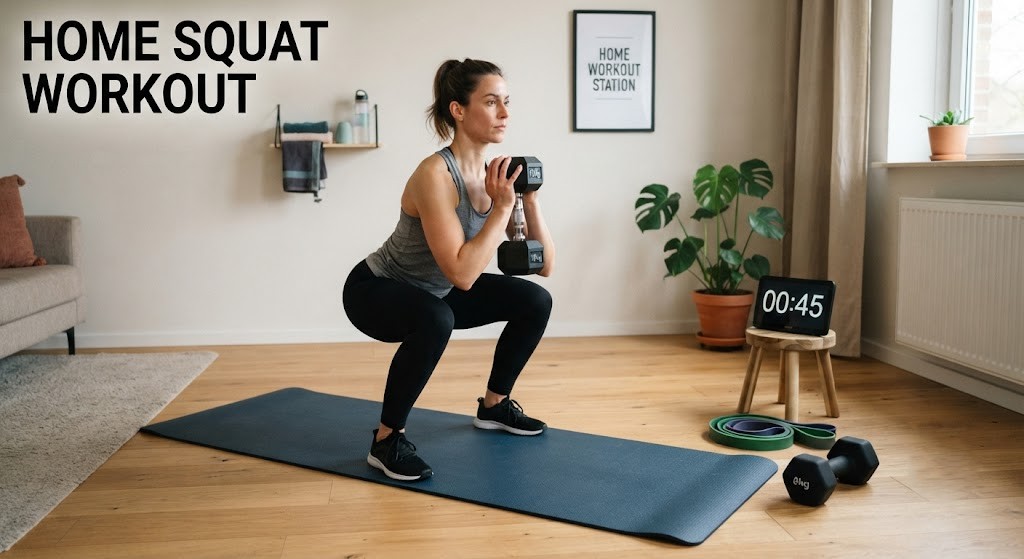
Yes. A 30 day squat challenge at home can be completed without equipment because bodyweight squats require only enough space to move safely.
Optional equipment can be introduced later to increase resistance or provide variety once basic technique has been established.
Optional Equipment for a Squat Challenge
| Equipment | How it can help |
|---|---|
| Yoga mat | Adds comfort during mobility exercises. |
| Resistance band | Adds external resistance to some squat variations. |
| Dumbbells | Increase resistance for stronger trainees. |
| Timer | Helps organize timed sets and rest periods. |
For example, someone completing the beginner version can use only bodyweight and a chair for support while learning the movement.
home workout without equipment
What Equipment and Tools Do You Need for a 30-Day Squat Challenge?
The basic 30 day squat challenge requires no equipment. However, simple tools can make progression easier for intermediate participants.
Bodyweight training is especially convenient for people who want a lower body workout at home without investing in a full home gym.
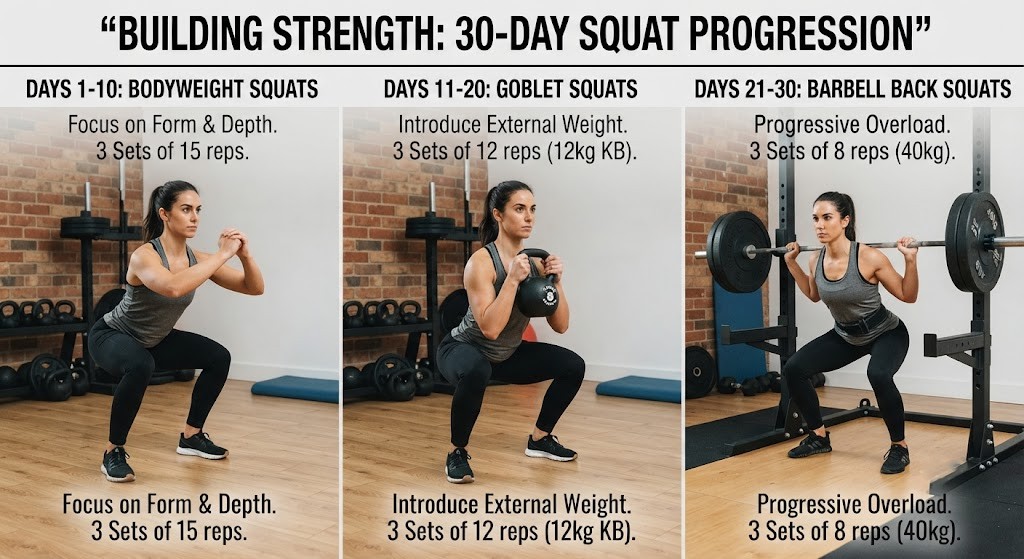
Once bodyweight squats become comfortable, a resistance band or dumbbell can provide additional resistance. Increasing resistance can create a stronger training stimulus without endlessly increasing repetition counts.
The key is to establish good bodyweight squat mechanics first and then progress appropriately.
What Results Can You Expect From 30 Days of Squats?
A 30 day squat challenge can improve lower-body muscular endurance, movement practice, and exercise consistency. However, visible muscle or body-composition changes vary considerably between individuals.
Your results can be influenced by:
- Training history.
- Nutrition.
- Sleep and recovery.
- Genetics.
- Resistance level.
- Overall physical activity.
- Consistency with the program.
For example, a beginner may notice that bodyweight squats feel easier after several weeks and that they can complete more repetitions with better control.
Will Your Legs or Glutes Look Different After 30 Days?
Some people may notice changes in how their lower body feels or performs, particularly if they are new to resistance exercise. However, there is no guaranteed amount of muscle growth or visual change after exactly 30 days.
The amount of visible change depends on the overall training stimulus and individual factors.
Therefore, the challenge is better viewed as a way to establish a foundation for continued lower-body training rather than a guarantee of dramatic physical transformation within one month.
Can a 30-Day Squat Challenge Help With Weight Loss?
Squats alone should not be treated as a guaranteed weight-loss strategy.
The CDC notes that physical activity increases energy expenditure, while reducing calorie intake also contributes to creating the calorie deficit associated with weight loss. — Source: CDC, 2026.
Therefore, a 30 day weight loss workout challenge should combine strength training with appropriate aerobic activity, nutrition, recovery, and sustainable habits. 30 day weight loss workout challenge
Can Squats Alone Help You Lose Weight?
Squats alone are unlikely to produce predictable weight loss because body weight is influenced by total energy intake, activity, and other individual factors.
Squats are better viewed as one component of a complete fitness routine.
For example, pairing the squat challenge with brisk walking, full-body strength exercises, and balanced nutrition creates a more complete approach than performing hundreds of squats each day.
Moreover, adults can spread their recommended weekly activity across multiple sessions rather than completing everything in one workout. — Source: CDC, 2025.
Should You Do Squats Every Day?
You do not need to perform challenging squat workouts every day because recovery is an important part of progressive training.
The calendar intentionally includes rest and mobility days to help manage fatigue and support continued good technique.
For example, if your legs remain unusually sore or your squat form deteriorates, reduce the volume and prioritize recovery rather than forcing yourself to complete the planned number.
Why Are Rest Days Included?
Rest days give you an opportunity to recover between more demanding sessions. They also make the challenge more sustainable than simply performing high-volume squats every day.
Mobility days can include gentle movement that helps you stay active without adding another challenging squat workout.
Compression Boots Benefits for Recovery
How Can Beginners Modify the 30-Day Squat Challenge?
Beginners should feel free to modify the challenge based on their current fitness level.
A practical approach is to focus on the prescribed movement while reducing the repetition target. You can also divide the day’s repetitions into smaller sets.
Beginner Modification Checklist
Before increasing your squat volume, ask:
- Can I maintain a stable foot position?
- Can I control the descent?
- Do my knees remain aligned with my toes?
- Can I keep my torso braced?
- Can I complete the repetitions without rushing?
- Do I recover adequately between sessions?
If the answer to several of these questions is no, reduce the difficulty before progressing.
This approach helps make the 30 day squat challenge accessible without turning the repetition target into the only measure of success.
What Should You Do After Completing a 30-Day Squat Challenge?
After completing a 30 day squat challenge, progress by adding resistance, increasing exercise difficulty, or following a balanced lower-body strength program instead of simply performing more repetitions.
The goal should be sustainable progression rather than an endless repetition challenge.
For example, you could progress from bodyweight squats to:
- Goblet squats.
- Split squats.
- Lunges.
- Hip hinges.
- Other leg-strength movements.
Strength Training: Build Muscle, Strength & Lifelong Fitness
Build a More Balanced Workout
Although squats are useful, a complete strength routine should not rely on one movement.
Combining lower-body exercises with upper-body and core movements creates a more balanced training routine. A core workout for beginners can complement lower-body training without adding excessive squat volume.
For people who enjoy bodyweight challenges, a 30 day calisthenics challenge can provide a broader progression beyond squats.
How Can You Stay Consistent Beyond 30 Days?
The long-term value of a 30 day squat challenge comes from building a sustainable exercise habit rather than completing one month of high-volume repetitions.
A structured progression gives you an opportunity to practice proper squat form, improve lower-body endurance, and develop consistency. Once the 30 days are finished, the next goal should be continuing to train rather than immediately increasing the number of squats again.
Choose your next step based on your fitness goal:
- For strength: Gradually add resistance.
- For general fitness: Combine squats with full-body exercises.
- For endurance: Progress volume carefully.
- For variety: Introduce additional squat and lower-body variations.
- For sustainable fitness: Continue balancing training with recovery.
Conclusion: Is a 30-Day Squat Challenge Worth Trying?
A 30 day squat challenge can be a simple and practical way to build consistency, practice squat technique, and improve lower-body muscular endurance. The most effective approach is not about completing the largest possible number of squats—it is about following a gradual progression while maintaining good form and allowing adequate recovery.
Use the 30-day calendar as a starting point rather than an endpoint. Once you complete the challenge, you can add resistance, explore more challenging lower-body exercises, or move into a broader strength-training routine.
Most importantly, consistency beats extreme repetition. A sustainable workout routine that you can continue beyond 30 days will ultimately be more valuable than simply chasing a higher squat count.
FAQs
What is a 30 day squat challenge?
A 30 day squat challenge is a structured workout that gradually increases squat repetitions or difficulty over 30 days.
Is a 30 day squat challenge effective?
A 30 day squat challenge can help improve lower-body endurance, squat technique, and exercise consistency.
What happens if I do 100 squats daily for 30 days?
Doing 100 squats daily may improve muscular endurance, but excessive volume can cause fatigue and affect proper form.
How many squats should a beginner do per day?
A beginner can start with 15–20 controlled squats per day and gradually increase the repetitions.
Can beginners do a 30 day squat challenge?
Yes, beginners can do a 30 day squat challenge by starting with manageable repetitions and focusing on proper form.
Can I do a 30 day squat challenge at home?
Yes, a 30 day squat challenge can be completed at home with bodyweight squats and little or no equipment.
Will a 30 day squat challenge build muscle?
A 30 day squat challenge can improve lower-body muscular endurance, while muscle growth depends on training, nutrition, and recovery.
Can a 30 day squat challenge help with weight loss?
A 30 day squat challenge can support physical activity, but weight loss also depends on nutrition and overall calorie balance.
Should I do squats every day for 30 days?
You do not need to do challenging squats every day because rest days can help support recovery and proper form.
What should I do after a 30 day squat challenge?
After 30 days, you can add resistance, try advanced squat variations, or follow a balanced lower-body workout.