
Free FFMI Calculator
Calculate your Fat-Free Mass Index, lean mass, and height-adjusted FFMI.
What does your result mean?
FFMI formula
Fat-free mass = weight × (1 − body-fat percentage ÷ 100).
FFMI = fat-free mass in kg ÷ height in meters squared.
Adjusted FFMI = FFMI + 6.1 × (1.8 − height in meters).
This calculator provides estimates, not medical advice. Accuracy depends on the body-fat measurement. FFMI alone does not measure strength, health, or athletic performance.
Tracking your weight alone cannot tell you how much of your body weight comes from fat-free mass. A Free FFMI Calculator helps estimate your Fat-Free Mass Index using your height, weight, and body fat percentage.
Whether you're building muscle, losing fat, or improving body composition, FFMI provides another way to monitor your fitness progress. Learn how to calculate FFMI, understand your results, and use them effectively.
What Is an FFMI Calculator?
An FFMI calculator estimates your fat-free mass relative to your height. Fat-free mass includes muscles, bones, organs, body water, and other non-fat tissues.
It can help you track body composition changes during muscle-building, cutting, and body-recomposition programs. However, FFMI does not directly measure skeletal muscle.
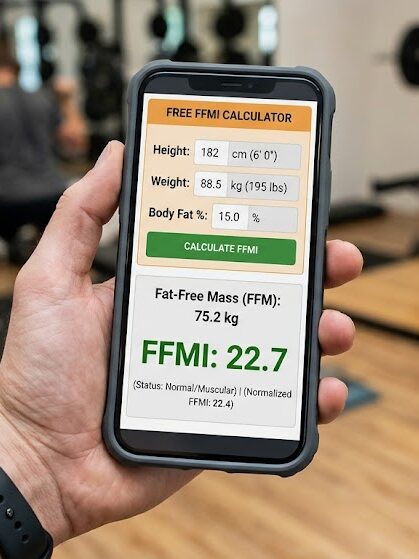
How to Calculate FFMI
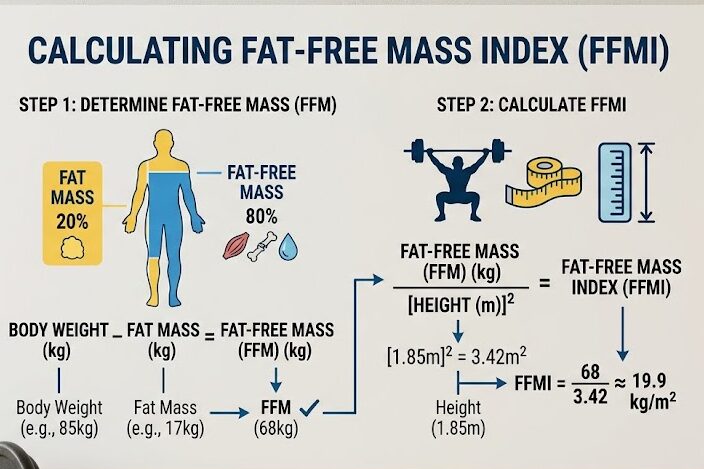
Calculating FFMI involves two main steps.
Step 1: Calculate Fat-Free Mass
Formula:
Fat-Free Mass = Weight × (1 − Body Fat Percentage ÷ 100)
For example, if you weigh 80 kg and have 20% body fat:
80 × (1 − 20 ÷ 100) = 64 kg
Your estimated fat-free mass is 64 kg.
Step 2: Calculate Standard FFMI
Formula:
[
\text{FFMI}=\frac{\text{Fat-Free Mass (kg)}}{\text{Height (m)}^2}
]
If your fat-free mass is 64 kg and your height is 1.80 m:
[
\text{FFMI}=\frac{64}{1.80^2}\approx19.75
]
Your estimated FFMI is 19.75.
What Is Normalized FFMI?
Normalized FFMI adjusts your standard score for height using a commonly used reference-height formula.
Formula:
[
\text{Normalized FFMI}=\text{FFMI}+6.1(1.8-\text{Height in m})
]
For someone who is 1.70 m tall with a standard FFMI of 20:
20 + 6.1 × (1.8 − 1.7) = 20.61
Normalized FFMI helps adjust comparisons for height but remains an estimate.
How to Use the Free FFMI Calculator
Follow these simple steps:
- Enter your current weight.
- Enter your height using the requested units.
- Enter your estimated body fat percentage.
- Click Calculate.
- Review your fat-free mass, standard FFMI, and normalized FFMI if available.
For reliable comparisons, use consistent measurement methods. Inaccurate body fat estimates can significantly affect your results.
What Is a Good FFMI Score?
A good FFMI score depends on sex, age, training history, body composition, and the population used for comparison. There is no single score that guarantees an ideal physique, good health, or athletic performance.
A higher FFMI indicates more estimated fat-free mass relative to height, but it does not necessarily mean more skeletal muscle.
Can FFMI determine natural muscular potential?
No. FFMI cannot reliably determine someone's maximum natural muscularity or prove whether they use performance-enhancing drugs. Use it as one progress indicator rather than a definitive classification.
How Accurate Is an FFMI Calculator?
An FFMI calculator performs a mathematical calculation, but its accuracy depends on your measurements and body fat estimate.
Common body fat estimation methods include:
- Skinfold measurements: Depend on technique and measurement equations.
- Bioelectrical impedance (BIA): Can be affected by hydration.
- DEXA scans: Estimate body composition using X-ray technology.
- Visual estimates: Are subjective and difficult to reproduce consistently.
For better comparisons, measure your weight consistently and use the same body fat estimation method over time.
FFMI vs. BMI: What Is the Difference?
FFMI and BMI both use height, but they measure different things.
| Feature | FFMI | BMI |
|---|---|---|
| Measures | Fat-free mass relative to height | Total weight relative to height |
| Body fat estimate | Required | Not required |
| Muscle-related insight | Provides context about fat-free mass | Cannot distinguish fat from lean mass |
| Main limitation | Depends on body fat estimation | May misclassify highly muscular individuals |
You can use a BMI calculator to examine different aspects of your measurements.
How Can You Improve Your FFMI?
Improving FFMI generally involves increasing fat-free mass relative to height. Your progress depends on training, nutrition, recovery, and measurement accuracy.
Follow Progressive Resistance Training
Use a structured workout plan and gradually increase resistance, repetitions, or training volume as appropriate.
Explore the progressive overload workout plan and strength training for beginners.
Eat Enough Protein and Calories
Adequate protein and sufficient energy support muscle repair, growth, and training recovery.
Use the free protein intake calculator and explore the high-protein diet for muscle growth.
Prioritize Recovery
Sleep, rest days, and consistent training habits support long-term progress. Learn more through the muscle recovery and rest days.
Choose the Right Nutrition Strategy
- Muscle gain: Consider a controlled calorie surplus and adequate protein.
- Fat loss: Use a sustainable calorie deficit while maintaining resistance training.
- Body recomposition: Track strength, weight, waist measurements, and estimated body composition together.
Explore the lean bulk diet plan.
How Often Should You Calculate FFMI?
Recalculate FFMI every four to eight weeks under similar measurement conditions. Record your weight, waist measurement, strength progress, and estimated FFMI to identify longer-term trends.
Conclusion
A Free FFMI Calculator helps estimate fat-free mass relative to height using your weight and body fat percentage. It can support muscle-building, fat-loss, and body-recomposition tracking.
However, FFMI is not a direct measurement of skeletal muscle or a complete assessment of health. Combine your results with strength progress, body measurements, nutrition, and recovery to evaluate your fitness journey more effectively.
FAQs
What does FFMI stand for?
FFMI stands for Fat-Free Mass Index, which estimates fat-free mass relative to height.
How do I calculate the FFMI?
Divide your fat-free mass in kilograms by your height in meters squared.
Is a 27 FFMI good?
An FFMI of 27 indicates high estimated fat-free mass relative to height, but it doesn't prove natural or enhanced muscle development.
Is 30% body fat chubby?
It depends on sex, age, and individual body composition. Body fat percentage alone doesn't define appearance or health.
How big can I get naturally?
Your natural muscle potential depends on genetics, training, nutrition, recovery, and consistency.
What is a good FFMI score?
It varies by sex, age, training experience, and the reference population.
Is FFMI better than BMI?
FFMI estimates fat-free mass, while BMI measures total body weight relative to height.
Can I calculate FFMI without body fat percentage?
Not reliably with the standard formula, because you need an estimate of fat-free mass.
Does a higher FFMI mean more muscle?
Not necessarily. Fat-free mass also includes bones, organs, and body water.
How accurate is a free FFMI calculator?
Accuracy depends on the quality of your measurements and body fat estimate.
How often should I check my FFMI?
Every four to eight weeks is a practical interval for tracking changes.
4 thoughts on “Free FFMI Calculator: Calculate Fat-Free Mass Index & Track Muscle Growth”