
Yoga for nervous system regulation combines gentle movement, mindful breathing, and relaxation to help you manage everyday stress and feel more grounded. Whether you want to unwind after a busy day or develop a calming daily routine, simple yoga practices can help you build greater body awareness and relaxation.
What Is Yoga for Nervous System Regulation?
Yoga for nervous system regulation is a mind-body practice that uses comfortable postures, breathing techniques, and mindful awareness to support relaxation and stress management. It encourages you to slow down, notice physical sensations, and respond more thoughtfully to stressful situations.
The autonomic nervous system regulates many automatic body functions, including heart rate, breathing, and digestion. Its sympathetic branch helps prepare the body for action, while its parasympathetic branch supports functions associated with rest and recovery. Both branches work together to help the body respond to changing demands.
Gentle yoga may support relaxation by combining controlled movement, attention to breathing, and periods of rest. However, yoga does not automatically reset the nervous system or guarantee relief from anxiety or stress-related symptoms.
yoga breathing exercises for relaxation
Why Does Yoga for Nervous System Regulation Matter?
Yoga for nervous system regulation matters because everyday stress can affect sleep, mood, concentration, muscle tension, and general well-being. A regular, comfortable practice can create time to pause, release unnecessary physical tension, and develop practical relaxation habits.
Potential benefits include:
- Stress management: Gentle movement and breathing may help you feel less tense.
- Improved body awareness: You may become more aware of physical signs of stress, such as clenched jaws or raised shoulders.
- Relaxation: Supported poses provide an opportunity to slow down and rest.
- Sleep preparation: A gentle evening routine may help some people transition toward bedtime.
- Mindful responses: Paying attention to present-moment sensations can help you recognize emotions without immediately reacting to them.
- Physical mobility: Gentle yoga movements can help maintain flexibility and comfortable joint movement.
Research suggests yoga may help some people manage stress and anxiety symptoms, although the strength of evidence varies across studies and outcomes. It should complement appropriate medical or mental health care rather than replace it. (Source: National Center for Complementary and Integrative Health, 2023)
How Does Yoga Affect the Nervous System?
Yoga may influence stress responses through breathing, physical movement, focused attention, and relaxation. These practices work together to help some people feel calmer and become more aware of how their bodies respond to stress.
1. Gentle breathing encourages relaxation
Slow, comfortable breathing may help you feel more settled and can influence heart rate and other autonomic responses. You do not need to take unusually deep breaths to benefit.
Try breathing naturally through your nose if comfortable. Allow your exhale to last slightly longer than your inhale, but do not force the rhythm or hold your breath.
2. Gentle movement helps release physical tension
Slow yoga movements allow you to notice tightness in areas such as the neck, shoulders, back, and hips. Moving within a comfortable range can help you maintain mobility while taking a break from daily demands.
3. Mindfulness improves body awareness
Mindfulness involves noticing your breathing, physical sensations, and thoughts without judging them. Rather than trying to eliminate every stressful thought, you can practice returning your attention to the present moment.
mindfulness exercises for beginners
4. Rest provides time to unwind
Restorative poses and relaxation exercises create space to pause without needing to achieve a physical goal. This can make yoga a useful addition to a daily stress-management routine.
Best Yoga Poses for Nervous System Regulation
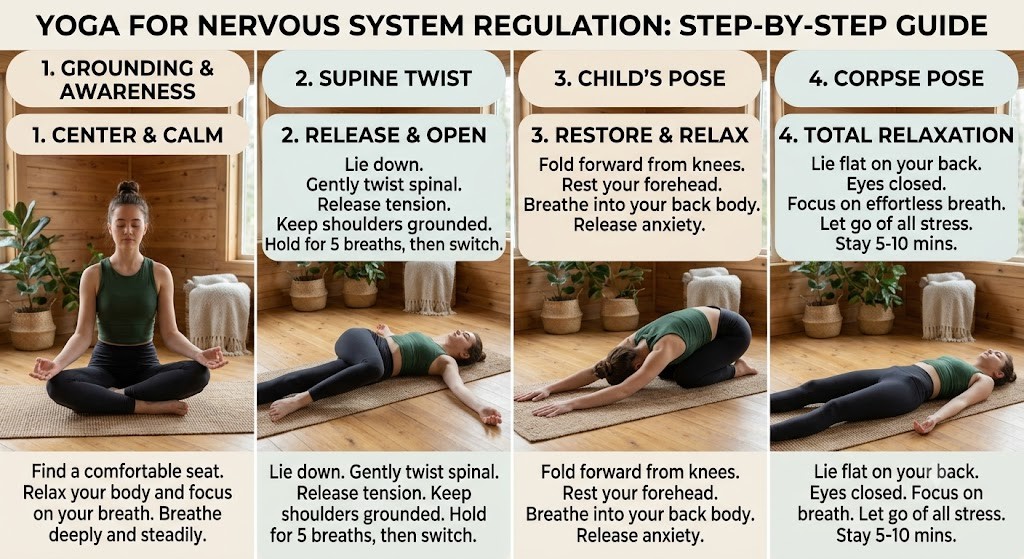
The best yoga poses for nervous system regulation are comfortable postures that encourage gentle movement, rest, and mindful breathing without creating unnecessary strain.
1. Child’s Pose (Balasana)
Child’s Pose is a resting position that gently stretches the back and hips while providing an opportunity to breathe comfortably.
How to do it:
- Kneel on a yoga mat.
- Bring your big toes together and separate your knees to a comfortable width.
- Slowly lower your torso toward your thighs.
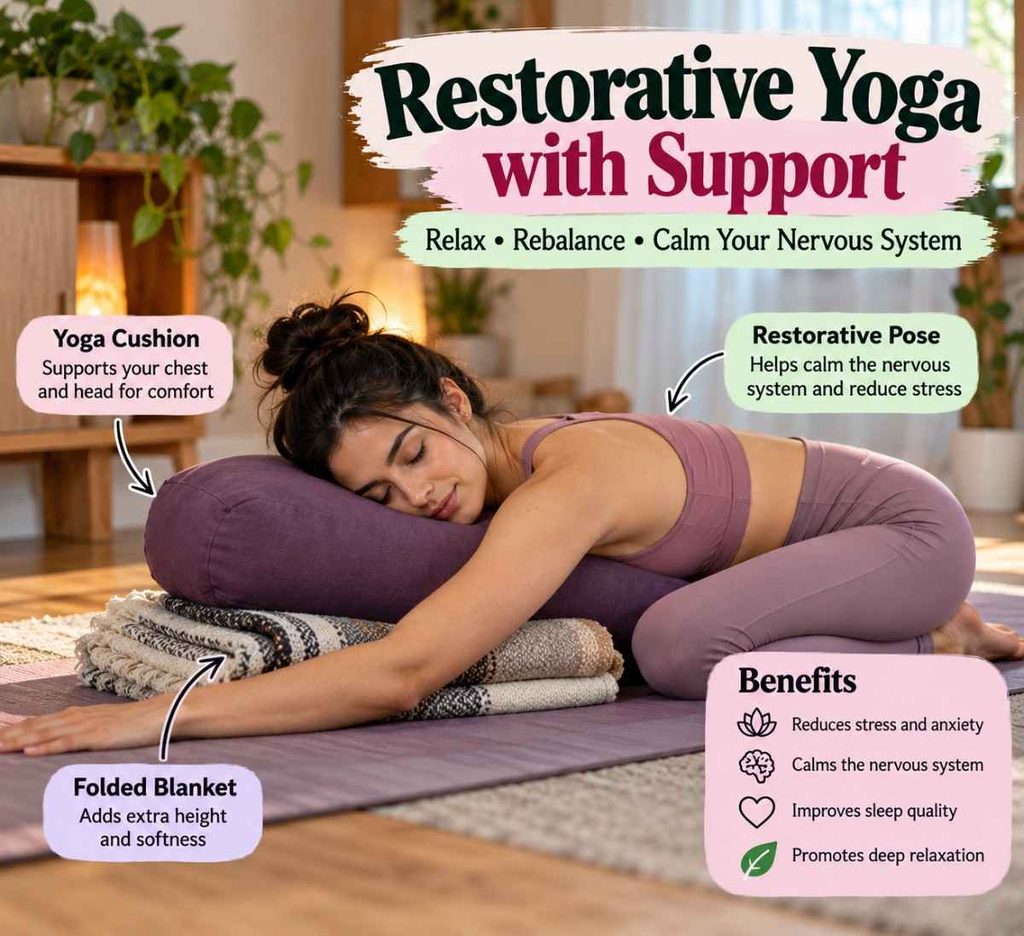
- Rest your forehead on the mat or a cushion.
- Stay for 30–60 seconds while breathing naturally.
Best for: Taking a quiet break when you feel tense or mentally overloaded.
Modification: Place a cushion under your chest or forehead. If kneeling hurts your knees, choose another comfortable resting position.
2. Cat-Cow Pose (Marjaryasana-Bitilasana)
Cat-Cow Pose combines gentle spinal movements with breathing to encourage mobility and body awareness.
How to do it:
- Start on your hands and knees, with your wrists below your shoulders.
- Inhale gently as you lift your chest and tilt your pelvis slightly upward.
- Exhale as you round your back and tuck your chin comfortably.
- Continue slowly for 6–10 cycles.
Best for: Reducing feelings of stiffness and reconnecting with comfortable movement.
Modification: Reduce the range of motion if your wrists, neck, or back feel uncomfortable.
3. Legs-Up-the-Wall Pose
Legs-Up-the-Wall is a restorative yoga variation in which you lie on your back with your legs supported by a wall.
How to do it:
- Sit sideways beside a wall.
- Lower your upper body onto the mat as you bring your legs up the wall.
- Adjust your position until your legs feel comfortable.
- Rest your arms by your sides.
- Stay for 2–5 minutes if the position feels good.
Best for: Quiet relaxation after a busy day.
Modification: Keep your knees slightly bent or place a cushion under your head. Leave the pose if you experience discomfort, dizziness, or unusual pressure.
4. Supported Reclined Bound Angle Pose
This restorative pose allows you to rest on your back while your knees fall outward gently, with cushions supporting your thighs.
How to do it:
- Lie on your back with your knees bent.
- Bring the soles of your feet together.
- Allow your knees to open only as far as feels comfortable.
- Place cushions beneath your thighs.
- Relax for 1–3 minutes while breathing naturally.
Best for: A gentle, supported relaxation session.
Modification: Keep your knees closer together if the hip stretch feels uncomfortable.
5. Corpse Pose (Savasana)
Savasana is a relaxation posture that involves lying comfortably and allowing your body to rest without trying to achieve a particular mental state.
How to do it:
- Lie on your back on a yoga mat.
- Let your legs rest apart and your arms settle beside your body.
- Close your eyes if comfortable, or keep them softly open.
- Notice your breathing without trying to control it.
- Rest for 3–5 minutes.
Best for: Ending a yoga session with quiet rest and body awareness.
Modification: Lie on your side or place a cushion beneath your knees if lying flat is uncomfortable.
restorative yoga for relaxation
Best Breathing Exercises for Nervous System Regulation
Gentle breathing exercises can complement yoga by encouraging relaxation and helping you direct your attention away from stressful thoughts. The best technique is one that feels comfortable rather than forced.
Diaphragmatic breathing
Diaphragmatic breathing focuses on allowing the abdomen to move naturally during breathing.
- Sit comfortably or lie on your back.
- Place one hand on your abdomen.
- Inhale gently through your nose if comfortable.
- Notice your abdomen rising naturally.
- Exhale without pushing the air out.
- Continue for 1–3 minutes.
If focusing on breathing makes you anxious or lightheaded, stop the exercise and return to normal breathing.
Gentle extended-exhale breathing
This technique involves allowing the exhale to be slightly longer than the inhale, without breath-holding.
- Inhale comfortably for approximately 3 seconds.
- Exhale gently for approximately 4 seconds.
- Repeat for 1–2 minutes if comfortable.
These timings are only examples. You can breathe at your natural pace if counting feels restrictive.
Alternate-nostril breathing
Alternate-nostril breathing is a traditional yoga practice in which you breathe through one nostril at a time. Some people find it calming, although evidence for its specific effects on nervous system regulation remains limited.
To try a gentle version, sit comfortably and close one nostril lightly while breathing through the other. Switch sides for the next breath, keeping the breathing natural and avoiding breath-holding.
pranayama breathing techniques
A 10-Minute Yoga Routine for Nervous System Regulation
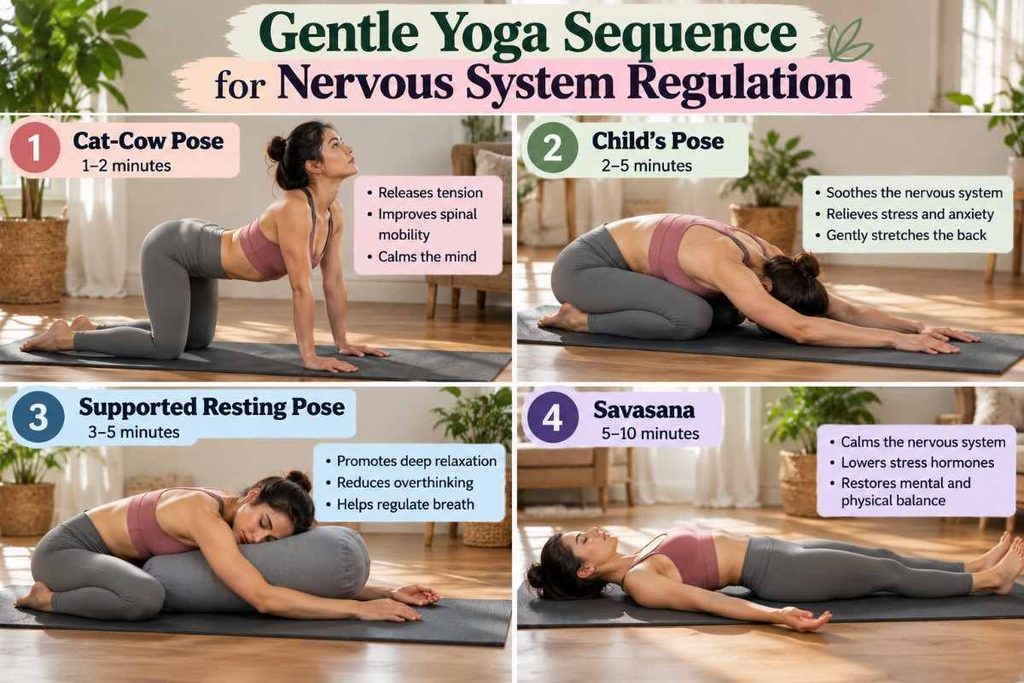
A 10-minute yoga routine can help you build a manageable relaxation habit without requiring an elaborate workout or a large amount of free time.
| Time | Practice | Purpose |
|---|---|---|
| Minutes 1–2 | Comfortable breathing | Settle into the session |
| Minutes 3–4 | Cat-Cow Pose | Encourage gentle spinal movement |
| Minutes 5–6 | Child’s Pose | Rest and notice your breathing |
| Minutes 7–8 | Supported resting pose | Relax in a comfortable position |
| Minutes 9–10 | Savasana | Finish with quiet rest |
How to follow the routine:
- Choose a quiet space where you feel comfortable.
- Begin with natural breathing instead of immediately trying to slow it down.
- Move gently between poses and avoid pushing through pain.
- Use cushions or folded blankets for support.
- Finish with a short period of rest.
You can practice this sequence in the morning, during a work break, or before bed. Shorten or change any position that does not feel comfortable.
morning yoga routine for beginners
Which Type of Yoga Is Best for Nervous System Regulation?
Gentle yoga styles are practical starting points when your primary goal is relaxation rather than an intense workout.
| Yoga style | Main focus | Suitable for |
|---|---|---|
| Restorative yoga | Supported positions and rest | People who prefer a restful practice |
| Hatha yoga | Postures, breathing, and controlled movement | Beginners who prefer a slower class |
| Yin yoga | Longer-held, mostly floor-based poses | People who enjoy stillness and gentle stretching |
| Gentle flow yoga | Slow transitions between poses | People who prefer relaxation alongside movement |
| Yoga nidra | Guided relaxation and awareness | People who prefer a guided, lying-down practice |
No single yoga style is best for everyone. Choose one that feels physically comfortable and emotionally manageable. If stillness makes you uncomfortable, try gentle movement, walking, or a simple stretching routine instead.
yoga nidra for deep relaxation
How Often Should You Practice Yoga for Nervous System Regulation?
Practicing gentle yoga for 5–15 minutes on most days is a reasonable starting point for developing a consistent relaxation habit. You do not need to practice for an hour or complete every pose to make the routine worthwhile.
A simple weekly schedule could look like this:
- Monday: Gentle yoga and comfortable breathing.
- Tuesday: Short mobility session.
- Wednesday: Restorative yoga.
- Thursday: Cat-Cow Pose and Savasana.
- Friday: Gentle yoga flow.
- Saturday: A longer session if you enjoy it.
- Sunday: Rest or take a comfortable walk.
Research suggests yoga may help some people manage stress and anxiety symptoms, but outcomes vary. Consistency, comfort, and selecting a suitable practice are more useful than following a rigid schedule.
Signs Your Yoga Practice May Be Helping
The effects of yoga for nervous system regulation are best assessed through your everyday experiences rather than a single measurement.
You may notice that:
- You feel calmer after a session.
- Your shoulders or jaw feel less tense.
- You find it easier to pause before reacting to stress.
- You become more aware of your breathing and physical tension.
- Your evening routine feels more restful.
- You feel more comfortable taking breaks when overwhelmed.
These are personal observations, not proof that your nervous system has been medically regulated or that a particular health condition has improved.
If you do not feel relaxed immediately, that does not mean you are doing yoga incorrectly. Try a shorter session, keep your eyes open, change positions, or switch to gentle walking.
Common Mistakes to Avoid
Avoid turning a relaxation practice into another source of pressure. Yoga should be adapted to your physical abilities and personal comfort.
Common mistakes include:
- Forcing deep breaths: Breathe gently instead of taking exaggerated inhalations.
- Holding uncomfortable poses: Use cushions, reduce the stretch, or change positions.
- Expecting instant results: Your response may vary from session to session.
- Choosing overly intense classes: Start with gentle movements if relaxation is your main goal.
- Ignoring emotional discomfort: Stop or modify the practice if it makes you feel distressed or overwhelmed.
- Replacing professional care with yoga: Persistent anxiety, sleep problems, or other concerning symptoms may need professional assessment.
Yoga is generally considered safe when practiced appropriately, but injuries can occur. Beginners should avoid forceful breathing and extreme poses. People with injuries, medical conditions, or pregnancy-related concerns should seek suitable modifications or professional guidance.
Conclusion
Yoga for nervous system regulation can be a practical way to support relaxation, improve body awareness, and manage everyday stress. Start with a few comfortable poses, gentle breathing, and a short period of rest rather than trying to perfect an elaborate routine.
Practice consistently, notice how your body responds, and adjust your approach when necessary. Yoga can complement other healthy habits and professional support, but it is not a guaranteed treatment for nervous system disorders or mental health conditions.
FAQs
What is the best yoga pose for nervous system regulation?
Child’s Pose and Savasana are useful starting points because they allow comfortable rest and gentle attention to breathing. Choose a position that feels safe and manageable for you.
How long does yoga take to calm the nervous system?
Some people feel calmer after a short session, while others notice changes gradually with regular practice. There is no universal time frame or guaranteed response.
Is yoga good for an overstimulated nervous system?
Gentle yoga may help some people manage feelings of stress and tension. If stillness or breath-focused exercises increase discomfort, try gentle movement with your eyes open.
Should I practice yoga in the morning or at night?
Either can work. Morning yoga may help you begin the day mindfully, while gentle evening yoga can provide a transition toward rest.
Can yoga help with anxiety?
Yoga may help some people manage anxiety symptoms, but evidence is not conclusive for treating anxiety disorders. It should not replace recommended professional treatment.
What breathing technique is best for relaxation?
Gentle breathing with a slightly longer exhale may help some people relax. Stop counting breaths if it causes discomfort, dizziness, or anxiety.
Is restorative yoga better than regular yoga for relaxation?
Restorative yoga emphasizes supported positions and rest, making it useful for people who prefer a slower practice. Individual preferences and responses vary.
Can beginners practice yoga for nervous system regulation at home?
Yes. Beginners can start with simple poses, comfortable breathing, and short relaxation sessions. Use modifications and seek qualified instruction when you need help with technique or safety.
Sources
- National Center for Complementary and Integrative Health. (2023). Yoga: Effectiveness and Safety.
- National Center for Complementary and Integrative Health. (2021). Relaxation Techniques: What You Need to Know.
- National Center for Complementary and Integrative Health. Mind and Body Approaches for Stress and Anxiety.
Disclaimer: This article is for informational and educational purposes only and is not a substitute for personalized medical advice. Consult a qualified healthcare professional before making significant changes to your diet, exercise routine, or supplement use.