
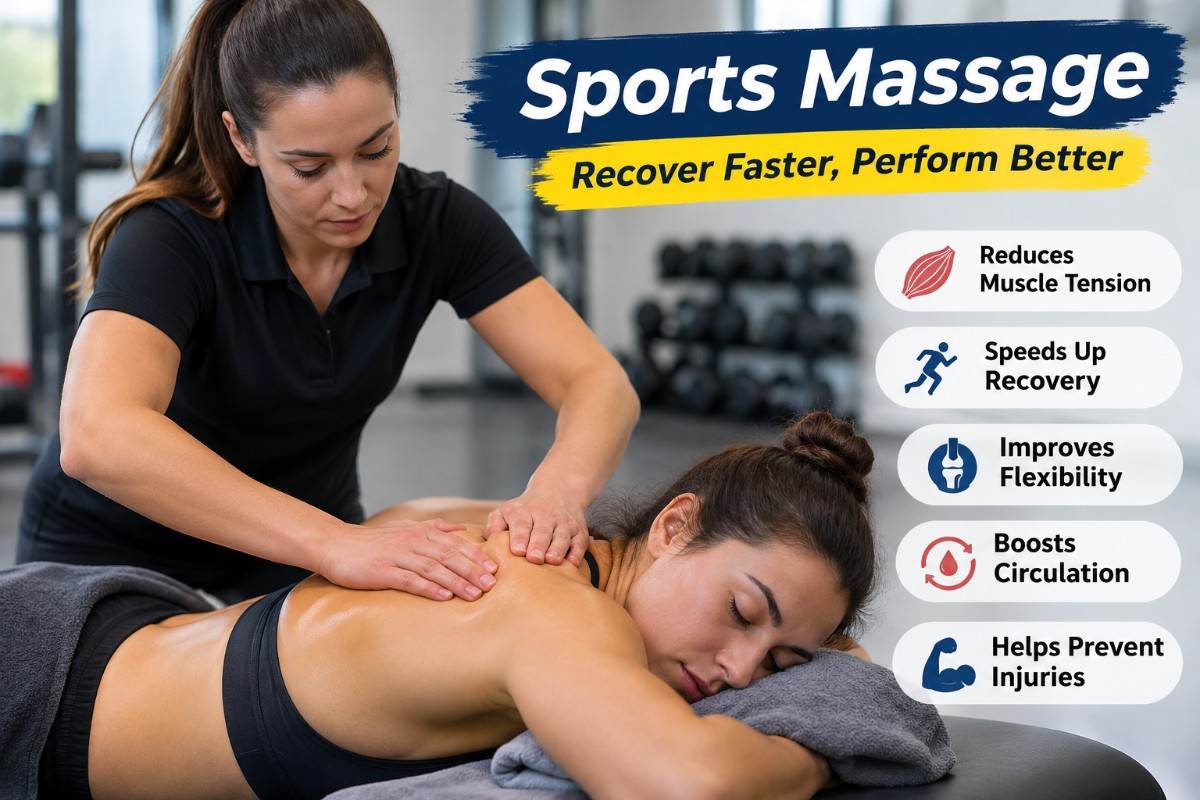
Sports massage is a popular soft-tissue therapy used by athletes, gym enthusiasts, runners, and physically active individuals to manage muscular tension and support recovery. Whether you participate in competitive sports, lift weights, or exercise regularly, sports massage therapy may help you manage post-exercise soreness, improve short-term flexibility, and promote relaxation.
Unlike general relaxation massage, sports massage focuses on the physical demands associated with exercise and athletic activities. It uses different techniques to address specific muscle groups depending on an individual’s sport, training schedule, and physical needs.
Understanding what sports massage involves, its potential benefits, different treatment approaches, and recovery applications can help you decide whether it deserves a place in your fitness routine.
What Is Sports Massage?
Sports massage is a form of massage therapy that uses different manual techniques to work on muscles and other soft tissues. It is commonly adapted to an individual’s sport, physical activity, training schedule, and areas of muscular discomfort.
Unlike a general relaxation massage, sports massage often focuses on specific muscle groups that experience repeated physical demands. For example, runners may receive attention around their calves, hamstrings, quadriceps, and glutes, while weightlifters may focus on their shoulders, upper back, and hips.
Sports massage therapy can be performed before or after exercise, during training periods, or as part of a broader recovery routine. The treatment may involve techniques such as effleurage, petrissage, compression, friction, and controlled stretching.
Sports massage is sometimes discussed alongside sport and therapeutic massage because both approaches can involve soft-tissue techniques. However, sports massage is particularly adapted to the physical demands of athletic activities and exercise.
It should complement rather than replace appropriate training, rest, rehabilitation, and medical care.
muscle recovery techniques after exercise
Why Does Sports Massage Matter?
Sports massage matters because it may help reduce perceived muscle soreness, improve short-term flexibility, and provide temporary relief from muscular tension associated with physical activity.
Intense exercise places repeated demands on muscles and surrounding tissues. Although training helps the body adapt and become stronger, it can also cause temporary soreness, stiffness, and fatigue.
Sports massage for recovery is often used as a complementary approach alongside adequate sleep, balanced nutrition, hydration, mobility exercises, and appropriate rest.
Potential benefits include:
- Muscle relaxation: Massage may help reduce the sensation of muscular tightness.
- Flexibility: Certain massage techniques may temporarily improve range of motion.
- Perceived soreness: Massage may help reduce delayed-onset muscle soreness (DOMS).
- Relaxation: A session can promote physical comfort and relaxation.
- Body awareness: Working with a qualified therapist may help identify areas of tension that deserve attention.
However, sports massage does not guarantee faster muscle repair, prevent every sports injury, or directly improve athletic performance. Its effects vary depending on the individual, technique, timing, and physical condition.
How to Reduce Muscle Soreness After Workout
Types of Sports Massage
Sports massage can be divided into different types depending on when it is performed and what the athlete needs. Each approach uses different techniques and pressure levels according to the activity and treatment goals.
1. Pre-Event Sports Massage
Pre-event sports massage is performed before a competition or demanding physical activity. It generally uses shorter, lighter, and more stimulating techniques rather than prolonged deep pressure.
Its purpose is to help athletes feel physically prepared and relaxed before exercise.
Common characteristics include:
- Short, brisk massage movements.
- Gentle compression of major muscle groups.
- Attention to muscles involved in the upcoming activity.
- Avoiding excessive pressure that could leave muscles uncomfortable.
Pre-event massage should complement a proper dynamic warm-up rather than replace it.
2. Post-Event Sports Massage
Post-event sports massage is performed after a competition, workout, or demanding training session. It typically uses comfortable, controlled techniques to help athletes relax and manage post-exercise muscle soreness.
It may include:
- Gentle effleurage (gliding strokes).
- Light kneading.
- Comfortable compression.
- Gentle work on muscles that experienced considerable physical stress.
A post-event massage should not involve aggressive pressure on already painful or injured tissues.
3. Maintenance Sports Massage
Maintenance sports massage is performed periodically during regular training. It focuses on areas that experience repeated muscular tension and physical stress.
For example, a runner might receive attention to the calves, quadriceps, hamstrings, and glutes, while a swimmer may focus on the shoulders and upper back.
It can be included in a broader routine involving strength training, mobility work, adequate sleep, and recovery days.
4. Rehabilitation Sports Massage
Rehabilitation sports massage may be used as a complementary treatment during recovery from certain sports-related injuries.
A qualified physiotherapist or appropriately trained healthcare professional should first assess the injury and determine whether massage is suitable.
Massage alone cannot repair torn ligaments, heal fractures, or replace an appropriate rehabilitation programme.
Common Sports Massage Techniques
Sports massage uses different manual techniques to work with muscles and surrounding soft tissues. A therapist selects techniques according to the athlete’s needs, comfort, and physical condition.
Understanding common sports massage techniques can help you become familiar with what may happen during a treatment session.
1. Effleurage
Effleurage involves smooth, continuous gliding strokes performed with the hands or palms.
It is commonly used at the beginning and end of a massage session to help the recipient relax and prepare the treatment area.
2. Petrissage
Petrissage involves kneading, lifting, rolling, or gently squeezing soft tissues.
It is commonly applied to larger muscle groups, including the thighs, calves, shoulders, and back.
3. Friction Massage
Friction massage involves focused movements applied to a relatively small area of tissue. The therapist uses controlled pressure and movement rather than broad gliding strokes.
It may be used for specific areas of muscular tension, but should not be applied aggressively over an acute injury.
4. Compression
Compression involves applying controlled pressure to a muscle using the hands, palms, or other suitable contact surfaces.
It can be useful when working with larger muscle groups and is often adapted to the athlete’s comfort level.
5. Tapotement
Tapotement consists of rhythmic, percussive movements such as gentle tapping or cupping.
It is sometimes used in pre-event massage to provide a stimulating sensation. Its application depends on the sport, individual response, and therapist’s assessment.
6. Trigger Point Techniques
Trigger point techniques involve applying controlled pressure to specific sensitive areas within muscles.
They may be used to address localized muscular discomfort, although not every painful spot represents a trigger point.
trigger point massage therapy techniques
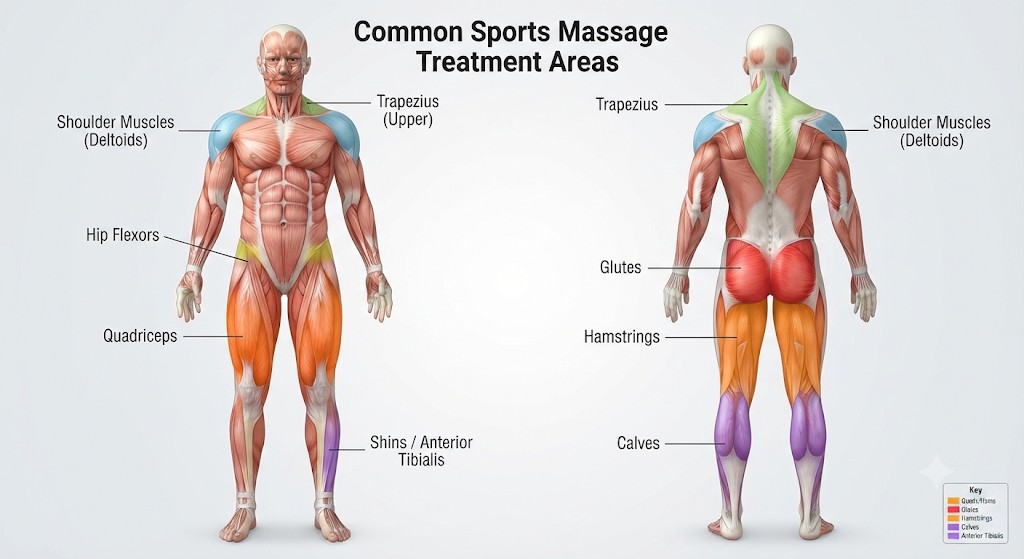
Which Muscles Are Commonly Targeted During Sports Massage?
Sports massage usually focuses on muscle groups that experience repeated loading during a particular sport or exercise.
Different activities place different demands on the body.
| Muscle group | Commonly associated activities |
|---|---|
| Quadriceps | Running, cycling, jumping and squats |
| Hamstrings | Sprinting, running and football |
| Calves | Running, jumping and walking |
| Glutes | Running, cycling and strength training |
| Hip flexors | Running, cycling and kicking sports |
| Trapezius | Weightlifting, swimming and upper-body training |
| Shoulders | Swimming, tennis and throwing sports |
| Lower back muscles | Weightlifting, rowing and gymnastics |
Sports Massage for Different Types of Athletes
Sports massage for athletes can be adapted to the physical demands of different sports. The areas treated and techniques selected depend on training intensity, movement patterns, and individual needs.
Sports Massage for Runners
Running repeatedly loads the lower body, particularly the calves, hamstrings, quadriceps, and glutes.
A runner may choose sports massage to address post-training soreness or temporary muscle tightness.
Common areas of focus include:
- Calf muscles.
- Hamstrings.
- Quadriceps.
- Gluteal muscles.
- Hip flexors.
Runners should also include appropriate running recovery, gradual training progression, and strength exercises.
Sports Massage for Weightlifters
Weightlifting places repeated demands on the shoulders, back, arms, hips, and legs.
A weightlifter may use sports massage as a complementary recovery practice when experiencing muscular tension after demanding training sessions.
Common areas include:
- Trapezius.
- Latissimus dorsi.
- Pectoral muscles.
- Quadriceps.
- Glutes.
- Forearms.
strength training recovery strategies
Sports Massage for Cyclists
Cycling involves repetitive lower-body movements, particularly through the quadriceps, hamstrings, calves, and glutes.
Sports massage may help cyclists manage perceived muscle tightness following long rides or intense cycling sessions.
Sports Massage for Football Players
Football involves sprinting, acceleration, sudden direction changes, jumping, and kicking.
Players may focus on the calves, hamstrings, quadriceps, hip flexors, and glutes during maintenance or post-training massage.
Sports Massage for Swimmers
Swimming repeatedly engages the shoulders, upper back, chest, and core muscles.
Sports massage may be adapted to address muscular tension associated with repetitive strokes and training volume.
What Happens During a Sports Massage Treatment?
A sports massage treatment generally begins with a discussion about your activity level, training schedule, physical discomfort, and treatment goals.
Understanding the treatment process can help beginners and experienced athletes know what to expect before their first appointment.
A typical appointment involves the following stages:
- Initial consultation: The therapist asks about your sport, exercise routine, medical history, and any previous injuries.
- Assessment: The therapist identifies areas of muscular tension and discusses which areas may benefit from treatment.
- Preparation: You are positioned comfortably on a massage table, and the therapist explains the techniques to be used.
- Massage treatment: The therapist applies suitable techniques to selected muscle groups.
- Feedback: You communicate whether the pressure feels comfortable or needs adjustment.
- Aftercare: The therapist may recommend appropriate movement, hydration, rest, or mobility exercises.
Sessions can vary in duration depending on the treatment goals and the areas being addressed. There is no single ideal session length for everyone.
Sports massage should not be excessively painful. If you experience sharp pain, unusual discomfort, or worsening symptoms, communicate with the therapist immediately.
foam rolling exercises for muscle recovery
How Often Should You Get a Sports Massage?
The frequency of sports massage depends on your training schedule, physical needs, budget, and response to treatment.
There is no universally established massage schedule that every athlete should follow.
| Situation | Possible approach |
|---|---|
| Occasional exercise | Massage when needed for comfort |
| Regular gym training | Periodic sessions based on muscular tension |
| Endurance training | Consider sessions around demanding training periods |
| Competitive sports | Coordinate massage with training and competition schedules |
| Injury rehabilitation | Follow guidance from a qualified healthcare professional |
More frequent or deeper massage is not necessarily better. Allow your body to respond to treatment, and avoid repeating aggressive techniques over sore or injured areas.
Sports Massage vs Deep Tissue Massage
Sports massage and deep tissue massage are related forms of massage therapy, but they are not identical.
Sports massage is organised around physical activity and athletic needs, whereas deep tissue massage generally focuses on applying slower, more sustained pressure to deeper layers of soft tissue.
| Feature | Sports massage | Deep tissue massage |
|---|---|---|
| Main focus | Sport-related muscular needs | Deeper soft-tissue tension |
| Target audience | Athletes and active individuals | People experiencing muscular tension |
| Techniques | May combine several massage techniques | Often uses slower, sustained pressure |
| Timing | Before, during, or after training | Based on individual treatment needs |
| Pressure | Light to firm, depending on purpose | Often moderate to firm |
| Main goal | Support comfort and recovery around exercise | Address areas of persistent muscular tension |
Neither technique needs to be painful to be effective. The appropriate approach depends on the individual and treatment objective.
deep tissue massage benefits and techniques
Sports Massage vs Therapeutic Massage
Sports massage and therapeutic massage can overlap because both may use manual techniques to address muscular tension and physical discomfort.
However, their primary applications can differ.
Sports massage is generally adapted to the demands of exercise, training, and athletic activities. Therapeutic massage is a broader term that can describe massage approaches used to support comfort and address particular physical concerns.
| Feature | Sports massage | Therapeutic massage |
|---|---|---|
| Main focus | Athletic and exercise-related needs | Individual physical concerns and comfort |
| Target audience | Athletes and physically active individuals | People with different physical needs |
| Treatment approach | Adapted to sport and training schedules | Selected according to individual goals |
| Techniques | May include compression, kneading and stretching | Depends on the massage approach |
| Timing | Often coordinated with training | Based on individual treatment needs |
The terms are not always used consistently across countries and professional settings. Treatment methods and practitioner qualifications can also vary.
Does Sports Massage Actually Improve Muscle Recovery?
Sports massage may provide modest improvements in perceived muscle soreness and flexibility, but research does not establish that it directly improves athletic performance.
A 2020 systematic review and meta-analysis published in BMJ Open Sport & Exercise Medicine examined 29 studies involving 1,012 participants.
Researchers found small statistically significant improvements in flexibility and delayed-onset muscle soreness (DOMS), but no evidence of improvements in strength, jumping, sprinting, endurance, or fatigue.
A separate 2023 systematic review examined 114 studies and reported potential benefits involving pain, perceived recovery, relaxation, and flexibility. However, the authors also concluded that using massage specifically to improve sports performance remains questionable.
These findings suggest that massage may be useful as a complementary recovery strategy, but it should not be treated as a shortcut to improved athletic performance.
For better recovery, combine appropriate massage, when useful, with:
- Adequate sleep.
- Balanced nutrition.
- Sufficient protein intake.
- Appropriate hydration.
- Gradual training progression.
- Rest and recovery days.
- Active recovery when suitable.
active recovery workouts for athletes
Sports Massage Benefits and Limitations
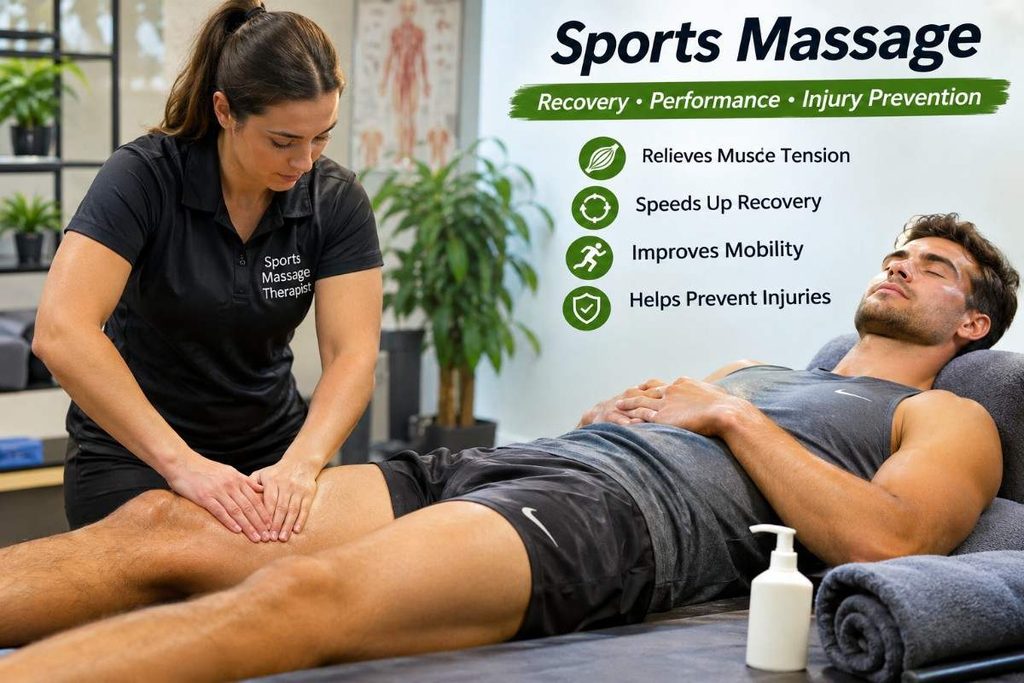
Sports massage has potential benefits, but it is important to understand what it can and cannot do.
Potential Benefits of Sports Massage
1. May Reduce Delayed-Onset Muscle Soreness
Massage may help reduce the discomfort associated with DOMS following unfamiliar or intense exercise.
2. May Temporarily Improve Flexibility
Some research suggests that massage can produce small improvements in flexibility and range of motion.
3. May Help Manage Muscular Tension
Targeted massage can provide temporary relief from the sensation of tight or uncomfortable muscles.
4. May Promote Relaxation
A massage session can provide a relaxing experience and help reduce perceived stress.
5. May Support an Overall Recovery Routine
Athletes may find massage useful alongside sleep, nutrition, appropriate exercise programming, and rehabilitation.
Limitations of Sports Massage
Sports massage also has limitations:
- It does not guarantee injury prevention.
- It does not replace physiotherapy or medical treatment.
- It does not automatically improve strength, speed, or endurance.
- It cannot repair significant muscle tears or ligament injuries.
- Excessive pressure may cause additional soreness or bruising.
Risks and Precautions of Sports Massage
Sports massage is generally well tolerated when performed appropriately, but it is not suitable in every situation.
Possible side effects include:
- Temporary muscle soreness.
- Bruising.
- Tenderness.
- Tiredness after treatment.
Avoid massage over open wounds, active skin infections, suspected fractures, or areas of acute injury.
You should seek medical advice before receiving sports massage if you have:
- A suspected blood clot or history of blood clots.
- A bleeding disorder or take blood-thinning medication.
- Severe osteoporosis.
- A recent serious injury or surgery.
- Significant unexplained swelling or pain.
- A medical condition that may affect treatment safety.
Important: Sudden severe muscle pain, significant swelling, unusual weakness, or inability to bear weight requires appropriate medical assessment rather than an attempt to massage the problem away.
The National Center for Complementary and Integrative Health notes that rare serious complications have been reported, particularly with vigorous massage or in people at increased risk of injury.
How to Choose a Qualified Sports Massage Therapist
Choosing an appropriately trained sports massage therapist is important for both comfort and safety.
Before booking a session, consider the following:
- Training and qualifications: Check their education, professional training, and relevant credentials.
- Sports experience: Look for experience working with athletes or people involved in your type of exercise.
- Initial assessment: A responsible therapist should ask about your medical history, injuries, and training schedule.
- Communication: They should explain the treatment and adjust pressure according to your feedback.
- Professional boundaries: You should feel comfortable, respected, and informed throughout the session.
- Referral practices: A good therapist should recognise when a problem requires assessment by a doctor or physiotherapist.
Do not choose a therapist simply because they advertise extremely deep or painful massage techniques.
Conclusion
Sports massage can be a useful complementary therapy for athletes and physically active individuals who want to manage muscular tension, support relaxation, and potentially reduce post-exercise soreness.
From pre-event and post-event sports massage to maintenance treatments, different techniques and approaches can be adapted to running, weightlifting, cycling, swimming, and other sports.
Understanding sports massage benefits, treatment methods, and potential limitations can help you make informed decisions about including it in your recovery routine.
However, massage should be part of a broader recovery strategy rather than a replacement for proper training, nutrition, sleep, and injury management. Choosing a qualified therapist and using appropriate pressure can help make sports massage a more comfortable and practical part of an active lifestyle.
FAQs
What is sports massage used for?
Sports massage is used to address muscular tension, support relaxation, and help manage soreness associated with physical activity.
Is sports massage painful?
Sports massage should not be excessively painful. Some techniques may create temporary pressure or discomfort, but the therapist should adjust treatment to your comfort level.
Is sports massage good for muscle recovery?
Sports massage may provide modest improvements in flexibility and delayed-onset muscle soreness, but evidence does not establish that it directly improves athletic performance.
Should I get a sports massage before or after exercise?
Both are possible. Pre-event massage generally uses shorter and lighter techniques, while post-event massage often focuses on relaxation and comfortable muscle treatment.
How long does a sports massage take?
The duration depends on the treatment goals and areas being addressed. Sessions may range from approximately 20 minutes to over an hour.
Can beginners get sports massages?
Yes. Sports massage is not limited to professional athletes. Recreational exercisers and beginners may also consider it when appropriate.
What is the difference between sports massage and regular massage?
Sports massage is adapted to physical activity, training schedules, and sport-related muscular needs. Regular relaxation massage generally focuses more on overall comfort and relaxation.
What is the difference between sports massage and therapeutic massage?
Sports massage focuses primarily on the physical demands of exercise and athletic activities. Therapeutic massage is a broader term covering different approaches used to address individual physical concerns and promote comfort.
Can sports massage prevent injuries?
There is insufficient evidence to conclude that sports massage reliably prevents sports injuries. Proper training progression, strength development, technique, and recovery remain important.
How often should athletes get sports massages?
There is no universal frequency. The schedule should depend on training demands, individual needs, treatment response, and professional guidance.
Can sports massage help with DOMS?
Research suggests massage may provide a small reduction in delayed-onset muscle soreness, although the size of the benefit varies.
Sources
- Davis, H. L., Alabed, S., & Chico, T. J. A. (2020). Effect of Sports Massage on Performance and Recovery: A Systematic Review and Meta-Analysis. BMJ Open Sport & Exercise Medicine.
- Dakić, M., et al. (2023). The Effects of Massage Therapy on Sport and Exercise Performance: A Systematic Review. Sports.
- National Center for Complementary and Integrative Health. Massage Therapy: What You Need to Know.
- Ferreira, R. M., et al. (2023). The Effects of Massage Guns on Performance and Recovery: A Systematic Review.
Disclaimer: This article is for informational and educational purposes only and is not a substitute for personalized medical advice. Consult a qualified healthcare professional before making significant changes to your diet, exercise routine, or supplement use.
1 thought on “Sports Massage: Benefits, Techniques, Types, and Recovery Guide”