
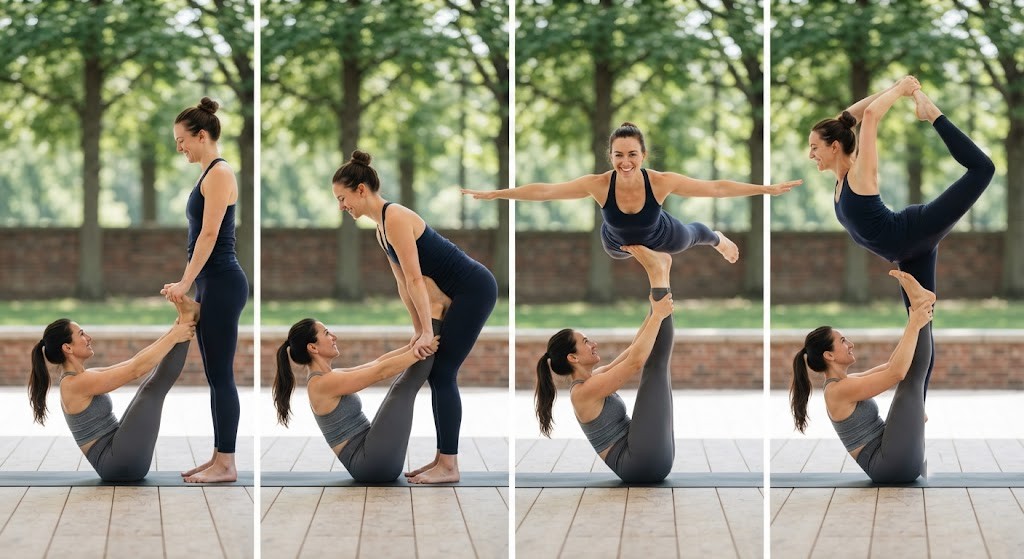
You’ve probably seen impressive acro yoga poses on social media and assumed they’re only for experienced yogis. In reality, many easy acro yoga poses are specifically designed for beginners and can be practiced safely with the right technique, communication, and preparation.
Whether you’re looking to improve balance, strengthen your core, increase flexibility, or simply enjoy a unique workout with a partner, beginner acro yoga offers an exciting way to build confidence while having fun. In this guide, you’ll discover the best easy acro yoga poses, essential safety rules, step-by-step instructions, common mistakes to avoid, recommended equipment, and practical tips to help you progress safely.
What Is Acro Yoga and How Does It Work?
Acro yoga is a partner-based practice that combines traditional yoga, acrobatics, and therapeutic movement to improve balance, flexibility, strength, coordination, and trust.
Unlike traditional yoga, where you practice independently on a mat, acro yoga relies on teamwork. One partner supports another while maintaining stability, creating a practice that strengthens both the body and communication skills.
For example, even someone with limited flexibility can safely perform Bird Pose with a trusted partner, making acro yoga far more accessible than many beginners expect.
Acro yoga emerged in the early 2000s by blending classical yoga with partner acrobatics and Thai-inspired therapeutic techniques. Today, it is practiced worldwide for recreation, fitness, rehabilitation, and community connection.
According to the Yoga Alliance, millions of people practice yoga worldwide each year, and partner-based yoga continues to grow in popularity through community classes and wellness events.
Source: Yoga Alliance, 2024.
The Three Essential Roles in Acro Yoga
| Role | Responsibility |
|---|---|
| Base | Supports the flyer using hands and feet while staying stable on the ground. |
| Flyer | Performs poses while maintaining body tension and balance. |
| Spotter | Assists both partners and helps prevent falls during new movements. |
Among all beginner-friendly poses, Bird Pose is widely considered the foundation because it teaches body alignment, communication, and balance.
Why Are Easy Acro Yoga Poses Great for Beginners?
Easy acro yoga poses help beginners build confidence while minimizing injury risk. Instead of focusing on difficult inversions or complex transitions, beginner poses emphasize body awareness, control, and teamwork.
They Build Trust
Every successful acro yoga pose depends on clear communication.
Simple verbal cues like:
- “Ready?”
- “1-2-3 Lift”
- “Hold”
- “Lower”
- “Stop”
help both partners move together safely and confidently.
They Improve Strength
Even beginner poses challenge multiple muscle groups simultaneously.
Regular practice helps improve:
- Core strength
- Shoulder stability
- Leg strength
- Grip endurance
- Postural control
- Overall body awareness
Consistent beginner acro yoga practice develops coordination, flexibility, communication, and muscular endurance over time.
They Increase Flexibility
Many beginner poses gently stretch the:
- Hamstrings
- Hip flexors
- Chest
- Shoulders
- Lower back
For example, Folded Leaf Pose provides an excellent hamstring stretch while remaining relatively simple to perform.
beginner flexibility exercises
core strengthening yoga exercises
Research suggests yoga participation improves flexibility, muscular endurance, and balance in healthy adults.
Source: American College of Sports Medicine, 2023.
What Safety Rules Should You Follow Before Practicing Acro Yoga?
Safe practice is the foundation of successful acro yoga. Before attempting even the easiest poses, spend a few minutes preparing your body and your partner.
Warm Up Properly
Spend 8–10 minutes warming up before every session.
A good warm-up includes:
- Cat-Cow stretches
- Shoulder circles
- Wrist mobility exercises
- Hip openers
- Gentle squats
- Core activation
Proper preparation improves mobility and reduces injury risk.
5 Minute Warm Up Before Workout
Always Practice with a Spotter
When learning new poses, a spotter adds an important layer of safety.
For example, during Bird Pose, a spotter can stabilize the flyer’s shoulders until both partners feel comfortable.
Communicate Clearly
Never assume your partner knows what you’re about to do.
Use simple commands like:
- Ready?
- Lift
- Hold
- Lower
- Stop
Clear communication keeps movements coordinated and controlled.
Choose a Safe Practice Surface
Practice on:
- Yoga mats
- Gymnastics mats
- Grass
- Crash pads
Avoid:
- Concrete
- Slippery floors
- Uneven ground
When Should You Skip Practice?
Avoid acro yoga if you have:
- Recent injuries
- Severe dizziness
- Uncontrolled high blood pressure
- Acute joint pain
- Pregnancy without medical approval
What Are the Easiest Acro Yoga Poses to Learn First?
Easy acro yoga poses are designed to help beginners develop balance, communication, strength, and confidence before progressing to advanced partner skills.
1. Bird Pose
Difficulty: ⭐ Beginner
Benefits
- Improves balance
- Builds trust
- Strengthens the core
- Teaches body alignment
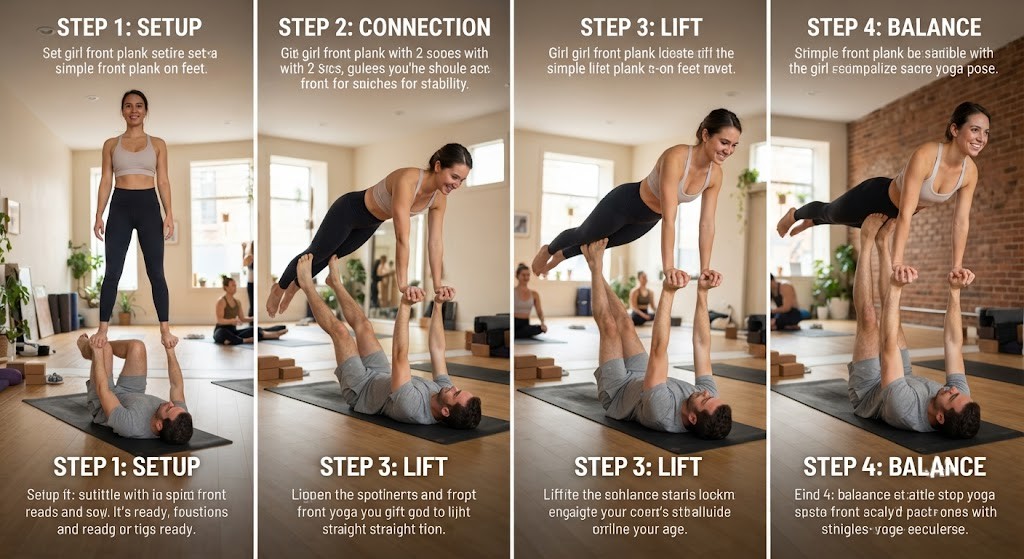
Step-by-Step
- Base lies comfortably on the back.
- Feet rest on the flyer’s hips.
- Partners connect hands.
- Flyer leans forward slowly.
- Base extends the legs.
- Hold while breathing normally.
Common Mistakes
- Bent legs
- Looking down
- Relaxed core
Beginner Tip: Keep your arms straight and maintain steady eye contact throughout the pose.
2. Front Bird
Difficulty: ⭐ Beginner
Benefits
- Improves stability
- Enhances body awareness
Steps
- Begin in Bird Pose.
- Extend the chest slightly forward.
- Keep the legs fully engaged.
- Hold for several breaths.
Common Mistakes
- Leaning too far forward
- Relaxing the core
3. Throne Pose
Difficulty: ⭐ Beginner
Benefits
- Builds confidence
- Improves posture
Steps
- Base bends the knees.
- Feet support the flyer’s hips.
- Flyer sits upright.
- Hold hands for stability.
Common Mistakes
- Rounded shoulders
- Leaning backward
4. Folded Leaf Pose
Difficulty: ⭐ Beginner
Benefits
- Deep hamstring stretch
- Relaxation
- Improved flexibility
Steps
- Base supports the flyer’s hips.
- Flyer folds forward gently.
- Relax the shoulders.
- Breathe deeply.
Common Mistakes
- Forcing the stretch
- Holding the breath
5. Back Bird
Difficulty: ⭐⭐ Easy
Benefits
- Opens the chest
- Improves spinal mobility
Steps
- Begin in Bird Pose.
- Rotate carefully.
- Extend the chest upward.
6. Whale Pose
Difficulty: ⭐⭐ Easy
Benefits
- Gentle backbend
- Improves shoulder mobility
Steps
- Flyer relaxes over the base’s feet.
- Maintain continuous communication.
- Lower carefully.
7. Double Plank
Difficulty: ⭐⭐ Easy
Benefits
- Builds upper-body strength
- Improves stability
Steps
- Base performs a plank.
- Flyer carefully mirrors the position.
- Maintain a straight body alignment.
8. High Flying Whale
Difficulty: ⭐⭐ Beginner-Intermediate
Benefits
- Improves flexibility
- Strengthens shoulders
Beginner Tip
Practice this pose only after becoming comfortable with Whale Pose.
9. Shoulder Stand on Feet
Difficulty: ⭐⭐ Beginner-Intermediate
Benefits
- Enhances balance
- Builds upside-down confidence
Safety Reminder: Always use a spotter.
10. Supported Star Pose
Difficulty: ⭐ Beginner
Benefits
- Develops full-body balance
- Engages the core
Beginner Tip: Move slowly and stay controlled throughout the pose.
Comparison of Easy Acro Yoga Poses
| Pose | Difficulty | Primary Benefit |
|---|---|---|
| Bird Pose | ⭐ | Balance and trust |
| Front Bird | ⭐ | Stability |
| Throne Pose | ⭐ | Posture |
| Folded Leaf | ⭐ | Flexibility |
| Back Bird | ⭐⭐ | Chest opening |
| Whale Pose | ⭐⭐ | Shoulder mobility |
| Double Plank | ⭐⭐ | Upper-body strength |
| High Flying Whale | ⭐⭐ | Shoulder strength |
| Shoulder Stand on Feet | ⭐⭐ | Balance |
| Supported Star | ⭐ | Core engagement |
What Are the Most Common Beginner Acro Yoga Mistakes?
Most beginner mistakes happen because people progress too quickly or overlook essential safety habits.
Common mistakes include:
- Skipping warm-ups
- Poor communication
- Looking away during lifts
- Locking elbows or knees
- Attempting advanced poses too soon
- Ignoring balance
- Practicing without a spotter
For example, locking your knees reduces natural shock absorption and can place unnecessary stress on your joints.
What Equipment Do You Need for Beginner Acro Yoga?
While acro yoga requires very little equipment, a few basic items can make practice safer and more comfortable.
| Equipment | Why It Helps |
|---|---|
| Yoga mat | Prevents slipping |
| Crash mat | Cushions falls |
| Yoga blocks | Assist stretching |
| Resistance bands | Improve mobility |
| Grip socks | Increase traction |
| Comfortable clothing | Allows full movement |
Helpful Alternatives
If you don’t own specialized equipment, you can practice using:
- Thick carpet
- Grass
- Folded blankets
Can You Learn Acro Yoga at Home Safely?
Yes. Beginners can safely learn easy acro yoga poses at home by following proper safety precautions.
For the safest experience:
- Practice only foundational poses.
- Choose a reliable partner.
- Use proper equipment.
- Avoid advanced inversions without professional instruction.
Bird Pose and Throne Pose are excellent choices for home practice because they emphasize control and balance rather than height.
How Often Should Beginners Practice Acro Yoga?
Most beginners benefit from practicing two to three times per week.
This schedule allows enough recovery while steadily improving strength, coordination, and confidence.
Sample Weekly Practice Plan
| Day | Focus |
|---|---|
| Monday | Bird Pose + Core |
| Wednesday | Throne Pose + Folded Leaf |
| Friday | Balance + Transitions |
Research indicates adults should perform muscle-strengthening activities at least twice weekly for overall health.
Source: World Health Organization, 2024.
What Should You Learn After Mastering Easy Acro Yoga Poses?
Once you’ve mastered the fundamentals, continue progressing gradually instead of rushing into difficult skills.
A smart progression includes:
- Practice consistently.
- Improve communication.
- Learn safe transitions.
- Join local workshops.
- Increase mobility.
- Develop shoulder strength.
- Build advanced inversions gradually.
This gradual approach helps reduce injury risk while improving long-term performance.
restorative yoga for beginners
Tips for Faster Progress
To enjoy long-term success with beginner acro yoga:
- Prioritize proper form over difficult poses.
- Practice with the same partner when possible.
- Focus on steady breathing.
- Build strength outside of acro yoga with regular yoga and bodyweight exercises.
- Celebrate small improvements rather than rushing toward advanced skills.
Remember, trust and teamwork are just as important as physical strength.
Conclusion
Easy acro yoga poses offer a fun, safe, and rewarding introduction to partner yoga while improving strength, flexibility, balance, communication, and trust. Starting with foundational poses like Bird Pose, Throne Pose, and Folded Leaf allows beginners to build confidence and master essential techniques before progressing to more advanced skills.
The key to success is consistency rather than speed. Prioritize proper warm-ups, communicate clearly with your partner, practice on safe surfaces, and use a spotter whenever learning new movements. With patience and regular practice, you’ll build the skills needed to enjoy acro yoga safely for years to come.
FAQs
What are the best easy acro yoga poses for beginners?
Bird Pose, Throne Pose, Front Bird, and Folded Leaf are excellent beginner poses.
Is acro yoga safe for beginners?
Yes, acro yoga is safe when practiced with proper technique, a spotter, and clear communication.
How often should beginners practice acro yoga?
Practice 2–3 times per week to improve strength, balance, and confidence.
Do I need to be flexible to start acro yoga?
No, beginner acro yoga focuses more on balance and teamwork than flexibility.
Can I learn acro yoga at home?
Yes, you can practice beginner poses safely at home with a trusted partner and proper precautions.
What equipment do I need for beginner acro yoga?
A yoga mat, crash mat, and comfortable clothing are recommended for safe practice.
What is the most important safety rule in acro yoga?
Always communicate with your partner, warm up properly, and use a spotter for new poses.
What should I learn after mastering beginner acro yoga poses?
Gradually learn safe transitions, improve strength, and progress to more advanced poses.