

Strong glutes are about more than developing the gluteus maximus. The gluteus medius plays an important role in hip stability, pelvic control, and lower-body movement. Adding targeted glute medius workouts to your routine can help strengthen your hips, improve balance, and build more complete glute development.
What Are Glute Medius Workouts?
Glute medius workouts are exercises designed to strengthen the gluteus medius, a muscle located on the outer surface of your pelvis. This muscle helps move your leg away from your body’s midline, stabilize your pelvis, and control hip movement during activities such as walking, running, squatting, and climbing stairs.
The gluteus medius is one of the three main gluteal muscles, alongside the gluteus maximus and gluteus minimus.
Unlike exercises that primarily emphasize hip extension, many glute medius exercises involve hip abduction and single-leg stability.

best glute workouts for muscle growth
Why Are Glute Medius Workouts Important?
Glute medius workouts are important because this muscle helps stabilize your pelvis and control your hips during everyday movements and exercise.
Strengthening the gluteus medius can support several aspects of lower-body performance.
- Hip stability: Helps maintain pelvic control during single-leg movements.
- Better balance: Contributes to stability while walking, running, and standing on one leg.
- Lower-body strength: Supports movements such as lunges, squats, and step-ups.
- Hip movement: Helps move your leg outward through hip abduction.
- Running performance: Contributes to pelvic stability during the single-leg support phase of running.
- Glute development: Complements exercises that primarily target the gluteus maximus.
However, strengthening the gluteus medius does not guarantee injury prevention or eliminate existing hip and knee pain.
hip mobility exercises for better movement
10 Best Glute Medius Exercises
The best glute medius exercises combine hip abduction, resistance training, and single-leg movements to strengthen the outer hips and improve pelvic stability.
Here are 10 exercises you can include in your gym or home workout routine.
1. Side-Lying Hip Abduction
Side-lying hip abduction is one of the most direct exercises for targeting the gluteus medius.
How to perform:
- Lie on your side with your legs extended.
- Keep your hips stacked and your body straight.
- Slowly raise your upper leg toward the ceiling.
- Keep your toes pointing forward or slightly downward.
- Pause briefly at the top.
- Lower your leg slowly without completely relaxing.
Recommended sets: 3
Repetitions: 12–15 per side
Equipment: None or ankle weights.
2. Clamshells
Clamshells strengthen the hip abductors and external rotators, including the gluteus medius.
How to perform:
- Lie on your side with your knees bent.
- Keep your feet together and stack your hips.
- Slowly lift your upper knee while keeping your feet touching.
- Avoid rotating your pelvis backward.
- Pause at the top.
- Lower your knee slowly.
Recommended sets: 2–3
Repetitions: 12–15 per side
Equipment: Optional resistance band.
3. Banded Lateral Walks
Banded lateral walks strengthen the hip abductors through repeated side-to-side movement against resistance.
How to perform:
- Place a resistance band around your thighs or ankles.
- Stand with your feet approximately hip-width apart.
- Bend your knees slightly and push your hips backward.
- Take a controlled step sideways.
- Follow with your other foot while maintaining band tension.
- Continue in one direction before switching sides.
Recommended sets: 3
Repetitions: 10–15 steps per direction
Equipment: Resistance band.
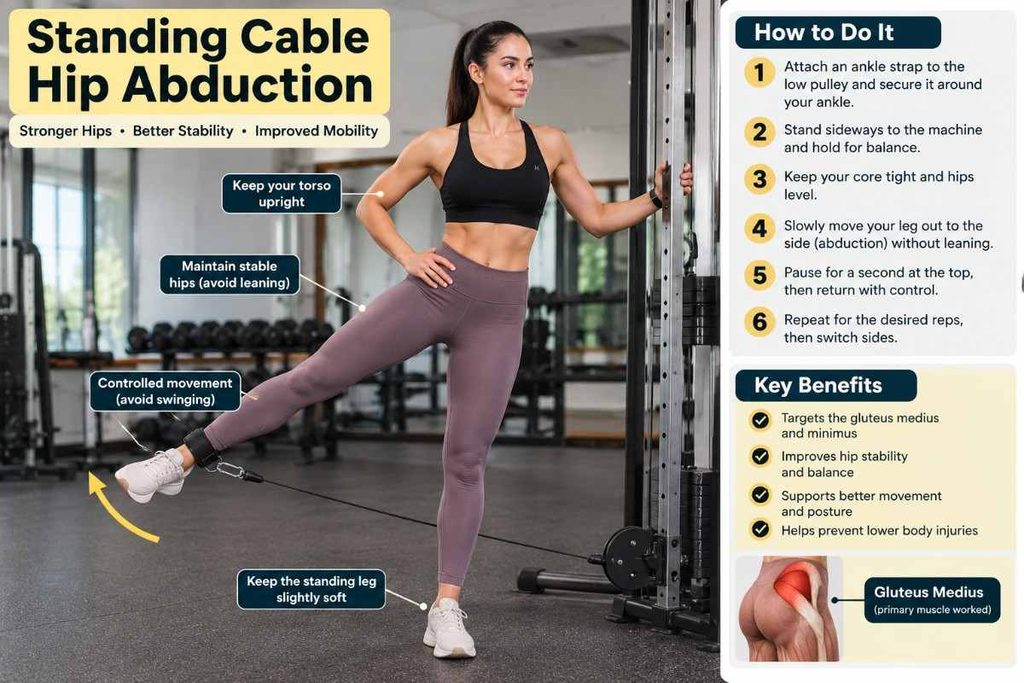
4. Standing Cable Hip Abduction
Standing cable hip abduction targets the gluteus medius by moving one leg away from the body’s midline against cable resistance.
How to perform:
- Attach an ankle strap to a low cable pulley.
- Stand sideways to the cable machine.
- Attach the strap to your outside ankle.
- Hold the machine for balance.
- Move your working leg outward without leaning your torso.
- Return slowly to the starting position.
Recommended sets: 3
Repetitions: 12–15 per side
Equipment: Cable machine and ankle strap.
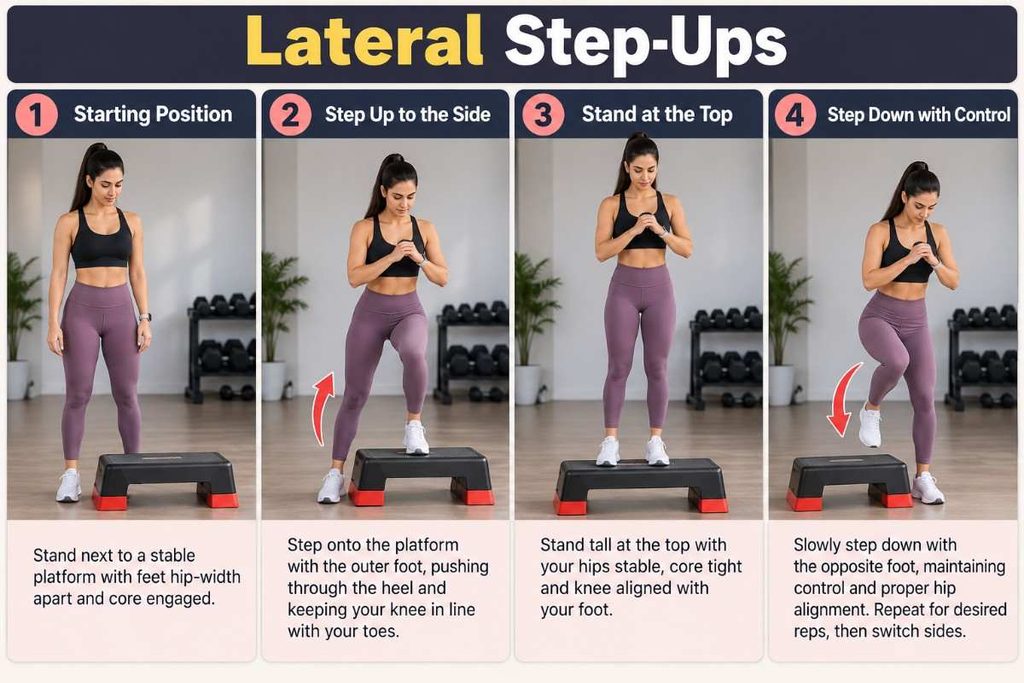
5. Lateral Step-Ups
Lateral step-ups strengthen the gluteus medius by challenging hip stability while stepping onto an elevated platform.
How to perform:
- Stand beside a stable exercise step or low box.
- Place your inside foot on the platform.
- Push through the elevated foot to lift your body.
- Keep your pelvis level and knee aligned with your foot.
- Lower yourself slowly.
- Complete your repetitions before switching sides.
Recommended sets: 3
Repetitions: 10–12 per side
Equipment: Step platform or exercise box.
6. Single-Leg Glute Bridge
The single-leg glute bridge is a unilateral exercise that challenges the gluteal muscles while requiring pelvic stability.
How to perform:
- Lie on your back with your knees bent.
- Keep one foot flat on the floor.
- Lift your opposite foot off the ground.
- Push through your planted heel to raise your hips.
- Keep your pelvis level throughout the movement.
- Lower your hips slowly and repeat.
Recommended sets: 2–3
Repetitions: 10–12 per side
Equipment: None.
7. Hip Hikes
Hip hikes strengthen the hip abductors by challenging the gluteus medius to control pelvic movement while standing on one leg.
How to perform:
- Stand sideways on a low step with one foot supported.
- Allow the opposite leg to hang freely.
- Keep your standing knee relatively straight.
- Slowly lower the unsupported side of your pelvis.
- Raise that side of your pelvis using your standing hip muscles.
- Repeat with controlled movement.
Recommended sets: 2–3
Repetitions: 12–15 per side
Equipment: Low step or platform.
8. Side Plank with Hip Abduction
Side plank with hip abduction combines core stabilization with active hip movement, making it a challenging glute medius exercise.
How to perform:
- Lie on your side with your elbow positioned beneath your shoulder.
- Stack your legs and lift your hips.
- Maintain a straight line through your body.
- Slowly raise your upper leg.
- Hold briefly without rotating your pelvis.
- Lower your leg while maintaining the side plank.
Recommended sets: 2–3
Repetitions: 8–12 per side
Equipment: Exercise mat.
9. Single-Leg Squats
Single-leg squats challenge the gluteus medius by requiring the hip muscles to stabilize the pelvis and control the knee during a single-leg movement.
How to perform:
- Stand on one leg with your other foot slightly lifted.
- Extend your arms forward for balance.
- Slowly bend your standing knee and hips.
- Lower into a comfortable squat depth.
- Keep your knee aligned with your foot.
- Push through your standing foot to return upright.
Recommended sets: 2–3
Repetitions: 8–10 per side
Equipment: None or a support for balance.
10. Monster Walks
Monster walks use resistance bands to challenge the hip abductors through diagonal and forward stepping movements.
How to perform:
- Place a resistance band around your thighs or ankles.
- Stand with your feet apart and knees slightly bent.
- Step diagonally forward with one foot.
- Follow with the opposite foot while maintaining band tension.
- Continue moving forward with controlled steps.
- Reverse direction to return to your starting position.
Recommended sets: 2–3
Repetitions: 10–12 steps in each direction
Equipment: Resistance band.
Best Glute Medius Workouts at Home
You can strengthen your gluteus medius at home using bodyweight exercises and resistance bands without needing expensive gym equipment.
Here is a simple home workout:
| Exercise | Sets | Reps |
|---|---|---|
| Side-lying hip abduction | 3 | 15 per side |
| Clamshells | 2 | 15 per side |
| Banded lateral walks | 3 | 12 steps each way |
| Single-leg glute bridges | 2 | 10 per side |
| Hip hikes | 2 | 12 per side |
Equipment needed:
- Exercise mat
- Resistance band
- Stable step or platform (optional)
Rest for approximately 45–90 seconds between sets, adjusting as needed.
Best Glute Medius Workouts at the Gym
Gym-based glute medius workouts allow you to use cable machines, resistance bands, dumbbells, and exercise platforms to progressively increase resistance.
Here is an example gym routine:
| Exercise | Sets | Reps |
|---|---|---|
| Standing cable hip abduction | 3 | 12–15 |
| Lateral step-ups | 3 | 10–12 |
| Side-lying hip abduction | 3 | 12–15 |
| Banded lateral walks | 2 | 15 steps |
| Single-leg glute bridges | 2 | 12 |
Choose a resistance level that allows you to maintain proper technique throughout every repetition.
glute workout for stronger and rounder glutes
How Often Should You Train Your Glute Medius?
Training your glute medius two or three times per week can be a practical starting point, provided you manage exercise intensity and recovery.
Consider these guidelines:
- Beginners can start with two weekly sessions.
- Intermediate lifters can use two or three sessions depending on recovery.
- Allow recovery between challenging sessions.
- Increase resistance gradually.
- Avoid adding excessive isolation exercises to an already demanding glute routine.
A systematic review of gluteus medius rehabilitation exercises found that different exercises produce different levels of muscle activity. Side-lying hip abduction, resisted side-stepping, lateral step-ups, and single-leg exercises are among the useful options for targeted strengthening. (Source: Ebert et al., 2017; Selkowitz et al., 2021).
Common Glute Medius Workout Mistakes to Avoid
Common mistakes during glute medius workouts include using excessive resistance, rotating the pelvis, rushing repetitions, and relying on momentum instead of controlled movement.
1. Using Too Much Resistance
Heavy resistance can make it difficult to maintain proper hip alignment. Start with manageable resistance and increase it gradually.
2. Rotating Your Hips
During clamshells and side-lying hip abductions, avoid rolling your pelvis backward to lift your leg higher.
3. Using Momentum
Swinging your leg reduces movement control. Perform each repetition slowly and deliberately.
4. Ignoring Single-Leg Exercises
Only performing seated or lying exercises can limit the variety of movement patterns in your program. Include appropriate standing exercises for balance and stability.
5. Neglecting Recovery
Training the same muscles intensely every day may interfere with recovery. Give your muscles sufficient time to adapt between demanding sessions.
How to Progressively Strengthen Your Glute Medius
Progressive overload helps your gluteus medius become stronger by gradually increasing the challenge placed on the muscle.
You can apply progressive overload through several methods:
- Increase resistance: Use stronger resistance bands or slightly heavier ankle weights.
- Increase repetitions: Gradually add repetitions while maintaining good technique.
- Improve movement control: Slow down each repetition and avoid momentum.
- Increase difficulty: Progress from basic hip abduction to more challenging single-leg exercises.
- Improve consistency: Follow a structured routine and monitor your progress.
You do not need to increase resistance every workout. Prioritize proper technique and gradual progression.
progressive overload training guide for muscle growth
Glute Medius Workouts for Runners and Athletes
Glute medius workouts can benefit runners and athletes because this muscle helps control pelvic movement and stabilize the hip during single-leg activities.
Useful exercises include:
- Single-leg squats
- Lateral step-ups
- Banded lateral walks
- Hip hikes
- Single-leg glute bridges
These exercises can help develop hip strength and movement control. However, stronger glute muscles alone do not guarantee improved athletic performance or prevent injuries.
Conclusion
Glute medius workouts are an important part of a balanced lower-body training routine. Exercises such as side-lying hip abduction, clamshells, lateral step-ups, cable hip abduction, and banded lateral walks can help strengthen the outer hips and improve pelvic stability.
Start with manageable resistance, focus on controlled movements, and gradually increase the difficulty as your strength improves. Consistent training alongside exercises for the gluteus maximus and other lower-body muscles can support balanced glute development.
FAQs
What is the best exercise for the gluteus medius?
Side-lying hip abduction is one of the most direct exercises for targeting the gluteus medius. Lateral step-ups and resisted side-stepping are also useful options.
Can you train your glute medius every day?
You generally do not need to train it every day. Two or three weekly sessions can provide a practical starting point, depending on exercise intensity and recovery.
Do squats work the gluteus medius?
Yes, squats involve the gluteus medius as a stabilizing muscle, although they are not as direct as hip abduction exercises.
Are resistance bands effective for glute medius workouts?
Yes, resistance bands provide external resistance during exercises such as clamshells, lateral walks, and monster walks.
How long does it take to strengthen the gluteus medius?
Progress varies depending on your training experience, consistency, resistance, and recovery. Noticeable strength improvements may develop over several weeks of consistent training.
Do glute medius exercises make your hips wider?
Strength training can increase muscle development around the outer hips, but the extent of visible changes depends on genetics, muscle growth, and overall body composition.
Can I train my glute medius at home?
Yes, exercises such as clamshells, side-lying hip abduction, hip hikes, and lateral walks can be performed at home.
What is the difference between the gluteus medius and gluteus maximus?
The gluteus medius primarily helps with hip abduction and pelvic stability, while the gluteus maximus is mainly responsible for powerful hip extension.
Are glute medius workouts good for knee stability?
They strengthen muscles that help control hip and pelvic movement, which can contribute to lower-limb movement control. However, they are not a standalone treatment for knee problems.
Should I train glute medius before or after glute workouts?
You can train it after your main glute exercises or include lighter activation exercises in your warm-up, depending on your training goals.
Sources
- Shah, A., and Bordoni, B. (2023). Anatomy, Bony Pelvis and Lower Limb, Gluteus Medius Muscle. StatPearls, NCBI Bookshelf.
- Ebert, J. R., et al. (2017). A Systematic Review of Rehabilitation Exercises to Progressively Load the Gluteus Medius. Journal of Sport Rehabilitation.
- Selkowitz, D. M., et al. (2021). A Systematic Review and Meta-Analysis of Common Therapeutic Exercises That Generate Highest Muscle Activity in the Gluteus Medius and Gluteus Minimus Segments.
- American Academy of Orthopaedic Surgeons. (n.d.). Hip Conditioning Program.
- American College of Sports Medicine. (2026). Resistance Training Prescription for Muscle Function, Hypertrophy, and Physical Performance in Healthy Adults.
Disclaimer: This article is for informational and educational purposes only and is not a substitute for personalized medical advice. Consult a qualified healthcare professional before making significant changes to your diet, exercise routine, or supplement use.
1 thought on “Glute Medius Workouts: 10 Best Exercises for Stronger Hips and Glutes”