

The Larsen Press is a bench press variation that challenges your upper-body strength by removing leg drive from the movement. It focuses on controlled pressing, chest strength, and upper-body stability.
Whether you’re improving your bench press technique or looking for a new chest exercise, the Larsen Press can be a useful addition to your workout routine.
What Is the Larsen Press?
The Larsen Press is a barbell bench press variation performed with your legs extended and feet elevated above the floor. Unlike a traditional bench press, it removes assistance from your legs, making the upper body work harder to control the weight.
This exercise is commonly used as an accessory movement by strength athletes who want to improve pressing control and upper-body strength.
best chest workouts for building stronger pecs
Why Is the Larsen Press Important?
The Larsen Press is useful because it challenges your chest, shoulders, and triceps without relying on leg drive.
Its main benefits include:
- Upper-body strength: Emphasizes the muscles responsible for pressing.
- Better control: Encourages a controlled barbell movement.
- Chest development: Provides another variation for chest training.
- Stability: Challenges your ability to maintain a consistent upper-body position.
- Bench press assistance: Can complement traditional bench press training.
Muscles Worked During the Larsen Press
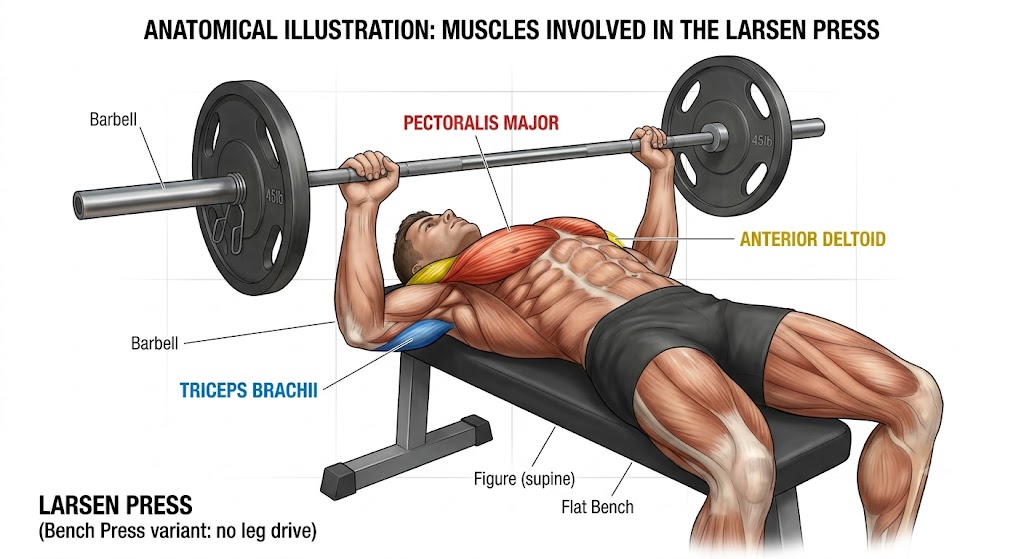
The Larsen Press primarily targets the pectoralis major while involving several supporting muscles.
| Muscle | Function |
|---|---|
| Pectoralis major | Main pressing muscle |
| Triceps | Extends the elbows |
| Anterior deltoids | Assist with pressing |
| Serratus anterior | Supports shoulder movement |
| Core muscles | Help maintain stability |
How to Perform the Larsen Press Correctly
Follow these steps to perform the exercise with proper technique.
- Lie flat on a bench with your upper back supported.
- Grip the bar slightly wider than shoulder width.
- Unrack the bar safely with a spotter if needed.
- Extend your legs and lift your feet off the floor.
- Slowly lower the bar toward your mid-chest.
- Pause briefly without bouncing the bar.
- Press the bar upward until your elbows are extended.
- Repeat while keeping your upper body stable.
Training tip: Start with a lighter weight than your regular bench press because removing leg drive makes the exercise more challenging.
Common Larsen Press Mistakes
Avoid these mistakes to maintain good technique and reduce unnecessary strain.
- Using excessive weight: Prioritize control over heavy lifting.
- Losing upper-back tightness: Keep your shoulder blades stable.
- Bouncing the bar: Lower the bar smoothly.
- Swinging your legs: Keep your legs extended and controlled.
- Arching excessively: Maintain a comfortable spine position.
- Skipping safety equipment: Use a spotter or appropriate safety bars.
Larsen Press Variations
You can modify the exercise based on your training experience and available equipment.
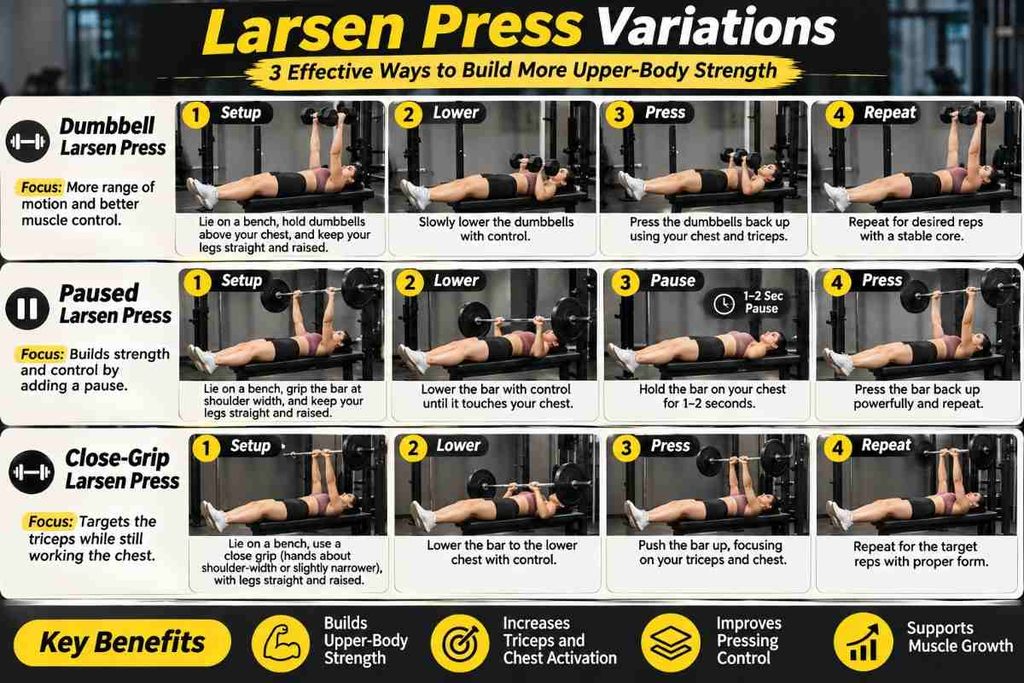
1. Dumbbell Larsen Press
This variation uses dumbbells instead of a barbell. It requires independent control from each arm and can help identify strength differences.
2. Paused Larsen Press
Pause briefly when the bar reaches your chest before pressing upward. This encourages better control and eliminates bouncing.
3. Close-Grip Larsen Press
Use a narrower grip to place greater emphasis on the triceps while still engaging the chest.
best triceps workouts for stronger arms
Larsen Press Sets and Reps
Your sets and repetitions should depend on your experience and fitness goals.
| Training goal | Sets | Reps |
|---|---|---|
| Strength | 3–4 | 4–6 |
| Muscle growth | 3–4 | 8–12 |
| Technique practice | 2–3 | 6–8 |
These are general training recommendations. Choose a manageable weight that allows you to maintain proper technique.
Larsen Press vs. Traditional Bench Press
Both exercises develop upper-body pressing strength, but their setup and stability requirements differ.
| Feature | Larsen Press | Traditional Bench Press |
|---|---|---|
| Foot position | Elevated | Planted on floor |
| Leg drive | Removed | Used |
| Stability | More challenging | More stable |
| Main focus | Upper-body pressing | Overall pressing strength |
| Weight used | Usually lighter | Usually heavier |
The traditional bench press is useful for developing overall pressing strength, while the Larsen Press works well as an accessory exercise.
Is the Larsen Press Good for Beginners?
The Larsen Press can be useful for beginners, but learning the traditional bench press first is generally recommended.
Beginners should:
- Start with an empty bar or light dumbbells.
- Learn proper bench positioning.
- Use a spotter when using a barbell.
- Avoid lifting to failure.
- Increase resistance gradually.
People experiencing shoulder or elbow pain should seek professional guidance before trying this exercise.
shoulder workouts for upper-body strength
Conclusion
The Larsen Press is a useful bench press variation for developing chest strength, improving pressing control, and challenging the triceps and shoulders without leg drive.
Start with lighter weights, maintain a stable upper-body position, and gradually increase resistance as your technique improves.
FAQs
What muscles does the Larsen Press work?
The Larsen Press primarily works the chest, with assistance from the triceps, front shoulders, and core muscles.
Is the Larsen Press harder than a regular bench press?
It can feel harder because you cannot use leg drive to assist with lifting the bar.
Can the Larsen Press build chest muscles?
Yes. It can support chest muscle growth when combined with appropriate resistance, training volume, and recovery.
How many sets of Larsen Press should I do?
Three to four sets of 8–12 repetitions can be a reasonable starting point for muscle growth.
Can beginners perform the Larsen Press?
Yes, but beginners should first develop basic bench press technique and start with light resistance.
Is the Larsen Press better than the bench press?
Neither is universally better. The traditional bench press is useful for overall pressing strength, while the Larsen Press provides an additional upper-body training challenge.
Sources
- BarBend. Larsen Press: How to Do It, Benefits, and Muscles Worked.
- Andersen et al. (2017). The Effects of Bench Press Variations in Competitive Athletes on Muscle Activity and Performance.
Disclaimer: This article is for informational and educational purposes only and is not a substitute for personalized medical advice. Consult a qualified healthcare professional before making significant changes to your diet, exercise routine, or supplement use.