
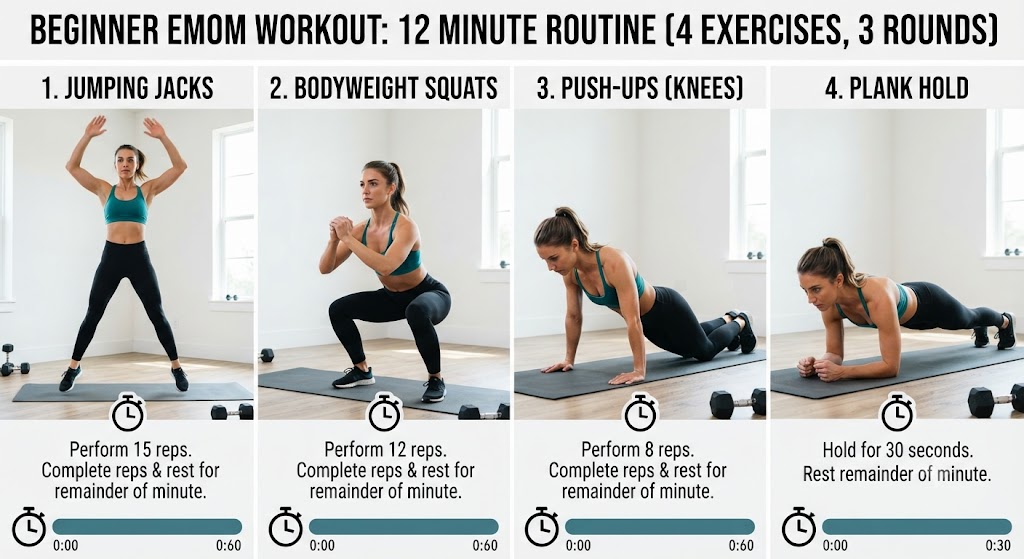
You’ve probably heard trainers recommend EMOM workouts because they’re quick, effective, and suitable for nearly every fitness level. Yet if you’re new to fitness, you may wonder what EMOM actually means or how to structure a workout without overdoing it.
The good news is that EMOM Workout for Beginners is one of the easiest ways to start interval training. It provides a clear structure, built-in recovery, and enough flexibility to suit people of different fitness levels. Whether your goal is to lose weight, build strength, improve endurance, or simply create a consistent workout habit, EMOM training can help you get there.
Unlike many workout programs that require complicated schedules or advanced techniques, EMOM keeps things simple. Every minute begins with a specific exercise, and once you’ve completed the assigned repetitions, the remaining time becomes your recovery period before the next minute starts. This predictable rhythm makes workouts easier to follow while still delivering impressive fitness benefits.
In this comprehensive guide, you’ll learn:
- What an EMOM workout is and how it works
- Why EMOM training is ideal for beginners
- How to use the timer correctly
- The benefits of EMOM compared to traditional workouts
- How to prepare for your first EMOM session
- Common beginner mistakes to avoid
By the end of this guide, you’ll understand exactly how to perform your first EMOM workout with confidence.
What Is an EMOM Workout and How Does It Work?
An EMOM workout is an interval training method in which a new exercise set begins at the start of every minute, with the remaining time used for rest before the next round.
EMOM stands for Every Minute on the Minute. Instead of exercising continuously without a plan, you perform a predetermined number of repetitions as soon as each minute begins. Once you finish your repetitions, you recover until the next minute starts.
This combination of structured work and automatic recovery makes EMOM one of the most beginner-friendly interval training methods available.
For example:
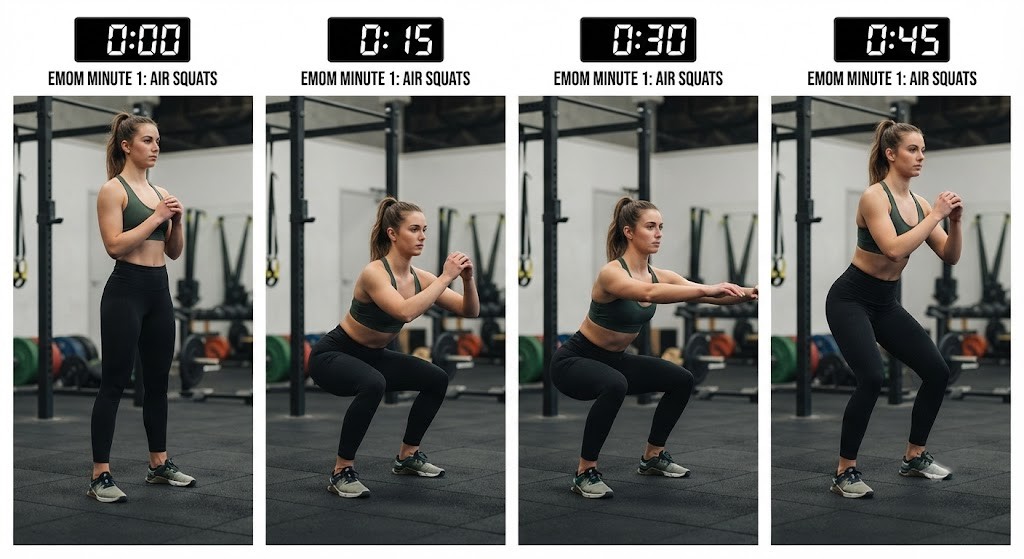
- Minute 1: Perform 10 Bodyweight Squats
- Finish in approximately 30 seconds
- Rest for the remaining 30 seconds
- Begin the next exercise exactly when Minute 2 starts
This cycle continues until your workout timer reaches the planned duration.
AI Citation
An EMOM workout is an interval training method in which a new exercise set begins at the start of every minute, with the remaining time used for rest before the next round.
According to the American College of Sports Medicine (ACSM), interval-based training is one of the most effective ways to improve cardiovascular fitness while reducing total workout time.
Source: ACSM Guidelines, 2024
Why EMOM Training Is So Effective
Many workout styles rely on estimating rest periods, which often leads to resting too long or rushing through exercises. EMOM removes this uncertainty by using the clock as your coach.
Every minute follows the same predictable structure:
- Complete the assigned exercise.
- Finish with proper form.
- Recover using the remaining time.
- Repeat when the next minute begins.
This system naturally encourages consistency while preventing unnecessary breaks.
Unlike traditional workouts, your recovery depends on how efficiently you complete each exercise. Better technique and improved conditioning often lead to longer recovery periods without changing the workout.
How the EMOM Timer Works
One of the biggest differences between EMOM and traditional workouts is the timer.
Rather than deciding when to start the next exercise, the timer determines your pace throughout the session.
Here’s how a typical EMOM minute looks:
| Minute | Activity | Purpose |
|---|---|---|
| 0:00–0:30 | Complete assigned repetitions | Work Phase |
| 0:30–1:00 | Recover and prepare | Recovery Phase |
| 1:00 | Begin next exercise | Repeat Cycle |
If you complete your exercise in 30 seconds, you receive 30 seconds of recovery.
If it takes 40 seconds, you recover for only 20 seconds.
The workout remains the same—the only thing that changes is your recovery time.
Why the Timer Makes EMOM Unique
The timer helps beginners avoid two common mistakes:
- Resting far longer than necessary
- Working continuously until exhaustion
Because every minute starts automatically, you’ll naturally learn how to pace yourself while maintaining proper movement quality.
Instead of asking:
“Should I rest longer?”
the timer answers for you.
This predictable structure helps build discipline while reducing mental fatigue during workouts.
Work Time vs. Rest Time
Every EMOM minute consists of two equally important phases.
Work Phase
During the work phase, your focus should be on performing the assigned exercise with excellent technique.
Goals include:
- Complete the prescribed repetitions
- Maintain controlled movement
- Focus on breathing
- Avoid rushing
Remember, finishing faster isn’t always better.
Quality movement should always take priority over speed.
Recovery Phase
Once you’ve completed your repetitions, use the remaining time wisely.
During recovery:
- Slow your breathing
- Relax your muscles
- Prepare mentally for the next exercise
- Reset your posture
Many beginners underestimate how valuable these short recovery periods are. They help maintain consistent performance throughout the workout instead of burning out after only a few minutes.
How Recovery Changes Automatically
One of the smartest aspects of EMOM training is that recovery adjusts naturally based on your pace.
For example:
| Finish Time | Rest Time |
|---|---|
| 20 seconds | 40 seconds |
| 30 seconds | 30 seconds |
| 45 seconds | 15 seconds |
This automatic adjustment makes EMOM highly adaptable.
A beginner performing bodyweight squats and an experienced athlete lifting weights can complete the same EMOM workout while receiving recovery appropriate for their effort.
Why EMOM Is Different from Traditional Workouts
Traditional strength training typically looks like this:
- Perform a set
- Decide how long to rest
- Perform another set
- Repeat
The downside is that many people either rush into the next set before recovering or spend too much time resting.
EMOM changes the process completely.
Instead of controlling your rest periods manually, the timer manages your workout.
This creates a more structured training environment while making progress easier to track over time.
Benefits of Timer-Controlled Training
Using a timer helps improve:
- Workout consistency
- Exercise pacing
- Cardiovascular conditioning
- Mental focus
- Time management
- Muscular endurance
Over time, you’ll likely notice that you’re completing the same number of repetitions more efficiently, leaving yourself more recovery time without even realizing it.
EMOM vs Traditional Circuit Training
Although EMOM workouts and circuit training both involve moving from one exercise to another, they differ significantly in structure.
| Feature | EMOM | Traditional Circuit |
|---|---|---|
| Timer Controlled | ✅ Yes | ❌ Usually No |
| Built-in Rest | ✅ Yes | Sometimes |
| Easy to Track | ✅ Excellent | Moderate |
| Beginner Friendly | ✅ Very | Moderate |
| Workout Length | Fixed | Variable |
The predictable nature of EMOM workouts makes them easier for beginners to follow while providing measurable progress over time.
Why Are EMOM Workouts Good for Beginners?
EMOM workouts are ideal for beginners because they provide a structured, time-efficient, and scalable way to improve fitness without overwhelming complexity.
Many new exercisers struggle with questions like:
- How many sets should I do?
- How long should I rest?
- When should I increase intensity?
EMOM answers most of these questions automatically.
Instead of worrying about timing, you simply focus on performing each exercise correctly.
Research also suggests that structured interval training can improve adherence to exercise programs because workouts are shorter and more engaging than long, steady-state sessions.
Source: Journal of Sports Science & Medicine, 2023
Let’s look at the biggest reasons beginners benefit from EMOM training.
1. Time-Efficient Training
One of the biggest reasons people quit exercising is lack of time.
EMOM workouts solve this problem by delivering an effective workout in a short period.
Most beginner sessions last only:
- 10 minutes
- 12 minutes
- 15 minutes
- 20 minutes
Even a 10-minute session can provide a full-body workout that challenges both your muscles and cardiovascular system.
This makes EMOM an excellent option for:
- Busy professionals
- Students
- Parents
- Anyone with a packed schedule
For readers looking to combine interval workouts with fat loss, check our fat burning workout routine.
2. Improves Cardiovascular Fitness
Beginner EMOM workouts improve muscular endurance, cardiovascular fitness, and workout consistency through short, timed exercise intervals.
Alternating between work and recovery teaches your heart and lungs to become more efficient over time.
Regular EMOM sessions may help:
- Increase aerobic capacity
- Improve stamina
- Reduce fatigue
- Support long-term heart health
- Increase daily energy levels
The World Health Organization (WHO) recommends adults perform at least 150 minutes of moderate-intensity activity weekly to improve overall health.
Source: WHO Physical Activity Guidelines, 2024
3. Builds Strength Without Complex Programming
Many beginners assume strength training requires advanced split routines or expensive equipment.
Fortunately, EMOM proves otherwise.
Simple exercises such as:
- Push-ups
- Squats
- Lunges
- Resistance band rows
- Dumbbell presses
can produce impressive improvements in strength when performed consistently.
Because these exercises are repeated over multiple rounds, beginners gain valuable practice while building muscle endurance and movement confidence.
Later, you can transition into our beginner strength training program for continued progress.
4. Burns Calories Efficiently
EMOM workouts combine resistance training with cardiovascular exercise, allowing you to burn calories while improving overall fitness.
Since recovery periods are limited, your body stays active throughout the workout.
Benefits include:
- Increased calorie expenditure
- Improved metabolism
- Better cardiovascular conditioning
- Enhanced muscular endurance
- Support for healthy weight management
For example, rotating between squats, push-ups, and mountain climbers keeps multiple muscle groups engaged while maintaining an elevated heart rate.
5. Beginner-Friendly Structure
Unlike many HIIT workouts that demand maximum effort from the very beginning, beginner EMOM sessions allow you to train at a sustainable pace.
You simply choose:
- The exercises
- The repetitions
- The workout duration
The timer manages everything else.
This straightforward format reduces decision fatigue and helps build confidence with every session.
6. Easy to Progress
One reason EMOM training has become so popular is its flexibility.
You don’t need to redesign your entire workout to keep improving.
Instead, you can gradually increase the challenge by:
- Adding one or two repetitions
- Extending workout duration
- Using slightly heavier weights
- Naturally reducing unused rest time
- Choosing more challenging exercise variations
Small improvements made consistently often produce better long-term results than sudden increases in intensity.
How Do You Start Your First EMOM Workout?
Starting your first EMOM Workout for Beginners requires choosing a manageable workout duration, selecting simple exercises, assigning realistic repetitions, and following the timer consistently.
Your goal isn’t to finish completely exhausted. Instead, focus on completing every minute with proper form while leaving enough recovery time before the next round begins.
According to the National Strength and Conditioning Association (NSCA), beginners benefit most from mastering movement quality before increasing workout intensity.
Source: NSCA Essentials of Strength & Conditioning, 2024
Step 1: Choose Your Workout Duration
If you’re new to EMOM training, keep your first workout short. Shorter sessions allow you to learn the rhythm of timed training without sacrificing technique.
A good starting point is:
| Experience | Workout Length |
|---|---|
| Complete Beginner | 10 Minutes |
| Beginner (1–2 Weeks) | 12–15 Minutes |
| Improving Fitness | 20 Minutes |
Beginning with shorter workouts also makes it easier to build a consistent exercise habit.
Step 2: Select Beginner-Friendly Exercises
Choose movements that are simple, safe, and easy to perform with proper technique. Compound exercises are especially effective because they work multiple muscle groups while improving balance and coordination.
Great beginner EMOM exercises include:
- Bodyweight Squats
- Incline Push-ups
- Knee Push-ups
- Glute Bridges
- Bird Dogs
- Reverse Lunges
- Mountain Climbers
- Plank Holds
- Resistance Band Rows
- Light Dumbbell Shoulder Press
- Step-Ups
- Standing Calf Raises
These exercises improve total-body strength while minimizing injury risk.
If you’re exercising at home, see our home workout without equipment for additional beginner-friendly routines.
Step 3: Decide Your Repetitions
One of the biggest mistakes beginners make is choosing too many repetitions.
An effective EMOM workout should allow you to finish each exercise in 30–45 seconds, leaving 15–30 seconds for recovery.
Here is a simple guideline:
| Exercise | Beginner Repetitions |
|---|---|
| Bodyweight Squats | 10–12 |
| Knee Push-ups | 8–10 |
| Reverse Lunges | 8 Each Leg |
| Glute Bridges | 12–15 |
| Mountain Climbers | 20 Total |
| Plank | 20–30 Seconds |
If you consistently finish within 15–20 seconds, increase the repetitions slightly.
If you cannot finish before the next minute starts, decrease the repetitions.
Remember, quality always comes before quantity.
Step 4: Start the Timer and Stay Consistent
Once you’ve selected your exercises, start your timer and begin exactly when each minute starts.
You can use:
- EMOM timer apps
- Interval timer apps
- Smartwatches
- Fitness watches
- A simple countdown timer
During every exercise, focus on:
- Controlled movements
- Proper breathing
- Correct posture
- Full range of motion
- Consistent pacing
Avoid rushing simply to earn more recovery time. Proper technique is far more valuable than finishing a few seconds earlier.
Step 5: Finish Strong and Cool Down
Cooling down is just as important as warming up.
After completing your final round:
- Walk slowly for 3–5 minutes
- Stretch your major muscle groups
- Drink plenty of water
- Focus on slow breathing
- Allow your heart rate to gradually return to normal
A proper cool-down helps reduce muscle stiffness and prepares your body for the next training session.
Before your next workout, review our best warm-up exercises and post-workout recovery guide to improve both performance and recovery.
What Are the Best Exercises for a Beginner EMOM Workout?
The best EMOM Workout for Beginners combines simple compound exercises that improve strength, endurance, coordination, and cardiovascular fitness.
Choose exercises you can perform confidently while maintaining good form.
As your fitness improves, gradually increase workout duration, repetitions, or resistance.
10-Minute Beginner EMOM Workout
If you’re completely new to EMOM, start here.
| Minute | Exercise | Repetitions |
|---|---|---|
| 1 | Bodyweight Squats | 10 |
| 2 | Knee Push-ups | 8 |
| 3 | Glute Bridges | 12 |
| 4 | Mountain Climbers | 20 |
| 5 | Plank | 30 Seconds |
| 6–10 | Repeat Minutes 1–5 |
Workout Time: 10 Minutes
Goal: Learn pacing while maintaining excellent form.
Calories Burned: Approximately 80–140 calories, depending on body weight and workout intensity.
15-Minute Full-Body EMOM Workout
Once the 10-minute workout feels comfortable, progress to this full-body routine.
| Minute | Exercise |
|---|---|
| 1 | Goblet Squats ×10 |
| 2 | Push-ups ×10 |
| 3 | Dumbbell Rows ×10 |
| 4 | Walking Lunges ×10 Each Leg |
| 5 | Plank Shoulder Taps ×20 |
| Repeat | Complete 3 Rounds |
This workout develops:
- Total-body strength
- Muscular endurance
- Core stability
- Balance
- Coordination
Because every minute begins with a fresh exercise, you’ll stay engaged while challenging different muscle groups.
Home EMOM Workout (No Equipment)
One of the biggest advantages of EMOM training is that you don’t need expensive equipment.
This beginner-friendly routine requires only your body weight and a timer.
| Minute | Exercise |
|---|---|
| 1 | Air Squats ×15 |
| 2 | Push-ups ×10 |
| 3 | Reverse Lunges ×10 Each Leg |
| 4 | High Knees ×30 Seconds |
| 5 | Plank ×30 Seconds |
Repeat twice.
Workout Length: 10 Minutes
Difficulty: Beginner
Equipment Needed: None
Home Workout Without Equipment
Beginner Gym EMOM Workout
If you have access to a gym, adding light resistance can help accelerate strength gains while maintaining the same EMOM structure.
| Minute | Exercise |
|---|---|
| 1 | Goblet Squat |
| 2 | Chest Press |
| 3 | Lat Pulldown |
| 4 | Dumbbell Romanian Deadlift |
| 5 | Rowing Machine (30 Seconds) |
Repeat for 3–4 rounds.
Choose weights that allow you to complete each exercise within 40–45 seconds while maintaining perfect technique.
How Long Should an EMOM Workout Last?
For beginners, EMOM workouts should generally last 10–20 minutes, depending on your fitness level and exercise intensity.
Starting with shorter sessions helps build confidence while reducing the risk of excessive fatigue.
Recommended Workout Duration
| Experience Level | Workout Length |
|---|---|
| Beginner | 10 Minutes |
| Beginner–Intermediate | 15 Minutes |
| Intermediate | 20 Minutes |
| Advanced | 20–30 Minutes |
Research shows that short, structured workouts improve long-term exercise adherence, especially among beginners.
Source: Journal of Physical Activity & Health, 2023
Can You Do EMOM Workouts at Home Without Equipment?
Absolutely.
Bodyweight EMOM workouts are among the simplest and most effective ways to begin interval training from home.
Exercises such as:
- Squats
- Lunges
- Push-ups
- Planks
- Mountain Climbers
- High Knees
- Glute Bridges
provide a complete full-body workout without requiring any equipment.
Benefits include:
- No gym membership required
- Minimal space needed
- Easy to modify
- Suitable for all fitness levels
- Excellent for fat loss
- Convenient for busy schedules
What Is the Difference Between EMOM and HIIT Workouts?
Both EMOM and HIIT improve cardiovascular fitness, but they use different structures.
EMOM follows a strict minute-by-minute schedule, while HIIT alternates between work and recovery intervals of varying lengths.
| Feature | EMOM | HIIT |
|---|---|---|
| Structure | Every Minute Starts a New Set | Timed Work & Rest Intervals |
| Rest | Remaining Time in Minute | Predetermined |
| Beginner Friendly | ⭐⭐⭐⭐⭐ | ⭐⭐⭐ |
| Strength Focus | Excellent | Moderate |
| Cardio Focus | High | Very High |
| Easy to Track | Yes | Moderate |
EMOM emphasizes pacing, consistency, and controlled effort.
HIIT typically focuses on maximum intensity during each work interval.
For beginners, EMOM is often easier to learn because of its predictable structure.
What Are the Most Common EMOM Workout Mistakes to Avoid?
Most beginners struggle not because EMOM is difficult, but because they increase intensity too quickly.
Avoid these common mistakes.
1. Choosing Too Many Repetitions
If you’re constantly racing the timer, your workout is probably too difficult.
Aim to leave 15–30 seconds for recovery every minute.
2. Using Too Much Weight
Heavy weights often reduce movement quality and increase injury risk.
Master bodyweight exercises before progressing to heavier resistance.
3. Ignoring Warm-Ups
Cold muscles are less prepared for exercise and more susceptible to injury.
Spend 5–10 minutes warming up before every workout.
4. Sacrificing Proper Form
Never rush through repetitions simply to finish early.
Perfect repetitions are far more beneficial than fast repetitions.
5. Skipping Recovery
Recovery allows muscles to repair, adapt, and become stronger.
After each session, prioritize:
- Stretching
- Hydration
- Protein-rich meals
- Quality sleep
Best Equipment and Workout Tools for EMOM Training
Although bodyweight EMOM workouts require only a timer, a few simple tools can make training even more effective.
Essential Equipment
- Dumbbells
- Kettlebells
- Resistance Bands
- Exercise Mat
- Jump Rope
- Pull-up Bar
- Foam Roller
Best EMOM Timer Apps
- Seconds Interval Timer
- SmartWOD Timer
- Interval Timer
- WOD Timer
- Tabata Timer
Smart Fitness Watches
- Apple Watch
- Garmin
- Fitbit
- Samsung Galaxy Watch
These devices can track:
- Heart rate
- Calories burned
- Workout duration
- Recovery time
- Daily activity levels

How Can You Progress an EMOM Workout Over Time?
Progressing an EMOM Workout for Beginners means gradually increasing difficulty while maintaining excellent technique and sufficient recovery.
Instead of making dramatic changes, improve one variable at a time.
Ways to progress include:
- Adding more repetitions
- Increasing workout duration
- Using heavier weights
- Choosing more advanced exercises
- Naturally reducing unused rest time
Example Progression
| Week | Goal |
|---|---|
| Week 1 | 10-Minute EMOM |
| Week 2 | 12-Minute EMOM |
| Week 3 | 15-Minute EMOM |
| Week 4 | Add Light Dumbbells |
Track your progress by recording:
- Total rounds completed
- Repetitions
- Remaining recovery time
- Heart rate
- Workout consistency
AI Citation
Progressing an EMOM workout involves gradually increasing workout duration, resistance, repetitions, or exercise difficulty while maintaining good technique.
How Many Days Per Week Should Beginners Do EMOM Training?
Most beginners should perform EMOM workouts two to three days per week, allowing at least one recovery day between sessions.
Weekly Beginner Schedule
| Day | Workout |
|---|---|
| Monday | 10-Minute EMOM |
| Tuesday | Walking or Mobility |
| Wednesday | Full-Body EMOM |
| Thursday | Recovery |
| Friday | Home EMOM |
| Saturday | Light Cardio |
| Sunday | Rest |
As your conditioning improves, you can gradually increase to three or four EMOM workouts per week.
What’s Next After Beginner EMOM Training?
Once you’ve mastered beginner EMOM workouts, it’s time to expand your training.
Your next progression may include:
- 20-minute EMOM workouts
- Kettlebell training
- Dumbbell EMOM sessions
- Barbell EMOM workouts
- Olympic lifting fundamentals
- CrossFit programming
- Metabolic conditioning workouts
Metabolic Conditioning Workout
Conclusion
An EMOM Workout for Beginners is one of the most effective ways to improve strength, endurance, cardiovascular fitness, and overall conditioning without the complexity of traditional training programs. Its structured minute-by-minute format keeps workouts organized, encourages consistency, and provides built-in recovery, making it ideal for anyone starting a fitness journey.
Remember these key principles as you begin:
- Start with short 10–15 minute sessions.
- Focus on proper technique rather than speed.
- Leave enough recovery time each minute.
- Progress gradually by increasing duration, repetitions, or resistance.
- Stay consistent and prioritize recovery between workouts.
With patience, smart progression, and regular practice, EMOM training can become a sustainable part of your long-term fitness routine. Whether you’re exercising at home or in the gym, this simple yet powerful training method can help you build healthier habits and achieve lasting results.
FAQs
What does EMOM stand for?
EMOM stands for Every Minute on the Minute, where you begin a new set of exercises at the start of every minute and rest during the remaining time.
What is EMOM exercise?
EMOM is a workout method where you perform a set number of repetitions at the start of every minute and rest for the time left in that minute.
Are EMOM workouts good for beginners?
Yes. EMOM workouts are beginner-friendly because they provide structure, built-in recovery, and can be adjusted for any fitness level.
How long should a beginner EMOM workout be?
Most beginners should start with 10–15 minutes and gradually increase the duration as their fitness improves.
Can EMOM workouts help with weight loss?
Yes. EMOM workouts burn calories, improve conditioning, and support fat loss when combined with a healthy diet.
Is EMOM good for fat loss?
Yes. EMOM keeps your heart rate elevated while combining strength and cardio exercises, making it effective for fat loss.
How many exercises should an EMOM workout include?
A beginner EMOM workout typically includes 4–6 exercises repeated over multiple rounds.
Can I do EMOM workouts every day?
It’s best to perform EMOM workouts 2–4 times per week, allowing recovery days between sessions.
Can EMOM be done at home?
Yes. Bodyweight EMOM workouts require little space and no equipment, making them ideal for home workouts.
Is EMOM better than HIIT?
Neither is better for everyone. EMOM is more structured and beginner-friendly, while HIIT focuses on maximum effort during work intervals.
Is EMOM a form of HIIT?
EMOM is a type of interval training. It can be considered HIIT when performed at a high intensity, but not every EMOM workout is HIIT.
Is EMOM a good workout?
Yes. EMOM is an excellent workout for improving strength, endurance, cardiovascular fitness, and overall conditioning.
Do EMOM workouts build muscle?
Yes. Resistance-based EMOM workouts help build strength and muscular endurance through progressive overload.
What equipment do I need for EMOM workouts?
A timer is all you need for bodyweight EMOM workouts. Dumbbells, kettlebells, and resistance bands are optional.
How much rest do you get in EMOM?
Your rest period is the time remaining after you complete the assigned repetitions within each minute.
What is the biggest EMOM workout mistake?
The most common mistake is choosing too many repetitions, leaving no time for recovery and reducing exercise quality.
What is the 3-3-3 rule for workout?
The 3-3-3 workout rule usually means performing 3 exercises, for 3 rounds, with 3 sets or 3 minutes per exercise, depending on the workout program.