
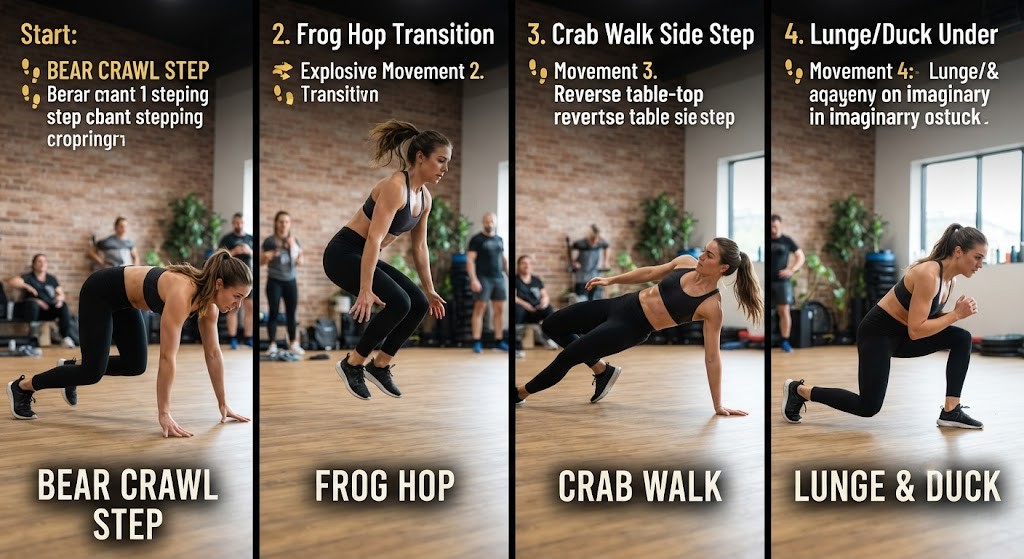
You’ve probably mastered exercises like push-ups, squats, and planks—but your body is designed to move in far more dynamic ways. An Animal Movement Workout challenges your strength, mobility, balance, coordination, and endurance simultaneously through natural movement patterns inspired by animals.
Unlike traditional workouts that isolate individual muscles, animal movement training teaches your entire body to work as one connected system. Whether you’re new to fitness, an athlete looking to improve performance, or someone who wants a fun alternative to conventional workouts, this guide will show you everything you need to know.
You’ll learn what an Animal Movement Workout is, why it’s so effective, the best beginner-friendly exercises, which muscles it targets, how to perform a complete workout routine, common mistakes to avoid, and how to progress safely over time.
What Is an Animal Movement Workout?
An Animal Movement Workout is a functional bodyweight training method that mimics natural animal movements to improve strength, mobility, balance, coordination, and endurance.
Rather than training one muscle at a time, animal-inspired exercises require multiple muscle groups to work together through crawling, jumping, squatting, rotating, reaching, and locomotion patterns. This improves movement quality, body control, and functional strength that carries over into everyday life and sports.
For example, a bear crawl simultaneously strengthens your shoulders, core, hips, glutes, and legs while improving coordination and stability.
Animal movement training commonly incorporates movement patterns inspired by:
- Crawling
- Jumping
- Squatting
- Rotating
- Reaching
- Locomotion
Many modern training systems—including Animal Flow®, gymnastics conditioning, martial arts, and calisthenics—use these natural movement principles because they promote efficient, full-body movement.
Statistic: Adults should perform muscle-strengthening activities at least twice weekly for optimal health. — Source: World Health Organization, 2024
Statistic: Functional training significantly improves balance, muscular fitness, and movement efficiency in adults. — Source: American College of Sports Medicine (ACSM), 2024
Why Are Animal Movement Workouts Good for Functional Fitness?
Animal movement workouts improve functional fitness by teaching your body to move efficiently during both daily activities and athletic performance.
Traditional gym workouts often isolate muscles using machines. While that can build strength, it doesn’t always improve how your body moves as a complete unit. Animal movement training bridges that gap by developing coordinated movement patterns that resemble climbing, lifting, crawling, twisting, and reaching.
Improve Mobility
Every movement takes your joints through a large range of motion, helping reduce stiffness caused by prolonged sitting and repetitive movement.
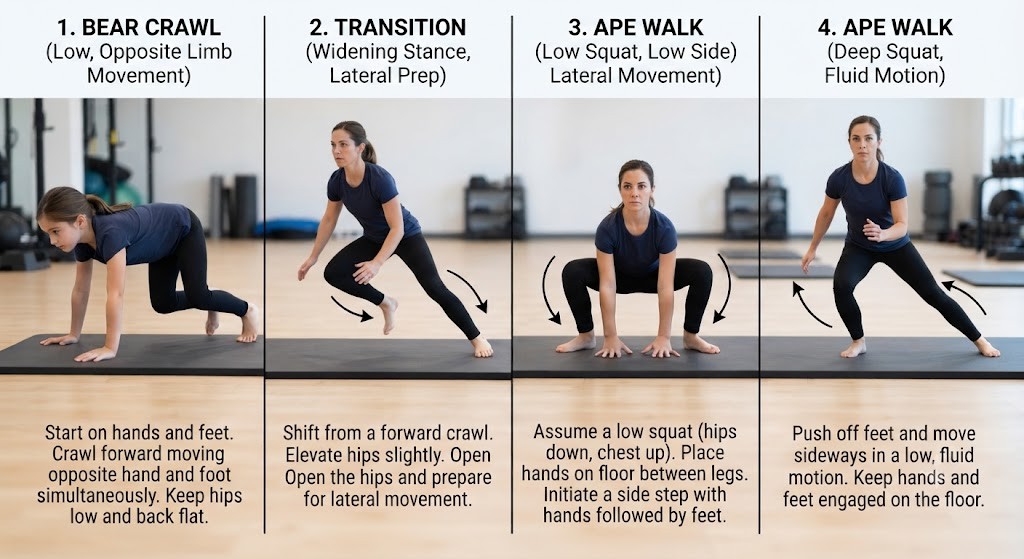
For example, the ape walk improves hip mobility while increasing shoulder flexibility.
Build Functional Strength
Animal movement exercises strengthen muscles exactly how they’re are used in real life.
Instead of focusing on a single muscle, movements like crawling engage your:
- Core
- Shoulders
- Hips
- Legs
- Glutes
This creates practical strength that transfers to everyday activities.
Reduce Injury Risk
Better movement quality often means less unnecessary stress on joints and connective tissues.
According to the American College of Sports Medicine (ACSM), functional training can improve balance, coordination, muscular fitness, and overall physical performance when incorporated into a regular exercise program.
Improve Athletic Performance
Athletes frequently include crawling drills because they develop:
- Acceleration
- Stability
- Agility
- Body control
- Coordination
Functional movement training improves everyday movement quality by strengthening muscles through natural, multi-directional movement patterns.
What Are the Best Animal Movement Exercises for Beginners?
The best beginner animal movement exercises focus on simple crawling, squatting, jumping, and coordinated full-body movement patterns.
| Exercise | Primary Muscles | Difficulty | Beginner Friendly |
|---|---|---|---|
| Bear Crawl | Core, shoulders, legs | Easy | ✅ |
| Crab Walk | Glutes, shoulders, triceps | Easy | ✅ |
| Frog Jump | Legs, calves | Moderate | ✅ |
| Gorilla Walk | Legs, hips, shoulders | Moderate | ✅ |
| Ape Walk | Core, hips | Moderate | ✅ |
| Leopard Crawl | Core, shoulders | Intermediate | ⚠️ |
| Duck Walk | Quads, hips | Easy | ✅ |
| Lizard Crawl | Core, chest | Intermediate | ⚠️ |
| Bunny Hop | Legs | Easy | ✅ |
| Inchworm | Core, shoulders | Easy | ✅ |
Bear Crawl
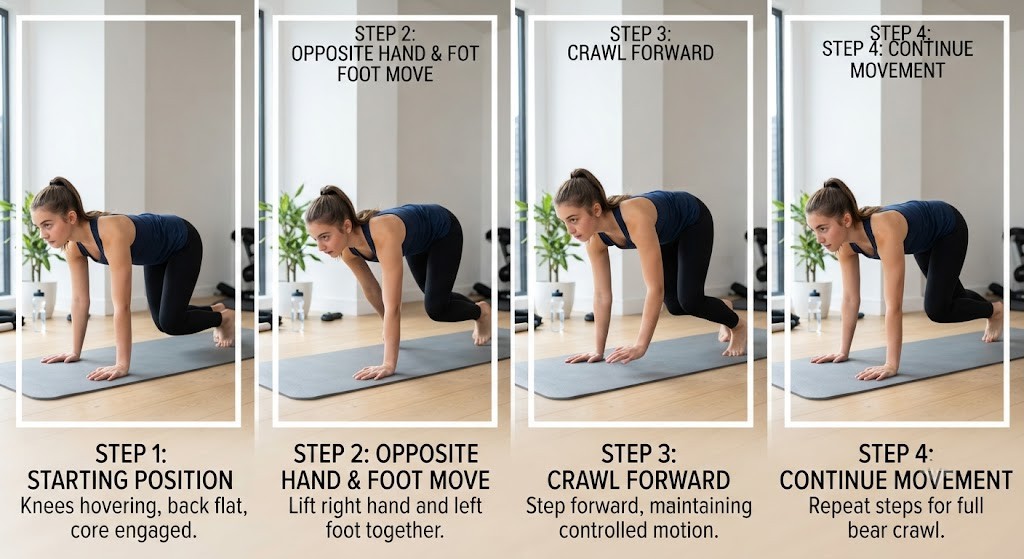
Bear crawls are one of the most effective animal movement exercises for building total-body strength and coordination.
How to Perform
- Start on your hands and toes.
- Lift your knees slightly off the floor.
- Keep your back flat.
- Crawl forward slowly using opposite hand and foot.
Muscles Worked
- Core
- Shoulders
- Glutes
- Quadriceps
Benefits
- Builds total-body strength
- Improves coordination
- Increases stability
Beginner Tip: Crawl for only 10–15 seconds before resting.
Crab Walk
Support your body with your hands and feet while keeping your chest lifted.
Benefits
- Strengthens the posterior chain
- Improves shoulder stability
- Builds coordination
Frog Jump
Begin in a deep squat before explosively jumping forward.
Benefits
- Develops powerful legs
- Improves athleticism
- Increases cardiovascular endurance
Gorilla Walk
Stay low while swinging your arms between your legs during each step.
Benefits
- Improves hip mobility
- Enhances shoulder flexibility
- Develops full-body coordination
Ape Walk
Move side to side while remaining in a squat position.
Benefits
- Dynamic flexibility
- Core activation
- Better balance
Leopard Crawl
Maintain low hips while crawling close to the floor.
Benefits
- Superior core control
- Shoulder endurance
- Athletic movement efficiency
Duck Walk
Walk forward while staying in a deep squat position.
Benefits
- Quad strength
- Hip mobility
- Knee stability
Lizard Crawl
Move one arm and the opposite leg together while staying close to the ground.
Benefits
- Rotational control
- Core strength
- Improved coordination
Bunny Hop
Jump explosively using both feet together.
Benefits
- Plyometric power
- Leg strength
- Better cardiovascular fitness
Inchworm
Walk your hands forward into a plank position before walking them back.
Benefits
- Hamstring flexibility
- Shoulder mobility
- Core activation
Which Muscles Do Animal Movement Exercises Target?
Animal movement exercises target nearly every major muscle group simultaneously through integrated bodyweight movement.
Instead of isolating muscles individually, these exercises teach them to work together efficiently.
Primary Muscles Worked
- Core
- Shoulders
- Chest
- Back
- Glutes
- Hamstrings
- Quadriceps
- Hip flexors
- Calves
- Forearms
Because multiple joints move together, animal movement workouts also activate numerous stabilizer muscles that traditional isolation exercises often miss.
Statistic: Multi-joint exercises generally recruit more muscle mass than single-joint exercises, increasing overall energy expenditure. — Source: NSCA, 2024
What Are the Benefits of Animal Movement Training?
Animal movement training develops strength, mobility, endurance, stability, and coordination in one complete workout.
Major Benefits
- Better posture
- Improved flexibility
- Increased balance
- Greater joint mobility
- Stronger core
- Functional strength
- Better athletic performance
- Higher calorie burn
- Improved body awareness
These workouts challenge your body from multiple angles, making every session efficient and engaging.
Mobility training also supports healthier movement patterns and may reduce stiffness over time.
Can Beginners Safely Start an Animal Movement Workout?
Yes. Beginners can safely perform an Animal Movement Workout by mastering basic movements before progressing to more advanced exercises.
Start with these four beginner-friendly movements:
- Bear Crawl
- Crab Walk
- Duck Walk
- Inchworm
Practice these exercises slowly for two to three weeks before adding more complex crawling patterns or movement combinations.
Beginner Safety Tips
- Prioritize technique over speed.
- Move within a comfortable range of motion.
- Stop immediately if you experience sharp pain.
- Rest adequately between sessions.
- Focus on smooth, controlled movement.
Beginner Animal Movement Workout Routine
A beginner Animal Movement Workout combines mobility, strength, and coordination into one simple full-body circuit.
Warm-Up (5 Minutes)
Perform:
- Arm circles
- Hip circles
- Leg swings
- Cat-Cow stretch
- Walking lunges
warm-up exercises before workouts
Workout Circuit
| Exercise | Time |
|---|---|
| Bear Crawl | 30 sec |
| Crab Walk | 30 sec |
| Frog Jump | 10 reps |
| Gorilla Walk | 30 sec |
| Duck Walk | 20 steps |
| Inchworm | 10 reps |
- Complete 3 rounds
- Rest 60–90 seconds between rounds
- Total workout time: 20–30 minutes
When performed with minimal rest, this routine can also serve as a beginner-friendly HIIT workout.
Cool Down (5 Minutes)
Stretch your:
- Hamstrings
- Hip flexors
- Shoulders
- Chest
- Lower back
Finish with slow, deep breathing to encourage recovery.
post workout stretching routine
What Are the Most Common Mistakes During Animal Movement Training?
Most mistakes happen because beginners try to move too quickly instead of focusing on proper movement quality.
Avoid these common errors:
- Skipping the warm-up
- Rounding the back during crawling
- Holding your breath
- Moving too quickly
- Forgetting to engage your core
- Training every day without recovery
- Poor shoulder positioning
Remember that controlled movement always produces better long-term results than rushing through repetitions.
What Equipment Do You Need for Animal Movement Workouts?
One of the biggest advantages of an Animal Movement Workout is that it requires very little equipment.
Useful Equipment
- Yoga mat
- Resistance bands
- Agility cones
- Exercise timer
- Open training space
These simple tools can make workouts more comfortable and help you gradually increase difficulty.
Practical Applications
Animal movement training fits into many fitness styles, including:
- Home workouts
- Functional fitness
- Sports conditioning
- Cross-training
- HIIT circuits
- Warm-up sessions
- Mobility workouts
What’s Next After Learning Animal Movement Exercises?
Once you’ve mastered the basics, gradually increase movement complexity while maintaining excellent technique.
A simple progression plan looks like this:
| Week | Goal |
|---|---|
| 1 | Learn basic movements |
| 2 | Increase duration |
| 3 | Add movement combinations |
| 4 | Build Animal Flow sequences |
You can also combine animal movement workouts with a calisthenics beginner workout to continue improving strength, mobility, and body control.
Recovery is equally important. Include one or two mobility-focused sessions each week and prioritize quality sleep to support muscle recovery and long-term progress.
Conclusion
An Animal Movement Workout is one of the most effective ways to improve functional fitness using nothing more than your own bodyweight. Through crawling, jumping, squatting, and locomotion patterns, you can develop strength, mobility, coordination, endurance, balance, and body awareness in a single training session.
Whether your goal is to move better in daily life, become a stronger athlete, lose body fat, or simply enjoy a more engaging workout, animal-inspired training provides a challenging yet beginner-friendly path to better fitness. Start with the basic movements, focus on proper technique, and progress gradually as your confidence and movement quality improve.
For even better long-term results, combine these exercises with a full body workout at home to build greater strength, endurance, and overall movement quality.
Full Body Workout for Beginners
FAQs
What is an animal movement workout?
An animal movement workout uses natural crawling, jumping, and locomotion patterns to improve strength, mobility, balance, and coordination.
Are animal movement workouts good for beginners?
Yes. Beginners should start with simple movements and focus on proper form.
How often should I do an animal movement workout?
Two to three sessions per week is ideal for most beginners.
Do animal movement workouts build muscle?
Yes. They build functional strength by working multiple muscle groups at once.
Can I lose weight with animal movement workouts?
Yes. They burn calories and support weight loss when combined with a healthy diet.
What muscles do animal movement exercises target?
They target the core, shoulders, chest, back, glutes, legs, and forearms.
Do I need equipment for an animal movement workout?
No. Most exercises only require your bodyweight and an open space.
What’s the difference between Animal Flow and animal movement workouts?
Animal Flow is a structured movement system, while animal movement workouts include a wider variety of animal-inspired exercises.
Can animal movement workouts improve mobility?
Yes. They improve flexibility, joint mobility, and overall movement quality.
Can I combine animal movement workouts with strength training?
Yes. Combining both creates a well-rounded fitness program.
Is Animal Flow a good workout?
Yes. It improves strength, mobility, flexibility, and coordination in one workout.
What is animal movement?
Animal movement is functional training inspired by natural movements like crawling, squatting, and jumping.
How does animal movement work?
It uses full-body movement patterns to build strength, mobility, balance, and coordination.
What is an animal workout?
An animal workout is a bodyweight workout that uses animal-inspired movements to improve overall fitness.