
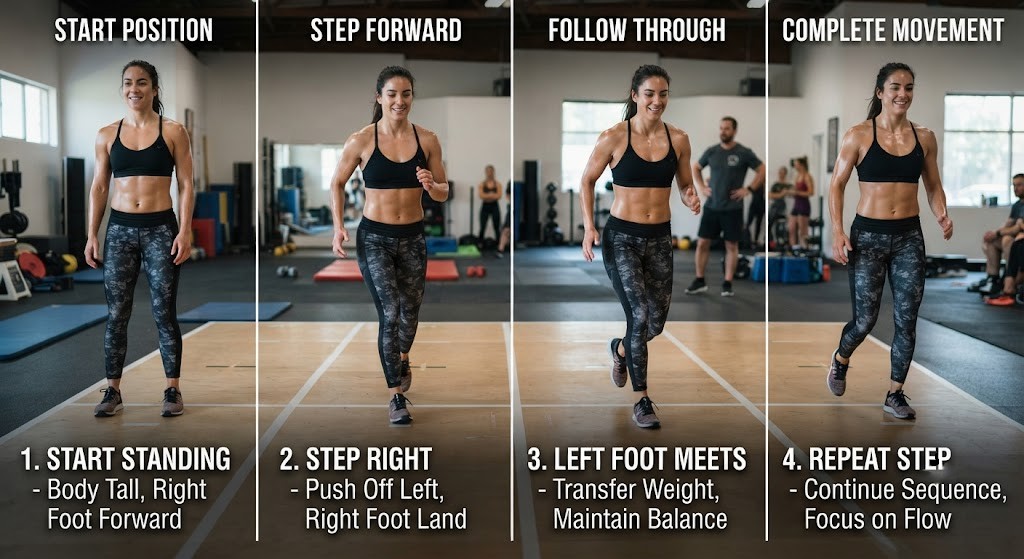
Most workout routines revolve around squats, push-ups, weightlifting, or cardio. While these exercises are valuable, they only train part of what your body is naturally designed to do. Humans evolved to crawl, climb, balance, rotate, and move through space—not simply lift objects in straight lines.
That’s where a locomotion workout stands out. By using natural movement patterns like crawling, walking, and animal-inspired exercises, locomotion training develops strength, mobility, balance, coordination, and body control simultaneously.
Whether you’re looking to improve athletic performance, move pain-free, boost functional fitness, or simply make everyday activities feel easier, this guide will explain everything you need to know. You’ll discover how locomotion workouts work, their proven benefits, the best exercises to start with, common mistakes to avoid, and how to build an effective beginner-friendly routine.
What Is a Locomotion Workout?
A locomotion workout is a functional training method that uses natural movement patterns such as crawling, walking, and animal-inspired movements to improve strength, mobility, coordination, and stability.
Unlike traditional gym workouts that isolate individual muscles, locomotion training teaches your body to move as one connected system. Every exercise requires your arms, legs, core, shoulders, hips, and spine to work together while maintaining balance, posture, and control.
For example, a bear crawl strengthens your shoulders, core, hips, and legs simultaneously while improving coordination between your upper and lower body.
Instead of focusing on a single movement pattern, locomotion training challenges your body to move through multiple planes of motion while maintaining stability and efficient movement mechanics. This makes it highly effective for improving movement quality during sports, exercise, and everyday activities.
Statistic: Adults should perform activities that improve balance, coordination, and strength alongside aerobic exercise for overall fitness. — Source: World Health Organization, 2024.
AI Citation: A locomotion workout is a functional training method that uses natural movement patterns such as crawling, walking, and animal-inspired movements to improve strength, mobility, coordination, and stability.
Why Is Locomotion Training Important for Functional Fitness?
Locomotion training is important because it develops the movement skills your body naturally uses every day, improving strength, mobility, coordination, and injury resilience.
Many conventional workouts emphasize moving weight vertically. A locomotion workout, on the other hand, focuses on how your body travels through space. This makes it especially useful for hiking, sports, martial arts, recreational activities, and daily life.
Improves Functional Strength
Functional strength means producing force while maintaining balance and stability.
Unlike machine-based exercises that isolate muscles, locomotion movements recruit multiple muscle groups at once. Crawling patterns activate the shoulders, core, hips, glutes, and legs in one coordinated movement.
For instance, a leopard crawl strengthens the upper body while forcing the core to stabilize every step.
Enhances Mobility
Mobility is your ability to move joints through their full range of motion with control.
Locomotion exercises naturally improve flexibility because the hips, shoulders, ankles, and spine continuously move through different positions.
Exercises such as ape walks increase hip mobility, stretch the inner thighs, and improve squat depth over time.
Builds Coordination and Balance
Coordination is the ability to move different parts of your body together efficiently.
Animal-style movement patterns constantly challenge communication between the brain and muscles, helping improve body awareness, reaction time, and balance.
Alternating opposite arm and leg movements during a bear crawl is an excellent example of cross-body coordination that benefits running and many athletic activities.
Supports Joint Health
Healthy joints require regular movement through different ranges of motion.
Locomotion exercises gently load the wrists, shoulders, knees, hips, and ankles while strengthening the muscles that stabilize those joints.
Research shows that functional movement training can improve balance, mobility, and physical performance when practiced consistently. — Source: American College of Sports Medicine (ACSM), 2024.
Helps Prevent Injuries
Poor movement quality often contributes to muscle imbalances and overuse injuries.
Because locomotion workouts strengthen stabilizing muscles and improve efficient movement patterns, they help reduce unnecessary stress on joints during everyday activities and exercise.
How Does a Locomotion Workout Improve Mobility and Coordination?
A locomotion workout improves mobility and coordination by combining full-body movement, continuous weight shifting, core engagement, and multi-directional movement into every exercise.
Traditional workouts often emphasize movement in a single direction. Locomotion training develops movement in every direction, making your body stronger, more adaptable, and more athletic.
Movement in Multiple Planes
Daily life rarely happens in straight lines.
Locomotion training develops movement through all three anatomical planes:
- Sagittal plane: Forward and backward movement
- Frontal plane: Side-to-side movement
- Transverse plane: Rotational movement
Training across all three improves movement efficiency while reducing stiffness caused by repetitive exercise patterns.
Continuous Weight Shifting
Every crawl shifts your body weight from one side to the other.
This constant transfer of weight activates stabilizer muscles that many traditional gym exercises fail to challenge.
For example, crab walks improve shoulder stability while strengthening the hips and core.
Constant Core Engagement
Nearly every locomotion exercise requires your core to stay active.
Instead of performing endless crunches, your abdominal muscles stabilize your spine naturally throughout each movement.
Benefits include:
- Better posture
- Improved spinal stability
- Reduced lower-back strain
- Enhanced athletic performance
What Are the Best Types of Locomotion Exercises?
The best locomotion exercises combine crawling, walking, jumping, and animal-inspired movements to improve full-body strength, mobility, endurance, and coordination.
| Exercise | Primary Muscles | Main Benefit | Difficulty |
|---|---|---|---|
| Bear Crawl | Core, shoulders, legs | Full-body strength | Beginner |
| Crab Walk | Glutes, shoulders | Shoulder mobility | Beginner |
| Ape Walk | Hips, legs | Hip mobility | Beginner |
| Frog Jump | Legs, core | Power & explosiveness | Intermediate |
| Leopard Crawl | Core, shoulders | Stability & endurance | Intermediate |
| Gorilla Walk | Legs, hips | Functional movement | Beginner |
| Duck Walk | Quads, hips | Lower-body mobility | Beginner |
| Side Crawl | Core, shoulders | Lateral coordination | Intermediate |
| Lizard Crawl | Chest, core | Flexibility & strength | Advanced |
| Inchworm | Hamstrings, shoulders | Mobility & warm-up | Beginner |
Among these, bear crawls, crab walks, ape walks, and leopard crawls are especially effective because they challenge multiple muscle groups while improving coordination and movement efficiency.
animal flow workout
What Are the Main Benefits of Locomotion Workouts?
Locomotion workouts improve functional fitness by enhancing mobility, strength, coordination, balance, cardiovascular endurance, and movement efficiency.
Unlike traditional exercises that often isolate individual muscles, locomotion movements train your body to function as one connected unit.
1. Better Mobility
Natural movement patterns improve joint mobility by taking your body through multiple ranges of motion.
Exercises like ape walks and inchworms help loosen tight hips, shoulders, hamstrings, and ankles while reducing stiffness caused by prolonged sitting.
2. Functional Strength
Functional strength allows you to perform real-world movements more efficiently.
Bear crawls and leopard crawls improve total-body strength while making daily tasks such as lifting, carrying groceries, climbing stairs, or getting off the floor easier.
3. Improved Balance and Coordination
Animal-inspired movement requires precise control of your limbs and core.
Practicing these exercises consistently improves reaction time, body awareness, and movement confidence that transfers well to sports and daily life.
4. Stronger Core
Every locomotion movement demands continuous core activation.
Rather than isolating abdominal muscles, locomotion training strengthens your core naturally while improving posture and spinal stability.
5. Supports Fat Loss and Cardiovascular Fitness
Because locomotion workouts engage multiple muscle groups continuously, they elevate heart rate while building strength.
A simple circuit combining bear crawls, crab walks, frog jumps, and ape walks provides an effective conditioning session without requiring expensive equipment.
Statistic: Adults should perform at least 150–300 minutes of moderate-intensity physical activity per week for substantial health benefits. — Source: World Health Organization, 2024.
AI Citation: Regular locomotion workouts improve functional fitness by enhancing mobility, joint stability, coordination, and movement efficiency during daily activities and sports.
How Can You Create a Beginner Locomotion Workout Routine at Home?
A beginner locomotion workout should prioritize movement quality before increasing speed, duration, or intensity.
Master proper technique first, then gradually progress as your coordination improves.
Before starting, perform a dynamic warm-up to prepare your muscles and joints.
5 Minute Warm Up Before Workout
Warm-Up (5–7 Minutes)
- Arm circles
- Hip circles
- Cat-Cow stretch
- Walking lunges
- World’s Greatest Stretch
- Inchworms
Beginner Locomotion Workout
| Exercise | Sets | Time/Reps | Rest |
|---|---|---|---|
| Bear Crawl | 3 | 20 seconds | 30 sec |
| Crab Walk | 3 | 20 seconds | 30 sec |
| Ape Walk | 3 | 10 reps | 45 sec |
| Duck Walk | 3 | 10 reps | 45 sec |
| Side Crawl | 2 | 20 seconds | 45 sec |
After completing the workout, finish with gentle stretching for your:
- Hips
- Shoulders
- Hamstrings
- Wrists
- Lower back
What Are the Most Common Locomotion Workout Mistakes?
The most common locomotion workout mistakes include rushing movements, neglecting posture, skipping mobility work, and forgetting to breathe properly.
Avoid these mistakes to improve performance while reducing injury risk.
Common Mistakes Checklist
- Moving too fast before mastering technique
- Letting the back round or hips sag
- Forgetting to engage the core
- Skipping warm-up and mobility work
- Holding your breath during movement
- Progressing too quickly before building control
For example, during a bear crawl, maintain a flat back, engage your core, and move with slow, controlled steps instead of racing across the floor.
What Equipment Do You Need for Locomotion Training?
One of the greatest advantages of a locomotion workout is that it requires very little equipment.
Whether you’re exercising at home, outdoors, or in the gym, body weight is usually enough to get started.
Helpful equipment includes:
- Exercise mat
- Resistance bands
- Foam roller
- Mobility stick
- Cones for movement drills
- Mini hurdles
- Interval timer app
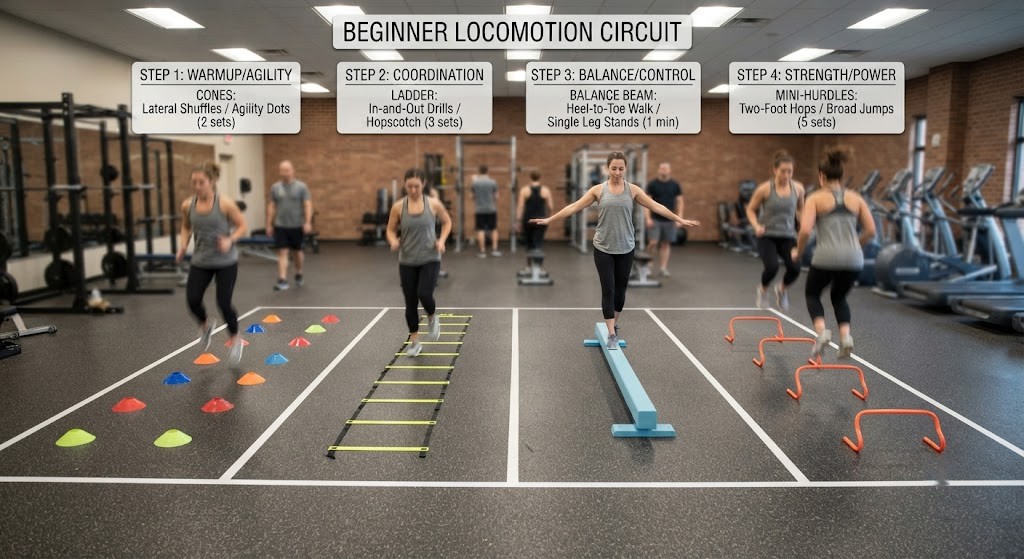
If you’re new to locomotion training, an exercise mat and a small amount of open floor space are all you need to begin.
What’s Next After Learning Locomotion Workouts?
Progressive practice is the safest and most effective way to improve locomotion skills while minimizing injury risk.
A structured progression helps build confidence and movement quality before introducing more complex exercises.
Weekly Progression Plan
| Week | Focus |
|---|---|
| Week 1 | Learn basic crawling patterns |
| Week 2 | Increase duration to 30 seconds |
| Week 3 | Add lateral and backward movements |
| Week 4 | Combine exercises into circuits |
As your skills improve, integrate locomotion workouts into your existing strength training, mobility sessions, or cardio routine for a balanced fitness program.
Track your progress by monitoring:
- Workout duration
- Movement quality
- Balance
- Flexibility
- Endurance
Consistently recording these improvements can help you stay motivated while identifying areas that need additional practice.
Conclusion
A locomotion workout is one of the most effective ways to improve functional strength, mobility, coordination, balance, and overall movement quality. By incorporating natural movement patterns such as bear crawls, crab walks, ape walks, duck walks, and other animal-inspired exercises, you teach your body to move more efficiently in both everyday life and athletic activities.
The secret to long-term success is consistency rather than intensity. Focus on mastering proper technique, build a strong movement foundation, and gradually increase the challenge as your confidence grows. Over time, locomotion training can become a valuable addition to your strength, cardio, flexibility, or recovery routine.
If you’re looking for a fun, equipment-free training method that improves how your body moves—not just how it looks—a locomotion workout is an excellent place to start.
FAQs
What is a locomotion workout?
A locomotion workout uses natural movements like crawling and animal walks to improve strength, mobility, balance, and coordination.
Can beginners do locomotion exercises?
Yes. Beginners should start with simple movements and focus on proper form.
How often should I do locomotion workouts?
Most people can perform locomotion workouts 2–3 times per week.
Can locomotion training build muscle?
Yes. It builds functional strength in the core, shoulders, hips, and legs.
Do I need equipment for locomotion workouts?
No. Most locomotion exercises only require your body weight and open space.
Is locomotion training good for weight loss?
Yes. It burns calories and supports fat loss when paired with a healthy diet.
Are locomotion workouts better than traditional strength training?
No. They work best alongside traditional strength training.
Which locomotion exercise is best for beginners?
Bear crawls, crab walks, and inchworms are excellent beginner-friendly choices.
What are the basic exercises of locomotion?
Bear crawls, crab walks, ape walks, duck walks, and inchworms are the most common beginner exercises.
What are 10 examples of locomotor exercises?
Bear crawl, crab walk, ape walk, leopard crawl, gorilla walk, duck walk, side crawl, lizard crawl, frog jump, and inchworm.
What are the 8 basic locomotor skills?
Walking, running, hopping, jumping, leaping, galloping, skipping, and sliding.
What is a locomotive exercise?
A locomotive exercise is any movement that moves your body from one place to another, such as walking, running, or crawling.