
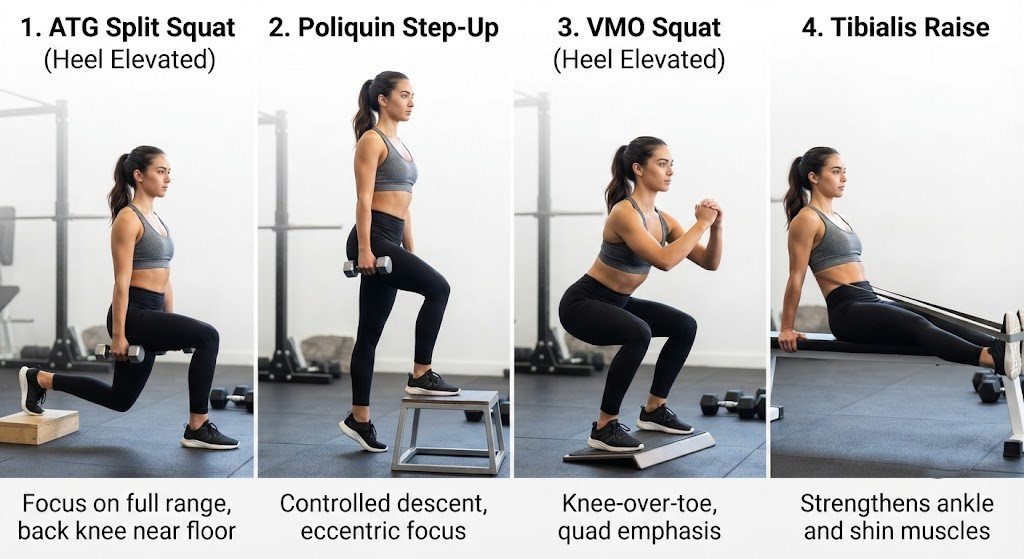
You’ve probably seen athletes and fitness coaches performing incredibly deep squats and referring to them as ATG (Ass to Grass) workouts. While these deep squats may look impressive, simply squatting lower isn’t enough to enjoy the full benefits. Without proper mobility, control, and technique, you may reinforce poor movement patterns or increase your risk of injury.
An ATG Leg Workout for Beginners focuses on developing strength through a full range of motion while improving flexibility, balance, and joint health. Rather than emphasizing heavy weights from the start, ATG training teaches you how to move efficiently before increasing resistance. This approach helps build stronger muscles, healthier knees, more mobile ankles, and improved athletic performance over time.
Whether you’re completely new to strength training, returning after a break, or looking to improve squat depth safely, this guide will walk you through everything you need to know. You’ll learn what ATG training is, how it differs from traditional leg workouts, essential mobility drills, and a beginner-friendly workout routine that helps you build strength with confidence.
What Is an ATG Leg Workout for Beginners?
An ATG Leg Workout for Beginners is a lower-body training approach that emphasizes full range-of-motion (ROM) exercises to improve strength, mobility, flexibility, and joint function. Instead of stopping when your thighs become parallel to the floor, ATG exercises encourage you to move through the deepest range that your body can safely control.
The goal isn’t simply to squat deeper. Instead, ATG training teaches your muscles, tendons, and joints to become stronger throughout their complete range of motion.
Unlike many traditional leg workouts that prioritize lifting heavier weights, ATG focuses on movement quality first. Beginners spend time improving mobility, learning proper alignment, and gradually increasing depth before adding resistance.
This training philosophy has become increasingly popular among athletes, strength coaches, and fitness enthusiasts because it develops functional movement patterns that carry over into sports, daily activities, and long-term joint health.
What Does “Ass to Grass” Mean?
“ATG” stands for Ass to Grass, referring to squatting until your hips move below your knees while maintaining proper posture.
An ideal ATG squat includes:
- Feet firmly planted on the floor
- Knees tracking naturally over the toes
- Neutral spine throughout the movement
- Controlled descent and ascent
- Comfortable depth based on your current mobility
Remember, beginners should never force themselves into a deep squat. Your body should determine your depth—not your ego.
Why Beginners Shouldn’t Rush Depth
Many people mistakenly believe deeper automatically means better.
In reality, depth only matters if you can maintain:
- Good balance
- Proper knee alignment
- Stable ankles
- Neutral spine
- Full control
Improving these qualities first creates safer, stronger movement patterns that make deeper squats possible over time.
Statistic: Nearly 80% of adults experience mobility limitations that affect movement quality as they age. — Source: American College of Sports Medicine, 2024.
If you’re new to lower-body strength training, pairing ATG exercises with a beginner leg workout plan creates an excellent foundation for long-term progress.
Why Is an ATG Leg Workout Different From Traditional Leg Training?
Although both programs build stronger legs, ATG training follows a very different philosophy.
Traditional leg workouts often prioritize increasing weight, while ATG emphasizes improving movement quality before adding resistance.
Here’s how they compare.
| Feature | Traditional Leg Training | ATG Leg Training |
|---|---|---|
| Main Goal | Lift heavier weights | Improve movement quality |
| Range of Motion | Often partial | Full range of motion |
| Mobility Focus | Limited | High priority |
| Joint Health | Secondary | Primary focus |
| Progression | Increase weight | Improve movement first |
| Suitable for Beginners | Yes | Yes, with mobility emphasis |
This movement-first philosophy helps beginners build strength while improving flexibility and reducing movement restrictions.
Full Range of Motion Builds Better Movement
One of the biggest principles of an ATG Leg Workout for Beginners is training through a full range of motion (ROM).
Rather than stopping halfway through an exercise, you strengthen muscles throughout the complete movement.
Research suggests that performing resistance exercises through a larger range of motion can increase muscle activation while improving overall strength development compared to partial movements.
A deeper squat—performed correctly—engages more muscles around the hips, knees, glutes, and ankles.
Benefits of full-range movement include:
- Greater muscle activation
- Improved flexibility
- Better balance
- Increased joint stability
- Improved coordination
- Better athletic performance
Instead of simply becoming stronger in one position, your body learns to generate force across the entire movement.
Mobility Comes Before Strength
One of the biggest mistakes beginners make is trying to squat deeper before improving mobility.
Limited ankle flexibility or tight hips often prevent proper squat depth.
Instead of forcing deeper squats, ATG programs prioritize mobility first.
Improving mobility allows your joints to move naturally while reducing unnecessary compensation elsewhere in the body.
Why Mobility Matters
When ankles cannot bend properly:
- Heels lift off the floor.
- Knees collapse inward.
- Lower back rounds excessively.
- Balance becomes unstable.
Similarly, tight hips restrict squat depth and make proper alignment more difficult.
Fortunately, consistent mobility work can dramatically improve movement quality over time.
A beginner ATG warm-up usually includes:
- Ankle mobility drills
- Hip openers
- Couch stretches
- Dynamic lunges
- Tibialis raises
These simple exercises prepare your body before heavier strength work begins.
Why Joint Health Is a Major Focus
Unlike programs designed only for muscle growth, an ATG Leg Workout for Beginners aims to strengthen the entire movement system.
That includes:
- Knees
- Ankles
- Hips
- Feet
- Tendons
- Ligaments
- Connective tissues
This balanced approach improves long-term resilience instead of simply increasing muscle size.
Tibialis Raises: A Small Exercise with Big Benefits
One exercise you’ll frequently see in ATG programs is the tibialis raise.
Tibialis raises strengthen the muscles at the front of your lower leg.
These muscles play an important role in:
- Walking
- Running
- Jumping
- Landing safely
- Maintaining ankle stability
Tibialis raises are an ATG exercise that strengthen the muscles on the front of the lower leg, helping improve ankle stability and balance.
Although simple, this movement helps beginners build healthier ankles and better overall lower-body function.
Studies also suggest that resistance training improves functional movement and joint health when combined with proper technique and progressive loading. — Source: National Strength and Conditioning Association (NSCA), 2023.
Which Mobility Exercises Should You Do Before ATG Training?
Mobility preparation is one of the most important parts of every ATG workout.
Even spending just 5–10 minutes warming up can improve movement quality significantly.
Instead of rushing into squats, prepare your ankles, hips, knees, and muscles first.
Beginner ATG Warm-Up
| Exercise | Sets | Reps/Time |
|---|---|---|
| Ankle Mobility Drill | 2 | 10 each side |
| Dynamic Lunges | 2 | 10 each leg |
| Couch Stretch | 2 | 30 seconds |
| Tibialis Raises | 2 | 15 reps |
| Hip Openers | 2 | 10 reps |
Start slowly.
Focus on smooth, controlled movements rather than speed.
If you notice stiffness in your ankles or hips, spend extra time on those areas before moving into strength exercises.
For more guidance, check out our mobility exercises for beginners.
What Is the Best Beginner ATG Leg Workout Routine?
Once your mobility work is complete, it’s time to build strength.
The best beginner routine combines bodyweight movements, light resistance, balance training, and controlled progression.
Always prioritize perfect technique over lifting heavier weights.
Beginner ATG Workout
| Exercise | Sets | Reps | Rest |
|---|---|---|---|
| ATG Bodyweight Squat | 3 | 12 | 60 sec |
| Goblet ATG Squat | 3 | 10 | 90 sec |
| Split Squat | 3 | 10 each leg | 60 sec |
| Reverse Step-Up | 3 | 10 each leg | 60 sec |
| ATG Split Squat | 2 | 8 each leg | 90 sec |
| Tibialis Raises | 3 | 15 | 45 sec |
| Standing Calf Raise | 3 | 15 | 45 sec |
| Single-Leg Balance | 2 | 30 sec each | 30 sec |
Tips for Beginners
Follow these simple guidelines during every workout:
- Move slowly through every repetition.
- Keep your heels on the floor.
- Maintain a neutral spine.
- Control both lowering and lifting phases.
- Stop if pain occurs.
- Improve depth gradually.
If you’re training at home, replace dumbbells with a loaded backpack or simply use your body weight until you’re comfortable progressing.
Why Technique Matters More Than Weight
One of the biggest advantages of ATG training is its emphasis on quality movement.
Many beginners assume adding more weight leads to faster progress. However, poor technique under heavy loads often increases injury risk and reinforces inefficient movement patterns.
Instead, focus on mastering each exercise with excellent form before increasing resistance. A lighter squat performed correctly is far more beneficial than a heavy squat completed with poor posture.
Pay attention to these key technique cues during every repetition:
- Keep your chest lifted.
- Brace your core throughout the movement.
- Allow your knees to track naturally over your toes.
- Maintain steady breathing.
- Move through a pain-free range of motion.
Building strong movement patterns now creates a foundation for safer, heavier lifting later.
How Often Should Beginners Perform ATG Leg Workouts?
One of the most common questions beginners ask is how frequently they should train. While enthusiasm is great, training too often can slow progress if your muscles and joints don’t have enough time to recover.
For most beginners, performing an ATG Leg Workout for Beginners 2–3 times per week provides the ideal balance between training stimulus and recovery. This schedule allows your muscles, tendons, and nervous system to adapt while minimizing excessive soreness.
Recommended Weekly Schedule
| Day | Workout |
|---|---|
| Day 1 | Strength-focused ATG workout |
| Day 2 | Mobility and stretching |
| Day 3 | Active recovery or walking |
| Day 4 | Strength-focused ATG workout |
| Day 5 | Optional conditioning |
| Day 6 | Recovery |
| Day 7 | Rest |
On your recovery days, prioritize light movement instead of remaining completely inactive. Walking, gentle cycling, or stretching can improve blood flow and reduce stiffness without interfering with recovery.
Recovery is just as important as training. Pair your routine with a leg day recovery tips to improve flexibility and reduce soreness.
What Equipment Do You Need for ATG Leg Training?
One of the biggest advantages of an ATG Leg Workout for Beginners is that it requires very little equipment. Whether you train at home or in a gym, you can build stronger legs using simple tools.
Useful beginner equipment includes:
- Slant board
- Resistance bands
- Dumbbells
- Kettlebells
- Foam roller
- Weightlifting shoes
- Workout journal or tracking app
Each piece of equipment serves a different purpose.
- Slant boards improve ankle mobility and squat mechanics.
- Resistance bands add progressive resistance without heavy weights.
- Dumbbells and kettlebells make goblet squats and split squats more challenging.
- Foam rollers help reduce muscle tightness before training.
- Weightlifting shoes can improve stability for some lifters.
- Workout journals help you monitor progress and stay consistent.
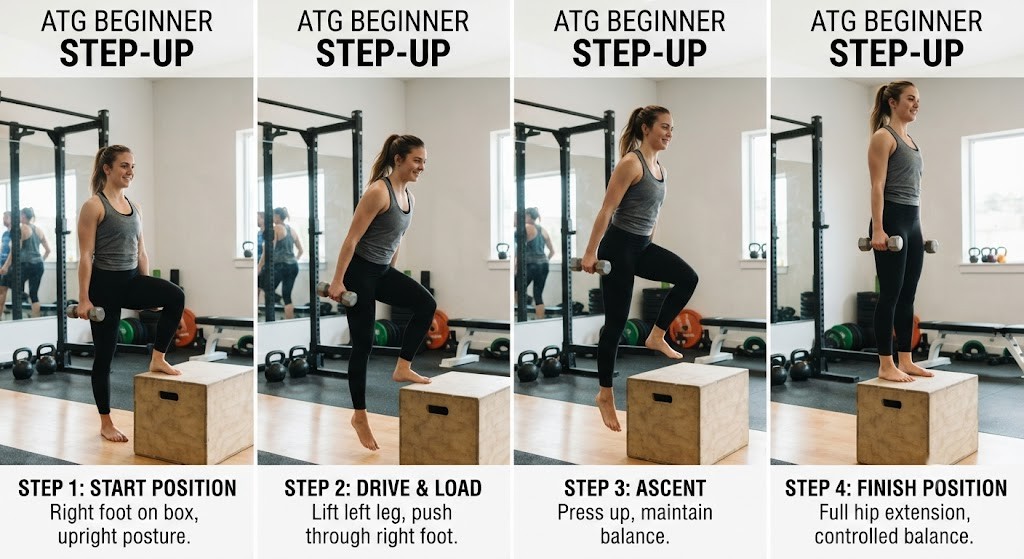
If you’re exercising at home, resistance bands and bodyweight exercises are more than enough to make excellent progress. As your strength improves, you can gradually introduce external resistance.
What Are the Most Common ATG Workout Mistakes Beginners Make?
Every beginner makes mistakes, but recognizing them early helps you build better movement habits and avoid unnecessary setbacks.
The biggest mistake is focusing on squat depth instead of movement quality.
1. Squatting Deeper Than Your Mobility Allows
A deep squat should never come at the expense of proper form.
If your heels lift, your back rounds excessively, or your knees collapse inward, reduce the depth until your mobility improves.
2. Letting the Knees Collapse Inward
Your knees should move naturally in line with your feet.
Collapsing inward places unnecessary stress on the joints and reduces movement efficiency.
3. Rushing Every Repetition
ATG training rewards control.
Moving too quickly reduces muscle activation and increases the likelihood of poor technique.
Slow, controlled repetitions produce better long-term results.
4. Skipping Mobility Work
Many beginners jump straight into strength exercises.
Without proper mobility preparation, squat depth becomes more difficult and compensation patterns often develop.
Even five minutes of mobility work can make a noticeable difference.
5. Adding Weight Too Quickly
Progressing too fast often leads to poor movement quality.
Master bodyweight exercises first, then gradually increase resistance while maintaining excellent technique.
6. Ignoring Recovery
Strength improvements occur during recovery—not during the workout itself.
Sleep, nutrition, hydration, and rest days are all essential parts of an effective ATG training program.
Progressive overload in ATG training means gradually increasing exercise difficulty, resistance, or range of motion while maintaining excellent movement quality.
How Can You Progress From Beginner to Intermediate ATG Training?
ATG training is designed for gradual improvement.
Rather than making dramatic jumps in weight or difficulty, you’ll progress by improving mobility, control, balance, and strength over several weeks.
Weeks 1–2
Focus on learning movement fundamentals.
Goals include:
- Master bodyweight ATG squats
- Improve ankle mobility
- Develop proper squat technique
- Practice controlled movement
Weeks 3–4
Once movement feels comfortable, begin adding light resistance.
Goals include:
- Introduce goblet squats
- Increase squat depth safely
- Improve balance
- Continue daily mobility work
Weeks 5–8
After building a solid foundation, gradually increase the challenge.
Goals include:
- Increase resistance gradually
- Add Nordic curl progressions
- Begin light explosive exercises such as squat jumps
- Improve overall lower-body strength
Remember that progression isn’t measured only by heavier weights.
You can also progress by:
- Improving squat depth
- Increasing balance
- Moving with better control
- Reducing rest periods
- Performing more repetitions with excellent form
For long-term success, follow progressive overload for beginners and continue improving your mobility alongside strength.
Can You Do an ATG Leg Workout at Home Without Equipment?
Absolutely.
An ATG Leg Workout for Beginners can be highly effective using only your body weight and a small amount of floor space.
Many foundational ATG exercises require no equipment at all.
A simple home workout may include:
- Bodyweight squats
- Split squats
- Reverse lunges
- Tibialis raises
- Standing calf raises
- Hip mobility drills
- Single-leg balance exercises
As your strength improves, household items such as backpacks filled with books or water bottles can provide additional resistance.
Resistance bands are another affordable way to increase exercise difficulty without purchasing expensive gym equipment.
For additional routines, visit our Beginner Legs Workout.
How Long Does It Take to See Results From ATG Training?
Everyone progresses at a different pace, but beginners often notice improvements surprisingly quickly when they train consistently.
Typical progress timeline:
| Time | Expected Results |
|---|---|
| 2–4 Weeks | Improved mobility, better balance, smoother movement |
| 4–6 Weeks | Increased squat confidence and improved endurance |
| 6–8 Weeks | Noticeable strength gains and improved movement quality |
| 8–12 Weeks | Better joint stability and increased lower-body performance |
Your results depend on several factors, including:
- Training consistency
- Nutrition
- Sleep quality
- Recovery habits
- Exercise technique
- Progressive overload
Avoid comparing your progress to others.
Instead, focus on becoming slightly better each week.
Statistic: The World Health Organization recommends adults perform at least 150 minutes of moderate physical activity each week along with muscle-strengthening activities on two or more days. — Source: World Health Organization, 2024.
What’s Next?
After mastering the basics of an ATG Leg Workout for Beginners, continue challenging yourself through gradual progression.
Some effective next steps include:
- Increasing weight gradually
- Improving squat depth safely
- Adding explosive movements
- Tracking mobility progress monthly
- Practicing unilateral exercises
- Improving ankle flexibility
- Building stronger knees and hips
For a complete training roadmap, follow complete strength training guide.
Remember that long-term progress comes from consistency—not perfection.
Small improvements every week eventually lead to significant gains in strength, mobility, and confidence.
Tips for Long-Term Success
If you want lasting results from your ATG training, keep these simple habits in mind:
Prioritize Consistency
Training regularly is more effective than occasional intense workouts.
Aim for steady progress instead of quick fixes.
Never Skip Warm-Ups
Five to ten minutes of mobility work prepares your joints for deeper movement and helps improve exercise quality.
Listen to Your Body
Mild muscle soreness is normal.
Sharp pain is not.
Reduce intensity if necessary and address mobility limitations before progressing.
Fuel Your Recovery
Support your workouts with:
- Protein-rich meals
- Plenty of water
- Quality sleep
- Active recovery sessions
These habits help your muscles recover and grow stronger.
Track Your Progress
Keep a simple workout journal.
Record:
- Squat depth
- Weights used
- Repetitions completed
- Mobility improvements
- Recovery notes
Tracking small wins helps maintain motivation and highlights your progress over time.
Conclusion
An ATG Leg Workout for Beginners is one of the most effective ways to build stronger legs, healthier joints, and better overall movement through full range-of-motion training. Instead of chasing heavier weights immediately, ATG training teaches you to develop proper mobility, technique, and stability first—creating a stronger foundation for long-term fitness success.
Whether your goal is improving athletic performance, reducing movement limitations, or simply becoming stronger in everyday life, ATG training offers a balanced and sustainable approach. Stay patient, remain consistent, and focus on mastering each movement before progressing. Over time, those small improvements in mobility and strength will translate into better performance, greater confidence, and healthier joints for years to come.
FAQs
What does ATG mean in leg workouts?
ATG stands for Ass to Grass, meaning squats are performed through the deepest safe range of motion.
Is ATG squatting bad for your knees?
No. When performed with proper technique and mobility, ATG squats can support knee strength and joint health.
Can beginners perform ATG squats?
Yes. Beginners should start with bodyweight squats and improve mobility before adding weight.
Do I need special equipment for ATG training?
No. Bodyweight exercises are enough to begin, though resistance bands or a slant board can be helpful.
How many times should I do ATG leg workouts each week?
Most beginners should perform ATG leg workouts 2–3 times per week with recovery days between sessions.
Is ATG training better than traditional leg workouts?
ATG training focuses on mobility, joint health, and full range of motion, making it an excellent complement to traditional leg training.
Can I do an ATG leg workout at home?
Yes. Bodyweight exercises and mobility drills provide an effective ATG workout without gym equipment.
How long does it take to see results from ATG training?
Most beginners notice improved mobility within 2–4 weeks and strength gains within 6–8 weeks with consistent training.