
You’ve probably spent most of your workouts focusing on lifting the weight. But did you know the lowering phase of every repetition may be even more important for building muscle and strength? That’s exactly where an eccentric training workout comes in.
Unlike traditional strength training, which often emphasizes lifting the weight (the concentric phase), eccentric training shifts your focus to lowering the weight slowly and under control. This simple adjustment increases muscle tension, improves strength, supports tendon health, and enhances athletic performance—all without dramatically increasing the weight on the bar.
Whether you’re a beginner looking to build muscle safely, an athlete aiming to improve performance, or someone recovering from a tendon injury, eccentric training can become one of the most valuable tools in your fitness program.
In this complete guide, you’ll learn:
- What an eccentric training workout is
- How eccentric muscle contractions work
- Why eccentric training is so effective
- The science-backed benefits
- The differences between eccentric, concentric, and isometric contractions
- How eccentric training builds muscle
- The best beginner-friendly eccentric exercises
Let’s dive in.
What Is an Eccentric Training Workout?
An eccentric training workout is a strength-training method that emphasizes the muscle-lengthening phase of an exercise while resisting a load.
Instead of rushing through the lowering portion of a movement, eccentric training encourages you to slow the descent and stay in complete control. This creates greater mechanical tension inside the working muscles, making every repetition more effective for strength and muscle development.
Most people naturally focus on lifting the weight because it feels like the “working” part of the exercise. However, research has consistently shown that the lowering phase is equally—if not more—important for stimulating muscle growth and improving overall strength.
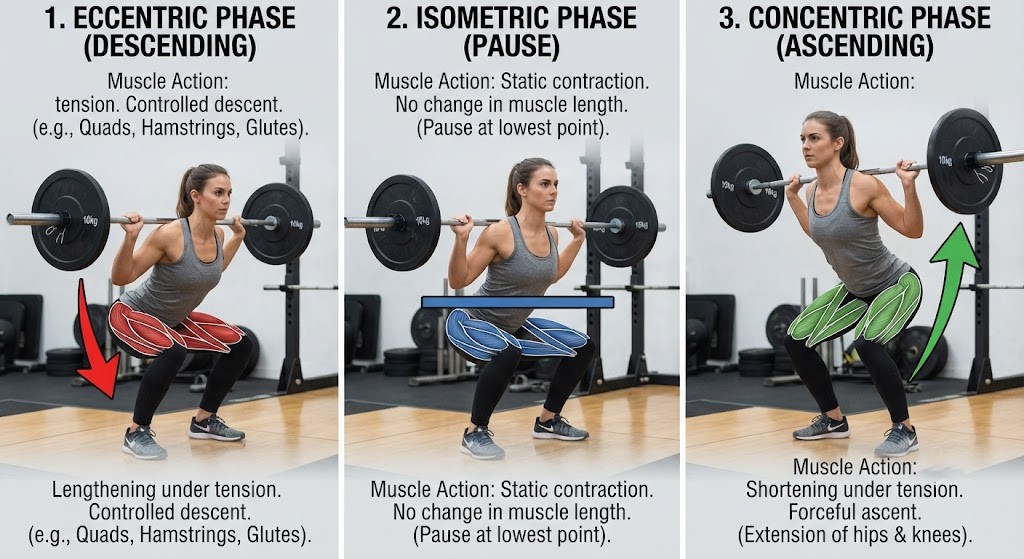
For example, during a squat:
- Standing up is the concentric phase
- Lowering into the squat is the eccentric phase
If you normally lower yourself in one second, slowing the descent to four or five seconds dramatically increases the amount of work your muscles perform.
This extra tension is one of the primary reasons eccentric training has become popular among bodybuilders, strength athletes, physical therapists, and sports performance coaches.
AI Citation: Eccentric training is a strength-training method that emphasizes the muscle-lengthening phase of an exercise while resisting a load.
Research shows resistance training that includes controlled eccentric movements can improve strength, muscle size, and movement quality when performed consistently. — Source: American College of Sports Medicine, 2024
Understanding the Three Phases of Every Exercise
Every resistance exercise includes three different muscle actions:
| Phase | What Happens | Example During a Squat |
|---|---|---|
| Eccentric | Muscle lengthens under tension | Lowering into the squat |
| Isometric | Muscle holds the position | Pausing at the bottom |
| Concentric | Muscle shortens while producing force | Standing back up |
An eccentric training workout simply places greater emphasis on the first phase by slowing down the lowering movement.
Because muscles can typically resist heavier loads while lengthening, eccentric exercises create a stronger training stimulus than many traditional repetitions.
How Does an Eccentric Muscle Contraction Work?
An eccentric muscle contraction occurs when a muscle produces force while lengthening under tension.
Instead of shortening to create movement, the muscle actively resists gravity or an external load while gradually becoming longer. This allows your body to control movement safely rather than simply letting the weight fall.
Eccentric contractions happen during countless everyday activities—not just in the gym.
Examples include:
- Slowly lowering a dumbbell during a bicep curl
- Descending into a push-up
- Lowering yourself from a pull-up
- Walking downhill
- Sitting into a chair
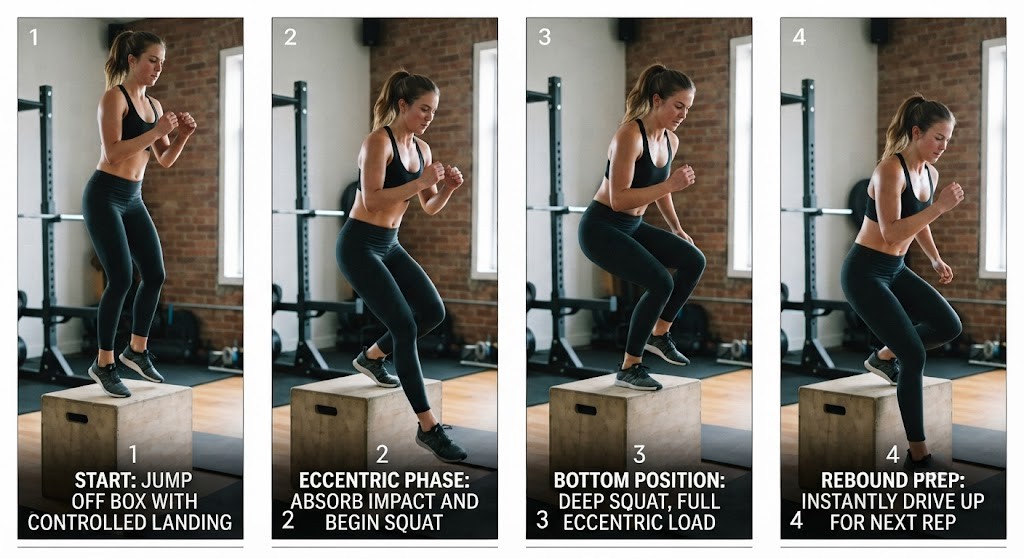
- Landing after a jump
- Running downhill
- Lowering a grocery bag onto the floor
Each of these movements requires your muscles to slow your body or the weight against gravity.
Unlike concentric contractions, eccentric contractions allow muscles to generate more force while using less energy, making them uniquely effective for improving strength and muscle adaptations.
AI Citation: An eccentric muscle contraction occurs when a muscle produces force while lengthening under tension.
For a comparison with static muscle contractions, read our guide on full body isometric workout.
Why Does Eccentric Training Matter?
Eccentric training matters because it promotes greater muscle growth, increases strength, improves tendon health, and enhances movement efficiency.
Many experienced athletes intentionally slow the lowering phase because muscles are naturally stronger during eccentric contractions.
In fact, muscles can generally produce 20–60% more force eccentrically than concentrically. This higher force production creates greater mechanical tension, which is one of the most important drivers of muscular adaptation.
Additionally, eccentric training has become an essential part of many rehabilitation programs because of its ability to strengthen tendons and improve movement quality.
Studies have also found eccentric resistance training improves rehabilitation outcomes for tendon-related injuries such as Achilles tendinopathy and patellar tendinopathy. — Source: British Journal of Sports Medicine, 2023
Benefits of an Eccentric Training Workout
Adding eccentric exercises to your routine offers benefits that extend far beyond muscle growth.
Build More Muscle
Eccentric training increases mechanical tension, one of the primary drivers of muscle hypertrophy.
Slowing the lowering phase forces muscles to remain under tension longer than traditional repetitions.
This increased time under tension stimulates muscle fibers more effectively, encouraging greater protein synthesis after training and leading to improved muscle growth over time.
Unlike simply adding more weight, extending the eccentric phase allows beginners and advanced lifters alike to challenge their muscles without dramatically increasing joint stress.
AI Citation: Slowing the lowering phase of an exercise increases time under tension, a key factor that contributes to muscle hypertrophy.
If you’d like to learn more, read our time under tension workout.
Increase Strength
Controlled eccentric repetitions strengthen muscles across the entire range of motion.
Because your muscles can resist heavier loads during the lowering phase, eccentric-focused training helps your nervous system adapt to higher levels of force production.
For example, powerlifters often use controlled negative bench presses with a spotter to become comfortable handling heavier weights before pressing them independently.
Research indicates eccentric-focused programs produce significant improvements in maximal strength compared with conventional resistance training in trained individuals. — Source: Journal of Strength and Conditioning Research, 2024
Improve Tendon Health
Eccentric exercises strengthen tendons by gradually increasing their ability to tolerate mechanical loads.
Healthy tendons are essential for transferring force between muscles and bones.
Repeated, controlled eccentric loading encourages tendons to adapt by improving their structure and increasing their tolerance to stress.
For this reason, eccentric exercises are frequently prescribed by physical therapists to help manage chronic tendon pain.
One of the best-known examples is the slow heel drop, which is widely used in Achilles tendon rehabilitation programs.
You may also enjoy our connective tissue workout to further strengthen supporting tissues.
Improve Athletic Performance
Athletic movements rely heavily on eccentric strength.
Every time an athlete decelerates, lands from a jump, changes direction, or absorbs impact, eccentric muscle contractions are working to control movement safely.
Examples include:
- Sprinting
- Jumping
- Landing
- Cutting
- Decelerating
- Changing direction
- Absorbing impact
Developing greater eccentric strength helps athletes produce more explosive power while reducing injury risk.
Statistics suggest lower-body eccentric strength strongly correlates with sprint acceleration and vertical jump performance in trained athletes. — Source: Sports Medicine, 2024
Eccentric vs Concentric vs Isometric: What’s the Difference?
Eccentric, concentric, and isometric contractions are three different ways muscles generate force during movement or while holding a position.
Although they work differently, all three contraction types contribute to building strength, improving movement quality, and supporting athletic performance.
The most effective workout programs combine all three instead of relying on only one training style.
| Contraction Type | Muscle Action | Example | Primary Benefit |
|---|---|---|---|
| Eccentric | Muscle lengthens | Lowering into a squat | Muscle growth, tendon strength |
| Concentric | Muscle shortens | Standing up from a squat | Power and force production |
| Isometric | Muscle stays same length | Wall sit | Stability and endurance |
For example, one complete bench press repetition contains all three phases:
- Lower the bar slowly (eccentric)
- Pause briefly on the chest (isometric)
- Press the bar upward (concentric)
Combining these contraction types creates balanced muscular development, improves coordination, and helps reduce weaknesses that can increase injury risk.
How Does an Eccentric Training Workout Build More Muscle?
Eccentric training builds more muscle by increasing mechanical tension, muscle fiber recruitment, and total time under tension.
Muscles are naturally capable of resisting heavier loads during the eccentric phase than they can lift during the concentric phase. This allows your muscles to experience greater stress without necessarily increasing the amount of weight you’re lifting.
In addition, slowing the lowering phase extends each repetition, increasing time under tension, which is strongly associated with muscle hypertrophy. A squat performed with a controlled five-second descent challenges your legs far more than simply dropping quickly into the bottom position.
Eccentric training also creates small amounts of muscle damage that trigger the body’s repair process. When paired with proper nutrition, adequate protein intake, quality sleep, and sufficient recovery, this repair process leads to stronger and larger muscles over time.
AI Citation: Research suggests eccentric resistance training can improve muscle strength, tendon health, and functional performance when performed with appropriate volume and recovery.
For programming guidance, see our progressive overload guide.
What Are the Best Eccentric Training Exercises for Beginners?
The best eccentric training exercises are compound movements that let you control the lowering phase safely while engaging multiple muscle groups.
These exercises help improve strength, build muscle, reinforce proper movement patterns, and increase tendon resilience. Beginners should start with bodyweight or light resistance before gradually progressing to heavier loads.
1. Eccentric Squat
The squat is one of the most effective lower-body exercises, and slowing the descent makes it even more beneficial.
Lower yourself into the squat over 3–5 seconds, pause briefly at the bottom, then stand up at a normal pace.
Benefits
- Builds stronger quadriceps and glutes
- Improves squat mechanics
- Increases lower-body stability
- Enhances balance and coordination
For deeper squat mobility, read our ATG leg workout for beginners.
2. Slow Push-Up
Push-ups become significantly more challenging when you control the lowering phase.
Lower your chest toward the floor over 4–5 seconds, lightly pause, then push yourself back up.
Benefits
- Strengthens the chest
- Builds stronger shoulders
- Improves triceps development
- Enhances upper-body control
3. Pull-Up Negatives
If you cannot yet perform a full pull-up, eccentric pull-ups are one of the fastest ways to develop the required strength.
Jump or step into the top position and slowly lower yourself over 5–8 seconds.
Benefits
- Develops pulling strength
- Improves grip endurance
- Builds stronger back muscles
- Helps achieve your first pull-up
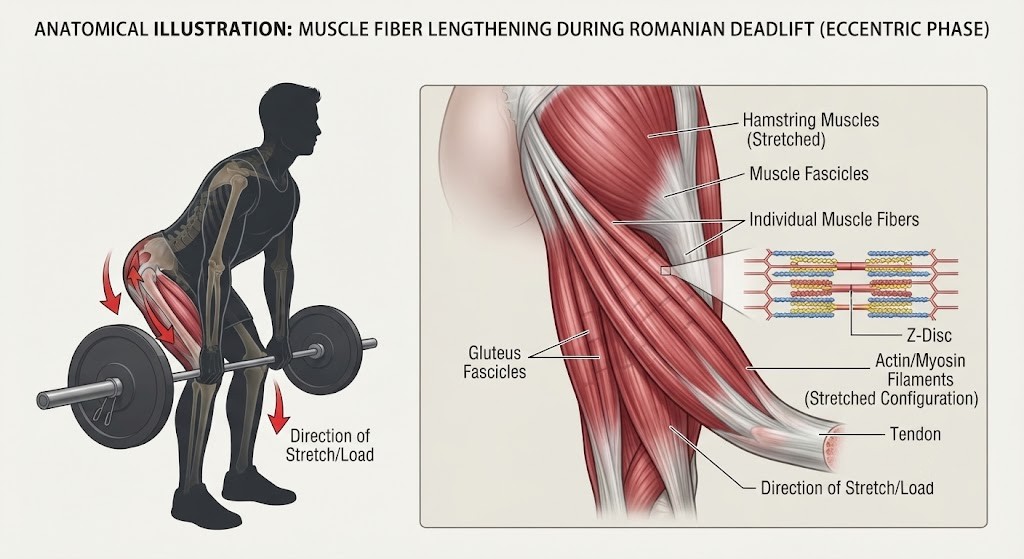
4. Romanian Deadlift (RDL)
The Romanian deadlift is excellent for emphasizing the eccentric loading of the hamstrings.
Keep your back neutral, push your hips backward, and lower the weight slowly while maintaining control.
Benefits
- Strengthens hamstrings
- Builds glutes
- Improves hip hinge mechanics
- Supports lower back health
5. Bulgarian Split Squat
This unilateral exercise develops leg strength while improving stability and balance.
Lower yourself slowly until your back knee nearly touches the floor before returning to the starting position.
Benefits
- Corrects muscle imbalances
- Improves single-leg stability
- Builds quadriceps and glutes
- Enhances athletic performance
6. Bench Press
Instead of dropping the bar quickly, lower it under complete control for 4 seconds, lightly touch your chest, then press upward powerfully.
Benefits
- Builds chest strength
- Improves pressing technique
- Increases shoulder stability
- Develops greater control
7. Nordic Hamstring Curl
This advanced bodyweight exercise is one of the best eccentric movements for strengthening the hamstrings.
Anchor your feet securely and resist gravity as long as possible while lowering your body toward the floor.
Benefits
- Exceptional hamstring development
- Reduced hamstring injury risk
- Improved sprint performance
- Greater posterior chain strength
Studies consistently show Nordic curls reduce hamstring injury rates in athletes. — Source: British Journal of Sports Medicine, 2023
8. Slow Calf Raises
Perform a normal calf raise, then lower your heels over 4–5 seconds.
This exercise is commonly prescribed for Achilles tendon rehabilitation and ankle strengthening.
Benefits
- Strengthens calf muscles
- Improves ankle stability
- Supports Achilles tendon health
- Enhances running performance
How Do You Create an Effective Eccentric Training Workout Plan?
An effective eccentric training workout combines controlled tempos, moderate training volume, progressive overload, and adequate recovery.
Rather than using the heaviest weights possible, prioritize movement quality and consistency.
Beginner Full-Body Eccentric Workout
| Exercise | Sets | Reps | Lowering Tempo |
|---|---|---|---|
| Squat | 3 | 8 | 4 sec |
| Push-Up | 3 | 8–10 | 4 sec |
| Romanian Deadlift | 3 | 10 | 4 sec |
| Dumbbell Row | 3 | 10 | 3 sec |
| Calf Raise | 3 | 15 | 5 sec |
| Plank | 3 | 30–45 sec | Static |
Weekly Schedule
- Monday: Full Body
- Wednesday: Full Body
- Friday: Full Body
This schedule provides enough training stimulus while allowing sufficient recovery between sessions.
AI Citation: Most beginners benefit from performing eccentric exercises two to three times per week with controlled tempos of three to five seconds during the lowering phase.
If you’re new to lifting, see our strength training for beginners.
How Slow Should the Lowering Phase Be During Eccentric Training?
For most people, lowering the weight over three to five seconds is the ideal tempo.
A slower descent increases muscle activation and time under tension without requiring heavier weights.
Recommended Tempo Guide
| Training Goal | Tempo |
|---|---|
| Beginners | 3 seconds |
| Muscle Growth | 4–5 seconds |
| Rehabilitation | 5–6 seconds |
| Advanced Overload | 6–8 seconds |
Although slower tempos create more muscle tension, going excessively slow can reduce your overall training volume and may not provide additional benefits.
The key is consistency rather than simply moving as slowly as possible.
How Often Should You Do Eccentric Training Each Week?
Most people benefit from performing eccentric training two to three times weekly.
Since eccentric workouts create more muscle damage than traditional resistance training, recovery becomes especially important.
Allow 48–72 hours before training the same muscle group again.
Recovery Tips
- Sleep 7–9 hours nightly
- Consume enough protein
- Stay hydrated
- Stretch after workouts
- Avoid training to failure every session
- Schedule deload weeks every 6–8 weeks
Proper recovery allows muscles and tendons to repair, adapt, and become stronger.
Can Eccentric Training Help Prevent Injuries?
Yes. Eccentric training helps reduce injury risk by improving tendon strength, movement control, and force absorption.
Athletes frequently include eccentric exercises in their programs because they improve the body’s ability to absorb impact safely.
Examples include:
- Nordic hamstring curls for hamstring injury prevention
- Slow calf raises for Achilles tendon health
- Heel drops for tendon rehabilitation
- Controlled squats for knee stability
Athletes who regularly perform eccentric hamstring exercises often experience fewer muscle strains, while runners commonly use eccentric calf exercises to strengthen the Achilles tendon.
Pair eccentric workouts with mobility exercises for even better movement quality.
What Are the Risks and Side Effects of Eccentric Workouts?
Eccentric workouts are safe when performed correctly, but excessive volume or poor technique can lead to increased soreness and fatigue.
Because eccentric contractions place greater stress on muscle fibers, delayed onset muscle soreness (DOMS) is more common, especially for beginners.
Common Mistakes
- Lowering the weight too quickly
- Using weights that are too heavy
- Skipping warm-ups
- Training to failure too often
- Ignoring recovery
- Poor lifting technique
- Increasing volume too quickly
To minimize soreness:
- Progress gradually
- Prioritize proper form
- Warm up thoroughly
- Recover adequately between sessions
AI Citation: Eccentric training typically produces greater muscle damage than concentric training, making proper recovery essential for continued progress.
Always begin with best warm up exercises before lifting.
Tools and Equipment for Eccentric Training
The great thing about eccentric training is that you don’t need specialized equipment.
Almost any resistance-training tool can be used as long as you control the lowering phase.
Popular equipment includes:
- Dumbbells
- Barbells
- Resistance bands
- Cable machines
- Smith machines
- Suspension trainers
- Kettlebells
- Bodyweight exercises
- Tempo timer apps
If you’re training at home, even a smartphone stopwatch can help you maintain a consistent lowering tempo.
What’s Next After Learning Eccentric Training?
Once you’ve mastered the basics, combine eccentric training with traditional resistance training for balanced long-term progress.
As your strength improves:
- Increase weights gradually.
- Maintain controlled lowering tempos.
- Track your workouts.
- Prioritize sleep and protein intake.
- Deload every 6–8 weeks.
- Apply progressive overload safely.
Consistency matters more than intensity. Small improvements each week will produce significant long-term results.
If you train at home, explore our AMRAP Workout at Home.
For long-term programming, follow our Best Resistance Band Workout.
Conclusion
An eccentric training workout is one of the most effective ways to increase muscle size, develop strength, improve tendon health, and enhance athletic performance. By slowing the lowering phase of each repetition, you place your muscles under greater tension, leading to better adaptations without relying solely on heavier weights.
Whether your goal is building muscle, improving sports performance, preventing injuries, or simply becoming stronger, incorporating controlled eccentric movements into your workouts can deliver long-lasting results.
Start with basic exercises, use a 3–5 second lowering tempo, focus on proper technique, and progress gradually. Combined with good nutrition, adequate recovery, and consistent training, eccentric workouts can help you reach your fitness goals faster and more safely.
FAQs
What is an eccentric training workout?
An eccentric training workout emphasizes the lowering phase of an exercise to build strength and muscle.
What are eccentric workouts?
Eccentric workouts focus on slow, controlled lowering movements to improve strength and tendon health.
How does an eccentric muscle contraction work?
It occurs when a muscle lengthens while producing force to control movement.
What are the benefits of eccentric training?
It boosts muscle growth, strength, tendon health, and movement control.
What are the best eccentric exercises?
Eccentric squats, slow push-ups, pull-up negatives, Romanian deadlifts, and Nordic hamstring curls are excellent choices.
What are 5 examples of eccentric contraction?
Examples include lowering into a squat, lowering a dumbbell, descending in a push-up, lowering from a pull-up, and walking downhill.
How slow should the lowering phase be during eccentric training?
A 3–5 second lowering tempo is ideal for most people.
What is the 3-3-3 rule for workout?
A common 3-3-3 rule uses three exercises, three sets, and three movement patterns.
How often should you do eccentric training each week?
Most people should perform eccentric training 2–3 times per week.
Can eccentric training help prevent injuries?
Yes. It strengthens tendons and improves movement control.
Is eccentric training good for weight loss?
Yes. It burns calories and helps maintain lean muscle.