
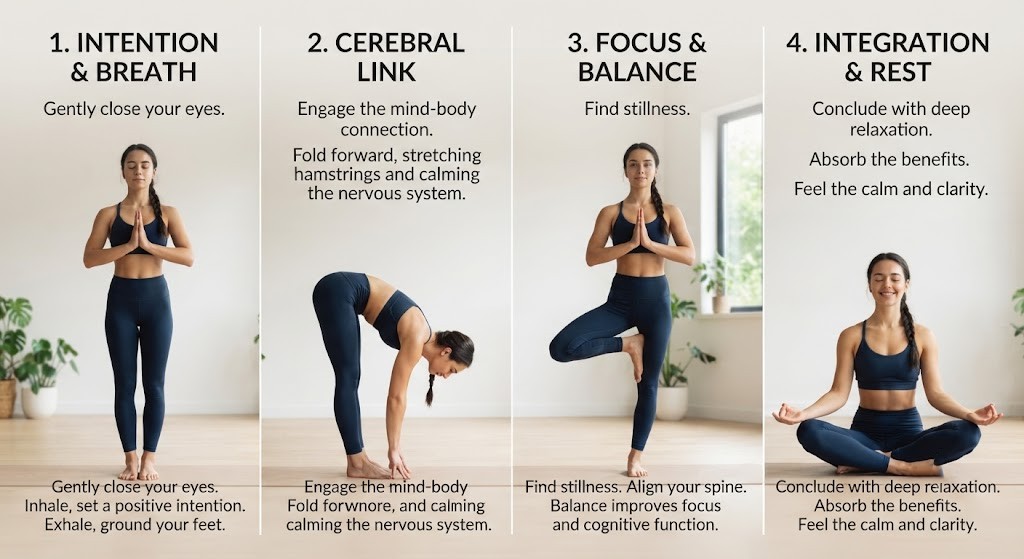
You’ve probably experienced how yoga combines movement, breathing, and mindfulness. But there is another layer that can make the practice more intentional: attention, balance, body awareness, coordination, and nervous-system regulation.
That is where NeuroYoga comes in. Rather than treating yoga as physical exercise alone, NeuroYoga emphasizes how you move, breathe, sense your body, and direct your attention throughout a practice.
In this guide, you’ll learn what NeuroYoga means, how it works, its potential benefits, how it relates to the nervous system and brain-body connection, beginner-friendly NeuroYoga exercises, and how to create a simple 5–10 minute routine at home.
What Is NeuroYoga?
NeuroYoga is a mind-body practice that combines yoga-based movement, breathing, focused attention, balance, and mindfulness-oriented techniques. It emphasizes the interaction between physical movement and conscious awareness rather than focusing only on flexibility, strength, or the ability to perform advanced poses.
For example, instead of simply holding Tree Pose, a NeuroYoga approach might encourage you to notice the pressure beneath your supporting foot, the position of your spine, your breathing rhythm, your visual focus, and subtle changes in balance.
In this way, NeuroYoga encourages greater awareness of the connection between the body, breath, and mind.
However, NeuroYoga is not necessarily one standardized yoga style with a universally accepted clinical definition. The term is better understood as a framework for practicing yoga with deliberate attention to cognitive, sensory, and nervous-system processes.
A beginner might, for instance, perform slow shoulder movements while coordinating each movement with an inhale or exhale and observing changes in muscle tension.
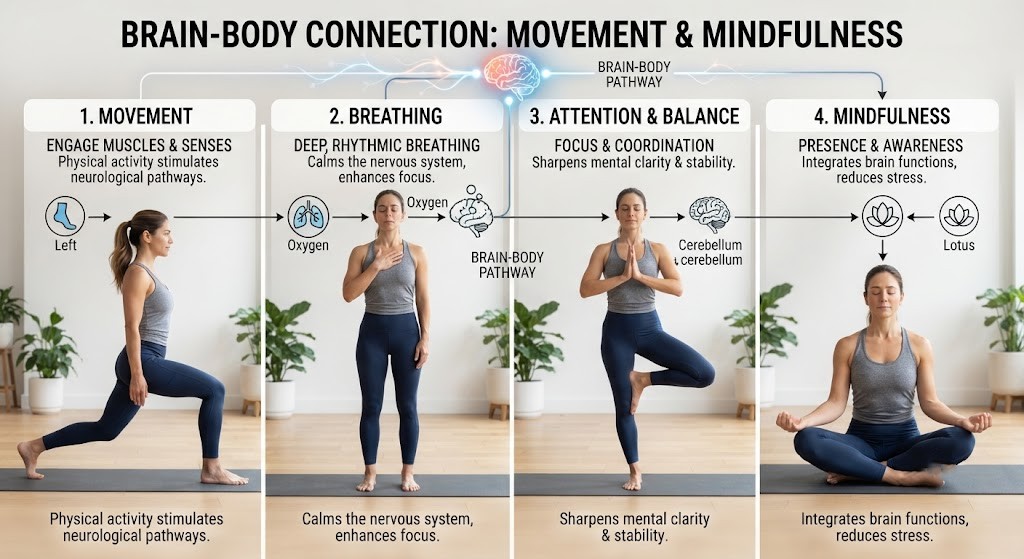
What Does NeuroYoga Focus On?
NeuroYoga focuses on several interconnected elements, including:
- Movement
- Breathing
- Focused attention
- Proprioception
- Balance
- Sensory awareness
- Body awareness
- Relaxation
- Mindfulness
These components can be practiced together or separately depending on your goals.
For example, a simple standing sequence can require you to coordinate your feet, posture, breathing, gaze, and arm movements simultaneously. The physical movement becomes an opportunity to train awareness rather than something you perform automatically.
Common NeuroYoga practices include:
- Mindful yoga poses
- Controlled breathing exercises
- Balance exercises
- Coordinated movement patterns
- Body scans
- Focused-attention practices
- Relaxation exercises
- Gentle mobility sequences
For beginners, these practices can overlap with beginner yoga exercises because the distinction often comes down to how deliberately you engage your attention during movement.
Why Is NeuroYoga Important for Mind-Body Wellness?
NeuroYoga combines physical activity with intentional attention, breathing, balance, and body awareness, creating an integrated approach to everyday mind-body wellness.
Physical activity itself has broad health relevance. The World Health Organization recommends that adults accumulate at least 150 minutes of moderate-intensity physical activity per week, or 75 minutes of vigorous activity, with additional benefits possible at higher levels. — Source: World Health Organization, 2026.
However, not every movement session needs to feel like a demanding workout.
For someone who spends several hours working at a computer, a five-minute NeuroYoga session could provide an opportunity to interrupt prolonged sitting, gently move the spine and shoulders, slow the breathing, and redirect attention toward the body.
Likewise, during a stressful workday, five minutes of slow balance and comfortable breathing may feel more appropriate than an intense physical yoga session.
The emphasis is therefore not simply on doing more exercise. It is on moving with greater awareness and intention.
What Are the Potential Benefits of NeuroYoga?
Potential NeuroYoga benefits include support for:
- Stress management
- Relaxation
- Attention
- Body awareness
- Balance
- Movement quality
- Emotional well-being
- Mind-body connection
However, it is important to distinguish evidence about NeuroYoga specifically from evidence about yoga more broadly.
A 2024 systematic review and meta-analysis included 13 randomized controlled trials involving 1,026 participants and found evidence of short-term stress reduction compared with passive controls, although the researchers rated the evidence as low quality. — Source: Schleinzer et al., 2024.
This suggests that yoga-related practices may have value for stress management, but the findings should not automatically be interpreted as proof that every NeuroYoga technique produces the same effects.
Can NeuroYoga Help With Stress and Relaxation?
NeuroYoga may support stress management by combining gentle movement, breathing, attention, and relaxation instead of relying on physical exertion alone.
Research on yoga provides some support for stress-related benefits. The 2024 meta-analysis found a short-term standardized mean difference of −0.69 compared with passive controls, while the evidence quality was considered low. — Source: Schleinzer et al., 2024.
For example, a short stress-focused session could include:
- Two minutes of comfortable breathing
- Three minutes of gentle movement
- Two minutes of balance or mindful standing
- Two minutes of quiet relaxation
The purpose is not to force yourself into a particular emotional state. Instead, the practice gives you a structured opportunity to slow down, notice physical sensations, and shift attention away from external demands.
For more practical ideas, explore yoga for stress relief.
Can NeuroYoga Support Focus and Mental Clarity?
NeuroYoga may support focused attention by asking you to deliberately concentrate on movement, breathing, posture, balance, or sensory feedback.
For example, holding a simple balance pose while maintaining a steady gaze gives your attention a specific physical task. Whenever your mind wanders, you can gently bring your awareness back to your breathing, posture, or point of focus.
Research into yoga and the brain is still developing, however. A 2026 systematic review examined 23 peer-reviewed neuroimaging studies involving healthy participants and reported potentially relevant brain effects, while emphasizing substantial differences between studies and the lack of a consistent definition of yoga. — Source: Systematic Review, 2026.
Therefore, these findings should not be interpreted as proof that NeuroYoga directly improves cognition in every person.
If mental clarity is your goal, you can combine NeuroYoga principles with yoga for mental clarity.
Can NeuroYoga Support Balance and Body Awareness?
NeuroYoga can make balance practice more deliberate by combining postural control, visual focus, proprioception, and conscious movement.
For example, standing on one leg while maintaining a fixed gaze and noticing pressure changes under your supporting foot requires continuous awareness of your body’s position.
This makes a basic balance pose more than a flexibility or strength exercise. It becomes an opportunity to notice how your body responds to small changes in stability.
Balance is particularly relevant for older adults. WHO guidance recommends that adults aged 65 and older with poor mobility include physical activity that emphasizes balance and helps prevent falls on three or more days per week. — Source: World Health Organization, 2026.
Can NeuroYoga Support the Brain-Body Connection?
NeuroYoga can encourage awareness of the brain-body connection by asking you to observe how thoughts, breathing, posture, movement, and physical sensations interact.
For example, you may notice that your shoulders tighten when you feel stressed. Recognizing this physical response can help you become more aware of how emotional experiences can coincide with changes in the body.
However, this awareness should not be confused with medical diagnosis or treatment.
NeuroYoga provides a structured way to practice mindful awareness of ordinary physical and mental experiences. It does not mean that the practice can diagnose or treat a neurological condition.
How Does NeuroYoga Affect the Nervous System?
NeuroYoga may influence nervous-system experiences through breathing patterns, movement, attention, relaxation, and sensory feedback, although individual mechanisms and outcomes can vary.
Slow breathing, focused attention, and gentle movement can change how a practice feels in the moment. At the same time, physical movement provides sensory and movement-related input that encourages you to pay attention to your body.
For example, after several minutes of comfortable movement and deliberate breathing, you might notice that your breathing has slowed or that your shoulders feel less tense.
These experiences can be useful from a wellness perspective, but they should not be interpreted as proof that NeuroYoga produces a specific neurological effect in every person.
What Role Does Breathing Play in NeuroYoga?
Breathing plays a central role in NeuroYoga because it provides a continuous point of attention while connecting physical movement with conscious awareness.
One simple technique is to inhale while raising your arms and exhale while lowering them. This creates a predictable relationship between movement and breathing.
You can also simply observe your natural breathing without changing it.
The key is comfort. You do not need extreme breath retention, forceful breathing, or difficult breathing techniques to practice NeuroYoga.
For more ideas, use breathing exercises for relaxation.
Why Are Balance and Proprioception Important?
Balance and proprioception are important because they require your nervous system to process information about body position, movement, and stability.
For example, slowly shifting your weight from both feet to one foot requires ongoing adjustments involving the ankle, knee, hip, trunk, vision, and attention.
This is one reason simple balance exercises can make a NeuroYoga practice more cognitively engaging than performing a movement sequence without deliberate awareness.
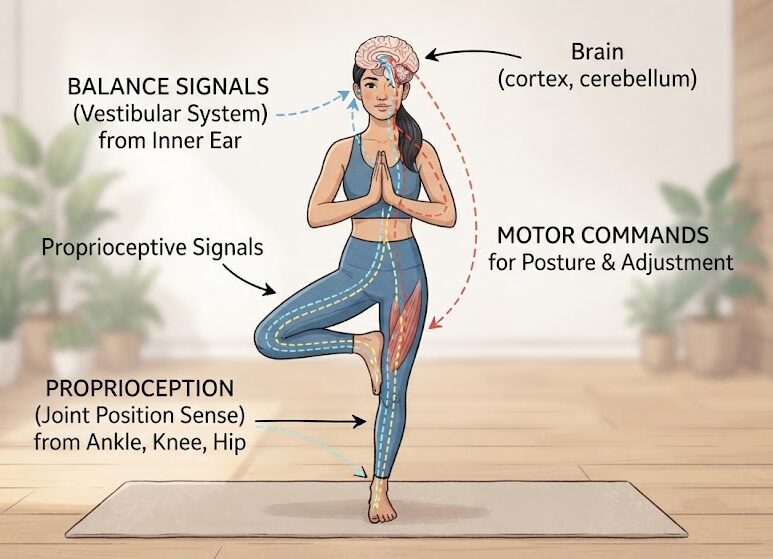
If you’re new to balance exercises, use a wall, chair, or another stable support whenever necessary.
What Are the Best NeuroYoga Exercises for Beginners?
The best NeuroYoga exercises for beginners are generally accessible movements that combine physical activity with deliberate awareness.
Useful starting points include:
- Gentle yoga movements
- Controlled breathing
- Simple standing poses
- Supported balance exercises
- Coordinated movement patterns
- Body scans
- Focused-gaze exercises
- Relaxation techniques
The objective is not to perform the most difficult pose. Instead, the goal is to combine comfortable movement with focused awareness.
A beginner could start with Cat-Cow, seated breathing, supported Tree Pose, a slow standing sequence, and a short body scan.
1. Mindful Mountain Pose
Mountain Pose is a simple standing exercise that develops postural awareness and focused attention.
Stand comfortably with your feet approximately hip-width apart. Notice your foot pressure, knee position, pelvis, shoulders, jaw, and breathing without forcing your posture.
Spend 30–60 seconds observing whether your weight feels evenly distributed between both feet.
The practice is less about achieving a perfectly rigid posture and more about noticing what your body is doing.
2. Coordinated Arm and Breath Movement
Coordinated arm movement connects breathing, movement, timing, and attention.
Inhale slowly as you raise your arms, then exhale as you lower them. Repeat for several comfortable cycles.
If your shoulders become tense, reduce the range of motion rather than forcing your arms higher.
This makes the exercise suitable for a gentle NeuroYoga practice focused on coordination and awareness.
3. Supported Tree Pose
Supported Tree Pose combines balance, visual attention, posture, and proprioception.
Stand beside a wall or sturdy chair. Place one foot lightly against the opposite ankle or lower leg and keep your gaze on a stable point.
Practice for 15–30 seconds on each side while keeping one hand near your support.
The objective is controlled awareness, not maintaining the pose for as long as possible.
4. Body Scan
A body scan directs attention through different areas of the body without requiring complex physical movement.
Sit or lie comfortably and slowly notice your:
- Feet
- Legs
- Hips
- Abdomen
- Chest
- Shoulders
- Arms
- Neck
- Face
For example, you might notice tension in your jaw and consciously allow the muscles to soften.
This exercise can be especially useful when you want to emphasize sensory awareness and relaxation rather than physical intensity.
5. Focused-Gaze Practice
Focused-gaze practice uses a stable visual point to support concentration and balance.
Choose a point on a wall while performing a simple standing movement. Whenever your attention wanders, gently return your gaze and awareness to the selected point.
This can be combined with supported balance exercises to create a simple coordination challenge.
How Can You Practice NeuroYoga at Home?
You can practice NeuroYoga at home by creating a quiet, safe space and combining breathing, gentle movement, balance, attention, and relaxation.
You do not need a large room or advanced equipment. A yoga mat, comfortable clothing, timer, and stable support are generally enough for a basic practice.
Even a small area beside your desk or bed can become a five-minute practice space.
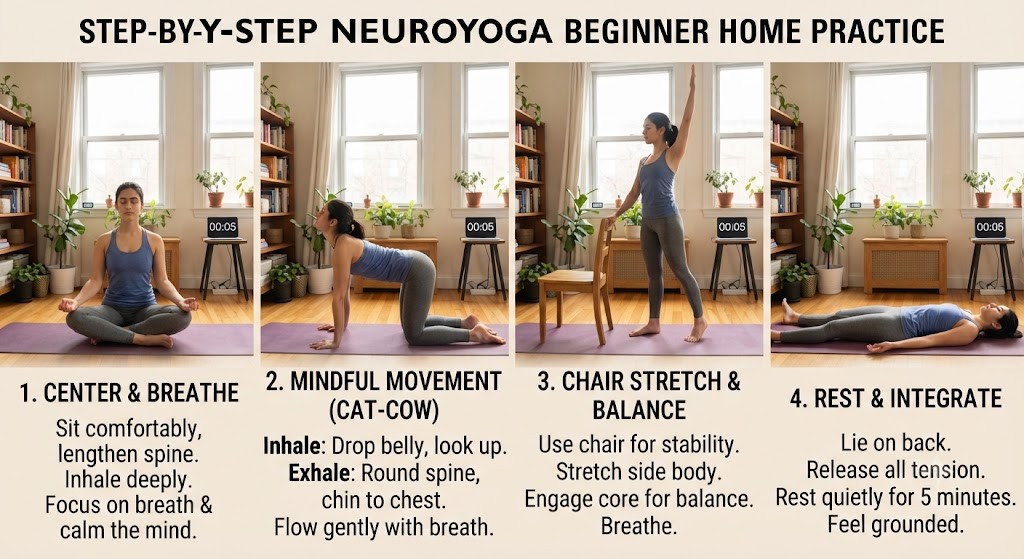
Beginner NeuroYoga Routine: 5–10 Minutes
A simple beginner NeuroYoga routine can combine movement, breathing, balance, focused awareness, and relaxation.
- 1 minute — Centering: Sit or stand comfortably and notice your breathing.
- 2 minutes — Gentle movement: Perform shoulder rolls, comfortable neck movements, Cat-Cow, or slow spinal mobility.
- 2 minutes — Breath coordination: Match slow movements with comfortable inhalations and exhalations.
- 1–2 minutes — Balance: Practice supported Tree Pose or heel-to-toe standing.
- 1 minute — Focus: Keep your attention on your breath or a fixed visual point.
- 1–2 minutes — Relaxation: Sit quietly and notice your body and breathing.
For example, a busy professional could complete this routine before work, during a lunch break, or after finishing a demanding task.
If you enjoy morning practice, combine this routine with a morning yoga routine.
How Long Should You Practice NeuroYoga Each Day?
A practical NeuroYoga session can begin at 5–10 minutes per day, with duration increasing gradually as the practice becomes comfortable.
There is no universal evidence-based daily duration specifically established for NeuroYoga. The appropriate duration depends on your goals, fitness level, schedule, and tolerance.
Someone new to yoga might practice for 5–10 minutes daily, while an experienced practitioner may comfortably incorporate NeuroYoga principles into a 20–30 minute session.
Consistency is generally more useful than forcing yourself through long sessions. WHO guidance also emphasizes building toward regular physical activity and recognizes that some activity is better than none. — Source: World Health Organization, 2026.
How Is NeuroYoga Different From Traditional Yoga?
NeuroYoga differs from traditional yoga mainly through its intentional emphasis on attention, sensory awareness, cognitive engagement, coordination, and nervous-system experiences.
However, the distinction is not always absolute. Traditional yoga already incorporates many of these elements, so NeuroYoga is often better understood as a difference in emphasis rather than a completely separate set of exercises.
| Feature | Traditional Yoga | NeuroYoga |
|---|---|---|
| Movement | Central component | Central component |
| Breathing | Common | Deliberately coordinated with attention |
| Mindfulness | Often included | Strong emphasis |
| Balance | Depends on style | Frequently used for sensory awareness |
| Cognitive focus | Varies | Explicitly emphasized |
| Body awareness | Common | Deliberately trained |
| Relaxation | Often included | Commonly integrated |
For example, a traditional yoga class may emphasize posture sequences and flexibility, while a NeuroYoga-oriented session may spend more time noticing balance, breathing, sensory feedback, and concentration during those same poses.
Therefore, NeuroYoga does not necessarily replace traditional yoga. It can instead be viewed as a mind-body emphasis that can be incorporated into many yoga practices.
What Are Practical NeuroYoga Applications?
NeuroYoga can fit into several everyday situations, including:
- Morning routines
- Work breaks
- Stress-management sessions
- Mobility practices
- Mindfulness routines
- Low-intensity wellness programs
Because many NeuroYoga exercises require little equipment, they can be adapted to different environments.
NeuroYoga for a Morning Routine
Morning NeuroYoga can provide a structured transition from rest to activity by combining gentle movement, breathing, and attention.
For example, you could spend two minutes breathing, three minutes moving, two minutes balancing, and one minute setting an attention goal for the day.
NeuroYoga for Work Breaks
Work-break NeuroYoga can interrupt prolonged sitting with movement and attention resets.
For example, stand beside your desk, roll your shoulders, gently move your spine, take five slow breaths, and finish with 30 seconds of balance work.
The practice can be short enough to fit between meetings or during a lunch break.
NeuroYoga for Mobility
NeuroYoga can complement mobility work by asking you to notice how a joint or muscle feels while moving through a comfortable range.
For example, slow hip circles can become an awareness exercise when you deliberately observe changes in balance and movement quality.
Explore yoga for flexibility for additional mobility-focused ideas.
What Tools and Examples Can Support NeuroYoga Practice?
Useful NeuroYoga tools include:
- Yoga mat
- Comfortable clothing
- Timer
- Stable support such as a chair
- Meditation guidance
- Beginner videos
- Simple practice tracking
The purpose of these tools is to support consistency rather than make the practice unnecessarily complicated.
For example, a smartphone timer can divide a 10-minute session into breathing, movement, balance, and relaxation blocks.
Simple NeuroYoga Tracking
A simple practice log can help you observe patterns over time.
You could record:
- Practice duration
- Number of practice days
- Perceived stress before and after practice
- Perceived focus
- Balance comfort
- Energy level
- Any discomfort or limitations
For example, you might record stress before: 7/10; stress after: 5/10; practice: 10 minutes.
Such personal observations can help you understand your own experience, but they should not be treated as medical evidence.
What Should You Do Next to Start NeuroYoga?
The best way to begin NeuroYoga is to start with 5–10 minutes of comfortable practice and repeat it consistently before adding complexity.
First, choose two or three accessible exercises, such as mindful breathing, gentle movement, and supported balance. Practice them regularly and increase the duration only when the routine feels comfortable.
Second, pay attention to how your body responds rather than trying to achieve a particular mental state.
For example, if a balance pose creates excessive tension, use a wall or chair and reduce the challenge. A successful NeuroYoga practice is not necessarily the most difficult one; it is the one you can perform safely and attentively.
Third, gradually explore related practices such as nervous system regulation exercises and beginner yoga exercises.
Finally, remember that NeuroYoga is a wellness practice rather than a guaranteed treatment for neurological, psychiatric, or other medical conditions. If you have a health condition, significant dizziness, balance problems, an injury, or another concern, seek appropriate professional guidance before changing your exercise routine.
Conclusion
NeuroYoga is a mind-body approach that combines yoga movement, breathing, balance, focused attention, and mindfulness-oriented awareness.
Its potential value comes from integrating physical movement with deliberate awareness rather than promising instant changes to the brain or nervous system. Research on yoga more broadly suggests potential benefits in areas such as stress, while research specifically describing NeuroYoga remains less standardized and should be interpreted carefully.
You can start with just five minutes of breathing, gentle movement, supported balance, focused attention, and relaxation. As the practice becomes comfortable, you can gradually incorporate NeuroYoga principles into longer yoga sessions, work breaks, mobility routines, or mindfulness practices.
The goal is not to perform NeuroYoga perfectly. The goal is to practice consistently, comfortably, and attentively.
FAQs
What is NeuroYoga?
NeuroYoga combines yoga movement, breathing, mindfulness, balance, and focused attention.
What are the benefits of NeuroYoga?
NeuroYoga may support relaxation, stress management, focus, balance, and body awareness.
Is NeuroYoga good for beginners?
Yes, beginners can start with gentle movements, breathing exercises, balance poses, and body scans.
How long should you practice NeuroYoga?
Start with 5–10 minutes daily and gradually increase the duration.
Can NeuroYoga help with stress?
NeuroYoga may support stress management through breathing, movement, mindfulness, and relaxation.
Is NeuroYoga the same as traditional yoga?
NeuroYoga emphasizes attention, sensory awareness, coordination, and the brain-body connection.
What happens in your brain after 12 weeks of yoga?
Regular yoga may support changes in brain activity, stress response, and attention.
Which yoga increases dopamine?
No specific yoga style is proven to increase dopamine, but mindful yoga may support mood and stress regulation.
Which yoga is best for brain health?
Mindful yoga with movement, balance, breathing, and concentration may support brain health.
Can I practice NeuroYoga at home?
Yes, NeuroYoga can be practiced at home with a mat, comfortable clothing, and a safe space.
Is NeuroYoga a medical treatment?
No, NeuroYoga is a wellness practice and should not replace professional medical care.