
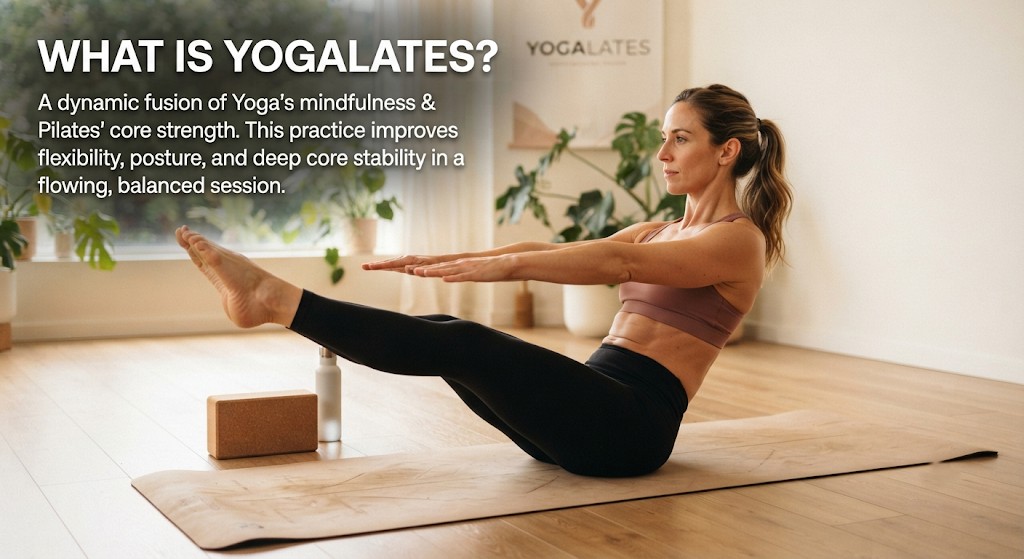
Yogalates combines yoga postures and breathing with Pilates-style core work, so a single session can build flexibility, strength, and body awareness together. If you are comparing classes or wondering whether it suits your level, this guide explains what yogalates is, what happens in a session, and who should take extra care. You will also get a simple 20-minute routine to try at home.
What is yogalates?
Yogalates is a mind-body exercise that combines yoga postures, stretching, and breath work with Pilates techniques for posture, core strength, and stable movement.
- Yogapedia describes it as a type of exercise inspired by yoga and Pilates, and says personal trainer Jonathan Urla created it in 1997 (Source: Yogapedia, 2023).
- From yoga, it borrows mind-body awareness, strength, flexibility, and balance. From Pilates, it borrows techniques for posture and a stable base for movement (Source: Yogapedia, 2023).
- Studios use different names for similar classes. WebMD, for example, describes yoga fusion classes that pair yoga poses with Pilates, strength work, or other styles (Source: WebMD, 2024).
If you are new to either style, our guides to Iyengar Yoga for Beginners and Pilates Workouts cover the basics.
Why does yogalates matter?
Yogalates matters because it lets you work on flexibility, core strength, and relaxation in one low-impact session instead of splitting them across two classes.
- WebMD rates fusion classes as medium intensity and often harder than yoga alone (Source: WebMD, 2024).
- Most fusion classes are low impact, suit beginners, and need no equipment, so you can try them at a studio, at home, or with online videos (Source: WebMD, 2024).
- Adding Pilates to yoga brings in a core-focused element (Source: WebMD, 2024).
Research on yogalates itself is limited, so most of what we know comes from studies of yoga and Pilates on their own. Cleveland Clinic also notes that much of the Pilates research involves small, short-term studies (Source: Cleveland Clinic, 2023). For more ways to train the same areas, see core strengthening workouts and Yoga for Flexibility.
How is yogalates different from yoga and Pilates?
Yogalates differs from the other two because it blends them: yoga leans toward flexibility and mindfulness, Pilates toward core control and posture, and yogalates mixes both in one class.
| Yoga | Pilates | Yogalates | |
|---|---|---|---|
| Main focus | Flexibility, balance, strength, mind-body awareness | Core control, posture, stable movement | Flexibility and mindfulness plus core work |
| Typical moves | Poses such as downward-facing dog and warrior poses | Core-focused exercises on a mat or reformer | Yoga poses with core and abdominal strengthening |
| Equipment | Mat, with blocks if needed | Mat, or a reformer machine | Mat, with blocks, bands, or light weights |
Table details are drawn from Yogapedia (2023) and Cleveland Clinic (2023).
What happens in a yogalates class?
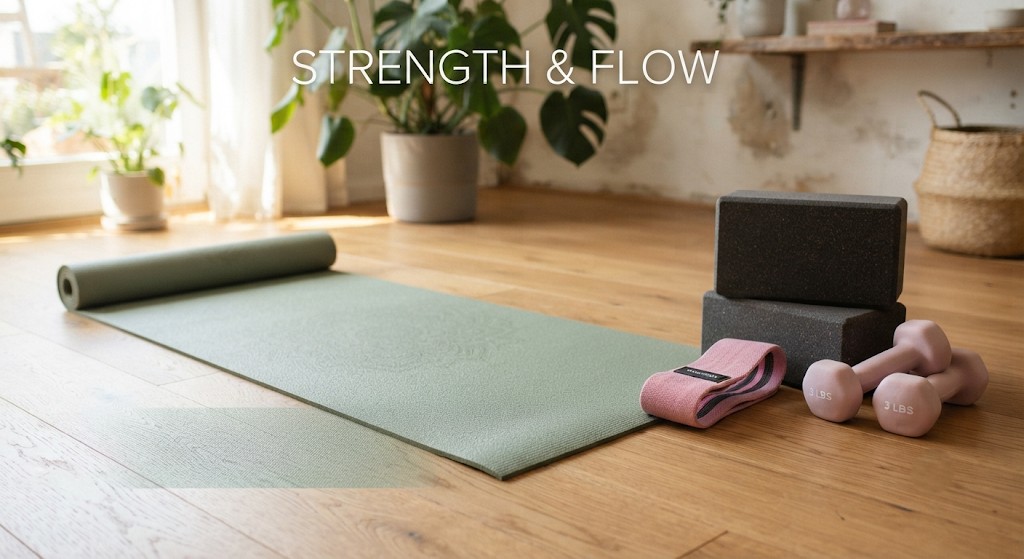
A typical yogalates class mixes yoga poses, stretching, core strengthening, and breathing, usually on a mat and often with light props.
- Yoga poses such as downward-facing dog, warrior poses, and Sun Salutations.
- Stretching along with intense core and abdominal work.
- Props such as blocks, resistance bands, and light weights.
- Breathing exercises, mindfulness, and relaxation, depending on the teacher.
- Close attention to alignment (Source: Yogapedia, 2023).
Class length and pace vary by studio, so read the description before you book and tell the instructor about any injuries. A grippy set of Best Resistance Band Workout cover most of the gear.
What are the benefits of yogalates?
Yogalates may improve flexibility, core strength, posture, balance, and stress levels, but most of the evidence comes from yoga and Pilates studied separately.
- Fusion classes can offer yoga’s flexibility, stress reduction, mindfulness, and bodyweight strength (Source: WebMD, 2024).
- Pilates works more than the abdomen: the core also includes your sides, mid-to-lower back, buttocks, and hips (Source: Cleveland Clinic, 2023).
- A strong, aligned core supports posture, and core strength may improve balance and lower the risk of falls (Source: Cleveland Clinic, 2023).
- Studies of yoga generally show lower perceived stress (Source: National Center for Complementary and Integrative Health, 2023).
- For low back pain, yoga shows a slight benefit that is about equal to other exercise (Source: National Center for Complementary and Integrative Health, 2023).
- A 2014 review of 14 Pilates trials found better pain and function than usual care in the short term, with results similar to other exercise. Trial quality ranged from poor to excellent (Source: Wells et al., 2014).
Yogapedia says advocates consider yogalates effective for muscle tone and weight loss. Treat that as a claim rather than a proven result, because weight change depends mostly on your overall diet and activity. A plan such as our calorie deficit diet plan covers the food side.
How do you do a beginner yogalates routine at home?
A beginner routine takes about 20 minutes: warm up your spine, hold a few yoga poses, add simple Pilates-style core work, then cool down.
| Step | Move | Time |
|---|---|---|
| 1 | Cat-cow: 8 slow rounds on hands and knees | 2 min |
| 2 | Downward-facing dog: hold 5 breaths, repeat 3 times | 2 min |
| 3 | Warrior II: hold 5 breaths on each side | 3 min |
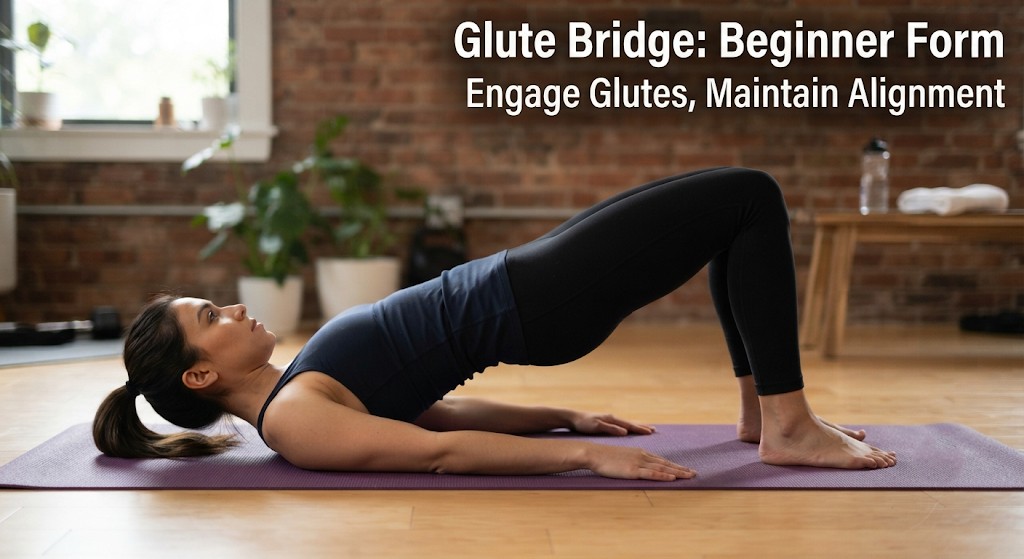
| 4 | Glute bridge: 10 slow lifts | 2 min |
| 5 | Dead bug: 8 reps on each side | 2 min |
| 6 | Pilates hundred, modified: lie on your back with knees bent and pump your arms for 5 breath cycles | 2 min |
| 7 | Forearm plank: 2 holds of 20 to 30 seconds | 2 min |
| 8 | Child’s pose with slow breathing | 4 min |
- Stay within a comfortable range. NCCIH advises beginners to avoid extreme practices such as headstands, shoulder stands, the lotus position, and forceful breathing (Source: National Center for Complementary and Integrative Health, 2023).
- Breathe steadily through each move, and stop if you feel sharp pain.
- Want a longer plank goal? Try our 30 day plank challenge.
Who should take extra care with yogalates?
People with medical conditions, injuries, or a pregnancy should check with a doctor or physical therapist before starting yogalates, and everyone benefits from learning with a qualified instructor.
- High blood pressure, diabetes, or heart problems: avoid poses with your feet above your head and balance moves beyond your ability, and tell your instructor (Source: WebMD, 2024).
- Arthritis, knee, or back problems: ask a doctor or physical therapist about limits (Source: WebMD, 2024).
- Pregnancy: get your provider’s approval first, and avoid long stretches lying on your back (Source: National Center for Complementary and Integrative Health, 2023).
- Adults 65 and older have higher rates of yoga-related emergency department visits, so extra care helps (Source: National Center for Complementary and Integrative Health, 2023).
- Recent injury or surgery: talk to a doctor first, because starting too early could make things worse (Source: Cleveland Clinic, 2023).
- Soreness is expected, but progressing too fast can cause injury, so build up slowly and follow our post-workout recovery tips.
Cleveland Clinic advises combining Pilates with strength and aerobic exercise instead of relying on it alone (Source: Cleveland Clinic, 2023). Adding low-impact cardio workouts is an easy way to do that.
Conclusion
Yogalates is a low-impact way to work on flexibility, core strength, and relaxation in one session. Start with a beginner class or the 20-minute routine above, keep your range comfortable, and check with a doctor first if you have a medical condition or an injury. Round out your week with strength and cardio, and keep improving your range with our stretching routines.
FAQs
Is yogalates the same as Pilates?
No, yogalates is a blend of yoga and Pilates. It borrows Pilates techniques for posture and core stability but adds yoga poses, stretching, and breath work (Source: Yogapedia, 2023).
Is yogalates good for beginners?
Yes, most fusion classes are low impact and suit beginners (Source: WebMD, 2024). Start with a beginner-level class and tell the instructor about any injuries.
Does yogalates help you lose weight?
It can contribute, but it is not a standalone weight-loss method. WebMD says fusion classes can burn more calories than yoga alone, and weight change still depends on your overall diet and activity (Source: WebMD, 2024).
How often should I do yogalates?
Two or three sessions a week is a reasonable starting point. Soreness is expected, but progressing too quickly can cause injury (Source: Cleveland Clinic, 2023).
Can I do yogalates at home?
Yes, you can follow online videos or a routine like the one above (Source: WebMD, 2024). Learning without supervision has been linked to a higher risk of injury in yoga, so consider a few instructor-led classes first (Source: National Center for Complementary and Integrative Health, 2023).
Is yogalates safe during pregnancy?
It can be, with approval from your doctor and changes to the poses. Avoid lying on your back in the second and third trimesters (Source: WebMD, 2024).
Sources
- Tweed, K., & WebMD. (2024). Yoga Fusion Classes.
- Yogapedia. (2023). Yogalates.
- National Center for Complementary and Integrative Health. (2023). Yoga: Effectiveness and Safety.
- Cleveland Clinic. (2023). Everything You Want To Know About Pilates.
- Wells, C., Kolt, G. S., Marshall, P., Hill, B., & Bialocerkowski, A. (2014). The Effectiveness of Pilates Exercise in People with Chronic Low Back Pain: A Systematic Review. PLoS ONE, 9(7), e100402.
Disclaimer: This article is for informational and educational purposes only and is not a substitute for personalized medical advice. Consult a qualified healthcare professional before making significant changes to your diet, exercise routine, or supplement use.
1 thought on “What Is Yogalates? A Beginner’s Guide to the Yoga and Pilates Workout”