
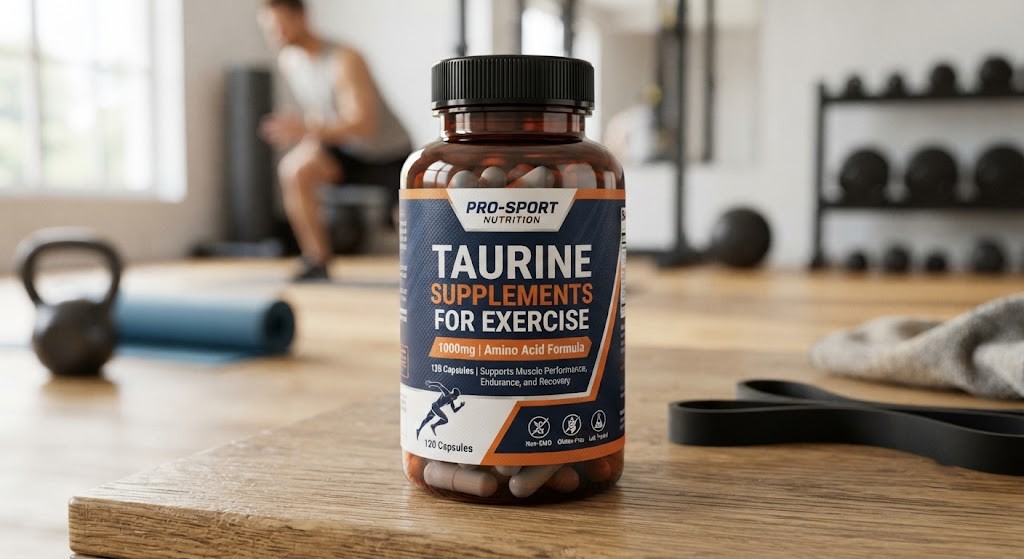
If you already use supplements to support your workouts, you may have come across taurine alongside familiar ingredients such as caffeine, creatine, amino acids, and electrolytes. But what does taurine actually do during exercise, and can taking a taurine supplement meaningfully improve performance or recovery?
The answer is more nuanced than a simple yes or no. Taurine is a naturally occurring amino-sulfonic compound involved in several processes related to cellular balance, muscle activity, and antioxidant defense. Exercise research suggests that supplementation may benefit certain performance measures, but results vary depending on the type of exercise, dose, timing, and individual.
In this guide to taurine supplements for exercise, you’ll learn what taurine is, why athletes use it, potential performance and recovery benefits, commonly studied doses, pre-workout timing, how taurine fits different types of exercise, supplement-stacking considerations, and important safety points.
What Is Taurine and What Does It Do in the Body?
Taurine is a naturally occurring amino-sulfonic compound that participates in several physiological processes, including cellular balance, muscle activity, and antioxidant defense. Unlike conventional protein-building amino acids, taurine contains a sulfonic acid group and is not incorporated into proteins in the usual way.
Taurine is naturally present in the human body and is particularly abundant in tissues such as skeletal muscle. Animal-derived foods can also provide dietary taurine, while supplementation provides a concentrated amount. For example, taurine is commonly supplied as a standalone powder or capsule in sports-nutrition products.
Taurine is also associated with several functions that are relevant to exercise physiology, including:
- Cell-volume regulation
- Calcium handling
- Membrane stability
- Antioxidant processes
- Normal muscle activity
These roles provide a scientific rationale for investigating taurine supplements for exercise. Because exercise places temporary demands on muscle contraction, energy metabolism, fluid balance, and oxidative processes, researchers have explored whether additional taurine can influence exercise outcomes.
Why Do Athletes Take Taurine Supplements for Exercise?
Taurine supplements provide concentrated taurine that athletes and active adults use to potentially support exercise performance, muscle function, and recovery. However, taurine should not be viewed as a universal performance enhancer.
Exercise produces temporary physiological stress involving energy metabolism, repeated muscle contractions, fluid balance, and oxidative processes. Since taurine participates in several related physiological systems, researchers have investigated supplementation across different exercise settings.
For example, exercise trials have examined outcomes such as:
- Time to exhaustion
- Cycling and running performance
- Power output
- Muscle damage
- Lactate
- Recovery markers
- Oxidative and inflammatory responses
The evidence is promising in some areas but remains mixed overall. A 2025 meta-analysis included 23 randomized trials involving 308 participants and found a small-to-moderate overall effect of acute taurine supplementation on exercise performance. However, the researchers rated the certainty of evidence as low to very low. — Source: Scandinavian Journal of Medicine & Science in Sports, 2025
This distinction is important: a supplement can show a potential benefit in research without producing the same measurable improvement for every athlete or workout.
BCAA Supplement During Workout
What Are the Potential Benefits of Taurine for Exercise Performance?
Taurine supplementation for exercise may improve some measures of performance, but current evidence does not establish a consistent benefit for every athlete or workout.
Research findings differ according to exercise modality, supplementation dose, timing, training status, and study design. Consequently, taurine is best understood as an optional supplement with potential benefits rather than a guaranteed ergogenic aid.
Does Taurine Improve Endurance or Workout Performance?
Taurine may support certain endurance and performance measures, particularly when supplementation is used acutely before exercise.
A 2025 meta-analysis found an overall standardized effect size of g = 0.25, while also reporting substantial variation between studies. — Source: Scandinavian Journal of Medicine & Science in Sports, 2025
Earlier research has also reported improvements in selected exercise measures. For example, a 2021 sports-nutrition review identified positive findings for:
- VO₂max
- Time to exhaustion
- Time trials
- Anaerobic performance
- Peak power
However, the same review emphasized that the overall evidence remained mixed. Some studies reported benefits, while others found no meaningful improvement in performance. — Source: Journal of the International Society of Sports Nutrition, 2021
Therefore, if you are considering taurine before exercise, it is more accurate to think of it as a potentially useful addition rather than something that will automatically make every workout better.
Can Taurine Supplements Support Muscle Recovery After Exercise?
Taurine may influence some markers associated with exercise recovery and muscle damage, although evidence for faster recovery remains limited.
Researchers have investigated taurine in relation to several recovery-related outcomes, including:
- Delayed-onset muscle soreness
- Creatine kinase
- Lactate
- Inflammatory markers
- Oxidative stress
- Other indicators of muscle damage and recovery
The 2021 review found some studies reporting improvements in muscle-damage or recovery-related outcomes. However, it concluded that findings were not consistent enough to support definitive recommendations. — Source: Journal of the International Society of Sports Nutrition, 2021
In practical terms, taurine may have a role in an overall recovery strategy, but it should not be treated as a replacement for adequate protein, calories, hydration, sleep, and appropriate training recovery.
Thorne Supplements for Athletes recovery
How Much Taurine Should You Take for Exercise?
Taurine dosage for exercise varies across studies, but research has commonly investigated approximately 1–6 grams in acute or longer supplementation protocols. This research range should not be interpreted as a universal personal recommendation.
A 2021 review reported exercise studies using doses below 1 gram through 6 grams. Protocols varied considerably, with supplementation provided approximately 10–15 minutes to 2 hours before exercise in some studies, or over several days to several weeks in others. — Source: Journal of the International Society of Sports Nutrition, 2021
The 2025 meta-analysis examined commonly studied acute doses of 1–6 grams and found no clear linear dose-response relationship. In other words, the evidence does not show that progressively increasing taurine intake will necessarily produce progressively greater exercise benefits. — Source: Scandinavian Journal of Medicine & Science in Sports, 2025
Taurine Dosage: What Does Exercise Research Actually Use?
| Exercise-supplement approach | Research context | Practical consideration |
|---|---|---|
| Lower dose | Some studies use around 0.5–2 g | Avoid assuming a higher dose is automatically better |
| Moderate dose | Many studies investigate 3–5 g | Consider the full product formula |
| Higher dose | Some research uses more than 5 g | Higher intake should not be adopted casually |
| Repeated supplementation | Some studies use daily intake for several days or weeks | Consistency may matter depending on the research question |
The key point is that taurine dosage should be based on the intended exercise goal, the product’s instructions, the available evidence, and individual circumstances rather than a “more is better” approach.
When Is the Best Time to Take Taurine Before a Workout?
Taurine is often studied before exercise, with research commonly testing intake approximately 1–2 hours before activity. However, the best timing has not been conclusively established for every exercise goal.
Taurine concentrations in the blood generally rise after ingestion and have been reported to peak at roughly one hour in earlier research, although individual pharmacokinetics can vary. — Source: Journal of the International Society of Sports Nutrition, 2021
This provides a practical reason why some research protocols administer taurine before exercise rather than immediately as a workout begins.
For example, someone training at 6:00 p.m. might take taurine according to the product label around the earlier part of the afternoon instead of assuming it must be consumed immediately before training.
The important consideration is consistency with the product’s directions and the purpose of supplementation. There is currently no universally established timing rule that guarantees the best result for every person.
Should You Take Taurine Before or After Exercise?
Pre-workout taurine has more direct research support than treating post-workout taurine as a universally necessary recovery supplement.
Some studies have investigated taurine around exercise, while others have used longer supplementation periods. This means timing should match the intended purpose rather than being treated as a fixed rule.
If the goal is to investigate whether taurine influences acute exercise performance, a pre-workout protocol may align more closely with the way many studies have been designed. If the focus is longer-term supplementation or recovery-related outcomes, the strategy may be different.
How Does Taurine Fit Into Different Types of Exercise?
Taurine can be considered across resistance training, endurance exercise, high-intensity workouts, and recreational fitness, but the expected benefit depends on the exercise context.
Different forms of exercise place different demands on the body. Therefore, results from an endurance study should not automatically be applied to a resistance-training session or a recreational workout.
Taurine for Resistance Training
Resistance-training evidence suggests taurine may influence selected measures of muscle performance or fatigue, but it should not replace established strength-building supplements or nutrition.
Research has investigated outcomes such as muscular strength, power, fatigue, and exercise-related biochemical markers. However, the mixed nature of the evidence means taurine should be considered an optional component of a broader resistance-training strategy.
For strength and muscle development, the fundamentals remain more important: progressive training, sufficient nutrition, adequate protein, recovery, and a well-designed program.
Taurine for Endurance Exercise
Endurance athletes may be interested in taurine because research has examined time to exhaustion, cycling, running, swimming, and metabolic responses.
Some trials have reported improvements in endurance-related outcomes, while others have found no meaningful change in time-trial performance. This inconsistency means individual results may differ.
For endurance athletes, taurine should therefore be evaluated alongside the more established foundations of endurance performance, including appropriate carbohydrate and fluid intake, training structure, recovery, and sleep.
Taurine for High-Intensity and Recreational Workouts
High-intensity exercise may produce different taurine responses from steady-state endurance exercise because energy demands and fatigue mechanisms differ.
As a result, findings from one type of exercise cannot automatically be generalized to another. Recreational gym-goers should focus on measurable outcomes rather than assuming that positive findings in trained athletes will necessarily translate into the same benefit for them.
Useful measures can include workout duration, repetitions, power, perceived exertion, or other performance indicators relevant to the activity.
Can Taurine Be Taken With Other Workout Supplements?
Taurine can appear alongside other ingredients in workout formulas, but combining supplements requires checking the complete ingredient label.
Taurine is frequently included in products containing other performance-related ingredients, such as:
- Caffeine
- Carbohydrates
- Electrolytes
- Other amino acids
- Other workout-support ingredients
This makes label checking particularly important. For example, a pre-workout may already contain taurine, so adding a separate taurine supplement could unnecessarily duplicate the ingredient.
Before combining products, check:
- The taurine amount per serving.
- The recommended serving size.
- The complete ingredient list.
- Whether taurine is already included in another product.
- The total amount consumed across the entire supplement routine.
This approach makes it easier to determine what you are actually taking and prevents unnecessary ingredient stacking.
BCAA supplements during workouts
EAA supplements for muscle growth
What Is the Difference Between Taurine Supplements and Taurine in Energy Drinks?
Taurine supplements provide taurine directly, while energy drinks often combine taurine with caffeine, sugar or sweeteners, and other ingredients.
That distinction matters when interpreting research. If an energy drink improves alertness, perceived effort, or exercise performance, the effect cannot automatically be attributed to taurine because other active ingredients may contribute.
For example, caffeine can influence alertness and perceived effort. Therefore, research investigating taurine as a standalone ingredient is particularly useful because it helps separate taurine’s potential contribution from the effects of other compounds.
When evaluating taurine supplements for exercise, always consider whether the product contains additional ingredients that could influence the workout.
How Should You Choose a Taurine Supplement for Exercise?
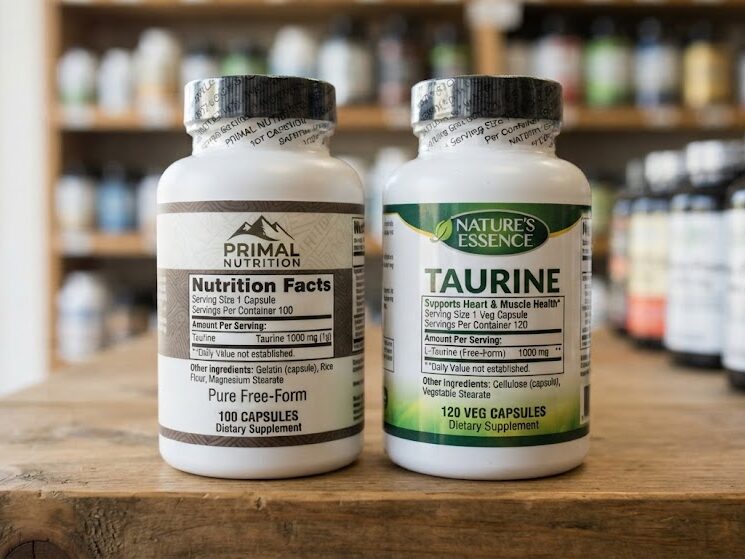
A quality taurine supplement should provide a clearly stated taurine amount, transparent ingredients, appropriate serving directions, and credible quality-control information.
A straightforward product can also make it easier to evaluate your response because you know exactly how much taurine you are consuming.
What to Look for on a Taurine Supplement Label
Check for:
- Taurine content per serving
- Full ingredient disclosure
- Clear serving instructions
- Batch or quality-testing information where available
- Minimal unnecessary proprietary blends
- Appropriate storage and expiration information
The serving size is particularly important because products can differ in how much taurine they provide per scoop, capsule, or serving.
In addition, compare a standalone taurine supplement with your existing pre-workout or energy formula. A transparent label makes it easier to determine whether you are adding taurine intentionally or simply duplicating an ingredient already present in your routine.
Are Taurine Supplements Safe for Regular Exercise?
Taurine supplements appear generally well tolerated in the human studies used to investigate exercise and related outcomes, but individual safety depends on health status, dose, medications, and the complete supplement routine.
A research finding that a supplement was well tolerated in a study population does not guarantee that the same product or dose is appropriate for every individual.
A 2024 meta-analysis of 25 randomized controlled trials involving 1,024 participants reported no significant increase in adverse effects compared with control groups across taurine interventions ranging from 0.5 to 6 grams per day. — Source: Nutrition & Diabetes, 2024
This provides useful evidence about tolerability, but responsible supplementation still requires consideration of individual circumstances.
People who are pregnant or breastfeeding, have a medical condition, take prescription medication, or are unsure whether taurine is appropriate should speak with a qualified healthcare professional before supplementation.
Product-specific directions should also take priority over generalized internet dosing advice. If taurine is already included in another supplement, the total intake from all products should be considered rather than evaluating each product in isolation.
How to Add Taurine to an Exercise Supplement Routine
The best way to add taurine to an exercise supplement routine is to identify your goal first, review your existing products, choose a sensible strategy, and evaluate measurable results.
Rather than adding taurine simply because it is popular in sports nutrition, use a structured approach.
A Practical Taurine Supplement Checklist
- Identify the goal: Decide whether your priority is endurance, workout performance, muscle function, or recovery.
- Review your routine: Check whether taurine is already present in your pre-workout or energy product.
- Evaluate necessity: Prioritize training, food, hydration, sleep, and recovery before adding another supplement.
- Choose a serving strategy: Follow the product label and consider the doses studied for your exercise goal.
- Track results: Record relevant measures such as workout duration, repetitions, power, perceived exertion, or recovery.
- Reassess: Continue only if the supplement provides a meaningful and practical benefit for you.
This approach turns supplementation into something measurable rather than relying solely on expectations or marketing claims.
For example, if your primary goal is endurance, track an appropriate endurance performance measure over time. If you are using taurine around resistance training, you might instead monitor repetitions, training volume, perceived exertion, or another consistent measure.
protein supplements for muscle recovery
Conclusion
Taurine supplements may be worth considering for some active adults, but current evidence does not support treating taurine as an essential performance supplement.
Research suggests potential benefits for selected measures of exercise performance, muscle function, and exercise-related physiological stress. At the same time, results remain inconsistent, and the 2025 meta-analysis found only a small-to-moderate overall effect with low to very low certainty of evidence. — Source: Scandinavian Journal of Medicine & Science in Sports, 2025
The most sensible approach is to view taurine supplements for exercise as a potential addition to an already solid training routine—not as a substitute for the fundamentals.
Ultimately, taurine supplementation should complement consistent training, adequate nutrition, hydration, sleep, and recovery. If you decide to try taurine, choose a transparent product, follow sensible serving guidance, check for duplicate ingredients, and judge its value based on your own measurable training goals.
FAQs
What is taurine?
Taurine is a naturally occurring amino-sulfonic compound involved in cellular balance, muscle activity, and antioxidant defense.
What are taurine supplements for exercise used for?
They may support exercise performance, muscle function, endurance, and recovery.
Is taurine good for workouts?
Taurine may support exercise performance, muscle function, and recovery, although research findings are mixed.
How much taurine should I take for exercise?
Research commonly studies around 1–6 grams, but the appropriate amount depends on the product and individual circumstances.
When should I take taurine before a workout?
Taurine is commonly studied when taken about 1–2 hours before exercise.
Is it okay to take taurine daily?
Taurine has been studied for daily use, but dosage and individual health factors should be considered.
Is taurine better than creatine?
No. Taurine and creatine serve different purposes, with creatine having stronger evidence for strength and high-intensity performance.
Does taurine improve exercise performance?
Taurine may improve some exercise performance measures, but results vary between studies.
Can taurine help with muscle recovery?
Taurine may support some recovery-related processes, but evidence remains mixed.
Does taurine raise testosterone?
There is not enough evidence to show that taurine reliably increases testosterone.
Can I take taurine with a pre-workout?
Yes, but check the label because many pre-workout products already contain taurine.
Is taurine in energy drinks the same as taurine supplements?
The taurine itself may be the same, but energy drinks contain additional ingredients such as caffeine and sweeteners.
Are taurine supplements safe for regular exercise?
Research suggests taurine is generally well tolerated at studied doses, but individual factors should be considered.
Who should talk to a healthcare professional before taking taurine?
People with medical conditions, those taking prescription medications, and pregnant or breastfeeding individuals should seek professional advice before use.