
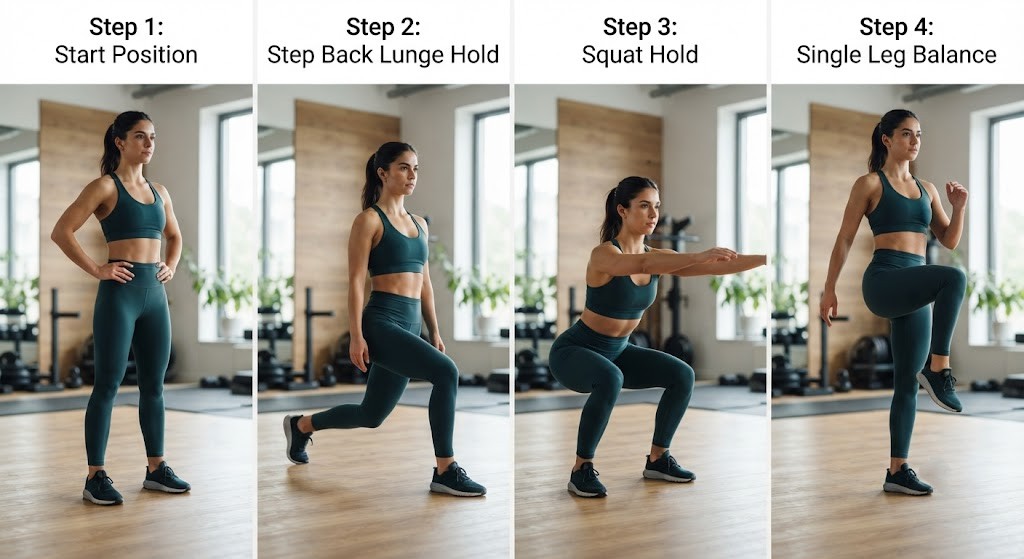
Most people associate getting stronger with lifting heavier weights or performing endless repetitions. While traditional strength training is highly effective, there’s another proven method that often goes overlooked—the Full Body Isometric Workout.
Instead of moving through repeated motions, isometric training challenges your muscles by holding specific positions under continuous tension. These static exercises can improve strength, posture, muscular endurance, and joint stability while requiring little to no equipment. Whether you’re a beginner exercising at home, an athlete looking to improve performance, or someone seeking a joint-friendly workout, a full body isometric routine can be an excellent addition to your fitness program.
In this guide, you’ll learn what a Full Body Isometric Workout is, how it works, its science-backed benefits, the best beginner-friendly exercises, common mistakes to avoid, and a complete workout routine you can start today.
What Is a Full Body Isometric Workout?
A Full Body Isometric Workout is a strength-training routine that builds muscle tension without changing joint position or creating visible movement.
Unlike traditional exercises where muscles shorten (concentric contraction) or lengthen (eccentric contraction), isometric exercises require you to maintain a fixed position while your muscles remain fully engaged.
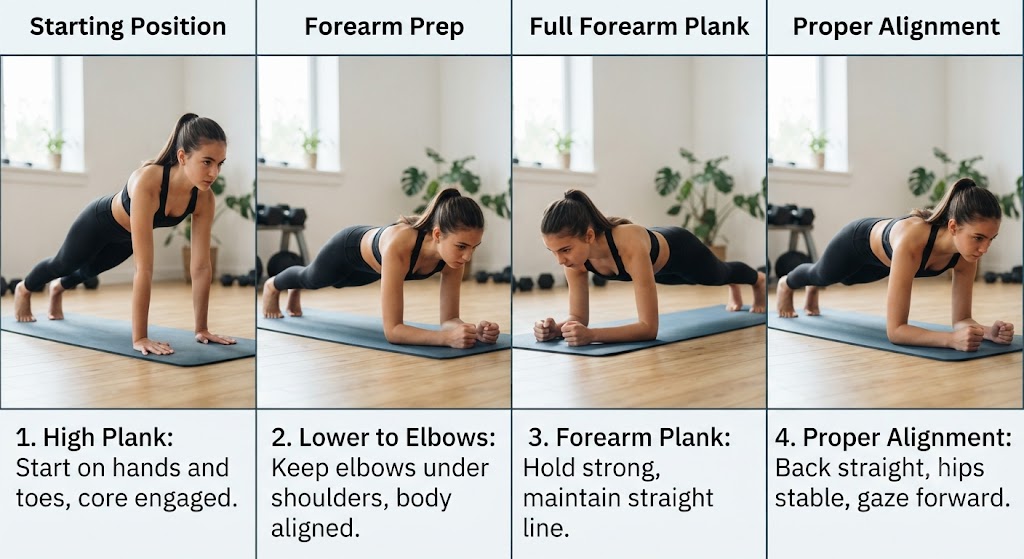
For example, during a plank, your body doesn’t move, but your shoulders, core, back, glutes, and legs work continuously to keep your body stable.
If you’re new to bodyweight fitness, also read our beginner bodyweight workout.
How Isometric Exercises Work
Isometric training involves holding muscles under continuous tension for a specific period, improving strength, muscular endurance, stability, and body control.
Every muscle contraction falls into one of three categories:
| Muscle Contraction | Description | Example |
|---|---|---|
| Isometric | Muscle contracts without movement | Plank |
| Concentric | Muscle shortens | Push-up upward phase |
| Eccentric | Muscle lengthens | Lowering into a squat |
According to the American College of Sports Medicine (ACSM), isometric exercises can improve muscular strength and joint stability when incorporated into a balanced resistance training program. — Source: ACSM, 2024
Statistic: Adults should perform muscle-strengthening activities at least 2 days per week for overall health. — Source: CDC, 2024
Why Does a Full Body Isometric Workout Matter?
A Full Body Isometric Workout is effective because it develops strength, stability, posture, and muscular endurance while placing relatively low stress on the joints.
Unlike high-impact exercises that involve repetitive movement, isometric exercises allow muscles to generate force without excessive joint motion. This makes them especially valuable for beginners, older adults, people returning from injury, and anyone looking for a convenient home workout.
For example, a wall sit strengthens the quadriceps and glutes without repetitive bending of the knees, making it a practical option for many individuals.
It also pairs well with a connective tissue workout to improve long-term joint health.
Major Benefits
- Builds functional strength
- Improves posture
- Enhances joint stability
- Supports injury prevention
- Improves muscular endurance
- Requires little or no equipment
- Saves time
- Suitable for home workouts and travel
Statistic: Nearly 31% of adults worldwide do not meet recommended physical activity levels. — Source: World Health Organization, 2024
How Does Isometric Training Build Strength?
Isometric training increases strength by keeping muscles under continuous tension for a fixed duration.
Although there is no visible movement, muscles are actively producing force throughout the hold. Over time, this stimulates strength gains, improves neuromuscular efficiency, and enhances muscular endurance.
Time Under Tension
One of the biggest reasons isometric exercises are effective is time under tension (TUT).
Time under tension refers to how long a muscle remains working during an exercise.
For example:
- Holding a plank for 45 seconds keeps your core engaged continuously.
- Holding a squat position challenges your quadriceps and glutes far longer than a few quick repetitions.
For more advanced programming, see our time under tension workout.
Nervous System Adaptation
Isometric exercises don’t just strengthen muscles—they also improve communication between your brain and muscles.
Better neural activation helps recruit more muscle fibers efficiently, leading to improved strength and better control during everyday activities and sports.
Progressive Overload
Progressive overload remains essential, even in isometric training.
Instead of adding repetitions, you can increase difficulty by:
- Holding positions longer
- Using resistance bands
- Performing single-leg or single-arm variations
- Increasing leverage
- Reducing rest periods
- Choosing more challenging static positions
Statistic: Research shows isometric resistance training can significantly improve maximal strength when performed consistently. — Source: Sports Medicine Journal, 2024
What Are the Benefits of Full Body Isometric Exercises?
Full body isometric exercises strengthen multiple muscle groups simultaneously while minimizing unnecessary joint stress.
Here are the biggest benefits.
Increased Strength
Holding challenging positions forces muscles to generate continuous force, helping improve overall strength over time.
Better Balance
Many isometric movements activate stabilizer muscles that improve coordination, balance, and body control.
Improved Core Stability
Exercises like planks, hollow holds, and side planks strengthen deep core muscles that support your spine.
For additional abdominal training, explore our best core strengthening exercises.
Lower Injury Risk
Since most isometric exercises involve controlled positions instead of explosive movements, they reduce excessive stress on joints while improving stability.
Pair your routine with injury prevention exercises.
Better Posture
Static exercises strengthen muscles responsible for maintaining proper posture, particularly the core, shoulders, and upper back.
Convenient Home Training
Most exercises require nothing more than your own body weight, making isometric workouts ideal for home, office, or travel.
Statistic: Bodyweight training remains among the world’s top fitness trends. — Source: ACSM Worldwide Fitness Trends, 2025
Which Muscles Does a Full Body Isometric Workout Target?
A properly designed Full Body Isometric Workout trains nearly every major muscle group.
| Exercise | Primary Muscles |
|---|---|
| Plank | Core, shoulders |
| Wall Sit | Quadriceps, glutes |
| Glute Bridge Hold | Glutes, hamstrings |
| Hollow Hold | Core |
| Superman Hold | Lower back |
| Side Plank | Obliques |
| Push-up Hold | Chest, shoulders, triceps |
| Squat Hold | Legs, core |
| Dead Hang | Grip, lats |
| Reverse Plank | Posterior chain |
Lower-body exercises can also complement an ATG leg workout.
Best Full Body Isometric Exercises for Beginners
The following exercises require minimal equipment and are suitable for almost every fitness level.
1. Plank
- Hold: 20–60 seconds
- Targets: Core, shoulders, glutes
2. Wall Sit
- Hold: 30–60 seconds
- Targets: Quadriceps, glutes
3. Glute Bridge Hold
- Hold: 30–45 seconds
- Targets: Glutes, hamstrings
4. Hollow Body Hold
- Hold: 20–40 seconds
- Targets: Deep core muscles
5. Side Plank
- Hold: 20–45 seconds each side
- Targets: Obliques, shoulders
6. Superman Hold
- Hold: 20–30 seconds
- Targets: Lower back, glutes
7. Push-Up Hold
Pause halfway through the movement.
- Hold: 15–30 seconds
8. Squat Hold
- Hold: 30–60 seconds
- Targets: Legs and core
9. Dead Hang
- Hold: 15–45 seconds
- Targets: Grip strength and upper back
10. Reverse Plank
- Hold: 20–40 seconds
- Targets: Posterior chain, shoulders
Full Body Beginner Workout
| Exercise | Hold | Sets |
|---|---|---|
| Plank | 30 sec | 3 |
| Wall Sit | 45 sec | 3 |
| Glute Bridge Hold | 30 sec | 3 |
| Side Plank | 20 sec each side | 2 |
| Superman Hold | 20 sec | 3 |
Rest 30–45 seconds between exercises.
How Long Should You Hold Each Isometric Exercise?
Most isometric exercises should be held between 20 and 60 seconds, depending on your experience and training goals.
Recommended Hold Times
| Experience Level | Hold Time |
|---|---|
| Beginner | 20–30 seconds |
| Intermediate | 30–45 seconds |
| Advanced | 45–90 seconds |
Remember, maintaining perfect form is always more important than holding a position longer.
Can You Build Muscle With Isometric Workouts Alone?
Yes, isometric workouts can contribute to muscle growth, especially for beginners and individuals returning to exercise.
However, combining isometric exercises with traditional resistance training generally leads to greater overall muscle development because it challenges muscles through a full range of motion.
For the best results:
- Increase hold duration gradually.
- Make exercises more challenging over time.
- Train consistently.
- Eat enough protein to support muscle recovery.
- Get sufficient sleep.
What Equipment Do You Need for Isometric Training?
One of the biggest advantages of a Full Body Isometric Workout is its simplicity.
Most exercises require no equipment at all, making them ideal for home workouts and travel.
Useful equipment includes:
- Yoga mat
- Resistance bands
- Stability ball
- Pull-up bar
- Timer
For equipment-free routines, visit our home workout without equipment.
Common Mistakes to Avoid During Isometric Exercises
Even simple exercises can become less effective if performed incorrectly.
Avoid these common mistakes:
- Holding your breath during the exercise
- Allowing poor posture or body alignment
- Holding positions for too long with poor form
- Progressing too quickly
- Skipping warm-ups and recovery
- Neglecting proper breathing
A good rule of thumb is to breathe steadily throughout every hold while maintaining proper posture.
Is a Full Body Isometric Workout Better Than Traditional Strength Training?
Neither training method is universally better.
Instead, they complement each other.
| Isometric Training | Traditional Strength Training |
|---|---|
| Static holds | Dynamic movement |
| Joint friendly | Greater muscle growth potential |
| Minimal equipment | Often requires weights |
| Excellent for stability | Excellent for power development |
Combining both methods provides a balanced approach to strength, endurance, mobility, and overall fitness.
Can Older Adults Safely Perform Isometric Exercises?
Yes. Many older adults can safely perform isometric exercises after receiving appropriate clearance from a healthcare professional.
Low-impact exercises such as:
- Wall sits
- Seated core bracing
- Glute bridge holds
- Standing wall pushes
can improve balance, muscular endurance, and stability while minimizing unnecessary joint stress.
What Is the Best Full Body Isometric Workout Routine?
A structured routine helps you progress safely and consistently.
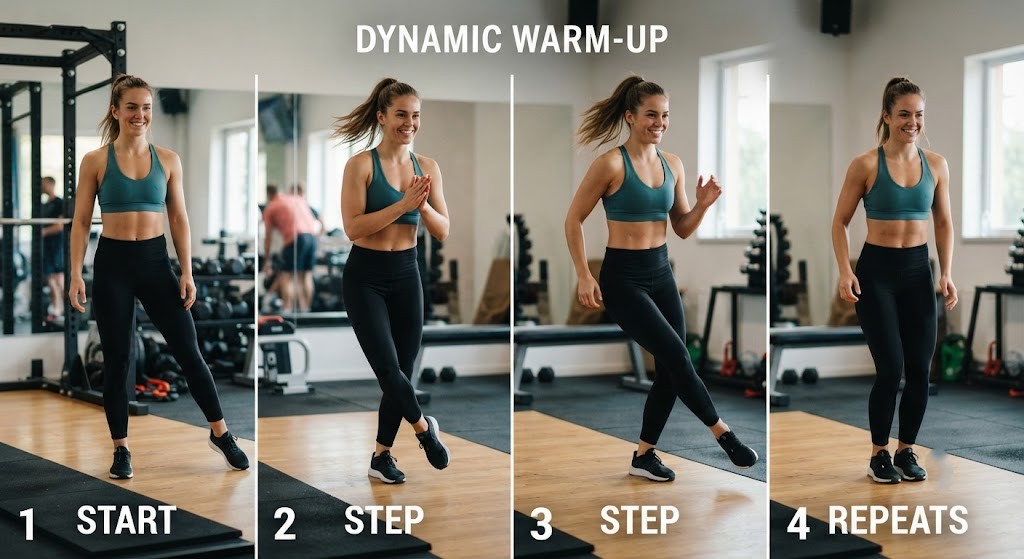
Warm-Up
Prepare your muscles with a full body mobility routine.
Spend 5–8 minutes performing:
- Arm circles
- Hip circles
- Leg swings
- Shoulder rolls
- Dynamic stretching
Beginner Routine
- Plank — 30 seconds
- Wall Sit — 30 seconds
- Glute Bridge Hold — 30 seconds
- Superman Hold — 20 seconds
- Side Plank — 20 seconds each side
Repeat 2 rounds.
Intermediate Routine
- Increase every hold to 45 seconds.
- Complete 3 rounds.
Advanced Routine
Increase holds to 60–90 seconds and add:
- Push-Up Hold
- Dead Hang
- Reverse Plank
What’s Next After Starting a Full Body Isometric Workout?
Consistency is the biggest factor in long-term success.
A balanced weekly schedule allows your muscles to recover while continuing to build strength.
| Day | Workout |
|---|---|
| Monday | Full Body Isometric |
| Tuesday | Walking + Mobility |
| Wednesday | Strength Training |
| Thursday | Isometric |
| Friday | Recovery |
| Saturday | Strength Training |
| Sunday | Stretching |
For balanced programming, see our beginner strength training plan.
Recovery is just as important as training.
Support your recovery with a gentle yoga routine, a 15 minute daily yoga routine, and follow our muscle recovery tips.
Nutrition Tips
- Eat enough protein.
- Stay hydrated.
- Sleep 7–9 hours.
- Progress gradually.
- Prioritize consistency over intensity.
Conclusion
A Full Body Isometric Workout is one of the simplest, most accessible, and most effective ways to improve strength, stability, posture, and muscular endurance without relying on expensive equipment or a gym membership. Because these exercises use static muscle contractions, they provide an efficient way to challenge your entire body while placing relatively low stress on your joints.
Whether you’re just beginning your fitness journey, recovering from an injury, traveling, or looking to complement your existing strength program, isometric training can help you build a stronger and more resilient body. Start with basic holds, master proper technique, and gradually increase the challenge over time. Remember, consistent effort—not complicated workouts—is what leads to lasting results.
FAQs
What is a full body isometric workout?
A full body isometric workout uses static holds to strengthen muscles without moving your joints.
How long should I hold an isometric exercise?
Beginners should hold each exercise for 20–30 seconds, while advanced exercisers can hold for up to 90 seconds.
Can isometric workouts build muscle?
Yes. Isometric workouts can build strength and muscle when performed consistently with progressive overload.
Are isometric exercises safe for beginners?
Yes. They are low-impact, beginner-friendly, and require little to no equipment.
Can I do isometric workouts every day?
Light isometric exercises can be done daily, but challenging sessions are best limited to 2–4 times per week.
Do I need equipment for isometric training?
No. Most isometric exercises use only your body weight.
Are isometric exercises good for improving posture?
Yes. They strengthen your core and back muscles, helping improve posture and stability.
Is a full body isometric workout effective for weight loss?
Yes. It supports weight loss when combined with a balanced diet and regular physical activity.
Can you build muscle with isometrics only?
Yes. You can build muscle with isometric exercises, but combining them with dynamic training often produces better results.
What is the 3-3-3 rule gym?
The 3-3-3 rule usually means performing 3 exercises, 3 sets each, 3 times per week.
How many times a week should I do isometric exercises?
Most people should perform isometric workouts 2–4 times per week for the best results.
What are the top 5 isometric exercises?
The top five are planks, wall sits, side planks, glute bridge holds, and push-up holds.