

Kelso shrugs are an effective upper-back exercise that focuses on strengthening the muscles responsible for shoulder blade movement. Unlike traditional shrugs, this exercise emphasizes scapular retraction rather than simply lifting your shoulders toward your ears.
What Are Kelso Shrugs?
Kelso shrugs are a chest-supported upper-back exercise that involves pulling your shoulder blades toward each other while keeping your arms relatively straight. They are commonly performed using dumbbells, a barbell, or a suitable cable setup.
The exercise is associated with strength coach and author Paul Kelso and is used to develop scapular control and strengthen the muscles of the upper back.
Unlike conventional shrugs, Kelso shrugs do not primarily involve shoulder elevation. Instead, the movement focuses on controlled shoulder blade retraction.
best upper back workout exercises
Why Do Kelso Shrugs Matter?
Kelso shrugs matter because they strengthen muscles involved in shoulder blade retraction and upper-back stability. They can complement traditional back exercises and help improve control during pulling movements.
Some potential benefits include:
- Upper-back development: Targets the middle trapezius and rhomboids.
- Scapular control: Trains controlled movement of the shoulder blades.
- Muscle isolation: Reduces the emphasis on elbow movement compared with traditional rows.
- Back workout variety: Adds a focused accessory movement to your training routine.
- Pulling exercise support: Complements exercises such as rows and lat pulldowns.
Kelso shrugs can be useful for building a more complete back workout, but they should not replace compound pulling exercises.
Kelso Shrugs Muscles Worked
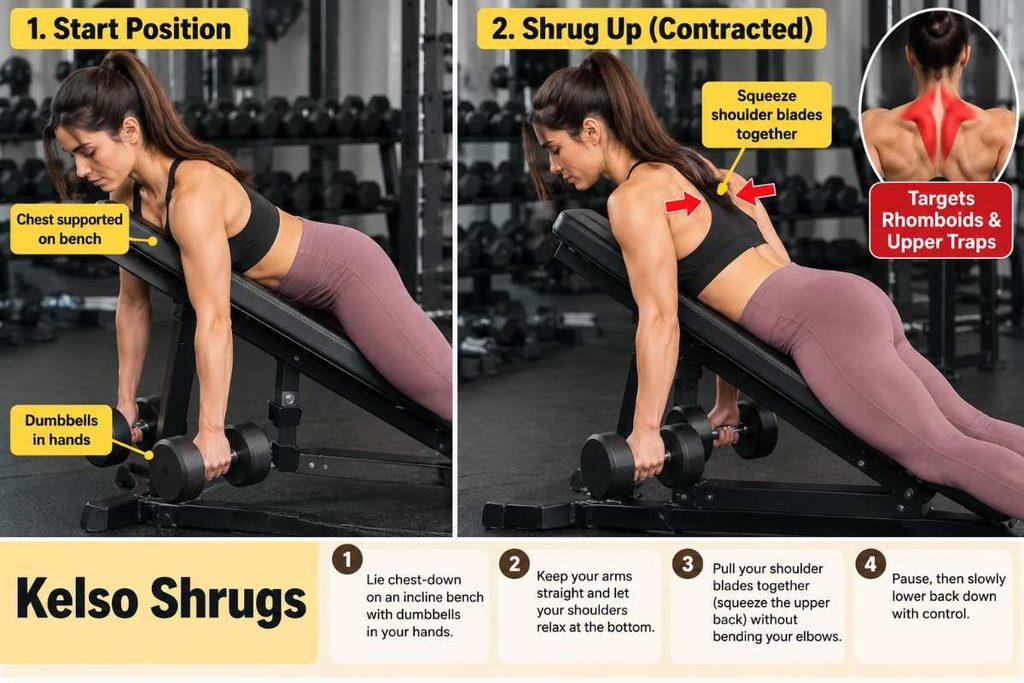
Kelso shrugs primarily target the middle trapezius and rhomboids, with other muscles contributing to shoulder blade stabilization.
1. Middle Trapezius
The middle trapezius is one of the main muscles involved in Kelso shrugs. It helps pull the shoulder blades toward the spine during the contraction.
2. Rhomboids
The rhomboid major and minor are located between the spine and shoulder blades. They assist with scapular retraction and help maintain shoulder blade positioning.
3. Lower Trapezius
The lower trapezius contributes to shoulder blade stabilization and positioning. Its involvement depends on the direction and control of the movement.
4. Upper Trapezius
The upper trapezius contributes to shoulder girdle stabilization, although Kelso shrugs emphasize a different movement from conventional shrugs.
5. Supporting Muscles
Other muscles around the shoulders and upper back help stabilize the body during the exercise. Their contribution varies depending on the equipment and technique.
How to Perform Kelso Shrugs Correctly
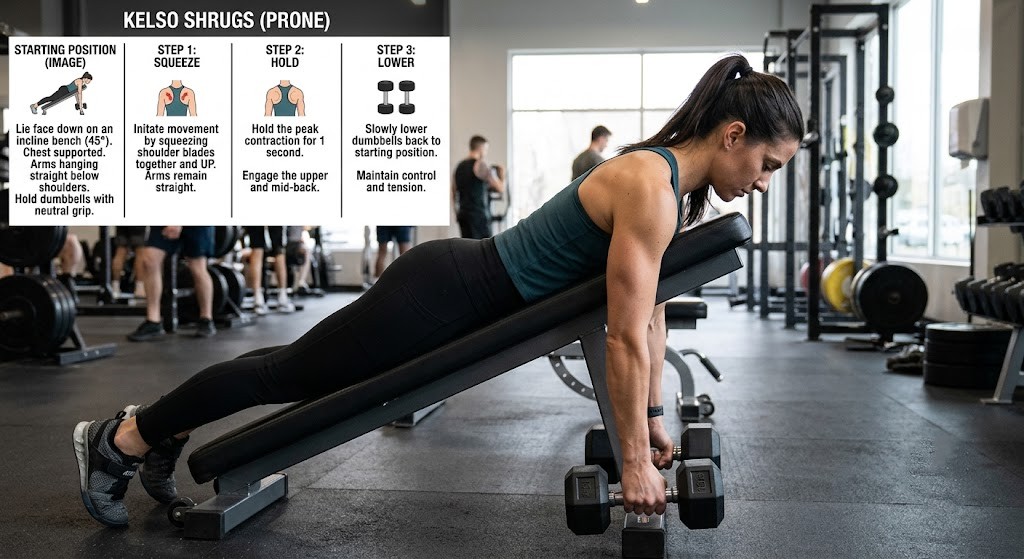
To perform Kelso shrugs correctly, position your chest against an incline bench, let your arms hang naturally, and squeeze your shoulder blades together without bending your elbows.
Follow these steps:
- Adjust the bench: Set an incline bench to approximately 30–45 degrees.
- Position your body: Lie face down with your chest supported by the bench.
- Hold the dumbbells: Allow your arms to hang toward the floor with your elbows extended.
- Start the movement: Let your shoulder blades move slightly forward in a comfortable range.
- Retract your shoulder blades: Pull them toward each other without turning the movement into a row.
- Squeeze your upper back: Hold the contracted position briefly.
- Return slowly: Allow your shoulder blades to move forward under control.
- Repeat: Complete your repetitions while maintaining consistent technique.
Keep your neck relaxed and avoid lifting your shoulders toward your ears.
Breathing Technique
Proper breathing helps maintain control throughout each repetition.
- Inhale as your shoulder blades move forward.
- Exhale as you squeeze your shoulder blades together.
- Breathe naturally between repetitions.
- Avoid holding your breath unnecessarily.
Different Types of Kelso Shrugs
Kelso shrugs can be performed using different equipment and body positions, although the incline chest-supported dumbbell variation is a practical starting point.
1. Dumbbell Kelso Shrugs
Dumbbell Kelso shrugs are performed with your chest supported on an incline bench while holding a dumbbell in each hand.
This variation allows independent arm positioning and makes it easy to adjust resistance.
Best for: Beginners and intermediate lifters.
2. Barbell Kelso Shrugs
Barbell Kelso shrugs use a barbell while your upper body remains supported or positioned in an appropriate incline setup.
This variation requires good control because the barbell connects both arms and may restrict individual movement.
Best for: Experienced lifters familiar with controlled upper-back exercises.
3. Bent-Over Kelso Shrugs
Bent-over Kelso shrugs are performed with your torso hinged forward while holding a barbell or dumbbells.
Instead of pulling the weight toward your body, focus on moving your shoulder blades while keeping your elbows relatively straight.
Best for: Lifters who can maintain a stable hip hinge and neutral spine.
4. Cable-Based Scapular Shrugs
A suitable cable setup can provide resistance during scapular retraction. However, the movement should remain a controlled shoulder blade exercise rather than becoming a conventional cable row.
Best for: Experienced lifters who have access to an adjustable cable station and can maintain proper positioning.
Kelso Shrugs vs. Traditional Shrugs
Kelso shrugs and traditional shrugs are different exercises because they emphasize different shoulder movements.
| Comparison | Kelso Shrugs | Traditional Shrugs |
|---|---|---|
| Main movement | Shoulder blade retraction | Shoulder elevation |
| Primary muscles | Middle traps and rhomboids | Upper traps |
| Common position | Chest-supported or bent-over | Standing |
| Equipment | Dumbbells or barbell | Dumbbells or barbell |
| Main focus | Upper-back development | Upper-trapezius development |
Traditional shrugs involve raising your shoulders toward your ears, whereas Kelso shrugs emphasize moving your shoulder blades toward each other.
Both exercises can complement a balanced back and shoulder workout.
best shoulder workouts for strength and muscle growth
Kelso Shrugs vs. Face Pulls
Kelso shrugs and face pulls both train muscles around the upper back and shoulder blades, but their movement patterns are different.
| Feature | Kelso Shrugs | Face Pulls |
|---|---|---|
| Equipment | Dumbbells or barbell | Cable machine |
| Main movement | Scapular retraction | Cable pull toward the face |
| Arm position | Mostly extended | Bent elbows |
| Primary focus | Middle traps and rhomboids | Rear delts and upper back |
| Exercise type | Scapular-focused movement | Compound accessory movement |
Kelso shrugs are useful when you want to emphasize shoulder blade retraction, while face pulls combine pulling with shoulder movement and external rotation.
Common Kelso Shrug Mistakes to Avoid
The most common Kelso shrug mistakes include bending the elbows, using excessive weight, shrugging toward the ears, and rushing through repetitions.
Avoid these errors to maintain proper technique.
1. Bending Your Elbows
Bending your elbows turns the movement into a rowing exercise. Keep your arms extended and focus on your shoulder blades.
2. Using Too Much Weight
Heavy weights can make it difficult to control scapular movement. Start with light resistance and increase it gradually.
3. Shrugging Toward Your Ears
Kelso shrugs emphasize shoulder blade retraction rather than excessive shoulder elevation. Keep your neck relaxed.
4. Moving Too Quickly
Fast repetitions can reduce control and make it difficult to maintain consistent technique. Use a smooth, controlled movement.
5. Lifting Your Chest Off the Bench
Keep your chest supported throughout the exercise. Avoid using your torso to generate momentum.
6. Forcing an Excessive Range of Motion
Do not force your shoulder blades into an exaggerated stretch or squeeze. Use a comfortable range that allows controlled movement.
How Many Sets and Reps of Kelso Shrugs Should You Do?
Most beginners can start with 2 sets of 10–15 repetitions, while more experienced lifters may use 3 sets depending on their overall training volume.
Here is a practical starting guide:
| Experience level | Sets | Repetitions |
|---|---|---|
| Beginner | 2 | 12–15 |
| Intermediate | 3 | 10–15 |
| Advanced | 3–4 | 10–15 |
These are suggested starting ranges rather than scientifically established Kelso shrug prescriptions.
Training recommendations:
- Start with light resistance.
- Rest approximately 60–90 seconds between sets.
- Maintain controlled repetitions.
- Increase resistance only when your technique remains consistent.
- Avoid training through shoulder discomfort.
The 2026 American College of Sports Medicine position stand supports individualized resistance-training programs and progressive training rather than relying on one rigid prescription for everyone. (Source: ACSM, 2026). PubMed+1
progressive overload training guide
How to Add Kelso Shrugs to Your Back Workout
Kelso shrugs work well as an accessory exercise after your primary compound pulling movements.
Here is an example upper-back workout:
| Exercise | Sets | Repetitions |
|---|---|---|
| Lat pulldowns | 3 | 10–12 |
| Seated cable rows | 3 | 10–12 |
| Chest-supported rows | 3 | 10–12 |
| Kelso shrugs | 2–3 | 12–15 |
| Face pulls | 2 | 12–15 |
Adjust the number of exercises and sets according to your experience, recovery, and fitness goals.
Should You Perform Kelso Shrugs Before or After Rows?
Perform Kelso shrugs after your main rowing exercises if your priority is maintaining strength and performance during compound back movements.
You can also use light scapular movements during your warm-up to practice shoulder blade control without creating unnecessary fatigue.
Are Kelso Shrugs Good for Beginners?
Yes, Kelso shrugs can be suitable for beginners when performed with light resistance and proper technique.
However, beginners should first understand how to move their shoulder blades independently of their elbows.
Follow these tips:
- Practice scapular retraction without weights.
- Learn to keep your elbows extended.
- Start with light dumbbells.
- Use a stable incline bench.
- Focus on controlled repetitions.
- Increase resistance gradually.
If you struggle to maintain the correct position, practice basic scapular retraction before progressing to weighted Kelso shrugs.
beginner back workout for building strength
Safety Tips and Precautions
Kelso shrugs are generally manageable when performed with appropriate resistance and controlled technique, but poor positioning and excessive loading can cause discomfort.
Keep these precautions in mind:
- Choose weights that allow controlled movement.
- Keep your neck relaxed.
- Avoid forcing your shoulder blades into an extreme position.
- Use a stable bench or suitable exercise setup.
- Stop if you experience sharp pain, numbness, or unusual discomfort.
- Seek professional guidance if you have an existing shoulder or upper-back injury.
The American Academy of Orthopaedic Surgeons recommends controlled scapular exercises and advises avoiding unnecessary tension around the neck. Its scapular retraction/protraction exercise also emphasizes keeping the elbow straight and avoiding shoulder elevation. (Source: AAOS, n.d.).
Conclusion
Kelso shrugs are a useful accessory exercise for strengthening the middle trapezius, rhomboids, and muscles responsible for shoulder blade movement. Unlike traditional shrugs, they emphasize scapular retraction rather than lifting the shoulders toward the ears.
Start with light resistance, maintain straight arms, and focus on controlled movement. Include Kelso shrugs alongside rows, pulldowns, and other back exercises to develop a balanced upper-back training routine.
FAQs
What muscles do Kelso shrugs work?
Kelso shrugs primarily target the middle trapezius and rhomboids, with additional involvement from muscles that stabilize the shoulder blades.
Are Kelso shrugs better than regular shrugs?
Neither exercise is universally better. Kelso shrugs emphasize scapular retraction, while traditional shrugs emphasize shoulder elevation and upper-trapezius development.
Can you do Kelso shrugs with dumbbells?
Yes, dumbbells are a convenient option for performing chest-supported Kelso shrugs using an incline bench.
How many sets of Kelso shrugs should I do?
Beginners can start with 2 sets of 10–15 repetitions. More experienced lifters can adjust their volume according to their training goals.
Do Kelso shrugs build bigger traps?
Yes, they can contribute to trapezius development, particularly the middle trapezius, when combined with progressive resistance training.
Are Kelso shrugs good for posture?
They strengthen muscles involved in shoulder blade positioning, but they are not a standalone solution for postural problems.
Can beginners perform Kelso shrugs?
Yes, beginners can perform them using light dumbbells, controlled repetitions, and a stable chest-supported position.
Should you bend your elbows during Kelso shrugs?
No. Keep your elbows extended to emphasize shoulder blade movement instead of turning the exercise into a rowing movement.
Should Kelso shrugs be performed before or after rows?
They are generally best performed after your main rowing exercises to avoid unnecessary fatigue before compound movements.
How often should you do Kelso shrugs?
Once or twice weekly can be a reasonable starting point, depending on your overall back-training volume and recovery.
Sources
- Paul Kelso. (1984). The Kelso Shrug System. Powerlifting USA.
- American Academy of Orthopaedic Surgeons. (n.d.). Rotator Cuff and Shoulder Conditioning Program.
- American College of Sports Medicine. (2026). Resistance Training Prescription for Muscle Function, Hypertrophy, and Physical Performance in Healthy Adults.
- American College of Sports Medicine. (2026). ACSM Publishes Updated Resistance Training Guidelines.
Disclaimer: This article is for informational and educational purposes only and is not a substitute for personalized medical advice. Consult a qualified healthcare professional before making significant changes to your diet, exercise routine, or supplement use.