
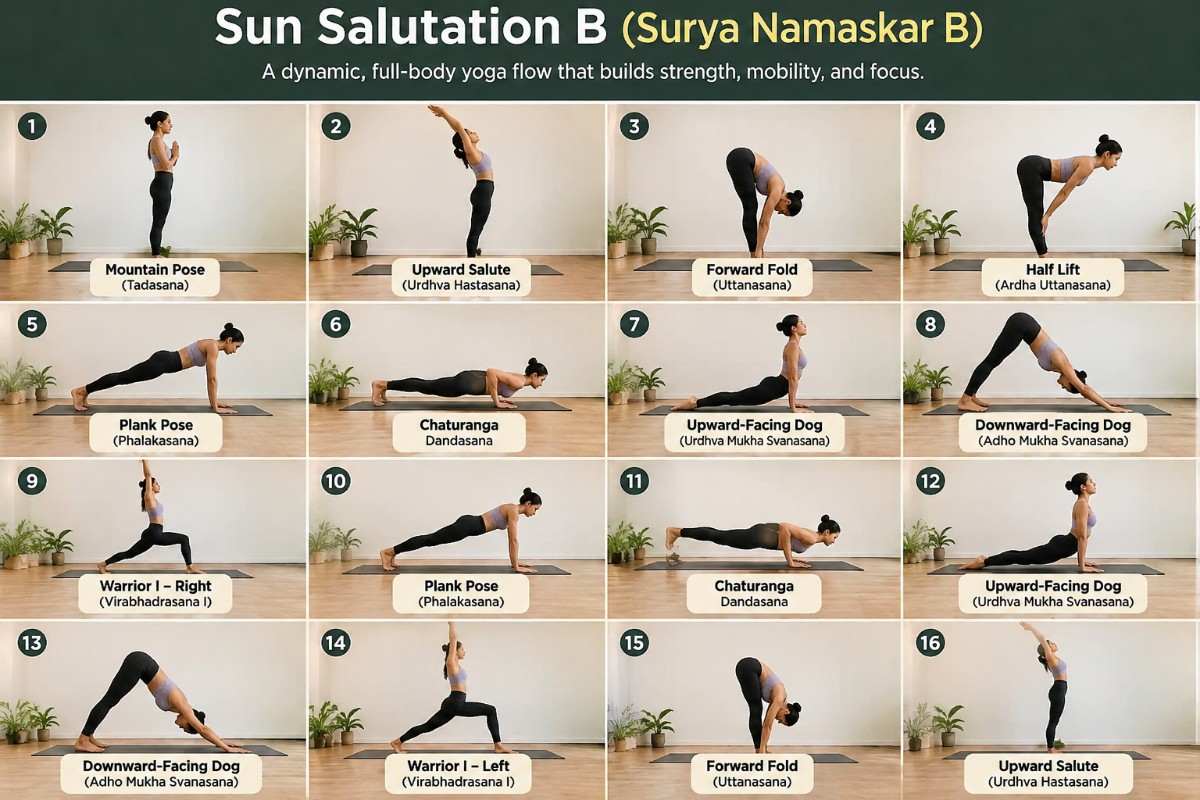
Sun Salutation B, also known as Surya Namaskar B, is a dynamic yoga sequence practised in Ashtanga Vinyasa Yoga. This form of sun salutation yoga combines Chair Pose, Warrior I, forward folds, Chaturanga, Upward-Facing Dog, and Downward-Facing Dog in a flowing series of movements coordinated with breathing.
Compared with Sun Salutation A, this sequence includes more standing postures and transitions, making it a useful way to develop strength, mobility, balance, and movement coordination. It is an important part of traditional yoga sun salutations and builds on the foundational movements introduced in Sun Salutation A.
What Is Sun Salutation B (Surya Namaskar B)?
Sun Salutation B is a traditional Ashtanga Vinyasa Yoga sequence consisting of 17 counted vinyasa movements. It includes Utkatasana (Chair Pose) and Virabhadrasana I (Warrior I) on both sides, along with forward folds, Chaturanga, Upward-Facing Dog, and Downward-Facing Dog.
The sequence is commonly practised after Sun Salutation A in the Ashtanga Primary Series. Each movement is coordinated with an inhalation or exhalation, while Downward-Facing Dog is traditionally held for five breaths at designated points.
Its main postures include:
- Samasthiti (Equal Standing Pose)
- Utkatasana (Chair Pose)
- Uttanasana (Standing Forward Fold)
- Ardha Uttanasana (Halfway Lift)
- Chaturanga Dandasana (Four-Limbed Staff Pose)
- Urdhva Mukha Svanasana (Upward-Facing Dog)
- Adho Mukha Svanasana (Downward-Facing Dog)
- Virabhadrasana I (Warrior I)
Sun Salutation B is a progression from Sun Salutation A, introducing additional standing strength and balance challenges. Together, these sequences form an important part of the Ashtanga sun salutation sequence.
Why Does Sun Salutation B Matter?
Sun Salutation B matters because it combines flowing movement with standing strength postures, helping practitioners prepare for the more demanding sequences in Ashtanga Yoga.
Unlike Sun Salutation A, it adds Chair Pose and Warrior I, which require greater lower-body engagement, balance, and coordination. These differences make it a more demanding variation of the traditional yoga sun salutation.
Practising the sequence can help you:
- Build familiarity with foundational Ashtanga transitions.
- Develop lower-body and upper-body muscular endurance.
- Practise balance in standing yoga postures.
- Coordinate breathing with continuous movement.
- Prepare the body for a longer Vinyasa Yoga practice.
17 Vinyasa Counts of Sun Salutation B
Sun Salutation B follows 17 counted vinyasa movements. The Sanskrit count identifies each transition, while the breath guides the movement.
| Count | Sanskrit count | Movement | Breathing |
|---|---|---|---|
| Starting | Samasthiti | Equal Standing Pose | Natural breathing |
| 1 | Ekam | Chair Pose | Inhale |
| 2 | Dve | Standing Forward Fold | Exhale |
| 3 | Trini | Halfway Lift | Inhale |
| 4 | Chatvari | Chaturanga Dandasana | Exhale |
| 5 | Pancha | Upward-Facing Dog | Inhale |
| 6 | Sat | Downward-Facing Dog | Exhale |
| 7 | Sapta | Warrior I, right side | Inhale |
| 8 | Astau | Chaturanga transition | Exhale |
| 9 | Nava | Upward-Facing Dog | Inhale |
| 10 | Dasa | Downward-Facing Dog | Exhale |
| 11 | Ekadasa | Warrior I, left side | Inhale |
| 12 | Dvadasa | Chaturanga transition | Exhale |
| 13 | Trayodasa | Upward-Facing Dog | Inhale |
| 14 | Chaturdasa | Downward-Facing Dog | Exhale |
| 15 | Panchadasa | Halfway Lift | Inhale |
| 16 | Sodasa | Standing Forward Fold | Exhale |
| 17 | Saptadasa | Chair Pose, then rise | Inhale |
| Finishing | Samasthiti | Equal Standing Pose | Exhale |
The exact traditional count and drishti (gaze points) are taught through the Ashtanga method. The table gives a practical overview of the sequence; follow your teacher’s count when learning the traditional form.
How to Do Sun Salutation B: Step-by-Step Instructions
Sun Salutation B begins in Samasthiti and moves through Chair Pose, forward folds, standing Warrior I positions, and flowing floor transitions before returning to standing. Follow the sequence in order to understand the complete sun salutation sequence and coordinate each movement with your breathing.
Starting Position: Samasthiti (Equal Standing Pose)
- Stand upright with your feet together or comfortably positioned.
- Distribute your weight evenly across both feet.
- Keep your spine naturally extended.
- Relax your shoulders and arms.
- Look forward and establish steady breathing.
Step 1: Utkatasana (Chair Pose)
Count 1 – Ekam | Inhale
- Bend your knees as if sitting into an imaginary chair.
- Shift your hips slightly backwards.
- Raise both arms overhead.
- Keep your chest lifted.
- Distribute your weight evenly across your feet.
- Avoid allowing your knees to collapse inward.
Chair Pose activates the thighs, glutes, and core while challenging balance.
Step 2: Uttanasana (Standing Forward Fold)
Count 2 – Dve | Exhale
- Straighten your legs comfortably.
- Hinge forward from your hips.
- Bring your hands towards the floor.
- Relax your neck and head.
- Bend your knees if your hamstrings feel tight.
Step 3: Ardha Uttanasana (Halfway Lift)
Count 3 – Trini | Inhale
- Lift your chest and extend your spine.
- Place your fingertips on the floor or yoga blocks.
- Lengthen your back.
- Keep your neck aligned with your spine.
- Look slightly forward or down.
Step 4: Chaturanga Dandasana (Four-Limbed Staff Pose)
Count 4 – Chatvari | Exhale
- Place your hands firmly on the mat.
- Step or jump both feet backwards.
- Move into a plank position.
- Bend your elbows close to your ribs.
- Lower your body with control.
- Keep your shoulders, hips, and legs aligned.
Beginners can lower their knees to make the transition easier.
Step 5: Urdhva Mukha Svanasana (Upward-Facing Dog)
Count 5 – Pancha | Inhale
- Transition over your toes.
- Press your palms into the mat.
- Straighten your arms comfortably.
- Lift your chest and thighs away from the floor.
- Keep your shoulders away from your ears.
- Avoid forcing your lower back into an excessive arch.
Step 6: Adho Mukha Svanasana (Downward-Facing Dog)
Count 6 – Sat | Exhale
- Tuck your toes under.
- Lift your hips upward and backward.
- Extend your arms.
- Lengthen your spine.
- Relax your head between your upper arms.
Maintain the posture for five steady breaths in the traditional sequence.
Step 7: Virabhadrasana I (Warrior I – Right Side)
Count 7 – Sapta | Inhale
- Step your right foot forward between your hands.
- Turn your back foot outward and ground the heel.
- Bend your right knee while keeping it aligned with your foot.
- Lift your torso.
- Raise both arms overhead.
- Keep your hips facing forward as comfortably as your mobility allows.
Warrior I engages the legs and challenges balance while introducing a standing lunge position.
Step 8: Chaturanga Dandasana Transition
Count 8 – Astau | Exhale
- Bring your hands down to the mat.
- Step your right foot backwards.
- Move through Chaturanga with control.
- Keep your elbows close to your sides.
Step 9: Urdhva Mukha Svanasana (Upward-Facing Dog)
Count 9 – Nava | Inhale
- Transition into Upward-Facing Dog.
- Press your hands into the floor.
- Lift your chest.
- Keep your shoulders relaxed.
- Maintain comfortable spinal extension.
Step 10: Adho Mukha Svanasana (Downward-Facing Dog)
Count 10 – Dasa | Exhale
- Lift your hips upward and backward.
- Extend your spine.
- Keep your hands grounded.
- Relax your neck.
- Breathe steadily.
Hold the position for five breaths before moving to the second side.
Step 11: Virabhadrasana I (Warrior I – Left Side)
Count 11 – Ekadasa | Inhale
- Step your left foot forward between your hands.
- Turn your right foot outward and ground the heel.
- Bend your left knee comfortably.
- Lift your torso.
- Raise both arms overhead.
- Keep your balance and avoid forcing your hips into a fixed position.
Step 12: Chaturanga Dandasana Transition
Count 12 – Dvadasa | Exhale
- Bring your hands down to the mat.
- Step your left foot backwards.
- Align your body in plank.
- Lower into Chaturanga with control.
Step 13: Urdhva Mukha Svanasana (Upward-Facing Dog)
Count 13 – Trayodasa | Inhale
- Transition over your toes.
- Press your palms into the floor.
- Lift your chest and thighs.
- Extend your spine comfortably.
- Keep your neck relaxed.
Step 14: Adho Mukha Svanasana (Downward-Facing Dog)
Count 14 – Chaturdasa | Exhale
- Lift your hips upwards.
- Lengthen your spine.
- Press through your hands.
- Keep your knees slightly bent if needed.
- Maintain steady breathing.
Hold for five breaths in the traditional sequence.
Step 15: Ardha Uttanasana (Halfway Lift)
Count 15 – Panchadasa | Inhale
- Step or jump both feet forward between your hands.
- Lift your chest.
- Extend your spine.
- Place your fingertips on the mat or blocks.
- Look slightly forward.
Step 16: Uttanasana (Standing Forward Fold)
Count 16 – Sodasa | Exhale
- Fold forward from your hips.
- Relax your neck.
- Bring your hands towards your feet.
- Keep your knees comfortably bent if needed.
Step 17: Utkatasana (Chair Pose)
Count 17 – Saptadasa | Inhale
- Bend your knees.
- Shift your hips backwards.
- Raise both arms overhead.
- Keep your chest lifted.
- Press your feet firmly into the mat.
Exhale and return to Samasthiti, completing one round of Sun Salutation B.

How to Breathe During Sun Salutation B
Breathing guides each movement in Sun Salutation B. Traditional Ashtanga practice uses Ujjayi breathing, with inhalations generally accompanying upward or opening movements and exhalations accompanying folds and lowering transitions.
This breath-led approach is a defining feature of Ashtanga sun salutations and helps practitioners maintain a steady rhythm throughout the sequence.
Sun Salutation B Breathing Sequence
| Count | Movement | Breathing |
|---|---|---|
| 1 | Chair Pose | Inhale |
| 2 | Forward Fold | Exhale |
| 3 | Halfway Lift | Inhale |
| 4 | Chaturanga | Exhale |
| 5 | Upward-Facing Dog | Inhale |
| 6 | Downward-Facing Dog | Exhale |
| 7 | Warrior I, right side | Inhale |
| 8 | Chaturanga | Exhale |
| 9 | Upward-Facing Dog | Inhale |
| 10 | Downward-Facing Dog | Exhale |
| 11 | Warrior I, left side | Inhale |
| 12 | Chaturanga | Exhale |
| 13 | Upward-Facing Dog | Inhale |
| 14 | Downward-Facing Dog | Exhale, then hold for five breaths |
| 15 | Halfway Lift | Inhale |
| 16 | Forward Fold | Exhale |
| 17 | Chair Pose | Inhale |
| Finish | Samasthiti | Exhale |
The five-breath hold is traditionally taken in the final Downward-Facing Dog at count 14, rather than at the earlier Downward-Facing Dog transitions.
What Is Ujjayi Breathing?
Ujjayi breathing is a controlled breathing technique used in many Ashtanga practices. It involves breathing through the nose while gently narrowing the back of the throat to create a soft, steady sound.
To practise comfortably:
- Sit or stand in a relaxed position.
- Breathe gently through your nose.
- Slightly narrow the back of your throat.
- Keep the breathing sound soft rather than forceful.
- Maintain a steady rhythm without holding your breath.
Beginners can use natural nasal breathing while learning the sequence. Comfortable breathing is more important than trying to imitate an advanced technique.
For more guidance, explore Yoga Breathing Techniques for Beginners.
Benefits of Sun Salutation B
Sun Salutation B combines standing strength postures, forward folds, backbends, and flowing transitions. Practising it regularly may support muscular endurance, mobility, balance, and coordination.
Like other forms of sun salutation yoga, it brings several movements together in one continuous routine. Its additional standing poses make it particularly useful for developing lower-body strength and balance.
1. Builds Lower-Body Strength
Chair Pose and Warrior I require the legs to support the body while maintaining controlled alignment.
These postures engage:
- Quadriceps
- Glutes
- Hamstrings
- Calves
- Hip stabilizing muscles
Repeated practice can help develop muscular endurance in the lower body.
2. Develops Upper-Body and Core Endurance
Chaturanga, Upward-Facing Dog, and Downward-Facing Dog require coordinated engagement from the arms, shoulders, chest, back, and abdominal muscles.
The repeated transitions make Sun Salutation B physically demanding, particularly for people who are new to weight-bearing yoga.
3. Improves Balance and Coordination
Warrior I requires you to coordinate your feet, hips, torso, and arms while maintaining a stable stance.
Moving between Warrior I and the floor-based postures also challenges body awareness and movement control.
4. Supports Flexibility and Mobility
Sun Salutation B includes several movements that take the body through different ranges of motion.
Regular practice may help maintain mobility in the:
- Shoulders
- Hips
- Hamstrings
- Ankles
- Spine
You can complement this sequence with Yoga for Flexibility.
5. Increases Physical Activity
The continuous transitions and repeated weight-bearing movements can raise your heart rate. The intensity depends on your pace, experience, fitness level, and number of rounds.
Sun Salutation B can contribute to an active routine, although it should not replace a complete cardiovascular or strength-training programme.
6. Encourages Mindful Movement
Coordinating movement with breathing encourages attention to posture, balance, and physical sensations.
This can make the sequence a moving mindfulness practice rather than simply a series of exercises.
7. Prepares the Body for Ashtanga Practice
Sun Salutation B is traditionally practised before the standing postures in the Ashtanga Primary Series. It helps practitioners become familiar with the movement patterns and physical demands of the sequence.
How Many Rounds of Sun Salutation B Should You Do?
Beginners can start with one or two modified rounds and gradually increase as their strength, coordination, and breathing control improve.
In the traditional Ashtanga Primary Series, Sun Salutation B is commonly practised for five rounds after five rounds of Sun Salutation A. Some teaching approaches and practice settings use fewer rounds.
| Experience level | Practical starting point |
|---|---|
| Complete beginner | 1 modified round |
| Beginner | 1–2 rounds |
| Intermediate | 2–3 rounds |
| Experienced | Follow the established practice or teacher’s guidance |
These are general suggestions, not strict requirements. Take breaks when needed and do not sacrifice alignment or breathing to complete more rounds.
Once you become comfortable with the sequence and want to explore a longer yoga challenge, check out our 108 Sun Salutations: Benefits, Meaning, Preparation & Safety Guide for preparation tips, pacing strategies, and safety advice.
Sun Salutation A vs. Sun Salutation B
Sun Salutation A and Sun Salutation B are foundational sequences in Ashtanga Vinyasa Yoga. Sun Salutation B is longer and introduces additional standing postures.
Understanding the difference between these two yoga sun salutations can help you choose an appropriate starting point and understand how the sequences fit together.
| Feature | Sun Salutation A | Sun Salutation B |
|---|---|---|
| Vinyasa count | 9 | 17 |
| Chair Pose | No | Yes |
| Warrior I | No | Yes, both sides |
| Chaturanga transitions | 1 | 3 |
| Main focus | Foundational flow | Flow with additional standing strength and balance |
| Complexity | Foundational | More demanding |
Sun Salutation A is generally learned first. Sun Salutation B builds on its movement patterns by adding Chair Pose and Warrior I.
Sun Salutation B vs. Traditional Surya Namaskar
Sun Salutation B is an Ashtanga Vinyasa sequence. It should not be confused with every traditional 12-position Surya Namaskar sequence taught in other yoga traditions.
Although both belong to the broader practice of sun salutations, their movements and counting systems are different.
For a complete introduction to the traditional practice, explore our Sun Salutation (Surya Namaskar) Steps, Benefits, Poses & Beginner’s Guide, covering the fundamental poses, sequence, and benefits.
| Feature | Ashtanga Sun Salutation B | Common 12-position Surya Namaskar |
|---|---|---|
| Structure | 17 counted vinyasas | Commonly 12 positions |
| Chair Pose | Included | Usually not included |
| Warrior I | Included on both sides | Usually not included |
| Chaturanga | Repeated transitions | Varies by style |
| Breathing | Specific vinyasa coordination | Varies by tradition |
| Practice style | Dynamic Ashtanga flow | Traditional flowing sequence |
The exact movements and breathing instructions can vary between yoga schools. Check which version your instructor teaches before following a sequence.
Beginner Modifications for Sun Salutation B
Sun Salutation B can be challenging for beginners because it includes repeated Chaturanga transitions and standing lunges. Modifications can make the sequence more manageable.
1. Modify Chair Pose
Bend your knees only as far as you can while keeping your feet grounded and your chest lifted. Avoid forcing a deep squat.
2. Use Blocks During Forward Folds
Place yoga blocks beneath your hands during Uttanasana and Ardha Uttanasana if the floor feels too far away.
3. Step Instead of Jumping
Step your feet backwards into plank and forwards between your hands. Jumping is not necessary to learn the sequence.
4. Lower Your Knees During Chaturanga
Practise a modified lowering movement with your knees on the mat. Keep your elbows controlled and avoid dropping your shoulders.
5. Shorten Your Warrior I Stance
If your hips or ankles feel restricted, use a shorter stance. Keep your front knee aligned with your foot and avoid forcing your hips to face directly forward.
6. Replace Upward-Facing Dog With Cobra
If Upward-Facing Dog creates discomfort in your lower back or wrists, practise a gentle Cobra variation instead.
For a more accessible starting point, explore Gentle Yoga.
Common Sun Salutation B Mistakes to Avoid
Good technique matters more than speed or the number of completed rounds.
- Forcing Chair Pose: Avoid bending your knees deeper than your mobility allows.
- Allowing the front knee to collapse: Keep the knee aligned with the direction of your toes in Warrior I.
- Forcing the hips square: Adjust your Warrior I stance to accommodate your natural hip mobility.
- Dropping the hips in Chaturanga: Maintain controlled body alignment and modify the pose when needed.
- Overarching the lower back: Keep backbends comfortable and avoid forcing spinal extension.
- Holding your breath: Maintain a steady breathing rhythm throughout the transitions.
- Rushing between postures: Take enough time to position your feet and hands safely.
- Ignoring wrist or shoulder discomfort: Reduce weight-bearing intensity or choose an appropriate modification.

Who Should Be Careful With Sun Salutation B?
Sun Salutation B involves repeated wrist loading, shoulder movement, knee bending, and standing lunges. Some people may need modifications or professional guidance before practising it.
Take extra care if you have:
- Recent wrist, shoulder, knee, hip, or back injuries.
- Persistent joint pain or restricted mobility.
- Balance difficulties.
- A condition that affects your ability to bear weight through your arms.
- Pregnancy-related movement restrictions or other medical considerations.
Stop if you experience sharp pain, dizziness, unusual shortness of breath, or other concerning symptoms. A qualified yoga instructor or healthcare professional can help you determine suitable modifications.
How to Include Sun Salutation B in Your Yoga Routine
Sun Salutation B can be included in a structured yoga session after a gentle warm-up and, in traditional Ashtanga practice, after Sun Salutation A.
Here is a simple beginner-friendly routine:
| Activity | Duration |
|---|---|
| Gentle joint warm-up | 3–5 minutes |
| Sun Salutation A | 2 rounds |
| Sun Salutation B | 1 modified round |
| Gentle stretching | 3–5 minutes |
| Relaxation and natural breathing | 2 minutes |
Adjust the routine according to your experience and comfort. You can also explore 15 Minute Daily Yoga Routine and Full Body Yoga for additional practice ideas.
Conclusion
Sun Salutation B (Surya Namaskar B) is a foundational Ashtanga Yoga sequence that combines 17 counted vinyasa movements with controlled breathing. Its additional Chair Pose and Warrior I transitions make it more physically demanding than Sun Salutation A.
Whether you are learning this specific Ashtanga sun salutation sequence or exploring different forms of yoga sun salutations, focus on correct alignment, controlled transitions, and comfortable breathing.
Start with modified movements, focus on comfortable breathing, and develop your technique gradually. With consistent practice, Sun Salutation B can become a useful part of a balanced yoga routine.
FAQs
How many poses are in Sun Salutation B?
Sun Salutation B follows 17 counted vinyasa movements. These connect Chair Pose, forward folds, Chaturanga, Upward-Facing Dog, Downward-Facing Dog, and Warrior I on both sides.
How many rounds of Sun Salutation B should beginners do?
Beginners can start with one modified round and gradually increase to two or three as their technique and stamina improve. Traditional Ashtanga practice commonly includes five rounds.
Is Sun Salutation B harder than Sun Salutation A?
Yes. Sun Salutation B includes Chair Pose, Warrior I on both sides, and three Chaturanga transitions, making it more demanding for many practitioners.
What muscles does Sun Salutation B work?
It engages the quadriceps, glutes, hamstrings, calves, shoulders, arms, chest, back, and abdominal muscles.
Can beginners practise Sun Salutation B?
Yes. Beginners can modify Chair Pose, shorten their Warrior I stance, step instead of jump, and lower their knees during Chaturanga.
How long does one round of Sun Salutation B take?
One round may take a few minutes, depending on breathing pace, transitions, and the five-breath hold in Downward-Facing Dog.
Does Sun Salutation B help with weight loss?
It contributes to physical activity and energy expenditure. However, weight loss depends on overall calorie balance, nutrition, activity levels, and consistency.
What is the difference between Surya Namaskar A and B?
Sun Salutation A has nine counted vinyasas, while Sun Salutation B has 17. Sun Salutation B adds Chair Pose and Warrior I on both sides.
Should I practise Sun Salutation A before B?
In traditional Ashtanga practice, Sun Salutation A is practised before Sun Salutation B. Learning A first can help you become familiar with the foundational transitions.
How many breaths should I hold Downward-Facing Dog?
In traditional Ashtanga Sun Salutation B, the final Downward-Facing Dog is held for five breaths before moving forward.
Sources
- Ashtanga Yoga – Primary Series: The Count, the Dṛṣṭi, and the Grips
- Ashtanga Yoga Denver – Sūrya Namaskāra B
- AshtangaYoga.info – Surya Namaskara A and B Practice Sheet
- The Yoga Shala – Ashtanga Primary Series Sanskrit Vinyasa Count
Disclaimer: This article is for informational and educational purposes only and is not a substitute for personalized medical advice. Consult a qualified healthcare professional before beginning a new exercise routine, particularly if you have an injury or an existing medical condition.