
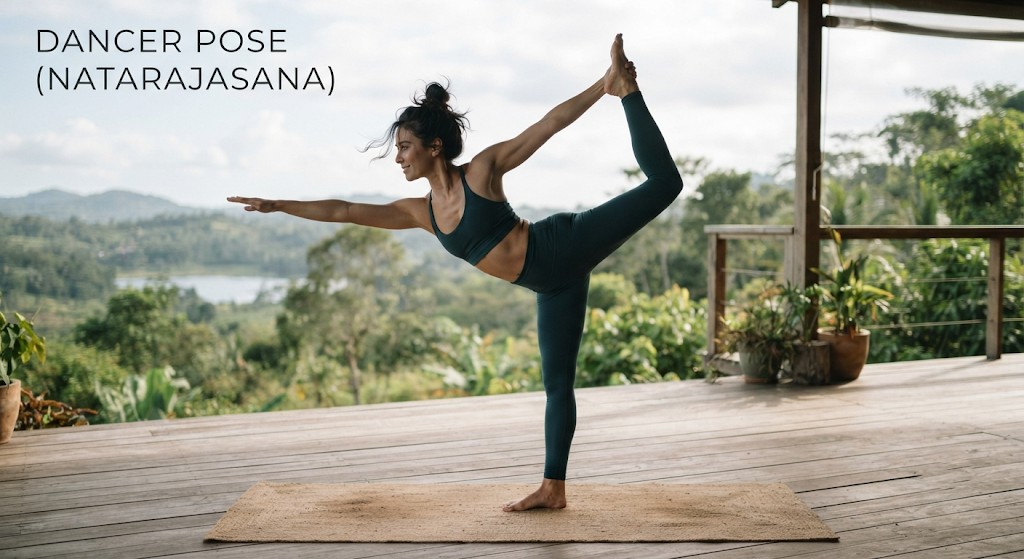
Dancer pose looks graceful, but it asks a lot of your body at once. You need a steady standing leg, an open chest, and a flexible front body. This guide shows you how to do dancer pose yoga step by step, which muscles it works, how to modify it, and how to keep it safe.
What is dancer pose yoga?
Dancer pose yoga, called Natarajasana in Sanskrit, is a standing balance that pairs a backbend with a one-legged stance. The name comes from “nata” (dancer) and “raja” (king), and the pose honors Shiva as Nataraja, Lord of the Dance. (Source: Yoga Journal)
Quick facts:
- Also known as Lord of the Dance pose and King Dancer pose
- Pose type: standing balance and backbend
- Usually taught at an intermediate level
- Helpful props: a strap, a wall, or a chair
If balancing on one leg still feels shaky, build confidence first with a simpler standing pose.
Why does dancer pose matter?
Dancer pose matters because it trains single-leg balance, leg strength, and mobility in the hips and chest in one position. It also asks for steady attention, since a wandering mind tends to topple you.
What you get from regular practice:
- A stronger standing leg and more stable ankle
- A deeper stretch through the front of the thigh and hip
- An open chest and shoulders, which helps if you sit for long hours
- Better focus, because the pose rewards a calm gaze and slow breathing
Harvard Health notes that yoga is widely seen as a way to build strength and flexibility, though research is still unclear on which styles work best. (Source: Harvard Health Publishing) harvard
What the research says
No study I found tests dancer pose by itself. The evidence below covers yoga in general, so treat it as a broad signal.
- A review of six trials in adults aged 60 and over found a small improvement in balance and a medium improvement in mobility. (Source: Youkhana et al., 2016)
- An earlier review of healthy people found that yoga may help balance, but study design and reporting quality varied a lot. (Source: Jeter et al., 2014)
- The National Center for Complementary and Integrative Health lists balance among the possible benefits of yoga. (Source: NCCIH)
yoga for balance and stability
Which muscles does dancer pose work?
Dancer pose strengthens the standing leg and core while stretching the lifted leg, chest, and shoulders. Here is how the work is split.
| Body area | What it does in the pose |
|---|---|
| Standing leg (quadriceps, glutes, calves) | Holds your weight and keeps you upright |
| Ankle stabilizers | Make constant small corrections to keep you steady |
| Core and lower back | Keep the ribs and hips from twisting |
| Lifted leg (glutes and hamstrings) | Press the foot back into your hand |
| Front of the lifted thigh and hip flexors | Lengthen as you hold the stretch |
| Chest and shoulders | Open as you lift your chest |
Tight hip flexors are a common reason the lifted leg won’t rise. A few minutes of targeted stretching beforehand can help.
A strong core also keeps your lower back from doing all the bending.
Poses that prepare you for dancer pose
The best prep poses open the hips, quads, and chest while building single-leg balance. Yoga Journal suggests placing dancer pose near the end of the standing part of your practice, after you have spent time opening the heart, hips, and legs. (Source: Yoga Journal)
Good warm-ups:
- Mountain pose, to set your alignment
- Low lunge, to open the hip flexors
- Standing quad stretch, to loosen the front of the thigh
- Tree pose, to practice balancing on one leg
- Warrior III, to build strength in the standing leg
Puppy pose yoga (Uttana Shishosana)
How to do dancer pose step by step
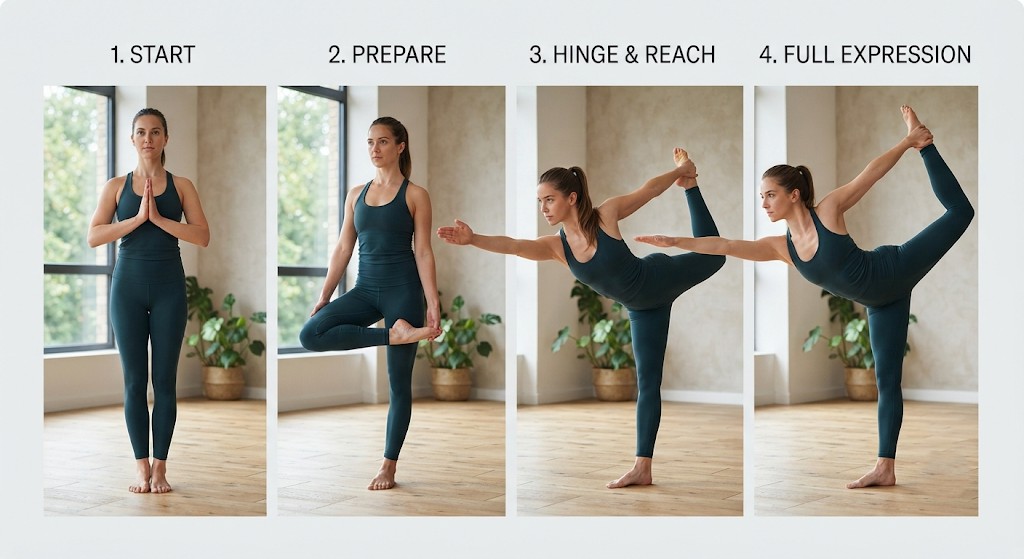
To do dancer pose, stand on one leg, hold the opposite foot behind you, and kick that foot back into your hand as you lift your chest. Go slowly and keep a wall or chair within reach while you learn.
- Stand tall in mountain pose with your feet hip-width apart and your weight even.
- Shift your weight onto your left foot and press the whole foot into the mat. Keep a soft bend in the knee so you don’t lock it.
- Pick a fixed spot at eye level and rest your gaze there.
- Bend your right knee and bring your heel toward your glute.
- Hold the inside of your right foot or ankle with your right hand.
- Keep your knees close together and your hips level, with the tailbone drawing gently down.
- Reach your left arm forward and lift your chest.
- Kick your right foot back into your hand while you hinge forward slightly from the hips.
- Hold for about 5 slow breaths without holding your breath.
- Release the foot with control, return to mountain pose, and repeat on the other side.
Common mistakes to avoid
- Twisting toward the lifted leg. Many people rotate the body toward the side of the lifted leg, which can hurt balance and strain the lower back, knees, or hips. Keep both hip bones facing forward.
- Letting the lifted knee drift far out to the side
- Locking the standing knee
- Dropping the chest and cranking the foot up with your lower back
- Holding your breath, which makes the pose tense and shaky
- Looking around the room instead of fixing your gaze
Dancer pose variations and modifications
Dancer pose has easier and harder versions, so you can pick the one that matches your balance and flexibility today.
| Variation | How it changes the pose | Best for |
|---|---|---|
| With a wall | Rest your free hand on a wall | Beginners learning balance |
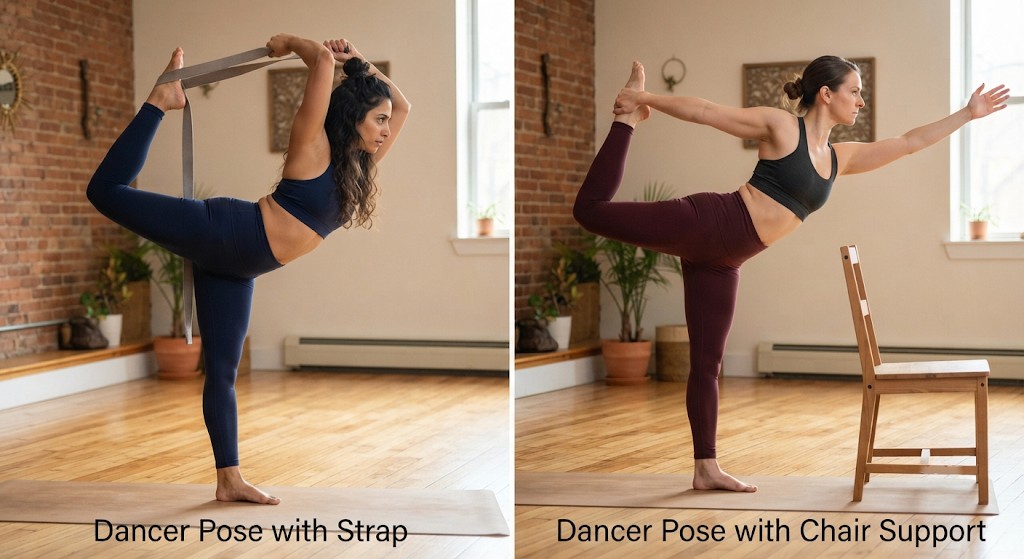
| With a chair | Hold a chair back with your front hand | Beginners or anyone who needs more support |
| With a strap | Loop a strap around the lifted foot and hold it | Tight quads or shoulders |
| Standard pose | Hold the foot, hinge forward, reach the front arm | Most regular practitioners |
| Prone dancer pose | Lie on your stomach and reach back for the foot | A backbend without the balance challenge |
| Deeper version | Use both hands on the foot and bend further | Experienced practitioners with plenty of mobility |
A strap lets you reach the foot without straining your shoulder or lower back, so it is worth owning one.
Flexibility improves slowly, so aim for steady progress over a few weeks rather than a deeper pose today.
Firefly pose yoga (Tittibhasana)
Is dancer pose safe? Precautions to know
Dancer pose is a deep backbend done on one leg, so it calls for care if you have ankle, knee, shoulder, or back problems.
- Skip or modify the pose if you have ongoing ankle or lower back pain, or if you are recovering from a shoulder, knee, or back injury.
- Go slowly if you have low blood pressure or feel dizzy easily, and check with a doctor if you’re unsure.
- Practice near a wall on a non-slip mat.
- Feel a stretch, not sharp pain. Come out of the pose if pain appears.
- Talk to a doctor before starting a new exercise routine if you have a health condition.
How long and how often should you practice?
Hold dancer pose for about 5 slow breaths per side, and build up gradually as your balance improves. Two or three practices a week, placed late in a standing sequence, is a reasonable starting rhythm. Follow it with some gentle stretching to settle the legs and back.
post-workout stretching routine
Pigeon pose yoga (Eka Pada Rajakapotasana)
Conclusion
Dancer pose yoga rewards patience. Start with a wall or chair, keep your hips square, and let the chest lift before you chase a deeper kick. The research on yoga points to modest balance gains, and this pose gives you a clear way to practice that skill. This week, try a few breaths on each side after your usual warm-up and see how steady you feel.
FAQs
Is dancer pose hard for beginners?
Yes, it can be, because it combines a one-legged balance with a backbend. Using a wall, chair, or strap makes it much more approachable.
What does Natarajasana mean?
Natarajasana means Lord of the Dance pose. “Nata” means dancer, “raja” means king, and “asana” means pose.
How long should I hold dancer pose?
About 5 slow breaths per side is a good starting point. Increase the time only when you feel steady and pain free.
How can I make dancer pose easier?
Rest a hand on a wall or chair, or loop a strap around your foot. Keep the kick gentle until your hips and quads loosen up.
Does dancer pose help with balance?
It may, since it trains single-leg stability. Research on yoga in general shows small balance improvements, but no study has tested this pose alone.
Can dancer pose hurt my back?
It can if you crank the foot up with your lower back or twist your hips. Lift the chest, keep the hips level, and back off if you feel pain.
Sources
- Youkhana, S., et al. (2016). Yoga-based exercise improves balance and mobility in people aged 60 and over: a systematic review and meta-analysis. Age and Ageing.
- Jeter, et al. (2014). A systematic review of yoga for balance in a healthy population. Journal of Alternative and Complementary Medicine.
- National Center for Complementary and Integrative Health. Yoga: Effectiveness and Safety.
- Harvard Health Publishing. Yoga offers range of health benefits.
- Yoga Journal. Lord of the Dance Pose.
Disclaimer: This article is for informational and educational purposes only and is not a substitute for personalized medical advice. Consult a qualified healthcare professional before making significant changes to your diet, exercise routine, or supplement use.