
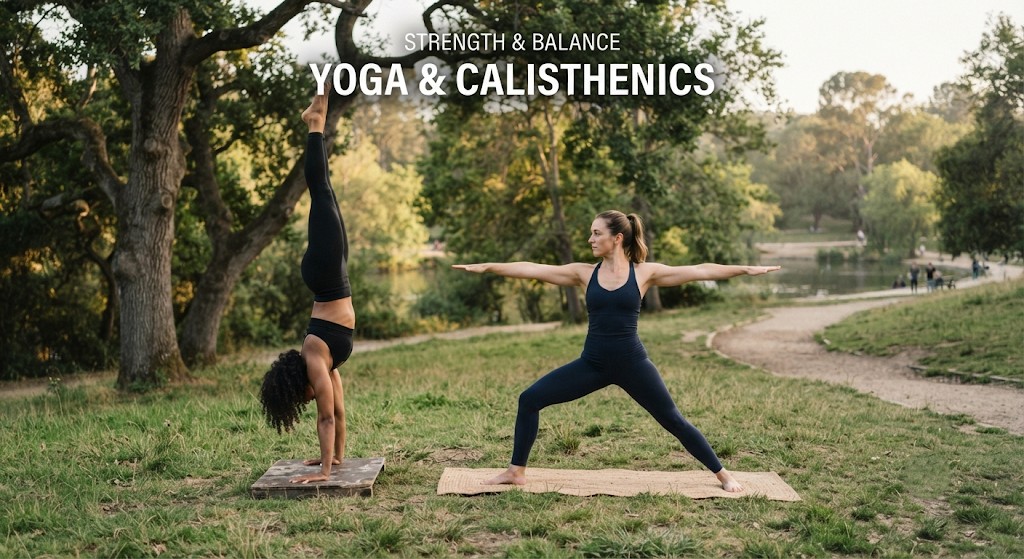
Yoga and calisthenics suit each other because calisthenics builds strength with your body weight, while yoga adds mobility, balance, and breath control. Each one leaves gaps when used alone, and combining them closes most of those gaps without any equipment. This guide compares the two, shows which moves pair well, and gives you a workout and a weekly plan to follow.
What are yoga and calisthenics?
Yoga is a mind-and-body practice that typically combines physical postures, breathing techniques, and meditation (Source: NCCIH), while calisthenics is strength training that uses your own body weight as resistance for full-body exercises (Source: Harvard Health Publishing). Both can be scaled from easy to hard, and both need very little gear.
- Yoga uses postures, breathing, and meditation, and styles range from gentle to physically demanding.
- Calisthenics uses push-ups, squats, lunges, planks, and similar moves that you make harder through progressions.
- Both can be done at home with a mat and a little floor space.
If you are new to either one, start with our calisthenics for beginners or our Iyengar Yoga for Beginners.
Why does combining yoga and calisthenics matter?
Combining them matters because each covers what the other leaves out. Adults are advised to get 150 minutes of moderate aerobic activity a week plus muscle-strengthening activity on 2 days that works all major muscle groups (Source: CDC). Calisthenics fits that strengthening goal naturally, and fitness experts regard it as an effective way to improve strength, endurance, flexibility, and coordination (Source: Harvard Health Publishing).
What the research says:
- In a 4-week trial of 23 men, progressive push-up training was compared with bench press training, and the results suggest push-up variations can improve upper-body strength (Source: Kotarsky et al., 2018).
- A 2021 meta-analysis of studies in older adults found moderate positive effects of yoga on muscle strength, balance, mobility, and lower-body flexibility (Source: Shin, 2021).
- The same analysis found small or no effects on cardiorespiratory endurance and upper-body flexibility (Source: Shin, 2021).
These studies examine each practice separately, and they are small or limited to specific groups. The benefits of combining the two are a reasonable inference, not a proven result. Because neither one reliably covers aerobic fitness, add brisk walking or similar activity to your week.
How do yoga and calisthenics compare?
Calisthenics focuses on strength and muscular endurance, while yoga focuses on mobility, balance, and body awareness, so the two work as complements.
| Feature | Yoga | Calisthenics |
|---|---|---|
| Main focus | Mobility, balance, breath control | Strength and muscular endurance |
| Equipment | Mat, optional blocks | None, optional bar or rings |
| Strength | Moderate, mostly from holds | Primary goal, progressed with harder variations |
| Flexibility and mobility | Primary goal | Improves with full range of motion |
| Cardio | Typically lower, higher in flowing styles | Higher when done as circuits |
| Mental focus | Breathing and mindfulness built in | Attention on form and effort |
| Watch points | Overstretching, wrists, shoulders | Joint overload, too much too soon |
What are the benefits of combining yoga and calisthenics?
The main benefit is balanced fitness, with strength from calisthenics and mobility from yoga working together.
- Better range of motion for deep squats and overhead positions, helped by regular Hip Opening Yoga.
- More balance and control from yoga holds and single-leg calisthenics.
- Built-in lighter days, since gentle yoga keeps you moving between harder strength sessions.
- Low cost and easy setup, which makes bodyweight workouts at home easier to keep up.
Which yoga poses pair best with calisthenics exercises?
The best pairings match a calisthenics exercise with a yoga pose that opens or supports the same area.
| Calisthenics exercise | Yoga pose to pair | Why it helps |
|---|---|---|
| Push-ups | Downward dog | Gets shoulders and wrists used to supporting body weight |
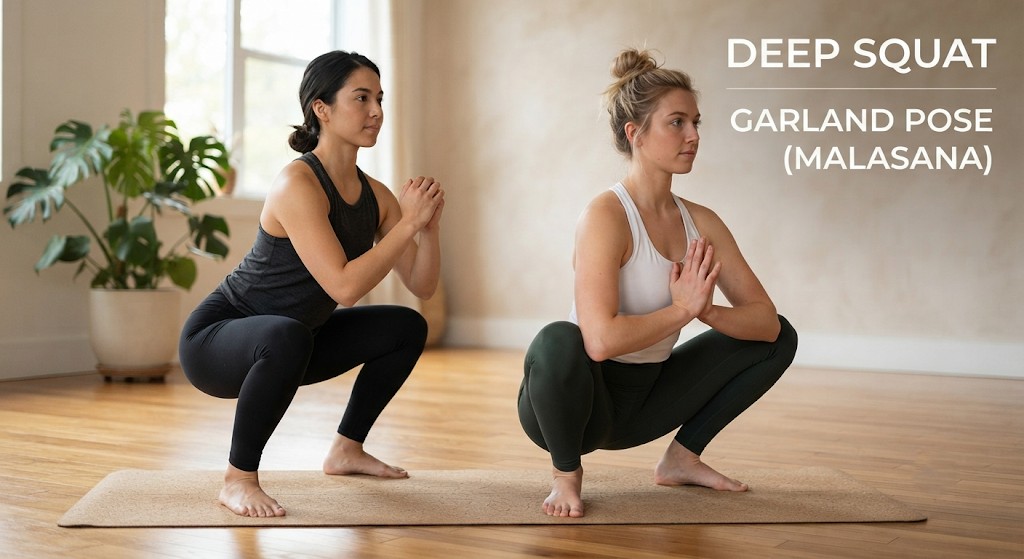
| Bodyweight squats | Garland pose (Malasana) | Opens the hips and ankles for deeper squats |
| Rows and pull-ups | Child’s pose with arms extended | Releases the upper back and sides |
| Planks | Cobra pose | Stretches the front of the body after core work |
| Lunges | Low lunge | Opens the hip flexors |
| Hollow holds | Boat pose | Trains the same core strength with a yoga cue |
For the first pair, read our guide to downward dog yoga, and use Deficit Push-Up to progress the strength side. Core work gets easier with a few core strengthening exercises.
What does a beginner yoga and calisthenics workout look like?
A beginner yoga and calisthenics workout takes about 35 minutes and moves from a warm-up to a strength circuit and then a short yoga flow.
- Warm-up, 5 minutes: cat-cow, hip circles, arm circles, and marching in place, or follow a set of warm-up exercises before a workout.
- Strength circuit, 15 minutes, 3 rounds: 6 to 10 push-ups (incline if needed), 10 to 15 bodyweight squats, 6 to 8 reverse lunges per leg, and a 20 to 30 second forearm plank. Rest 60 seconds between rounds, and see Goblet Squat Exercise to change the difficulty.
- Yoga flow, 10 minutes: downward dog, low lunge on each side, Warrior II on each side, garland pose, and a reclined twist, holding each for about 5 breaths.
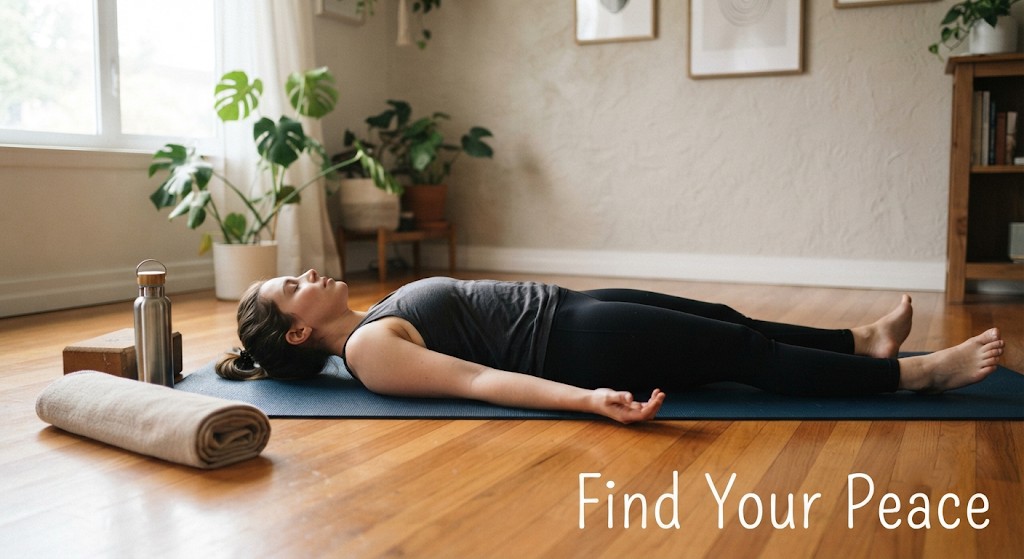
- Cool-down, 3 to 5 minutes: child’s pose, then a short rest on your back.
Harvard Health Publishing advises building up gradually, focusing on form, and leaving a slight bend in your knees and elbows instead of locking them (Source: Harvard Health Publishing). The push-up trial above used progressively harder variations over four weeks, which is a useful model: move from incline to standard push-ups before adding many extra reps (Source: Kotarsky et al., 2018).
How should you schedule yoga and calisthenics each week?
A simple weekly schedule uses two calisthenics days, two yoga days, and lighter aerobic activity on the days in between.
| Day | Session |
|---|---|
| Monday | Calisthenics circuit, 30 to 40 minutes |
| Tuesday | Yoga flow for hips and shoulders, 20 to 30 minutes |
| Wednesday | Brisk walk or easy cardio, 30 to 45 minutes |
| Thursday | Calisthenics circuit, 30 to 40 minutes |
| Friday | Gentle or restorative yoga, 20 to 30 minutes |
| Saturday | Longer walk or active play, 45 to 60 minutes |
| Sunday | Rest or light stretching |
This schedule meets the 2 days of muscle strengthening in the CDC guideline, and you can build the aerobic days toward 150 minutes a week over time (Source: CDC). The American College of Sports Medicine, as cited by Harvard Health Publishing, recommends only two or three complete strength workouts a week, with a day off in between (Source: Harvard Health Publishing). For a ready-made structure, see our stretching routine for recovery on rest days.
What mistakes should you avoid?
The most common mistake is doing too much too soon, which Harvard Health Publishing links to injuries (Source: Harvard Health Publishing). Other errors to watch for:
- Locking your knees or elbows at the top of push-ups, squats, and balance poses.
- Stretching deeply before you have warmed up.
- Skipping pulling exercises, since many bodyweight moves are push- and leg-dominant.
- Forcing yoga poses to chase flexibility, which should never feel painful.
- Training the same muscles hard on back-to-back days.
- Rushing reps and letting form slip.
Is combining yoga and calisthenics safe, and who should check first?
Combining them is low risk for most healthy adults, but anyone with an injury, a joint or health condition, or a pregnancy should talk with a healthcare provider first. NCCIH advises practicing yoga with a qualified instructor to reduce injury risk, since learning it without supervision has been linked with higher risk (Source: NCCIH). It also notes that yoga can be safe during pregnancy with precautions, once a healthcare provider confirms exercise is safe for you (Source: NCCIH).
- Stop if you feel sharp pain, numbness, or dizziness.
- Take rest days seriously, especially after hard calisthenics sessions.
- Scale moves down first, for example incline push-ups or bent-knee downward dog.
Conclusion
Yoga and calisthenics work best together when you train strength on two days, keep yoga on the days between, and add easy aerobic activity around them.
- Start with the 35-minute workout once or twice this week.
- Progress by moving to harder variations before adding many reps.
- Build toward 150 minutes of moderate activity across the week.
If your main goal is more mobility, continue with our yoga for flexibility.
FAQs
Can you do yoga and calisthenics on the same day?
Yes, and a common approach is to do the strength circuit first and finish with a gentle yoga flow. Warm up first either way.
Is yoga or calisthenics better for building muscle?
Calisthenics is better suited to building strength because you can progress to harder variations, while yoga builds strength mostly through holding poses. Both can raise muscular fitness in beginners.
How often should you do yoga and calisthenics?
Do calisthenics on 2 or 3 non-consecutive days a week and add yoga on 2 other days. The CDC advises muscle strengthening on at least 2 days a week for adults.
Do you need equipment for yoga and calisthenics?
No, you can start with only floor space. A mat adds comfort, and a sturdy bar or rings help later with pulling exercises.
Can beginners combine yoga and calisthenics?
Yes, with easier versions such as incline push-ups, shorter holds, and bent knees in downward dog. Start with one calisthenics day and one yoga day.
Will yoga and calisthenics help you lose weight?
They can be part of a weight-management plan, but neither guarantees weight loss. NCCIH notes that most of the yoga-based weight-control programs in one review led to gradual, moderate weight reductions.
Sources
- Centers for Disease Control and Prevention. (n.d.). Adult Activity: An Overview.
- Harvard Health Publishing. (n.d.). Calisthenics: An effective, low-frills way to stay fit.
- Kotarsky, C. J., Christensen, B. K., Miller, J. S., & Hackney, K. J. (2018). Effect of progressive calisthenic push-up training on muscle strength and thickness. Journal of Strength and Conditioning Research.
- Shin, S. (2021). Meta-analysis of the effect of yoga practice on physical fitness in the elderly. International Journal of Environmental Research and Public Health.
- National Center for Complementary and Integrative Health. (n.d.). Yoga: Effectiveness and Safety.
- National Center for Complementary and Integrative Health. (n.d.). 5 Things You Should Know About Yoga.
Disclaimer: This article is for informational and educational purposes only and is not a substitute for personalized medical advice. Consult a qualified healthcare professional before making significant changes to your diet, exercise routine, or supplement use.