
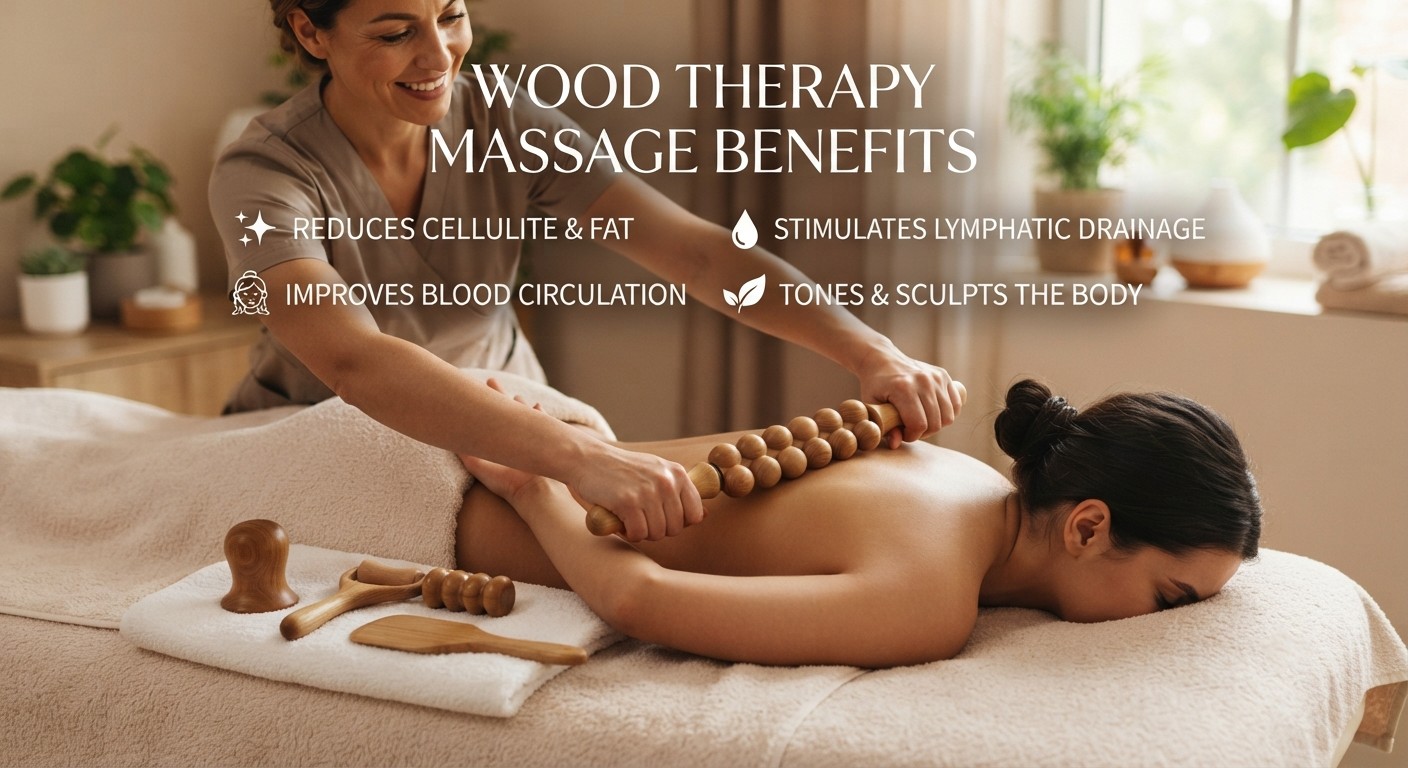
Wood therapy massage uses wooden tools to roll and press the body, and people book it hoping for relaxation, smoother skin, and a slimmer look. Some of those hopes have reasonable support, while others rest mostly on spa marketing. This guide sorts the wood therapy massage benefits by how well the evidence holds up, so you know what to expect before you book.
What are the benefits of wood therapy massage?
The benefits people report from wood therapy massage are mainly relaxation, relief from muscle tension, and a temporary smoothing of the skin. Wood therapy, also called maderotherapy, is a technique in which a practitioner uses rollers, paddles, and cup-shaped wooden tools to apply firm pressure to soft tissue.
Most of what is known about massage benefits comes from research on hands-on massage in general. Wood therapy itself has been studied far less, so many claims are plausible but unproven.
- Best supported: relaxation and general massage comfort
- Possible but modest: temporary skin smoothing and less puffiness
- Weakly supported or unproven: lymphatic drainage, cellulite removal, and fat loss
Why do wood therapy massage benefits matter?
They matter because the treatment is often sold as a body contouring solution, and separating realistic gains from exaggerated ones helps you decide whether it is worth your time and money.
- Much of the public information comes from providers who sell the service.
- Firm tool-based pressure carries more bruising risk than a light massage.
- Knowing the likely payoff helps you set a fair expectation, such as a relaxing session instead of a lasting body change.
If recovery is your main goal, wood therapy is one option among several. muscle recovery tip
Which wood therapy massage benefits are realistic?
Relaxation, muscle tension relief, and brief skin smoothing are the most realistic benefits, because they match what massage tends to do in general.
Relaxation and stress relief
Massage is widely used to promote relaxation (Source: Mayo Clinic). A slow, firm session in a quiet room can leave you calmer, whatever tool is used.
If you enjoy that effect, a movement practice can extend it at home. yoga for stress relief
Muscle tension and soreness
Firm pressure may ease tight, sore muscles for a while. A review summarized by the Department of Veterans Affairs concluded that massage should be strongly recommended for pain management compared with no treatment (Source: VA Whole Health Library). That finding covers massage broadly, and it is unknown whether wooden tools do anything extra compared with hands.
For sore muscles between sessions, you have other choices.
- Foam rollers cost less and are easy to use alone. foam rolling for sore muscles
- Massage guns give targeted pressure at home. massage guns for muscle recovery
Temporary skin smoothing and less puffiness
Some people notice smoother-looking skin and less puffiness right after a session, likely because firm strokes move fluid around. Researchers describe the improvements in cellulite appearance from massage as short lived (Source: Bass and Kaminer, 2020). Think of it as a short-term cosmetic effect.
Which wood therapy massage benefits lack evidence?
Lymphatic drainage, cellulite removal, and fat loss are the claims with the weakest support, because trials on wood therapy for these outcomes are scarce or missing.
| Claimed benefit | Evidence status |
|---|---|
| Relaxation | Reasonable, based on massage in general |
| Muscle tension relief | Plausible, with no clear advantage shown over hands |
| Less puffiness | Possible short-term effect, not well tested |
| Lymphatic drainage | Common marketing claim, little research on wooden tools |
| Cellulite reduction | No clear evidence of a lasting effect |
| Fat loss | No reliable evidence |
On cellulite specifically, a systematic review of 67 studies found no clear evidence of good efficacy for any evaluated treatment (Source: Luebberding et al., 2015). The same review notes that cellulite affects an estimated 80 to 90 percent of women after puberty, so it is a very common trait. Researchers also describe fibrous bands under the skin as central to cellulite (Source: Bass and Kaminer, 2020), and a tool working from the surface may not change them.
Habits tend to shape body composition more than any single treatment. Strength work for the lower body is a sensible place to start. leg workouts for toned thighs To track changes over time, you can estimate body composition instead of relying on the mirror. Free Ideal Body Weight Calculator
How does wood therapy compare with other massage options?
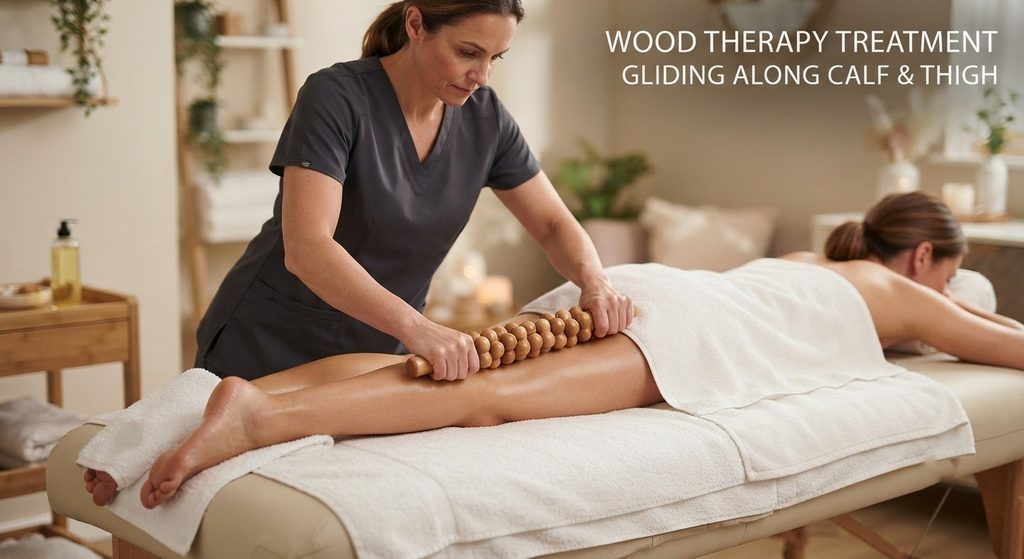
Wood therapy applies firmer, more targeted pressure than a relaxation massage, but it has no proven edge over hands-on massage or at-home tools.
| Option | Pressure | Who applies it | Best suited for |
|---|---|---|---|
| Wood therapy | Firm | Practitioner with wooden tools | Trying a firm, contouring-style massage |
| Swedish or relaxation massage | Light to moderate | Practitioner with hands | General relaxation |
| Foam roller | Adjustable | You | Post-workout tightness |
| Massage gun | Adjustable | You | Targeted muscle soreness |
Do the risks cancel out the benefits?
For most healthy adults they do not, because the risk of harm from massage appears to be low (Source: NCCIH). The main trade-off is that firm pressure can cause soreness and bruising, and massage can lead to bruising and bleeding in people who are at risk (Source: Merck Manual, 2025).
Talk to a healthcare provider first if any of these apply to you.
- A bleeding or clotting disorder
- An aneurysm or internal bleeding (Source: Mayo Clinic)
- Pregnancy or cancer treatment
- Broken or irritated skin
- A recent injury or surgery
How can you get the most from a session?
You get the most from a session by choosing a trained practitioner and communicating clearly about pressure and goals. A few steps help.
- Check the practitioner’s massage training and their experience with wood therapy.
- Share your health history and any medications before the session starts.
- Speak up if the pressure feels sharp instead of firm.
- Drink water afterward.
- Add light movement the same day. Assisted Stretching Benefits
- Support recovery with enough protein and sleep. high-protein foods
Conclusion
The best supported wood therapy massage benefits are relaxation, short-term muscle relief, and a brief smoothing of the skin. Claims about lasting cellulite reduction, lymphatic drainage, or fat loss lack solid evidence. If you decide to try it, pick a trained practitioner, share your health history, and treat the session as a comfortable extra on top of regular training, nutrition, and recovery.
FAQs
What are the main benefits of wood therapy massage?
The main benefits are relaxation, relief from muscle tension, and a temporary smoothing of the skin. These match what massage tends to do in general, and wood therapy itself has been studied far less.
Does wood therapy massage really reduce cellulite?
There is no clear evidence that it reduces cellulite for good. Any smoothing is thought to be short lived (Source: Bass and Kaminer, 2020).
Does wood therapy massage help you lose weight?
No reliable evidence shows that it causes fat loss. Weight and body composition depend mostly on eating, activity, and sleep habits.
Can wood therapy massage improve lymphatic drainage?
Providers often claim so, but research on wooden tools for lymphatic drainage is lacking. Firm strokes may shift fluid temporarily, which could explain reduced puffiness after a session.
Is wood therapy massage better than regular massage?
There is no evidence that it is better. It uses firmer, more targeted pressure, while a relaxation massage may suit you more if comfort is your main goal.
Does wood therapy massage cause bruising?
It can, because the technique relies on firm pressure. People with bleeding or clotting problems are at higher risk and should talk to a doctor first.
How soon will I notice wood therapy massage benefits?
Relaxation and slight skin smoothing may show up right after a session. No research-based timeline exists for longer-term changes.
Sources
- Luebberding, S., et al. (2015). Cellulite: An Evidence-Based Review. American Journal of Clinical Dermatology.
- Bass, L. S., & Kaminer, M. S. (2020). Insights Into the Pathophysiology of Cellulite: A Review. Dermatologic Surgery.
- National Center for Complementary and Integrative Health. (n.d.). Massage Therapy for Health: What the Science Says.
- Singla, A. (2025). Massage Therapy. Merck Manual Consumer Version.
- Mayo Clinic. (n.d.). Medical-Based Massage Therapy.
- U.S. Department of Veterans Affairs. (n.d.). Massage Therapy. Whole Health Library.
Disclaimer: This article is for informational and educational purposes only and is not a substitute for personalized medical advice. Consult a qualified healthcare professional before making significant changes to your diet, exercise routine, or supplement use.