
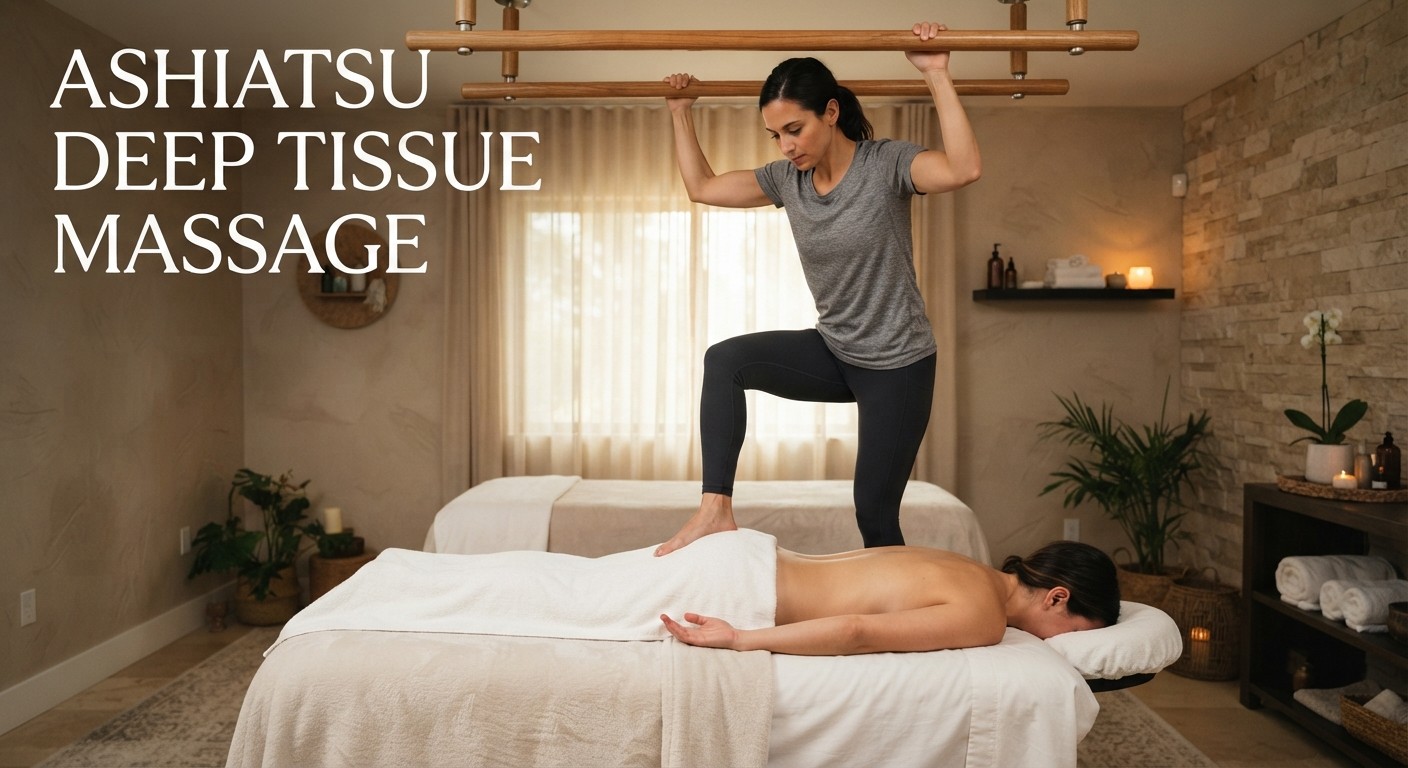
Ashiatsu massage therapists are licensed massage professionals who add barefoot technique to their work, using their feet and body weight to deliver broad, deep pressure. Whether you want to book a session or add the skill to your own practice, the same questions come up: what training makes someone qualified, and what should you check first? This guide covers what these therapists do, how to find a good one, and how to become one.
What is an ashiatsu massage therapist?
An ashiatsu massage therapist is a massage professional who applies pressure with their feet instead of their hands, usually while holding overhead bars for balance. (Source: Massage Magazine)
In most cases, ashiatsu is a skill added on top of a standard massage license, not a separate license. Training providers typically ask for a massage license, or for students to be close to finishing massage school.
- The therapist stands on or beside the table and grips ceiling-mounted bars to control pressure and balance. (Source: Massage Magazine)
- Strokes borrow from Swedish and deep tissue work, including effleurage, petrissage, friction, and deep compressions. (Source: Massage Magazine)
- Feet stay off the abdomen, face, scalp, and front of the neck. Therapists use their hands in those areas. (Source: Massage Magazine)
- Bar-free versions exist. Beginners can start with stool-based techniques for the upper back, shoulders, and neck. (Source: Massage Magazine)
Why do ashiatsu massage therapists matter?
Ashiatsu massage therapists matter because they offer clients broad, deep pressure and give therapists a way to work with less strain on their hands.
Clients who want firm work often seek them out. Athletes and active people are a common example. (Source: AMTA)
For therapists, the draw is physical sustainability. A Canadian survey of registered massage therapists found a high prevalence of pain and discomfort in the low back, shoulders, neck, wrists, and thumbs. (Source: Journal of Bodywork and Movement Therapies, 2008)
- One ashiatsu therapist quoted by AMTA says the technique wears on the body less than deep tissue and Swedish massage, so energy stays steady from the first client to the last. (Source: AMTA)
- The U.S. Bureau of Labor Statistics notes that many therapists can’t give massages 8 hours a day, 5 days a week because of the strength and endurance required. (Source: BLS)
- These are practitioner reports. Controlled research on whether ashiatsu lowers injury rates appears limited.
Clients who train hard often pair sessions with Ashiatsu Massage. Some also compare ashiatsu with sports massage for recovery.
What does an ashiatsu massage therapist do in a session?
In a session, an ashiatsu therapist screens your health history, then uses body weight and overhead bars to glide along large muscles while adjusting pressure to your feedback.
- The therapist asks about your health history, painful areas, and goals. Because the pressure is intense, a thorough intake matters. (Source: AMTA)
- You lie on a table, and the therapist sets up the bars and positioning.
- Long, slow strokes cover large muscle groups, most often the back and glutes.
- The therapist adjusts pressure as you report what feels too light, too firm, or sharp.
- Hands take over for areas where feet are not used.
The table below shows how an ashiatsu therapist differs from a standard hands-on therapist.
| Comparison | Ashiatsu therapist | Standard hands-on therapist |
|---|---|---|
| Main tools | Feet and body weight, plus hands for some areas | Hands, forearms, and elbows |
| Setup | Overhead bars, or a bar-free seated variation | Massage table |
| Extra training | Ashiatsu course on top of a license | License and any other modalities |
| Pressure feel | Broad, as the foot conforms to the muscle (Source: AMTA) | Can be focused on one spot |
How do you find a qualified ashiatsu massage therapist?
Start with a licensed massage therapist who has specific ashiatsu training, then confirm their background with a few direct questions.
Most states regulate massage therapy and require a license or certification, so check your state board’s website to verify a license. (Source: BLS) A referral from a friend who has had a good experience is another common starting point. (Source: University of Minnesota Taking Charge)
- Ask where they trained in ashiatsu and whether they hold a certification from that course.
- Ask how they screen for contraindications before the first session.
- Ask which style and techniques they use, and whether they work with bars or a bar-free approach.
- Ask about the fee and session length before you book. (Source: University of Minnesota Taking Charge)
- Describe your goals or problem areas and ask whether they can help.
Pay attention to the first visit. A therapist who skips the health history, ignores your feedback on pressure, or can’t explain their training is not a good fit.
If you are working through back stiffness between sessions, yoga for lower back pain and back workouts can support what the massage starts.
Who should avoid seeing an ashiatsu massage therapist?
People with certain conditions should skip ashiatsu or get medical clearance first, because the technique uses deep compression from body weight.
One ashiatsu instructor told AMTA that there are many contraindications and precautions, which is why a thorough intake comes before the first session. (Source: AMTA) Practitioners commonly list:
- Pregnancy
- Osteoporosis
- A rib fracture or recent surgery
- Fever or infection
- Open wounds or active skin problems
- A history of heart conditions
Tell your therapist about every injury, medication, and diagnosis, and check with your doctor if you are unsure.
How do you become an ashiatsu massage therapist?
You become an ashiatsu massage therapist by first earning a massage license, then completing ashiatsu training from an approved provider.
- Complete an approved massage program. Minimum education hours vary by state. For example, the Federation of State Massage Therapy Boards lists 650 hours for Alabama and 625 for Alaska. (Source: FSMTB)
- Pass your state’s required exam. Many states accept the MBLEx. (Source: FSMTB)
- Meet other state requirements. These may include a background check, liability insurance, and CPR certification. (Source: BLS)
- Take an ashiatsu course. One provider advertises a three-day fundamentals class that covers body mechanics, bar construction, contraindications, draping, and foot care.
- Confirm continuing education approval. Many ashiatsu courses are approved by the National Certification Board for Therapeutic Massage & Bodywork (NCBTMB), but check that your state board accepts the course.
- Build your setup and practice. Bar construction is part of many courses, and bar-free techniques are an easier first step.
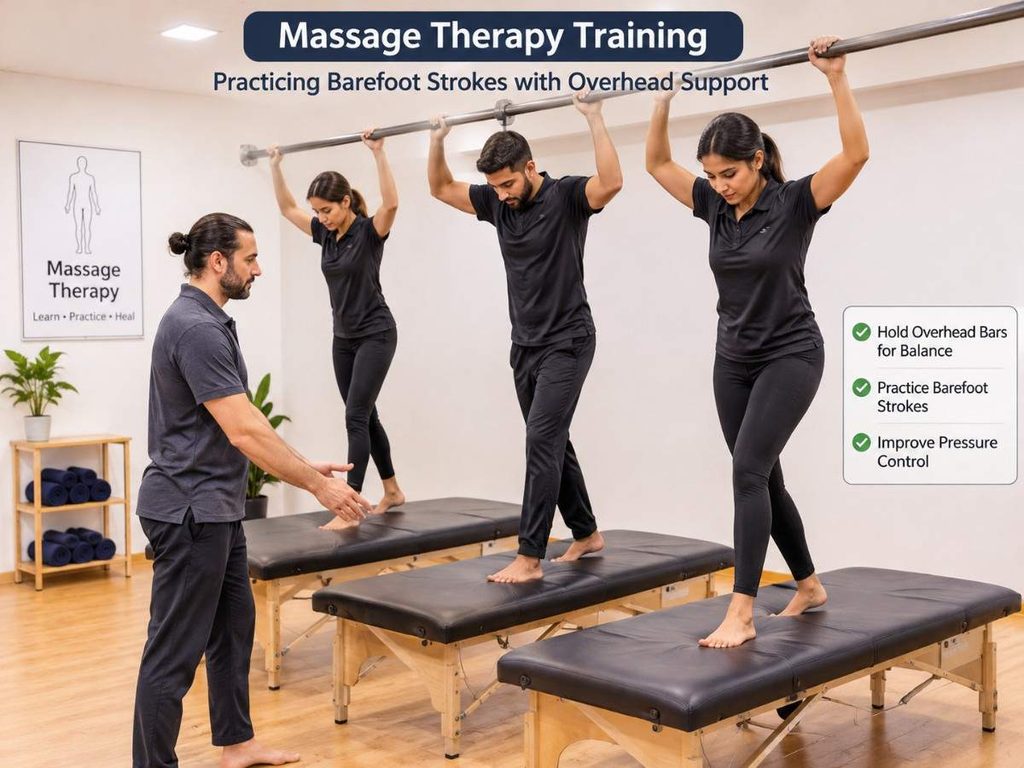
Foot care is part of the job. AMTA recommends monthly pedicures and keeping calluses and toenails trimmed and filed. (Source: AMTA)
The career outlook for massage therapists is positive. BLS projects 15% employment growth from 2025 to 2035, which is much faster than average, with about 20,400 openings per year. Many therapists are self-employed. (Source: BLS)
How do ashiatsu therapists protect their own bodies?
Ashiatsu therapists protect their bodies by pacing sessions, using sound body mechanics, and keeping up their own strength and recovery.
BLS says therapists can limit injury risk by using good body mechanics, spacing sessions properly, exercising, and getting massages themselves. (Source: BLS) The Canadian survey likewise points to proper posture, technique, and a regular self-care routine. (Source: Journal of Bodywork and Movement Therapies, 2008)
- Build grip and forearm endurance with forearm workouts.
- Strengthen your trunk for balance on the table with core stability exercises.
- Release tight feet, calves, and hips with foam rolling.
- Schedule active recovery on lighter days
- Protect your rest with sleep and muscle recovery.
- Keep joints moving with mobility exercises and a Post Workout Stretching Routine.
Conclusion
Ashiatsu massage therapists are licensed professionals with extra training in foot-based technique, and the best ones screen carefully before applying deep pressure. Clients should verify the license, ask about ashiatsu training, and share their full health history. Therapists who want to learn the technique should finish their licensing first, pick an approved course, and plan for their own physical upkeep.
FAQs
Do ashiatsu massage therapists need a license?
Yes, in most places. Most states regulate massage therapy and require a license or certification, and ashiatsu training is typically added on top of it.
How long does it take to learn ashiatsu?
Introductory courses are often about three days, but building confidence with the technique takes practice. Bar-free seated techniques can be an easier starting point.
Is ashiatsu certification required?
Certification usually comes from the training provider and is separate from your state license. Check with your state board for any additional requirements.
Can any massage therapist do ashiatsu?
No. It needs specific training, and the deep compression from body weight comes with more precautions than most massage styles.
Do ashiatsu therapists use their hands at all?
Yes. Therapists use their hands for the abdomen, face, scalp, and front of the neck, where feet are not used.
How much does an ashiatsu massage cost?
Cost varies by therapist, location, and setting. Ask for the fee and session length before you book.
Is ashiatsu safe?
It is generally considered safe when a trained therapist screens you first. People with osteoporosis, recent surgery, or other conditions should talk to a doctor before booking.
Sources
- U.S. Bureau of Labor Statistics. (n.d.). Massage Therapists. Occupational Outlook Handbook.
- Federation of State Massage Therapy Boards. (n.d.). Regulated States.
- American Massage Therapy Association. (n.d.). Exploring Japanese Massage Techniques. Massage Therapy Journal.
- Massage Magazine. (n.d.). Ashiatsu Massage: Walk Your Way to a Sustainable Massage Career.
- Journal of Bodywork and Movement Therapies. (2008). A survey of musculoskeletal injuries amongst Canadian massage therapists.
- University of Minnesota Taking Charge. (n.d.). How Can I Find the Right Massage Therapist?
Disclaimer: This article is for informational and educational purposes only and is not a substitute for personalized medical advice. Consult a qualified healthcare professional before making significant changes to your diet, exercise routine, or supplement use.
1 thought on “Ashiatsu Massage Therapists: What They Do and How to Find or Become One”