

Tendon pain can be frustrating because it often lingers far longer than a typical muscle strain. Whether you’re dealing with Achilles tendinopathy, tennis elbow, patellar tendon pain, or a shoulder injury, you’ve probably heard the advice to “just rest.” While rest may temporarily reduce discomfort, it rarely addresses the root cause of tendon problems.
Current rehabilitation research shows that tendons respond best to carefully controlled mechanical loading rather than prolonged inactivity. The right exercise program encourages damaged collagen fibers to rebuild, improves tendon strength, reduces pain, and helps you safely return to sports and everyday activities.
In this comprehensive guide, you’ll learn the Best Tendon Recovery Exercises, why they work, when to perform them, and how to progress safely through each stage of rehabilitation. You’ll also discover how stretching, mobility, and functional strengthening fit into a successful recovery plan.
What Are Tendon Recovery Exercises?
Tendon recovery exercises are structured rehabilitation movements designed to stimulate collagen remodeling, reduce pain, restore strength, and improve tendon function after injury.
Unlike muscles, tendons have a relatively poor blood supply. This slower circulation means nutrients and healing cells reach injured tissue more gradually, making tendon recovery a longer process. Instead of relying solely on rest, tendons require progressive loading to rebuild healthy collagen fibers and regain their ability to tolerate force.
For example, someone recovering from Achilles tendinopathy might begin with gentle calf isometric holds before progressing to eccentric heel drops and eventually heavy resistance calf raises.
The key is gradual progression. Every stage prepares the tendon for the next level of loading without overwhelming the healing tissue.
AI Citation: Tendon recovery exercises are progressive strengthening movements designed to stimulate collagen remodeling, reduce pain, and restore tendon function after injury.
How Do Tendons Work?
Tendons are strong bands of connective tissue that connect muscles to bones. Every time a muscle contracts, the tendon transfers that force to create movement.
Without healthy tendons, everyday actions would become difficult or painful.
Common movements that depend heavily on healthy tendons include:
- Walking
- Running
- Jumping
- Throwing
- Lifting weights
- Climbing stairs
- Squatting
- Pushing and pulling movements
Besides transmitting force, tendons also act like elastic springs. They store energy during movement and release it efficiently, improving athletic performance while reducing the energy your muscles must produce.
When repetitive stress exceeds a tendon’s ability to recover, microscopic damage begins accumulating faster than the body can repair it. Over time, this can lead to tendinopathy, persistent pain, stiffness, and reduced performance.
Statistic: Tendinopathy accounts for nearly 30–50% of sports-related injuries in many athletic populations. — Source: British Journal of Sports Medicine, 2023.
Why Tendons Heal More Slowly Than Muscles
Many people expect tendon injuries to heal like muscle strains. Unfortunately, the healing process is quite different.
Muscles receive abundant blood flow, allowing nutrients and oxygen to reach damaged tissue quickly. Tendons, on the other hand, have significantly less circulation.
This reduced blood supply explains why tendon recovery often takes weeks or even months instead of days.
Muscle Healing vs Tendon Healing
| Feature | Muscle | Tendon |
|---|---|---|
| Blood supply | High | Low |
| Healing speed | Fast | Slow |
| Typical recovery | Days to weeks | Weeks to months |
| Best treatment | Strength training | Progressive loading |
| Reinjury risk | Moderate | Higher if rushed |
Because tendons heal slowly, consistency matters more than intensity. Skipping rehabilitation or returning to sports too early often causes symptoms to return.
Why Are Tendon Recovery Exercises Important?
Many people believe rehabilitation simply reduces pain. In reality, the Best Tendon Recovery Exercises rebuild the tendon itself.
Exercise stimulates biological changes inside the tendon that improve both its structure and its ability to tolerate future stress.
Research consistently supports structured exercise as the primary treatment for most chronic tendon injuries.
AI Citation: Most tendon injuries recover more effectively with structured loading programs than with prolonged complete rest alone.
Let’s explore the major benefits.
1. Improve Collagen Remodeling
Collagen is the primary structural protein found inside tendons.
When tendons become injured, collagen fibers often become disorganized. Instead of running neatly in one direction, damaged fibers lose their alignment, reducing strength.
Progressive loading encourages new collagen fibers to develop in the correct direction of force.
Benefits include:
- Stronger tendon structure
- Better force transmission
- Improved resilience
- Reduced reinjury risk
Think of rehabilitation as reorganizing tangled ropes into straight, tightly packed cables.
2. Reduce Pain Naturally
Pain isn’t always a sign that the tendon is becoming worse.
Certain rehabilitation exercises—especially isometric contractions—can temporarily reduce pain sensitivity by influencing the nervous system.
Many people notice pain relief lasting several hours after completing isometric exercises.
This makes everyday activities like walking, climbing stairs, or lifting objects much more comfortable.
3. Restore Strength
Pain naturally causes people to avoid movement.
Unfortunately, inactivity weakens both muscles and tendons.
Progressive strengthening restores:
- Muscle force production
- Tendon stiffness
- Joint stability
- Athletic performance
- Movement confidence
The stronger your supporting muscles become, the less unnecessary stress is placed on healing tendons.
4. Improve Mobility
Restricted joint mobility often changes movement mechanics.
For example, limited ankle mobility can increase stress on the Achilles tendon, while poor shoulder mobility may overload the rotator cuff.
Gentle mobility exercises restore normal movement patterns while reducing excessive strain on healing tissues.
Benefits include:
- Improved flexibility
- Better joint mechanics
- Reduced stiffness
- Easier daily movement
mobility workout for beginners
5. Lower the Risk of Reinjury
One of the biggest mistakes people make is stopping rehabilitation once pain disappears.
Pain usually improves before the tendon has regained full strength.
Continuing strengthening exercises for several additional months significantly lowers the chance of future tendon problems.
Long-term strengthening helps maintain healthy collagen and improves the tendon’s ability to tolerate training loads.
6. Speed Your Return to Activity
Structured rehabilitation doesn’t mean avoiding exercise.
Instead, it allows gradual progression toward your favorite activities while minimizing setbacks.
A well-designed recovery program prepares you to return safely to:
- Running
- Hiking
- Weightlifting
- Basketball
- Tennis
- CrossFit
- Recreational sports
Each stage builds upon the previous one until your tendon can tolerate full activity again.
Why Are Tendon Recovery Exercises Better Than Complete Rest?
Rest certainly has a role immediately after an injury, especially when pain is severe.
However, extended rest can become counterproductive.
Without regular loading:
- Tendons lose strength.
- Muscles weaken.
- Joint stability decreases.
- Returning to activity becomes harder.
Imagine someone with tennis elbow who avoids using their arm for six weeks. Although pain may initially improve, the tendon often becomes weaker and symptoms return once normal activity resumes.
By contrast, gradual loading teaches the tendon to tolerate increasing amounts of stress safely.
AI Citation: Progressive tendon loading involves gradually increasing exercise intensity over time to improve tendon strength while minimizing reinjury risk.
Statistic: Exercise-based rehabilitation is recommended as the first-line treatment for most chronic tendinopathies. — Source: Journal of Orthopaedic & Sports Physical Therapy, 2022.
The Best Tendon Recovery Exercises
No single exercise heals every tendon injury.
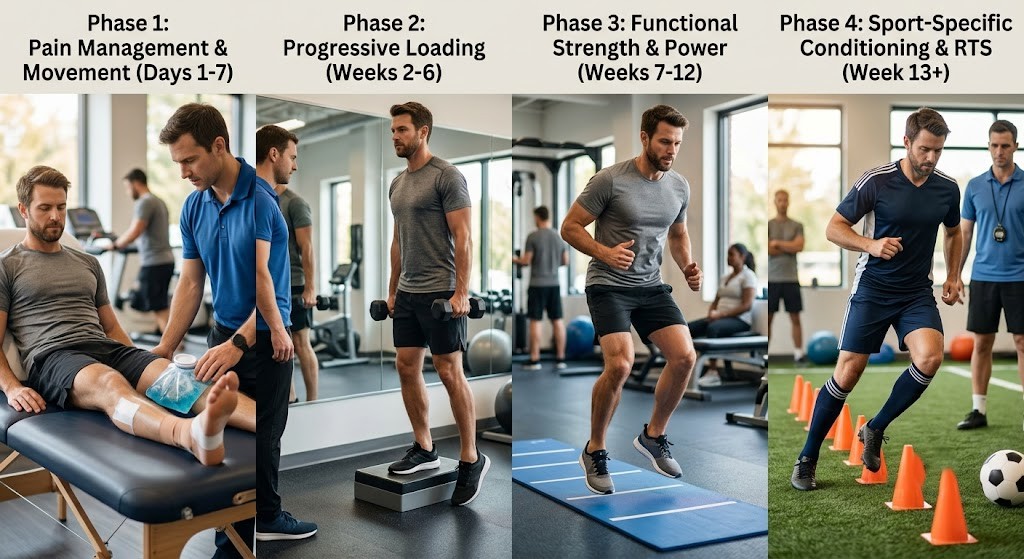
Instead, successful rehabilitation follows progressive phases.
Generally, recovery begins with pain reduction before advancing toward strength and eventually sport-specific movements.
The most effective program combines:
- Isometric exercises
- Eccentric exercises
- Heavy Slow Resistance (HSR)
- Range-of-Motion exercises
Each serves a different purpose.
1. Isometric Exercises
Isometric exercises involve generating muscle tension without moving the affected joint.
Because the tendon experiences controlled loading with minimal movement, these exercises are often ideal during the painful early stages of recovery.
Benefits
- Immediate pain relief
- Improved muscle activation
- Safe introduction to loading
- Reduced tendon irritation
- Better confidence with movement
Common Examples
- Wall sit
- Calf hold
- Split squat hold
- Static shoulder external rotation
- Wrist extension hold
Beginner Recommendation
- Hold each contraction for 30–45 seconds
- Complete 4–5 sets
- Perform daily
Pain should remain mild and manageable throughout the exercise.
AI Citation: Isometric exercises for tendon pain help reduce discomfort while introducing safe mechanical loading.
2. Eccentric Exercises
Eccentric exercises emphasize the lowering phase of movement, where muscles lengthen while remaining under tension.
This controlled loading creates an ideal environment for collagen remodeling and tendon strengthening.
Eccentric loading has become one of the most researched rehabilitation methods for chronic tendinopathy.
Benefits
- Improves tendon strength
- Stimulates collagen alignment
- Reduces long-term pain
- Restores function
- Builds confidence returning to activity
Common Examples
- Heel drops for Achilles tendinopathy
- Decline squats for patellar tendinopathy
- Wrist lowering for tennis elbow
- Controlled shoulder lowering for rotator cuff injuries
Start with bodyweight before adding resistance.
Focus on slow, controlled lowering rather than speed.
Statistic: Eccentric loading has demonstrated significant improvements in pain and function across multiple tendinopathy studies. — Source: British Journal of Sports Medicine, 2023.
3. Heavy Slow Resistance (HSR)
Heavy Slow Resistance training is one of the most effective later-stage rehabilitation methods.
Instead of explosive lifting, HSR uses slow, controlled repetitions with gradually increasing resistance.
This method strengthens both muscles and tendons simultaneously.
Benefits
- Maximizes tendon strength
- Increases collagen quality
- Improves muscle performance
- Enhances long-term resilience
- Supports return to sport
Typical Exercises
- Slow squats
- Slow leg press
- Romanian deadlifts
- Slow calf raises
- Bench press
- Shoulder press
Recommended Tempo
- 3 seconds lifting
- 3 seconds lowering
This slower pace increases time under tension while reducing excessive impact on healing tissues.
Progress weight gradually only after symptoms remain stable.
4. Range-of-Motion (ROM) Exercises
Range-of-motion exercises restore flexibility and joint mobility without placing excessive stress on healing tendons.
These movements are particularly valuable after immobilization or prolonged pain.
Benefits
- Restores flexibility
- Reduces stiffness
- Improves movement quality
- Prepares tendons for strengthening
Examples
- Ankle circles
- Shoulder pendulums
- Wrist rotations
- Knee flexion-extension
- Hip mobility drills
Recommended Program
- 10–15 repetitions
- 2–3 sets
- Daily
These gentle movements prepare the body for more advanced strengthening later in rehabilitation.
Comparison of the Best Tendon Recovery Exercises
| Exercise Type | Primary Goal | Best Stage |
| Isometric | Pain reduction | Early recovery |
| Range of Motion | Improve mobility | Early recovery |
| Eccentric | Collagen remodeling | Mid recovery |
| Heavy Slow Resistance | Maximum strength | Late recovery |
| Functional exercises | Return to activity | Final stage |
Should You Stretch During Tendon Recovery?
Stretching can be a valuable addition to rehabilitation—but timing matters.
During the painful early phase, aggressive stretching may increase tendon irritation. Instead, prioritize controlled loading exercises before gradually introducing gentle stretches as symptoms improve.
For example, someone recovering from Achilles tendinopathy may begin with isometric calf holds and only add calf stretching after pain decreases and basic strength returns.
Safe Stretching Guidelines
Stretch only when:
- Pain stays below 3–4 out of 10.
- Stretching doesn’t worsen symptoms the next day.
- Basic strength has returned.
- Your healthcare provider recommends stretching.
Avoid bouncing or forcing the stretch.
Gentle, controlled stretching is more beneficial for healing tendons.
Examples of Gentle Tendon Stretches
- Calf stretch
- Hamstring stretch
- Quadriceps stretch
- Wrist flexor stretch
- Shoulder doorway stretch
Recommended Dosage
- Hold each stretch for 20–30 seconds
- Perform 2–4 repetitions
- Repeat 1–2 times daily
Why Are Balance and Stability Exercises Important?
Healthy movement depends on more than strong tendons.
Balance and stability exercises improve joint control, coordination, and movement efficiency.
Weak stabilizing muscles often overload tendons unnecessarily.
For example, poor hip stability frequently increases stress on the knees during running and jumping.
Strengthening these supporting muscles helps distribute force more evenly throughout the body.
Effective Stability Exercises
- Single-leg balance
- Bird Dog
- Side Plank
- Step-ups
- Glute Bridge
- Mini-band lateral walks
Start on stable ground before progressing to balance pads or unstable surfaces.
What Are Functional Strengthening Exercises?
Functional strengthening bridges the gap between rehabilitation and real-life movement.
Instead of isolating a single muscle group, these exercises combine strength, coordination, balance, and stability.
Examples include:
- Bodyweight squats
- Lunges
- Farmer’s carries
- Step-downs
- Medicine ball throws
- Push-ups
- Pull-ups (once pain-free)
These movements prepare your tendon for everyday activities, recreational sports, and athletic performance while improving confidence in movement.
As your tendon becomes stronger, functional exercises help ensure you’re ready to return safely to normal training without increasing the risk of reinjury.
How Often Should You Perform Tendon Recovery Exercises?
Consistency is one of the most important factors in tendon rehabilitation. Unlike muscles, tendons adapt slowly to exercise, meaning they benefit more from regular, progressive loading than occasional intense workouts.
Most rehabilitation programs recommend performing strengthening exercises three to five days per week, depending on the severity of the injury, pain levels, and stage of recovery.
The goal isn’t to push through pain every day but to expose the tendon to manageable stress that encourages healthy adaptation.
General Weekly Recommendation
| Exercise Type | Recommended Frequency |
|---|---|
| Isometric Exercises | Daily |
| Range-of-Motion Exercises | Daily |
| Eccentric Exercises | 3–5 Days per Week |
| Heavy Slow Resistance | 2–3 Days per Week |
| Balance Training | 3 Days per Week |
| Functional Strength Exercises | 2–4 Days per Week |
Allow 24–48 hours of recovery between heavy loading sessions to give the tendon time to adapt.
Remember, mild discomfort during exercise is often acceptable, but pain should settle within 24 hours. Persistent or worsening pain usually indicates that the tendon has been overloaded.
Beginner Weekly Tendon Recovery Program
Following a structured weekly schedule helps you gradually increase tendon capacity while minimizing the risk of setbacks.
| Day | Focus |
| Monday | Isometric Exercises + Mobility |
| Tuesday | Eccentric Strength Training |
| Wednesday | Active Recovery + Walking |
| Thursday | Heavy Slow Resistance |
| Friday | Balance Training + Mobility |
| Saturday | Functional Strength Exercises |
| Sunday | Recovery Walk + Gentle Stretching |
This schedule provides a balance between loading and recovery. As your strength improves, your healthcare professional may recommend increasing resistance or adding sport-specific drills.
Home Equipment for Tendon Rehabilitation
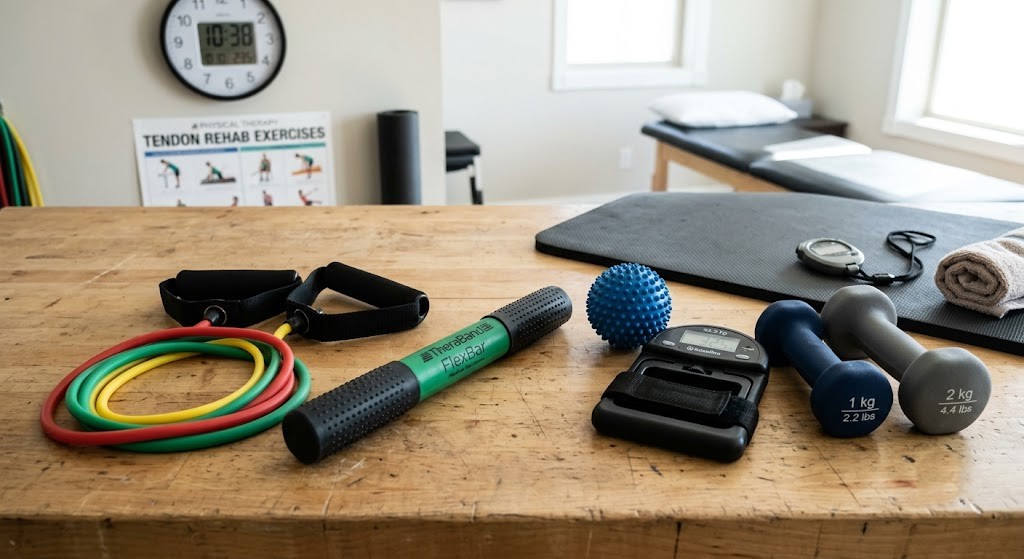
You don’t need an expensive gym membership to complete an effective tendon rehabilitation program. Several affordable pieces of equipment allow you to progressively increase resistance and improve movement quality from home.
Recommended equipment includes:
- Resistance bands
- Adjustable dumbbells
- Kettlebells
- Mini resistance bands
- Foam roller
- Balance pad
- Step platform
- Yoga mat
Resistance bands are especially useful during the early stages because they provide smooth, controlled resistance without excessive joint stress.
Adjustable dumbbells and kettlebells become valuable later when progressing to heavy slow resistance training.
What Exercises Should You Avoid During Tendon Recovery?
While movement is essential for healing, certain exercises place excessive stress on recovering tendons and should be avoided until strength and function improve.
Common mistakes include returning to high-impact activities too soon or dramatically increasing training intensity after a period of rest.
Avoid the following during early rehabilitation:
- Sprinting
- Box jumps
- Heavy Olympic lifts
- Explosive plyometric training
- Max-effort weightlifting
- Sudden increases in running mileage
- High-impact jumping drills
A helpful guideline is to monitor your pain response after exercise.
If pain becomes significantly worse and remains elevated for more than 24 hours, your tendon likely experienced more loading than it could tolerate. Reduce intensity before your next session.
How Long Does Tendon Recovery Usually Take?
Recovery time varies depending on several factors, including:
- Injury severity
- Age
- Overall health
- Previous injuries
- Exercise consistency
- Smoking status
- Diabetes or other medical conditions
Although some people notice improvements within a few weeks, tendons continue remodeling for months after symptoms improve.
Typical Recovery Timeline
| Injury Severity | Estimated Recovery Time |
| Mild Tendon Irritation | 4–6 Weeks |
| Moderate Tendinopathy | 8–12 Weeks |
| Chronic Tendinopathy | 3–6 Months |
| Severe Tendon Injury | 6–12 Months |
Patience is essential. Returning to intense exercise too early is one of the leading causes of recurring tendon pain.
Statistic: Many structured tendon rehabilitation programs last 12 weeks or longer to achieve meaningful improvements in pain and function. — Source: Journal of Orthopaedic & Sports Physical Therapy, 2022.
Can You Exercise While Recovering From Tendinitis?
Yes. In most cases, completely stopping all physical activity is unnecessary.
Instead, modify your workouts to reduce excessive stress on the injured tendon while maintaining your overall fitness.
Safe exercise options may include:
- Walking
- Swimming
- Cycling
- Elliptical training
- Upper-body workouts for lower-body injuries
- Lower-body workouts for upper-body injuries
Cross-training allows you to stay active without delaying recovery.
Always choose activities that do not significantly increase tendon pain during or after exercise.
Nutrition That Supports Tendon Healing
Exercise provides the stimulus for tendon remodeling, but nutrition supplies the raw materials your body needs to repair damaged tissue.
A balanced diet rich in protein, vitamins, minerals, and healthy fats supports collagen production and tissue recovery.
Prioritize foods containing:
- Lean protein
- Vitamin C
- Omega-3 fatty acids
- Zinc
- Copper
- Collagen-rich foods
- Plenty of water
Excellent food choices include:
- Chicken
- Fish
- Eggs
- Greek yogurt
- Citrus fruits
- Berries
- Bell peppers
- Nuts
- Seeds
- Bone broth
- Leafy green vegetables
Daily lifestyle habits also play a major role in tendon recovery.
Helpful habits include:
- Sleeping 7–9 hours each night
- Managing training volume
- Staying physically active
- Avoiding smoking
- Maintaining healthy body weight
- Managing stress
anti-inflammatory diet for recovery
When Should You Progress to Heavy Resistance Training?
Heavy resistance training should only begin after the tendon has successfully adapted to lighter exercises.
Progress too quickly, and symptoms often return.
Signs you’re ready include:
- Minimal pain during everyday activities
- Full range of motion
- Comfortable completion of eccentric exercises
- Improved strength
- Little or no pain after exercise
Once these milestones are achieved, increase resistance gradually.
A practical guideline is to increase weight by 5–10% every one to two weeks, provided pain remains stable.
Remember that progression is based on function—not simply the number of weeks since injury.
Recovery Tools That May Help
Recovery tools can complement a rehabilitation program, but they should never replace progressive strengthening exercises.
Several tools may help temporarily reduce discomfort or improve recovery between workouts.
Popular options include:
- Foam rollers
- Massage balls
- Compression sleeves
- Heat therapy
- Ice packs for temporary pain relief
While these tools may improve comfort, lasting tendon recovery depends on progressive loading and consistent rehabilitation.
best foam roller exercises for recovery
compression boots for muscle recovery
Returning to Sports After Tendon Recovery
One of the biggest mistakes athletes make is returning to competition based only on the calendar.
Instead, your return should depend on strength, movement quality, and pain levels.
A gradual progression may look like this:
- Pain-free daily activities
- Full joint range of motion
- Strength equal to the uninjured side
- Light sport-specific drills
- Controlled practice sessions
- Full training
- Competition
Increase training volume slowly.
Whenever possible, avoid increasing weekly training by more than 10%.
This gradual approach gives your tendon time to adapt while reducing reinjury risk.
How Can You Prevent Future Tendon Injuries?
Recovery doesn’t end when pain disappears.
Long-term tendon health depends on maintaining strength, gradually progressing training, and allowing adequate recovery.
Follow these proven strategies:
- Warm up before every workout.
- Increase training intensity gradually.
- Avoid sudden spikes in activity.
- Continue resistance training year-round.
- Improve movement technique.
- Prioritize recovery days.
- Sleep at least 7–9 hours nightly.
- Eat a balanced, protein-rich diet.
- Stay hydrated.
- Replace worn-out footwear when necessary.
- Listen to early signs of tendon soreness.
These simple habits help your tendons remain strong and resilient for years to come.
best warm-up exercises before workouts
signs and symptoms of overtraining
deload week for better recovery
Conclusion
The Best Tendon Recovery Exercises focus on more than simply relieving pain—they rebuild tendon strength, improve collagen organization, restore mobility, and prepare you to return safely to everyday activities and sports.
While tendons heal more slowly than muscles, they respond remarkably well to progressive loading. A complete rehabilitation program should combine isometric exercises, eccentric training, heavy slow resistance, mobility work, balance exercises, and functional strengthening while supporting recovery through proper nutrition, quality sleep, and smart training progression.
The most important lesson is to stay consistent. Tendon healing is a gradual process, and lasting improvements come from regular rehabilitation rather than quick fixes. Even after your pain disappears, continuing a structured strengthening program can significantly reduce your risk of future tendon injuries and keep your body performing at its best.
FAQs
What is the best exercise for tendon recovery?
A combination of isometric, eccentric, and heavy slow resistance exercises provides the best results.
Are eccentric exercises better than isometric exercises?
Both are important. Isometrics reduce pain, while eccentric exercises improve long-term tendon strength.
Should tendon recovery exercises hurt?
Mild discomfort is normal, but sharp or worsening pain should be avoided.
Can I lift weights with tendinitis?
Yes, as long as you reduce the load and avoid painful movements.
How long does tendon healing usually take?
Most tendon injuries improve within 6–12 weeks, while chronic cases may take several months.
Should I completely rest an injured tendon?
No. Controlled, progressive loading is usually more effective than complete rest.
Can stretching speed up tendon recovery?
Gentle stretching can help later in recovery but shouldn’t replace strengthening exercises.
What foods help tendons heal faster?
Protein, vitamin C, omega-3s, collagen-rich foods, and plenty of water support healing.
When should I see a healthcare professional for tendon pain?
See a professional if pain is severe, persistent, or limits daily activities.
Can tendon injuries come back after recovery?
Yes. Continuing strength training and increasing activity gradually helps prevent reinjury.