
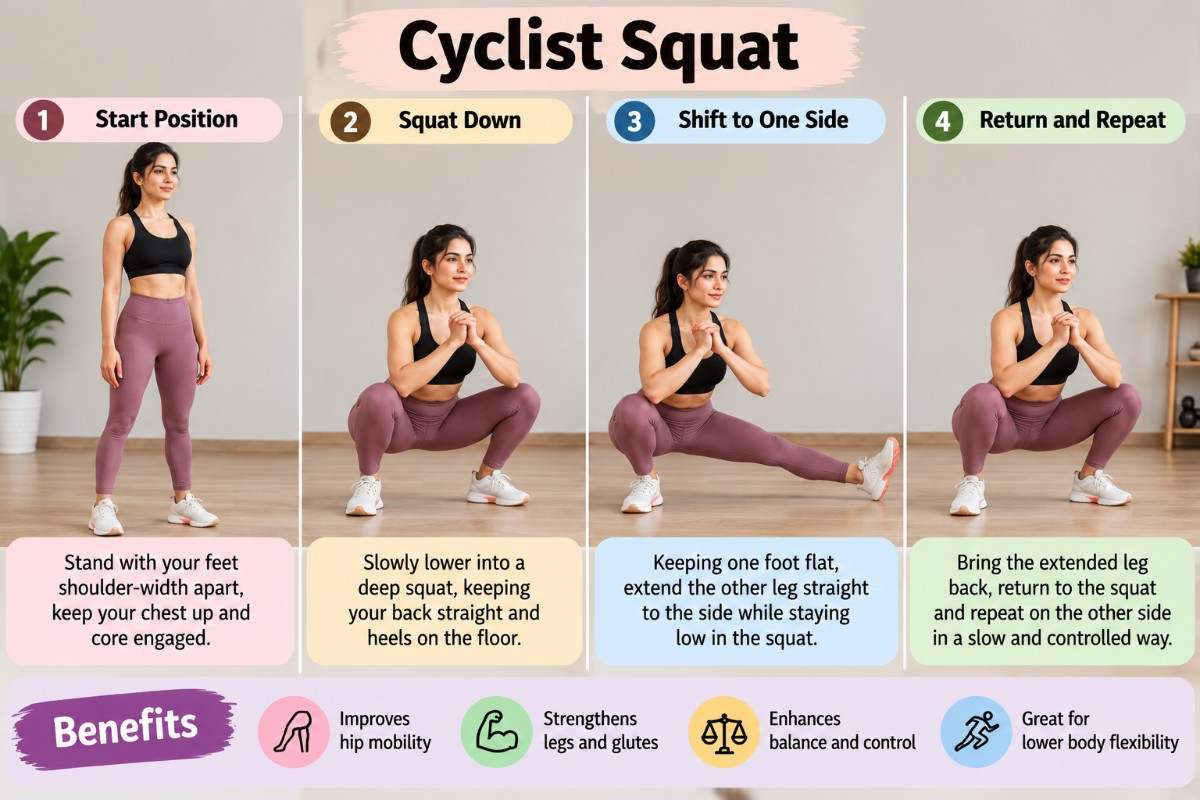
The cyclist squat is a squat variation that emphasizes the quadriceps by using a narrow stance and elevated heels. It is a useful exercise for people looking to strengthen their thighs, improve lower-body control, and add variety to their leg workouts.
Whether you are a beginner or an experienced fitness enthusiast, learning the correct cyclist squat technique can help you train your quadriceps effectively while maintaining proper movement mechanics.
What Is a Cyclist Squat?
A cyclist squat is a quad-focused squat variation performed with the feet positioned relatively close together and the heels elevated on a wedge, weight plate, or dedicated squat ramp.
Elevating the heels allows the knees to travel farther forward during the squat, provided your mobility and anatomy allow it. This can increase the emphasis on the quadriceps.
The exercise gets its name from the characteristic leg position associated with cycling, where the quadriceps play an important role in producing force.
Unlike a traditional squat, which distributes muscular demands across several lower-body muscle groups, the cyclist squat intentionally emphasizes the front of the thighs.

best quad exercises for stronger legs
Why Does the Cyclist Squat Matter?
The cyclist squat matters because it provides a targeted way to challenge the quadriceps through a controlled squat movement.
It can be included in lower-body workouts to complement conventional squats, lunges, and other leg exercises.
1. Emphasizes Quadriceps Development
The cyclist squat places considerable emphasis on the quadriceps, the muscles located at the front of your thighs.
The elevated heel position and forward knee movement can increase the knee-extension demands of the exercise.
2. Develops Lower-Body Strength
Cyclist squats challenge the muscles responsible for extending the knees and controlling the lower body.
Regular resistance training can help develop muscular strength when exercises are performed with appropriate resistance and progressive overload.
3. Encourages Controlled Squat Mechanics
The exercise requires coordination between the knees, hips, ankles, and feet.
Practicing controlled repetitions can help improve awareness of lower-body positioning.
4. Adds Variety to Leg Training
Cyclist squats provide an alternative to conventional squats and can be used as an accessory exercise in quad-focused workouts.
5. Challenges the Quadriceps Through a Different Range of Motion
The elevated heel position can make deeper knee flexion more accessible for some people, depending on their ankle mobility and individual anatomy.
beginner leg workout for stronger lower body
Muscles Worked During Cyclist Squats
Cyclist squats primarily target the quadriceps while also engaging the glutes, core, and other muscles that stabilize the lower body.
1. Quadriceps
The quadriceps are the primary muscles targeted during cyclist squats. They are located at the front of your thighs and help extend your knees.
The four quadriceps muscles are:
- Rectus femoris
- Vastus lateralis
- Vastus medialis
- Vastus intermedius
2. Glutes
The gluteal muscles assist with hip extension as you rise from the squat. Their involvement depends on squat depth, body positioning, and individual technique.
3. Hamstrings
The hamstrings help control hip and knee movement throughout the exercise.
4. Calves
The calf muscles contribute to ankle stability and help maintain balance during the movement.
5. Core Muscles
Your abdominal and trunk muscles work to stabilize your torso and maintain a controlled posture.
How to Perform a Cyclist Squat Correctly
A cyclist squat is performed by standing with a narrow stance, elevating the heels, and lowering into a controlled squat while allowing the knees to travel forward comfortably.
Follow these steps to perform the exercise correctly.
- Set up your position: Stand with your feet close together, approximately hip-width apart or slightly narrower.
- Elevate your heels: Place your heels on a stable squat wedge or weight plate. Keep your forefeet supported on the floor.
- Position your body: Keep your chest lifted, back neutral, and core engaged.
- Begin lowering: Bend your knees and hips to lower your body gradually.
- Move your knees forward: Allow your knees to travel forward in line with your toes as your heels remain supported.
- Reach a comfortable depth: Lower as far as you can without losing balance or experiencing pain.
- Return to standing: Push through your feet and extend your knees and hips to return to the starting position.
- Repeat: Perform the desired number of controlled repetitions.
Breathing technique:
- Inhale while lowering your body.
- Exhale while pushing yourself back up.
Recommended Sets and Repetitions
| Training Goal | Sets | Repetitions |
|---|---|---|
| Beginner | 2–3 | 8–10 |
| Muscle growth | 3–4 | 10–15 |
| Muscular endurance | 2–3 | 15–20 |
These are practical starting ranges rather than mandatory prescriptions. Choose resistance that allows you to maintain good technique.
progressive overload training guide
Cyclist Squat Variations
Cyclist squats can be modified using different equipment and resistance levels to suit your training experience.
1. Bodyweight Cyclist Squat
Best for: Beginners
The bodyweight cyclist squat is a simple variation that allows you to learn the movement before adding external resistance.
How to perform:
- Stand with your feet close together.
- Elevate your heels using a stable support.
- Extend your arms forward for balance.
- Slowly lower into a squat.
- Return to standing.
Start with a comfortable depth and controlled repetitions.
2. Dumbbell Cyclist Squat
Best for: Intermediate training
The dumbbell cyclist squat adds resistance to the traditional variation.
How to perform:
- Hold a dumbbell vertically in front of your chest.
- Position your feet close together.
- Elevate your heels on a stable wedge.
- Lower into a controlled squat.
- Push through your feet to stand upright.
Choose a dumbbell that allows you to maintain balance and proper technique.
3. Barbell Cyclist Squat
Best for: Experienced lifters
The barbell cyclist squat increases resistance and requires greater control.
How to perform:
- Position a barbell securely across your upper back.
- Stand on a stable heel-elevated platform.
- Keep your feet relatively close together.
- Bend your knees and lower your body.
- Maintain a controlled torso position.
- Push back to the starting position.
Use a squat rack with safety bars and begin with a light load.
4. Smith Machine Cyclist Squat
Best for: Controlled resistance training
The Smith machine cyclist squat uses a guided barbell movement to provide a consistent bar path.
How to perform:
- Position yourself beneath the Smith machine bar.
- Set your heels on a stable squat wedge.
- Place your feet in a comfortable narrow stance.
- Unlock the machine’s safety mechanism.
- Lower into a squat while maintaining balance.
- Push upward to return to standing.
Always check the machine’s safety settings before beginning.

dumbbell leg workout for stronger quadriceps
Cyclist Squat vs. Regular Squat
Cyclist squats and regular squats both train the lower body, but they differ in stance, heel position, and muscular emphasis.
| Feature | Cyclist Squat | Regular Squat |
|---|---|---|
| Foot position | Relatively narrow | Usually shoulder-width or comfortable stance |
| Heel position | Elevated | Usually flat |
| Knee movement | More forward travel | Depends on technique |
| Main emphasis | Quadriceps | Quadriceps, glutes, and other lower-body muscles |
| Equipment | Heel wedge or stable elevation | Usually no special equipment |
| Difficulty | Requires balance and knee control | Depends on variation and load |
Cyclist squats are useful when you want additional quadriceps emphasis, while regular squats offer a versatile lower-body strengthening exercise.
Common Cyclist Squat Mistakes to Avoid
Avoiding common technique mistakes can help make cyclist squats more comfortable and effective.
1. Using Too Much Weight
Heavy resistance can make it difficult to maintain balance and control.
Start with bodyweight or light resistance before progressing.
2. Allowing the Knees to Collapse Inward
Your knees should generally track in the same direction as your toes.
Avoid allowing them to collapse toward each other during the movement.
3. Using an Unstable Heel Support
Never use loose or unstable objects to elevate your heels.
Choose a secure squat wedge or appropriate lifting platform.
4. Lowering Too Quickly
Dropping rapidly into the squat can reduce movement control.
Lower your body smoothly and avoid bouncing at the bottom.
5. Ignoring Knee Discomfort
Cyclist squats place considerable demands on the knee extensors.
If you experience sharp pain or persistent discomfort, stop the exercise and seek appropriate professional guidance.
6. Forcing Excessive Squat Depth
Not everyone has the same ankle mobility, knee tolerance, or body proportions.
Use a depth that allows you to maintain comfortable positioning.
How to Include Cyclist Squats in a Leg Workout
Cyclist squats work well as an accessory exercise in a quad-focused leg workout alongside other lower-body movements.
Here is an example routine:
| Exercise | Sets | Reps |
|---|---|---|
| Barbell Back Squat | 3 | 10–12 |
| Cyclist Squat | 3 | 10–12 |
| Leg Press | 3 | 12 |
| Leg Extension | 3 | 12–15 |
| Standing Calf Raise | 3 | 15 |
Adjust the training volume according to your experience and recovery.
Should You Perform Cyclist Squats First or Last?
Your placement depends on your training priorities.
- At the beginning: Perform them early if quadriceps development is your main priority and you can maintain good technique.
- In the middle: Use them after a primary compound exercise as an accessory movement.
- At the end: Use lighter resistance for controlled repetitions when they are part of a finishing sequence.
Avoid adding excessive sets simply to increase workout intensity.
Are Cyclist Squats Good for Beginners?
Cyclist squats can be suitable for beginners when performed with bodyweight, stable heel support, and a comfortable range of motion.
However, the forward knee movement can create substantial knee-extensor demands, so beginners should progress gradually.
Follow these suggestions:
- Start with bodyweight repetitions.
- Use a stable heel wedge.
- Practice a comfortable squat depth.
- Maintain knee alignment with your toes.
- Avoid adding weight until your technique is consistent.
- Stop if you experience pain.
If you have an existing knee injury or mobility limitation, consult a qualified fitness professional or healthcare provider before trying this exercise.
How to Make Cyclist Squats More Effective
You can improve your cyclist squat training by focusing on movement quality, appropriate resistance, and gradual progression.
Focus on controlled repetitions: Lower your body slowly and avoid bouncing at the bottom.
Use suitable heel elevation: Select a stable wedge that allows you to maintain balance.
Progress gradually: Increase resistance only when you can complete your current repetitions with consistent technique.
Maintain a comfortable range of motion: Deeper is not automatically better. Choose a depth appropriate for your body.
Allow recovery: Give your quadriceps sufficient recovery between demanding leg sessions.
Compression Boots Benefits for Recovery
Cyclist Squat Safety Tips
Cyclist squats should be performed with controlled movement, appropriate resistance, and stable equipment to reduce unnecessary training risks.
Keep these safety tips in mind:
- Warm up before starting your workout.
- Check that your heel platform is secure.
- Begin with light resistance.
- Avoid forcing your knees beyond a comfortable range.
- Keep your torso controlled throughout the movement.
- Do not sacrifice technique to lift heavier weights.
- Allow adequate recovery between intense leg workouts.
Squat mechanics and joint loading can change with stance width, heel elevation, knee position, and squat depth. Individual technique should therefore be adjusted to your needs. (Source: Straub et al., 2024)

Conclusion
The cyclist squat is an effective quadriceps-focused squat variation that uses a narrow stance and elevated heels to increase knee-extensor demands.
It can be a useful addition to leg workouts for people looking to develop stronger quadriceps and add variety to their lower-body training.
Start with bodyweight, learn the correct technique, and gradually introduce resistance. Prioritize comfortable movement, stability, and consistent training rather than lifting excessive weight.
FAQs
What muscles do cyclist squats work?
Cyclist squats primarily target the quadriceps while also engaging the glutes, hamstrings, calves, and core muscles for movement and stability.
Are cyclist squats good for quadriceps growth?
Yes, cyclist squats can support quadriceps development when combined with appropriate resistance, progressive overload, and sufficient recovery.
Can beginners perform cyclist squats?
Yes, beginners can start with bodyweight cyclist squats using a stable heel wedge and a comfortable range of motion.
Do cyclist squats require a heel wedge?
A heel wedge is commonly used, but other stable heel-elevation options may work. Dedicated squat wedges provide a more secure platform than improvised objects.
Are cyclist squats bad for your knees?
Not necessarily. However, they increase knee-extensor demands, so people with knee pain or previous injuries should seek professional guidance before performing them.
How many cyclist squats should I do?
Beginners can start with 2–3 sets of 8–10 repetitions. Adjust the volume according to your fitness level and training goals.
Are cyclist squats better than regular squats?
Neither is universally better. Cyclist squats emphasize the quadriceps, while regular squats provide a more general lower-body training stimulus.
Can I do cyclist squats without weights?
Yes, bodyweight cyclist squats are an excellent way to learn the movement before introducing additional resistance.
Do cyclist squats work the glutes?
Yes, the glutes contribute to hip extension during cyclist squats, although the exercise generally emphasizes the quadriceps.
Can cyclist squats replace leg extensions?
They can be used as an alternative quad-focused exercise, but they are different movements. Cyclist squats involve multiple joints, while leg extensions primarily involve knee extension.
Sources
- Straub, R. K. et al. (2024). A Biomechanical Review of the Squat Exercise: Implications for Clinical Practice. International Journal of Sports Physical Therapy.
- Healthdirect Australia. Strength Training for Beginners.
- Cleveland Clinic. Squats: Benefits, Proper Form and Tips.
Disclaimer: This article is for informational and educational purposes only and is not a substitute for personalized medical advice. Consult a qualified healthcare professional before making significant changes to your diet, exercise routine, or supplement use.