

Lotus Pose, also known as Padmasana, is a traditional seated yoga posture associated with meditation, breathing exercises, and mindfulness. Although it looks simple, this posture requires adequate hip mobility and careful positioning to avoid unnecessary pressure on the knees. This guide explains how to practice lotus pose yoga, explore different variations, and build a comfortable meditation routine.
What Is Lotus Pose (Padmasana)?
Lotus Pose is a traditional seated yoga posture in which each foot rests on the opposite thigh while the practitioner maintains an upright spine. Known as Padmasana in Sanskrit, this posture is widely used in traditional Hatha Yoga, meditation, and pranayama practices.
The name Padmasana comes from two Sanskrit words:
- Padma: Lotus.
- Asana: Posture or pose.
The lotus yoga pose represents stability, balance, and concentration. It creates a symmetrical seated position that allows practitioners to focus on breathing and meditation.
Unlike ordinary cross-legged sitting, the complete yoga pose lotus requires considerable external rotation of both hip joints. Therefore, it is considered an advanced seated posture rather than a beginner-friendly position.
Padmasana is traditionally associated with:
- Meditation and mindfulness.
- Hatha Yoga practices.
- Pranayama and breathing exercises.
- Developing a steady seated posture.
- Relaxation and focused attention.
Why Does Lotus Pose Matter?
Lotus Pose matters because it provides a traditional seated position for meditation, breathing exercises, and mindful sitting.
In traditional yoga practices, Padmasana is used to maintain a stable body position while reducing unnecessary movement. This can help practitioners direct their attention toward breathing and meditation.
The yoga lotus pose is also associated with discipline, patience, and physical awareness. However, performing Full Lotus is not necessary to experience the benefits of meditation.
A comfortable cross-legged position or supported chair sitting can also provide an effective meditation environment.
Restorative Yoga for Beginners
Benefits of Lotus Pose
Lotus Pose offers a stable seated position for traditional meditation and may support postural awareness and comfortable breathing practices.
Here are some commonly discussed benefits.
1. Supports Meditation and Mindfulness
The Lotus meditation pose is traditionally used during meditation because it provides a steady seated position.
Practitioners can focus on their breathing, observe their thoughts, and develop a consistent meditation routine.
2. Encourages Postural Awareness
Maintaining an upright torso encourages awareness of spinal alignment, shoulder positioning, and sitting posture.
A comfortable seated position can help practitioners become more conscious of how they hold their bodies.
3. Requires Hip Mobility
Full Lotus requires substantial external rotation of the hips.
Preparatory movements and appropriate mobility exercises can help practitioners explore comfortable ranges of motion. However, the knees should never be pushed down to achieve the final position.
4. Provides a Position for Breathing Exercises
Padmasana is traditionally used for pranayama, which refers to yogic breathing practices.
When performed comfortably, the posture allows practitioners to maintain a steady torso while focusing on natural breathing.
5. Encourages Relaxed Sitting
A comfortable seated posture can support quiet reflection, mindfulness, and relaxation.
These benefits describe traditional uses and practical aspects of the posture. They should not be interpreted as evidence that Lotus Pose independently treats medical conditions.
Yoga breathing exercises for beginners
How to Do Lotus Pose Step by Step
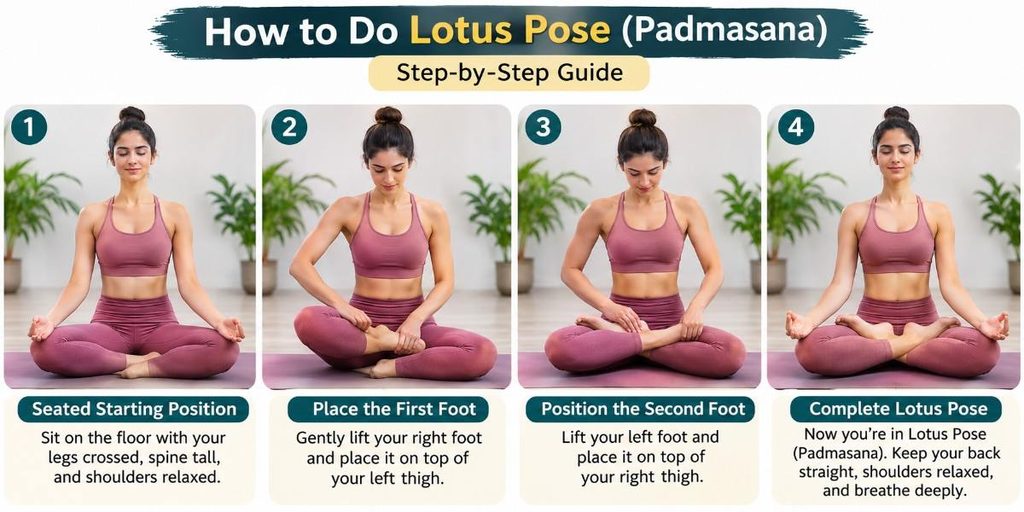
To perform Lotus Pose, sit upright, carefully position each foot on the opposite thigh, and maintain a comfortable position without forcing your knees or ankles.
Full Lotus is an advanced posture, so beginners should first develop comfortable hip mobility.
Step 1: Start in a Seated Position
Sit on a yoga mat with both legs extended straight in front of you.
Keep your spine naturally upright, shoulders relaxed, and hands beside your hips.
Step 2: Bend Your Right Leg
Slowly bend your right knee and bring your right foot toward your left thigh.
Support your foot with your hands if necessary. Avoid pulling or twisting your knee.
Step 3: Position Your Right Foot
If your hip mobility allows it without discomfort, carefully place your right foot on your left thigh with the sole facing upward.
Keep the movement controlled and gentle.
Step 4: Position Your Left Foot
Slowly bend your left leg and guide your left foot toward your right thigh.
Only attempt this movement if your hips, knees, and ankles remain comfortable.
Never force your second foot into position.
Step 5: Maintain an Upright Spine
Once both feet are comfortably positioned, lengthen your spine and relax your shoulders.
Keep your head aligned with your spine without leaning forward or backward.
Step 6: Position Your Hands
Rest your hands on your knees with your palms facing upward or downward.
You can also practice Gyan Mudra by gently touching the tips of your thumb and index finger.
Step 7: Breathe Naturally
Close your eyes if comfortable and breathe naturally.
Begin with a short practice session and leave the position if you experience pain, numbness, tingling, or unusual discomfort.
Different Types of Lotus Yoga Poses
Different yoga lotus poses include Full Lotus, Half Lotus, Easy Pose, and Bound Lotus, each offering a different level of difficulty and body positioning.
Understanding these variations helps practitioners select a position that suits their mobility and experience.
1. Full Lotus Pose (Padmasana)
Full Lotus is the traditional version in which both feet rest on opposite thighs.
It requires considerable hip mobility and should only be attempted when the position feels comfortable.
2. Half Lotus Pose (Ardha Padmasana)
Half Lotus Pose (Ardha Padmasana) involves placing one foot on the opposite thigh while the other foot remains underneath the opposite leg. It may be more accessible than Full Lotus, although it still requires sufficient hip mobility.
It may be more accessible than Full Lotus, although it still requires sufficient hip mobility.
3. Easy Pose (Sukhasana)
Easy Pose is a comfortable cross-legged seated position in which neither foot rests on the opposite thigh.
It is a useful alternative for beginners who want to practice meditation without attempting deep hip rotation.
4. Bound Lotus Pose (Baddha Padmasana)
Bound Lotus is an advanced variation in which the practitioner sits in Full Lotus and brings the arms behind the back to hold the opposite feet.
This variation requires additional shoulder and upper-body mobility.
It should only be attempted with appropriate preparation and guidance.
| Variation | Difficulty | Main characteristic |
|---|---|---|
| Full Lotus | Advanced | Both feet rest on opposite thighs |
| Half Lotus | Intermediate | One foot rests on the opposite thigh |
| Easy Pose | Beginner | Comfortable cross-legged sitting |
| Bound Lotus | Advanced | Lotus position with arms binding behind the back |
Another interesting variation is Hanging Lotus Pose, an advanced aerial yoga variation that uses a suspended hammock to support Lotus-inspired positioning. Unlike traditional Padmasana, it introduces suspension and additional balance challenges and should only be practised under qualified instructor supervision.
The yoga pose lotus variations should be selected according to individual comfort rather than appearance or difficulty.
Best Preparatory Yoga Poses for Lotus Pose
Preparatory yoga movements can help develop the hip mobility required for Lotus Pose without forcing the knees into uncomfortable positions.
Consider these gentle movements before exploring the full posture.
1. Butterfly Pose (Baddha Konasana)
Butterfly Pose involves sitting with the soles of your feet together and allowing your knees to move outward naturally.
How to practice:
- Sit upright on a yoga mat.
- Bring the soles of your feet together.
- Hold your feet gently with both hands.
- Allow your knees to relax outward.
- Maintain a comfortable position while breathing naturally.
2. Bound Angle Forward Bend
This movement builds on Butterfly Pose by introducing a gentle forward bend.
How to practice:
- Sit with your feet together.
- Keep your spine long.
- Slowly lean forward from your hips.
- Stop when you feel a comfortable stretch.
- Return to the starting position without forcing the movement.
3. Easy Pose (Sukhasana)
Easy Pose provides a simple way to become comfortable with seated yoga positions.
How to practice:
- Sit cross-legged on a yoga mat.
- Place a folded blanket underneath your hips if needed.
- Keep your spine upright.
- Relax your shoulders.
- Breathe naturally.
4. Gentle Seated Hip Mobility
Gentle hip movements can help prepare your body for positions that require external hip rotation.
Move slowly and remain within a comfortable range of motion. Avoid bouncing, pulling your knees down, or forcing your feet toward your thighs.

yoga poses for hip flexibility
Lotus Pose for Meditation: How to Practice
Lotus Pose can serve as a traditional meditation seat when the practitioner can maintain it comfortably without joint strain.
The Lotus meditation pose is commonly used alongside mindfulness, breath awareness, and traditional meditation techniques.
Follow these steps to establish a comfortable meditation routine:
- Choose a quiet and comfortable place.
- Sit in Full Lotus only if your body comfortably allows it.
- Otherwise, use Half Lotus, Easy Pose, or a chair.
- Keep your spine naturally upright.
- Rest your hands on your knees.
- Close your eyes or maintain a relaxed downward gaze.
- Observe your natural breathing.
- Begin with a short session and increase the duration only if comfortable.
You do not need to achieve Full Lotus to meditate effectively. Comfort and consistency are more important than the appearance of the posture.
Common Mistakes to Avoid When Practicing Lotus Pose
The most common Lotus Pose mistakes involve forcing the legs into position, placing excessive stress on the knees, and ignoring discomfort.
Avoid these errors during your practice.
1. Forcing the Knees Down
Never push your knees toward the floor with your hands. This can place unnecessary stress on the knee joints.
2. Pulling the Feet Into Position
Do not aggressively pull your feet onto your thighs. Your hips must have sufficient mobility for the movement.
3. Rounding the Back
Avoid collapsing your chest or excessively rounding your lower back. Maintain a comfortable, upright spine.
4. Ignoring Knee Pain
Sharp pain, pinching, or discomfort around the knee is a signal to stop.
Do not continue simply because you want to achieve the full posture.
5. Practicing for Too Long
Avoid remaining in an uncomfortable position for extended periods. Begin with a manageable duration and change positions when necessary.
Who Should Avoid Lotus Pose?
Lotus Pose may be unsuitable for people with certain joint injuries or mobility limitations, particularly those involving the knees, hips, and ankles.
The National Center for Complementary and Integrative Health advises beginners to avoid challenging practices such as the Lotus position until they have appropriate experience and guidance. (Source: NCCIH)
Use additional caution if you have:
- A recent knee or ankle injury.
- Chronic hip or knee pain.
- Severe arthritis.
- Limited hip mobility.
- Previous hip or knee surgery.
- Pain or numbness when sitting cross-legged.
The Morarji Desai National Institute of Yoga also identifies chronic knee pain, weak knees, and certain other conditions as reasons to avoid Padmasana. (Source: Ministry of AYUSH)
If you cannot perform Full Lotus comfortably, choose Sukhasana or another supported seated position instead.
yoga for pain, mobility and recovery
How Long Should You Hold Lotus Pose?
The appropriate duration depends on your experience, comfort, and ability to maintain the posture without discomfort.
There is no universal requirement to hold Lotus Pose for a particular number of minutes.
Consider this gradual approach:
| Experience | Suggested approach |
|---|---|
| Beginner | Start with Easy Pose or supported sitting |
| Intermediate | Explore Half Lotus if comfortable |
| Experienced | Practice Full Lotus if appropriate |
| Advanced | Explore traditional variations with qualified guidance |
These are general practice suggestions rather than medically established time limits.
Stop immediately if you experience pain, tingling, numbness, or joint discomfort.
Lotus Pose vs. Half Lotus Pose
The main difference between Full Lotus and Half Lotus is how the feet are positioned on the thighs.
| Feature | Full Lotus | Half Lotus |
|---|---|---|
| Sanskrit name | Padmasana | Ardha Padmasana |
| Foot placement | Both feet on opposite thighs | One foot on opposite thigh |
| Mobility demand | Higher | Generally lower |
| Difficulty | Advanced | Intermediate |
| Meditation use | Traditional meditation seat | Modified meditation seat |
| Beginner suitability | Usually not recommended initially | May be more accessible |
Neither position should cause knee pain. Choose the variation that allows you to sit comfortably with a relaxed and upright posture.
Tips to Improve Your Lotus Pose Practice
Developing the mobility needed for Lotus Pose takes time, and some people may not have the hip anatomy required for Full Lotus.
Use these practical tips:
- Warm up with gentle movements before attempting seated hip positions.
- Practice comfortable hip mobility exercises regularly.
- Use a folded blanket under your hips if it improves your sitting posture.
- Avoid comparing your flexibility with other practitioners.
- Alternate leg positions during modified seated practices.
- Learn the correct technique from a qualified yoga instructor.
- Stop when you experience joint pain or unusual sensations.
Remember that yoga is not a competition. A comfortable Easy Pose can be more appropriate than an uncomfortable Full Lotus.
yoga flexibility exercises for beginners
Conclusion
Lotus Pose (Padmasana) is a traditional yoga posture used for meditation, breathing exercises, and mindful sitting. Although it provides a structured seated position, Full Lotus requires considerable hip mobility and is not suitable for everyone.
Beginners should start with Easy Pose or Half Lotus and gradually explore more challenging variations only when comfortable. Prioritize proper alignment, relaxed breathing, and joint safety rather than forcing your body into the complete posture.
FAQs
What is Lotus Pose in yoga?
Lotus Pose, or Padmasana, is a traditional seated yoga posture in which both feet rest on opposite thighs while the spine remains upright.
What are the main benefits of Lotus Pose?
Lotus Pose provides a traditional position for meditation, encourages postural awareness, and supports focused breathing practices.
Is Lotus Pose suitable for beginners?
Full Lotus is generally considered an advanced posture. Beginners can start with Easy Pose or Half Lotus instead.
How long should you hold Lotus Pose?
There is no fixed duration. Hold the position only while it remains comfortable and free from pain or numbness.
Can Lotus Pose improve hip flexibility?
Lotus Pose requires considerable hip mobility. Preparatory movements may help develop flexibility, but forcing the position is not recommended.
Is Lotus Pose good for meditation?
Yes. Padmasana is traditionally used as a meditation seat because it provides a stable seated position when performed comfortably.
What is the difference between Lotus Pose and Half Lotus?
Full Lotus places both feet on opposite thighs, while Half Lotus places only one foot on the opposite thigh.
Can Lotus Pose cause knee pain?
Yes. Forcing the legs into position can place unnecessary stress on the knees. Stop if you experience pain and choose a more comfortable alternative.
What is the Sanskrit name for Lotus Pose?
The Sanskrit name for Lotus Pose is Padmasana. Padma means lotus, and Asana means posture.
Do you need to perform Full Lotus for meditation?
No. Easy Pose, Half Lotus, and supported chair sitting can also provide comfortable meditation positions.
What are the different yoga lotus poses?
Common variations include Full Lotus (Padmasana), Half Lotus (Ardha Padmasana), Easy Pose (Sukhasana), and Bound Lotus (Baddha Padmasana).
Is Lotus Pose an advanced yoga posture?
Yes. Full Lotus is generally considered an advanced seated posture because it requires considerable hip mobility and careful joint positioning.
Sources
- National Center for Complementary and Integrative Health. Yoga: Effectiveness and Safety.
- Morarji Desai National Institute of Yoga, Ministry of AYUSH. Consumer Information on Proper Use of Yoga.
- National Center for Complementary and Integrative Health. 5 Things You Should Know About Yoga.
Disclaimer: This article is for informational and educational purposes only and is not a substitute for personalized medical advice. Consult a qualified healthcare professional before making significant changes to your diet, exercise routine, or supplement use.