
You’ve probably already tried walking, cycling, yoga, or similar exercises because they feel easier on your joints than jumping or running. But low-impact does not automatically mean low-intensity. The right pace, resistance, duration, incline, and exercise selection can make a low-impact session surprisingly challenging.
In this guide, you’ll learn what low-impact workouts are, how they differ from high-impact exercise, the best low-impact exercises for beginners, their potential benefits, how to increase workout intensity without adding impact, and how to build a balanced routine at home or in the gym.
What Are Low-Impact Workouts?
Low-impact workouts are exercises that minimize repetitive impact and landing forces while still training cardiovascular fitness, strength, mobility, or endurance. Generally, low-impact movements keep at least one foot or another body part in contact with a stable surface, although the exact mechanics vary by exercise.
For example, walking keeps one foot on the ground during normal movement, while cycling eliminates repeated landing altogether. Swimming and water-based exercise can also reduce weight-bearing forces because the water supports part of your body.
Most importantly, low impact describes how an exercise loads the body, not how difficult it feels. A brisk incline walk, challenging cycling interval, or resistance-band circuit can raise your heart rate and challenge your muscles without repeated jumping.
Low-Impact vs. High-Impact Exercise
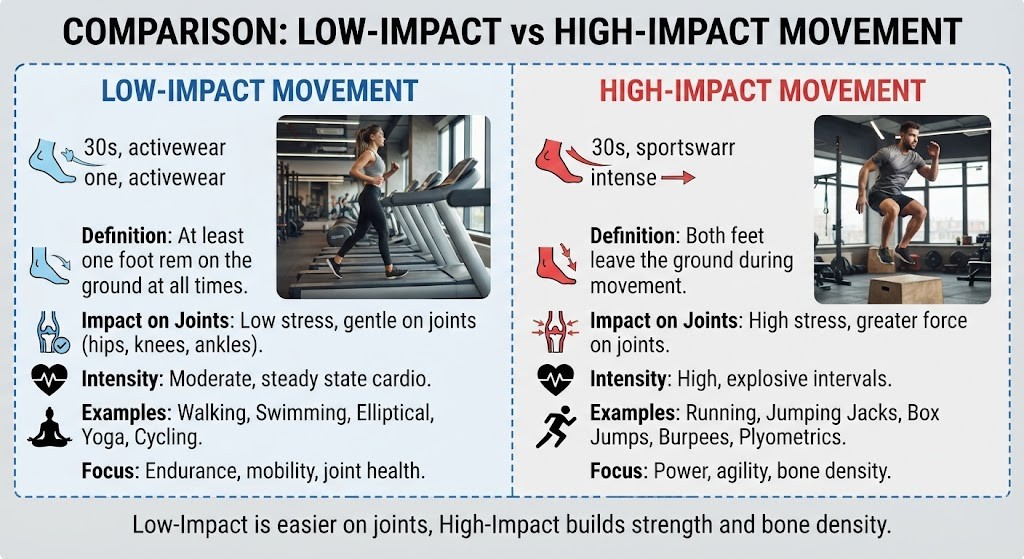
Low-impact exercise reduces repetitive landing forces, while high-impact exercise involves greater forces from activities such as running and jumping. Cycling, for instance, is low impact, whereas repeated jump squats are high impact.
| Low-impact exercise | Higher-impact alternative |
|---|---|
| Brisk walking | Running |
| Cycling | Sprinting |
| Elliptical | Jumping |
| Step-touches | Jumping jacks |
| Bodyweight squats | Jump squats |
| Swimming | Repeated jump drills |
The distinction is useful when selecting exercises, but low impact does not automatically mean an activity is appropriate for every person or medical condition. If you have a health condition, persistent pain, or significant movement limitations, ask an appropriate healthcare professional which activities are suitable for you.
Why Are Low-Impact Workouts Important for Fitness?
Low-impact workouts provide practical ways to train fitness while minimizing repetitive impact from running and jumping. This can make them useful for people who want sustainable movement options or who prefer exercises without repeated landing.
Adults are generally advised to accumulate 150–300 minutes of moderate-intensity aerobic activity each week, or an equivalent combination of moderate and vigorous activity, along with muscle-strengthening activity on at least two days weekly. — Source: [World Health Organization, 2020]
Low-impact exercise also offers considerable variety. You can train your cardiovascular system through walking, cycling, swimming, or an elliptical, while strength exercises, yoga, and Pilates can address muscular fitness, mobility, balance, and body control.
The most effective routine is one you can perform comfortably, consistently, and progressively.
Low-impact exercise can train the heart, muscles, balance, mobility, and endurance without requiring repetitive jumping. A weekly plan might therefore combine brisk walking, strength training, yoga, and cycling.
What Are the Best Low-Impact Workouts for Beginners?
The best low-impact workouts for beginners include walking, cycling, swimming, elliptical training, strength training, yoga, Pilates, and controlled cardio. The best starting point depends on your fitness level, goals, available equipment, and personal preferences.
For example, a beginner could start with a 20-minute brisk walk and two short strength sessions during the week. As fitness improves, the duration, resistance, pace, or frequency can gradually increase.
Walking and Low-Impact Cardio
Walking is one of the simplest low-impact cardio exercises because it requires little equipment and naturally limits repetitive landing compared with running. You can make a walking workout more demanding by increasing your pace, adding an incline, or extending the duration.
Cycling and elliptical training provide continuous movement without repeated running-style landings. Swimming offers another option, particularly for people who enjoy exercising in water.
These forms of cardio can also make it easier to vary your workouts throughout the week rather than relying on one activity.
Strength Training and Controlled Movement
Low-impact strength training uses controlled resistance exercises without requiring explosive jumping or landing. Squats, glute bridges, wall push-ups, resistance-band rows, and controlled core exercises can train major muscle groups.
You can modify these movements by changing the range of motion, resistance, repetitions, or exercise position. This makes strength training adaptable for beginners while still allowing progression over time.
Yoga and Pilates can complement strength training by adding mobility, balance, body control, and muscular endurance.
strength training for beginners
yoga for flexibility and mobility
What Are the Benefits of Low-Impact Exercise?
Low-impact exercise can improve cardiovascular fitness, muscular strength, mobility, balance, and exercise consistency when performed regularly. Combining different forms of exercise can help create a more complete fitness routine.
For example, brisk walking can provide aerobic activity, while resistance training can challenge major muscle groups. Yoga or Pilates can then add mobility, balance, and controlled movement.
The CDC recommends at least 150 minutes of moderate-intensity activity plus two days of muscle-strengthening activity each week for adults. — Source: [CDC, 2023]
Can Low-Impact Exercise Help With Weight Loss?
Low-impact exercise can contribute to weight management by increasing energy expenditure, but it does not guarantee weight loss. For example, a longer brisk walk can increase daily physical activity without requiring a running workout.
Body-weight changes depend on overall energy balance, nutrition, activity levels, sleep, and other individual factors. Therefore, a sustainable low-impact routine can be valuable because consistency often matters more than choosing the most punishing workout.
Can Low-Impact Workouts Improve Cardio Fitness?
Low-impact workouts can improve cardiovascular fitness when they provide enough intensity and volume to challenge the aerobic system. Cycling intervals, brisk walking, swimming, and elliptical sessions can all be adjusted to create more or less cardiovascular demand.
For example, a cycling workout can alternate several minutes of comfortable effort with shorter periods of faster pedaling. Over time, you can adjust duration, resistance, pace, or recovery periods as your fitness develops.
The CDC also notes that adults can accumulate their weekly activity across multiple sessions rather than completing all exercise at once. — Source: [CDC, 2025]
Can Low-Impact Workouts Be High Intensity?
Yes, low-impact workouts can be high intensity because exercise intensity can increase without adding jumping or running. A stationary-bike interval, for example, can become challenging by increasing both resistance and pedaling speed.
You can increase the difficulty of low-impact workouts through:
- Faster movement
- Greater resistance
- Longer work intervals
- Shorter recovery periods
- Increased incline
- More repetitions
- Heavier manageable weights
This distinction is important: low-impact refers primarily to impact and landing forces, while intensity refers to how hard the body is working.
Therefore, a low-impact workout can range from gentle movement to a demanding cardio or strength session.
What Are the Best Low-Impact Exercises for Beginners?
Beginner-friendly low-impact exercises include walking, marching in place, step-touches, bodyweight squats, glute bridges, wall push-ups, bird dogs, and controlled core exercises. These movements can generally be performed without jumping and can be adjusted to match your current ability.
Simple Beginner Exercise List
- Marching in place: Lift one foot at a time while keeping the movement controlled.
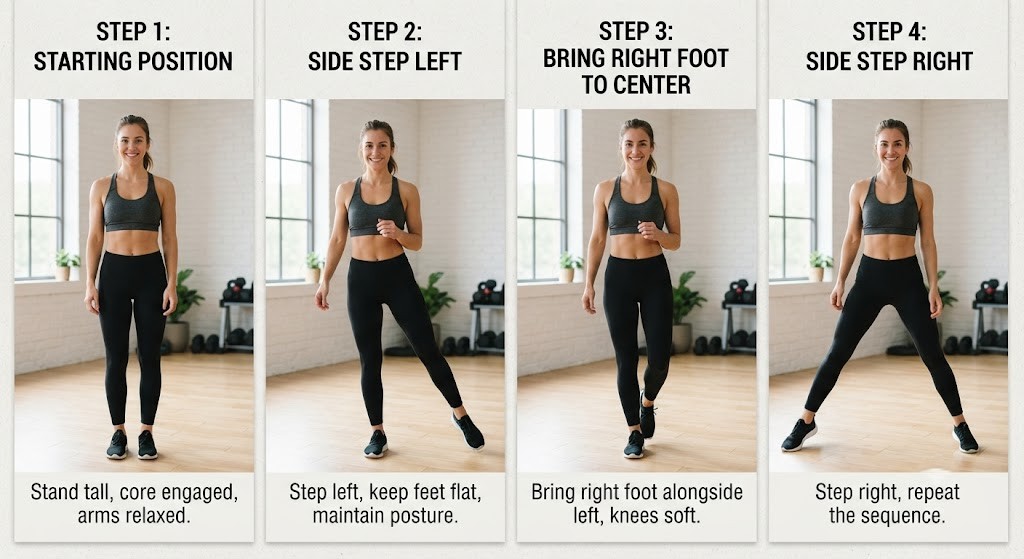
- Step-touches: Step sideways and bring the opposite foot in without jumping.
- Bodyweight squats: Sit the hips back and keep the chest comfortably upright.
- Glute bridges: Lie on your back and lift your hips while squeezing the glutes.
- Wall push-ups: Place your hands against a wall and bend your elbows under control.
- Bird dogs: From a hands-and-knees position, extend opposite arm and leg while keeping the torso stable.
- Controlled dead bugs: Move opposite limbs slowly while maintaining abdominal control.
For more core ideas, see core exercises for beginners.
How Can Beginners Modify Low-Impact Exercises?
Exercise modifications allow beginners to adjust difficulty without abandoning the movement pattern. This can make a workout more accessible while allowing you to develop control and confidence.
For example:
- Perform squats to a chair instead of lowering as deeply.
- Use wall push-ups instead of floor push-ups.
- Reduce resistance when an exercise feels too difficult.
- Decrease the range of motion when needed.
- Slow the movement to improve control.
- Take additional recovery time between exercises.
As your fitness improves, you can gradually increase repetitions, resistance, duration, or movement complexity.
How Do You Do a Low-Impact Workout at Home?
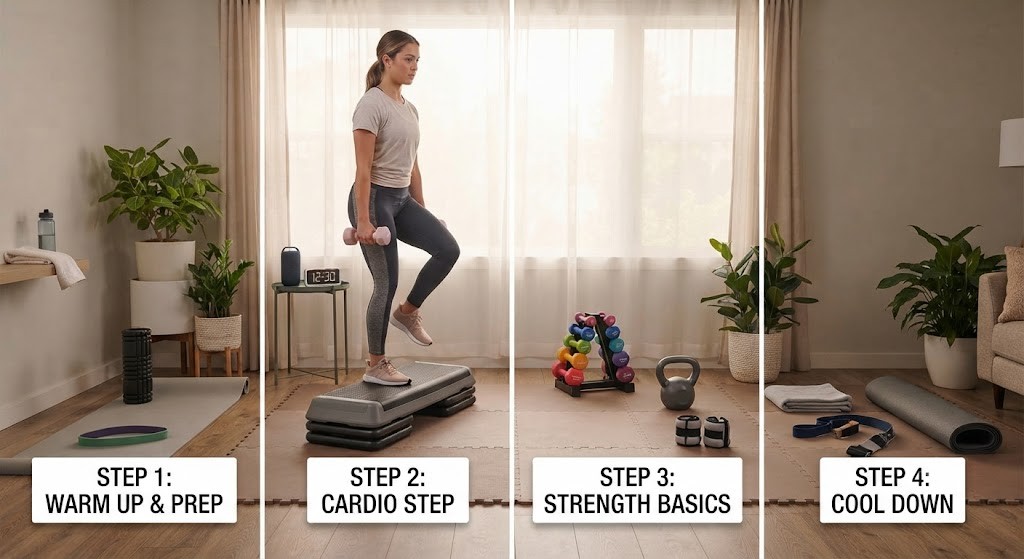
A good low-impact workout at home combines a gradual warm-up, moderate cardio or strength work, controlled movements, and a cooldown. You do not necessarily need a large amount of equipment to create an effective session.
For example, a 25-minute beginner workout can include five minutes of warm-up, 15 minutes of training, and five minutes of easy movement and stretching.
25-Minute Beginner Low-Impact Workout
Warm-Up — 5 Minutes
- Easy marching
- Shoulder rolls
- Step-touches
- Gentle hip movements
The goal is to gradually prepare your body for the main workout rather than immediately starting at your highest effort.
Main Workout — 15 Minutes
Complete three rounds:
- 45 seconds marching
- 45 seconds bodyweight squats
- 45 seconds wall push-ups
- 45 seconds step-touches
- 45 seconds glute bridges
Rest as needed between movements.
Keep the exercises controlled and choose a pace that matches your current fitness level.
Cooldown — 5 Minutes
Slow your movement gradually and finish with comfortable stretching.
A cooldown provides a natural transition from the main workout back to easier movement.
A beginner low-impact workout can combine a warm-up, 20–30 minutes of moderate exercise, strength or mobility movements, and a gradual cooldown.
How Can You Build a Low-Impact Workout Routine?
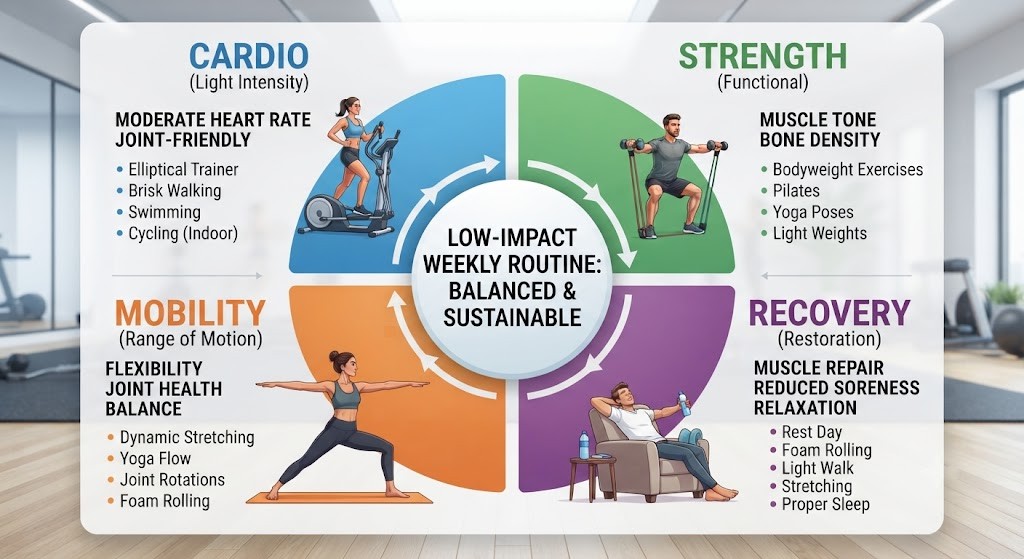
A balanced low-impact workout routine combines aerobic exercise, strength training, mobility, and recovery across the week. Instead of performing the same workout every day, alternate different training types to create variety.
A practical weekly schedule could look like this:
| Day | Workout |
| Monday | 25–30 min brisk walking |
| Tuesday | Full-body low-impact strength |
| Wednesday | Yoga or mobility |
| Thursday | 25–30 min cycling |
| Friday | Full-body strength |
| Saturday | Longer walk or swimming |
| Sunday | Rest or gentle mobility |
This schedule is an example rather than a requirement. Your ideal routine should reflect your current fitness level, available time, recovery needs, and goals.
Beginners do not need to start at the full recommended weekly volume. Gradual progression can make exercise more manageable and sustainable. WHO recommends that people who are currently inactive start with smaller amounts and build activity progressively. — Source: [WHO, 2020]
How Often Should You Do Low-Impact Workouts?
You can perform low-impact activity on most days of the week, depending on intensity, recovery needs, and your fitness level. Lower-intensity movement may be suitable more frequently, while challenging strength or interval sessions may require more recovery.
Someone starting out might use three short cardio sessions and two strength sessions before gradually adding more activity.
For general adult health, the CDC recommends 150 minutes of moderate activity per week and muscle-strengthening activity on at least two days. — Source: [CDC, 2025]
The important point is to build toward an appropriate amount of activity progressively rather than trying to complete everything immediately.
Is Low-Impact Exercise Good for Older Adults?
Low-impact exercise can be a useful fitness option for older adults because walking, swimming, cycling, and other controlled activities can support aerobic fitness and movement capacity. An older adult may combine walking with strength and balance exercises for a more complete routine.
WHO recommends that adults aged 65 and older include muscle-strengthening activity on at least two days weekly and add balance-focused activity when mobility is limited. — Source: [WHO, 2020]
For people with arthritis, the National Institute on Aging identifies low-impact options such as swimming, walking, and tai chi as activities that can place less stress on joints. — Source: [National Institute on Aging, 2025]
However, low-impact does not mean universally appropriate for every condition. People with chronic health conditions, significant pain, disability, or movement restrictions should seek individualized professional guidance when needed.
What Equipment Is Useful for Low-Impact Workouts?
Useful low-impact workout equipment includes resistance bands, light dumbbells, exercise mats, stationary bikes, walking shoes, and supportive workout surfaces. However, equipment is optional for many beginner workouts.
For example, a resistance band can add resistance to squats, rows, presses, and glute exercises without requiring heavy equipment.
Low-Impact Workout Tools
- Resistance bands: Useful for portable strength training.
- Light dumbbells: Add progressive resistance to full-body exercises.
- Exercise mat: Provides a comfortable surface for floor exercises.
- Stationary bike: Supports continuous low-impact cardio.
- Walking shoes: Improve comfort and support during walking sessions.
- Stable workout surface: Helps maintain control during standing exercises.
How Can You Make Low-Impact Workouts More Challenging?
Once basic movements become comfortable, you can progress without automatically adding jumps or other high-impact exercises.
The simplest progression methods are increasing time, resistance, repetitions, pace, or incline. For example, a beginner who comfortably walks for 20 minutes could gradually extend the session or introduce an incline rather than immediately switching to running.
Consider progressing one variable at a time:
- Increase duration: Exercise for a few additional minutes.
- Increase pace: Move faster while maintaining control.
- Increase resistance: Add a manageable band or dumbbell resistance.
- Increase repetitions: Perform more controlled repetitions.
- Increase incline: Add an incline to walking when appropriate.
- Adjust intervals: Extend work periods or reduce recovery periods when fitness allows.
Progression should remain manageable. If technique deteriorates or the exercise becomes uncomfortable, reduce the difficulty and focus on controlled movement.
What’s Next? How Should You Start a Low-Impact Workout Routine?
The best low-impact workout is one that matches a person’s fitness level, goals, available equipment, and ability to perform the movements comfortably and consistently.
If you’re new to exercise, start with a manageable amount rather than trying to replicate an advanced workout immediately.
A simple approach is:
- Choose one primary goal, such as improving cardio, building strength, increasing mobility, or becoming more consistent.
- Select two or three exercises that match that goal.
- Begin with a manageable duration and intensity.
- Progress gradually by increasing time, resistance, repetitions, pace, or incline.
- Include recovery and easier movement when needed.
- Pay attention to how your body responds and adjust the workout when necessary.
For example, a beginner can start with 15–20 minutes of walking three times per week and add short strength sessions.
If you have been inactive, have a chronic health condition, or plan to begin vigorous exercise, the CDC recommends discussing appropriate activity with a healthcare professional when appropriate. — Source: [CDC, 2025]
Conclusion: Make Low-Impact Fitness Part of Your Routine
Low-impact workouts provide an effective way to train cardiovascular fitness, strength, mobility, balance, and endurance while minimizing repetitive landing forces. Walking, cycling, swimming, elliptical training, strength exercises, yoga, and Pilates all provide practical options.
Most importantly, low impact does not mean easy or ineffective. You can make a low-impact workout challenging by adjusting pace, resistance, duration, incline, repetitions, and intervals without relying on repeated jumping or running.
If you’re just starting, choose movements that feel manageable and focus on consistency. Build gradually, combine cardio with strength and mobility, and allow enough recovery to keep your routine sustainable. The goal isn’t to find the hardest workout possible—it’s to create a low-impact fitness routine you can keep doing and progressively improve.
FAQs
What is a low-impact workout?
It is exercise that minimizes repetitive impact while improving fitness, strength, mobility, or endurance.
What’s the best low-impact workout?
Walking is one of the best low-impact workouts because it is simple and easy to modify.
Can you lose weight with low-impact workouts?
Yes, they can support weight loss by increasing calorie expenditure and physical activity.
What is the 3-3-3 rule in gym?
It is a workout approach that can have different meanings depending on the training program.
Are low-impact workouts good for beginners?
Yes, they are easy to modify and can be progressed gradually.
Can low-impact workouts be high intensity?
Yes, increasing pace, resistance, incline, or intervals can make them challenging.
What are examples of low-impact workouts?
Walking, cycling, swimming, yoga, Pilates, and elliptical training are common examples.
Can low-impact workouts improve cardio?
Yes, they can improve cardiovascular fitness when performed regularly.
What equipment is needed for low-impact workouts?
You can exercise without equipment, but bands, dumbbells, and mats can add variety.
12 thoughts on “Low-Impact Workouts: Effective Exercises for Strength, Fitness & Mobility”