
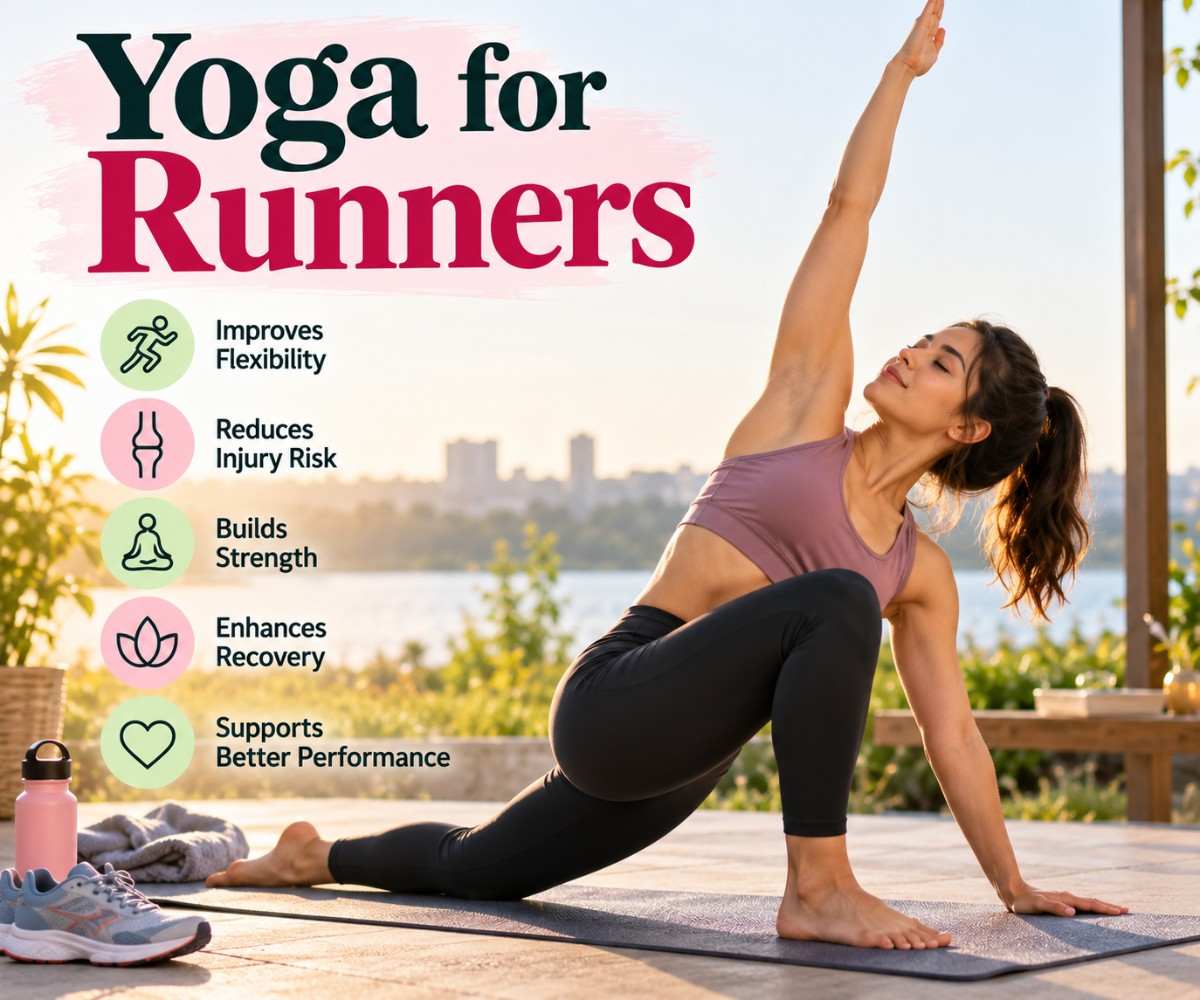
Yoga for runners can complement running by improving mobility, balance, body awareness, and relaxation. Whether you are training for your first 5K or preparing for a marathon, adding a short yoga routine to your weekly schedule can help you move more comfortably and support your overall training.
What Is Yoga for Runners?
Yoga for runners is a combination of yoga poses, controlled breathing, and mobility exercises designed to complement running. It often focuses on the calves, hamstrings, hip flexors, glutes, ankles, and lower back, which all contribute to comfortable running mechanics.
Unlike a demanding power-yoga class, a runner-focused routine can emphasize gentle stretches, controlled movements, balance, and recovery. The goal is to complement your running plan rather than exhaust your muscles before a workout.
Why Does Yoga for Runners Matter?
Yoga for runners can help maintain joint mobility, develop balance, and improve awareness of muscular tension, making it a useful addition to a balanced training program. Its benefits depend on the poses, consistency, and how well the routine fits around your running workload.
Potential benefits include:
- Improved mobility: Gentle movements can help you work on the range of motion around your hips, ankles, and other joints.
- Better balance: Single-leg poses challenge stability and body control.
- Muscle relaxation: Gentle stretching may reduce the sensation of tightness after a run.
- Stress management: Controlled breathing and relaxation can help you unwind after demanding training sessions.
- A more balanced routine: Yoga introduces slower movements and positions that differ from repetitive running.
Yoga is not guaranteed to prevent running injuries or eliminate muscle soreness. It should complement, not replace, appropriate training progression, strength work, adequate sleep, and recovery.
Best Yoga Poses for Runners
The best yoga poses for runners target areas that commonly feel stiff after repetitive running movements while allowing you to control the depth of each stretch.
1. Downward-Facing Dog
Downward-Facing Dog is a yoga pose that gently stretches the calves, hamstrings, shoulders, and back.
How to do it:
- Start on your hands and knees.
- Spread your fingers and press your hands into the mat.
- Lift your hips upward and backward to form an inverted V shape.
- Keep your knees slightly bent if your hamstrings or calves feel tight.
- Breathe slowly for 20–30 seconds without forcing your heels toward the floor.
Runner’s tip: Prioritize a comfortable spine position instead of trying to place your heels flat on the mat.
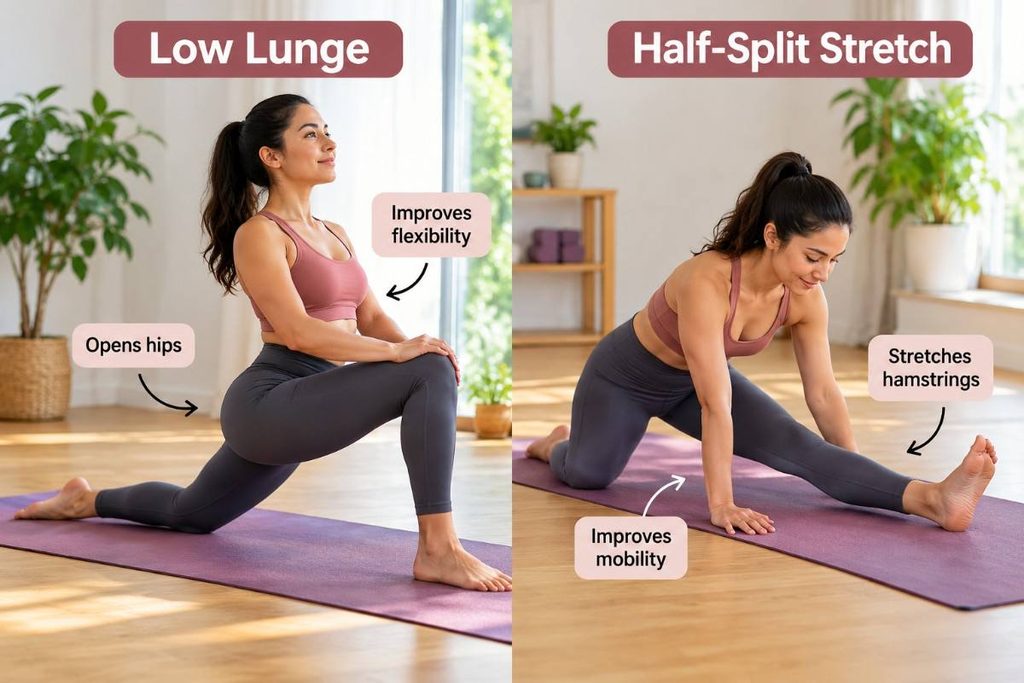
2. Low Lunge
A low lunge stretches the front of the hip and thigh, making it useful for runners who spend a lot of time moving in the same forward direction.
How to do it:
- Kneel on a mat and step one foot forward.
- Position your front knee approximately over your ankle.
- Lower your back knee onto a folded towel or cushion.
- Gently shift your hips forward while keeping your torso upright.
- Hold for 20–30 seconds and switch sides.
Avoid arching your lower back or pushing into a painful stretch.
3. Half Split
The half split is a controlled stretch for the hamstrings, which run along the back of your thighs.
How to do it:
- Begin in a kneeling lunge.
- Shift your hips backward as you straighten your front leg to a comfortable degree.
- Keep a slight bend in your front knee if necessary.
- Hinge forward from your hips while keeping your back relatively long.
- Hold for 20–30 seconds and repeat on the other side.
4. Figure-Four Stretch
The figure-four stretch targets the gluteal muscles and the muscles around the outer hip.
How to do it:
- Lie on your back with both knees bent.
- Place your right ankle over your left thigh, just above the knee.
- Hold behind your left thigh and gently draw it toward your torso.
- Keep your head and shoulders relaxed.
- Hold for 20–30 seconds, then change sides.
Stop if you feel sharp pain, numbness, or tingling.
5. Reclining Spinal Twist
A reclining spinal twist introduces gentle rotation through the torso and can provide a relaxing movement after a run.
How to do it:
- Lie on your back with your knees bent.
- Extend your arms out to the sides.
- Slowly lower both knees toward one side.
- Keep your shoulders relaxed against the mat as comfortably as possible.
- Breathe slowly for 20–30 seconds and switch sides.
6. Legs-Up-the-Wall Pose
Legs-Up-the-Wall is a restorative position that allows you to relax while your legs are supported.
How to do it:
- Sit sideways next to a wall.
- Lie back and gently bring your legs up against the wall.
- Adjust your distance from the wall until the position feels comfortable.
- Rest your arms by your sides and breathe naturally.
- Stay for 2–5 minutes if comfortable.
This pose may help you relax after training, but it is not a proven treatment for running-related injuries or a substitute for adequate recovery.
A 10-Minute Yoga Routine for Runners
A 10-minute yoga routine for runners can be a practical way to work on mobility without adding a long session to your training schedule.
| Exercise | Duration | Main focus |
|---|---|---|
| Cat-Cow | 1 minute | Gentle spinal movement |
| Downward-Facing Dog | 1 minute | Calves and posterior chain |
| Low Lunge | 2 minutes | Front of hips |
| Half Split | 2 minutes | Hamstrings |
| Figure-Four Stretch | 2 minutes | Glutes and outer hips |
| Reclining Spinal Twist | 1 minute | Gentle trunk rotation |
| Slow breathing | 1 minute | Relaxation |
Perform each movement gently, dividing the time between both sides where appropriate. Treat these durations as flexible guidelines rather than targets you must achieve.
When Should Runners Do Yoga?
Runners can schedule yoga before a run, after a run, or on a recovery day, depending on the intensity of the session and the purpose of the practice.
Yoga Before Running
Before running, choose dynamic movements and gentle mobility drills rather than long, intense static stretches. A short warm-up might include leg swings, walking lunges, ankle movements, and controlled Cat-Cow repetitions.
The goal is to prepare your body for movement, not to achieve maximum flexibility immediately before a demanding run.
5 Minute Warm Up Before Workout
Yoga After Running
After an easy run, gentle yoga can help you transition into a calmer recovery period. Focus on comfortable breathing and controlled stretches without forcing tight muscles into deep positions.
Following a hard interval workout or long run, keep the routine short and restorative if you feel fatigued.
Post Workout Stretching Routine
Yoga on Rest Days
Rest days can be suitable for a gentle yoga session focused on comfortable movement and relaxation. Avoid turning a recovery day into another strenuous workout, particularly when you have substantial fatigue or soreness.
How Often Should Runners Practice Yoga?
Runners can start with two or three short yoga sessions per week and adjust the frequency according to their training schedule, flexibility goals, and recovery needs.
A simple weekly plan might look like this:
| Running schedule | Suggested yoga practice |
|---|---|
| Easy running days | 5–10 minutes of gentle mobility |
| Speed workout days | Brief dynamic warm-up before running |
| Long-run days | Optional gentle stretching afterward |
| Rest days | 15–25 minutes of restorative yoga |
| Race week | Familiar, gentle movements without aggressive stretching |
Consistency matters more than performing difficult poses. If your running mileage increases, keep yoga manageable so it does not become an additional source of fatigue.
Yoga for Runners: Common Mistakes to Avoid
Runners should use yoga to improve comfortable movement and flexibility rather than force their bodies into advanced positions.
Avoid these common mistakes:
- Stretching through pain: Mild tension can be normal, but sharp pain, tingling, or numbness is a reason to stop.
- Holding deep stretches before speed sessions: Prolonged static stretching immediately before explosive efforts may temporarily affect performance. Use a dynamic warm-up instead.
- Ignoring strength training: Yoga does not fully replace progressive resistance training for building running-specific strength.
- Expecting yoga to prevent every injury: Running injuries can have multiple causes, and stretching alone is not a reliable injury-prevention strategy. (Source: American Orthopaedic Society for Sports Medicine, 2025)
- Forgetting to breathe: Slow, comfortable breathing can help you relax into a pose without forcing the movement.
Yoga or Stretching: Which Is Better for Runners?
Yoga and conventional stretching can both improve flexibility, but yoga also incorporates breathing, balance, movement control, and relaxation.
| Feature | Yoga | Conventional stretching |
|---|---|---|
| Flexibility | Can improve range of motion | Can improve range of motion |
| Balance | Often included | Depends on the exercise |
| Breathing and relaxation | Usually emphasized | May be included |
| Time commitment | Often involves a sequence of poses | Can target individual muscles |
| Best use | Whole-body mobility and relaxation | Targeted flexibility work |
Neither option is automatically superior for every runner. Choose the approach you can perform consistently and that addresses your specific mobility needs. Evidence also suggests that stretching should not be relied on as the sole strategy for preventing injuries or improving post-exercise recovery. (Source: Practical Recommendations on Stretching Exercise, 2025)
A Few Tips to Make Yoga More Effective for Runners
Small adjustments can make a runner-focused yoga routine easier to maintain and more comfortable.
- Start with poses that feel manageable and gradually increase your range of motion.
- Use a yoga mat and a folded towel or yoga blocks to support your body.
- Avoid strenuous yoga immediately before an important race or intense speed workout.
- Combine yoga with appropriate sleep, nutrition, hydration, and running-specific strength training.
- If a pose consistently aggravates a painful area, stop and seek guidance from a qualified healthcare professional.
Conclusion
Yoga for runners is a practical way to work on flexibility, mobility, balance, and relaxation alongside a running program. Start with a few beginner-friendly poses, spend around 10 minutes on a routine, and adjust the movements to your comfort level.
For the best overall results, combine yoga with appropriate running progression, strength training, and recovery habits. Remember that yoga is a useful complement to training, not a guaranteed way to prevent injuries or eliminate soreness.
FAQs
Is yoga good for runners?
Yes, yoga can help runners improve flexibility, mobility, balance, and relaxation when practiced consistently alongside a suitable training plan.
How long should runners do yoga?
Runners can begin with 5–15 minutes per session and increase the duration if it fits comfortably into their schedule.
Should I do yoga before or after running?
Use dynamic movements before running to prepare for exercise, and save longer static stretches or restorative poses for after running or separate sessions.
Can yoga improve running speed?
Yoga may help address mobility limitations, but evidence does not establish that yoga alone reliably increases running speed. Running-specific training remains essential.
Which yoga pose is best for runners?
There is no single best pose for every runner. Low lunges, Downward-Facing Dog, half splits, and figure-four stretches are useful options for targeting commonly stiff areas.
Can beginners practice yoga for running?
Yes, beginners can start with supported poses, short holds, and comfortable ranges of motion without attempting advanced yoga positions.
Does yoga prevent running injuries?
Yoga alone has not been shown to reliably prevent all running injuries. A balanced approach that includes appropriate training loads, strength, and recovery is more useful.
Is yoga better than stretching for runners?
Yoga includes stretching alongside balance, breathing, and movement control. Conventional stretching may be more convenient when you want to target a particular muscle group.
Sources
- American Orthopaedic Society for Sports Medicine. (2025). Flexibility and Stretching.
- Warneke et al. (2025). Practical Recommendations on Stretching Exercise: A Delphi Consensus Statement of International Research Experts. Journal of Sport and Health Science.
- Konrad et al. (2021). The Impact of a Single Stretching Session on Running Performance and Running Economy: A Scoping Review. Frontiers in Physiology.
- Ullman et al. (2021). Effects of Isometric Exercises versus Static Stretching in Warm-up Regimens for Running Sport Athletes: A Systematic Review.
Disclaimer: This article is for informational and educational purposes only and is not a substitute for personalized medical advice. Consult a qualified healthcare professional before making significant changes to your diet, exercise routine, or supplement use.