
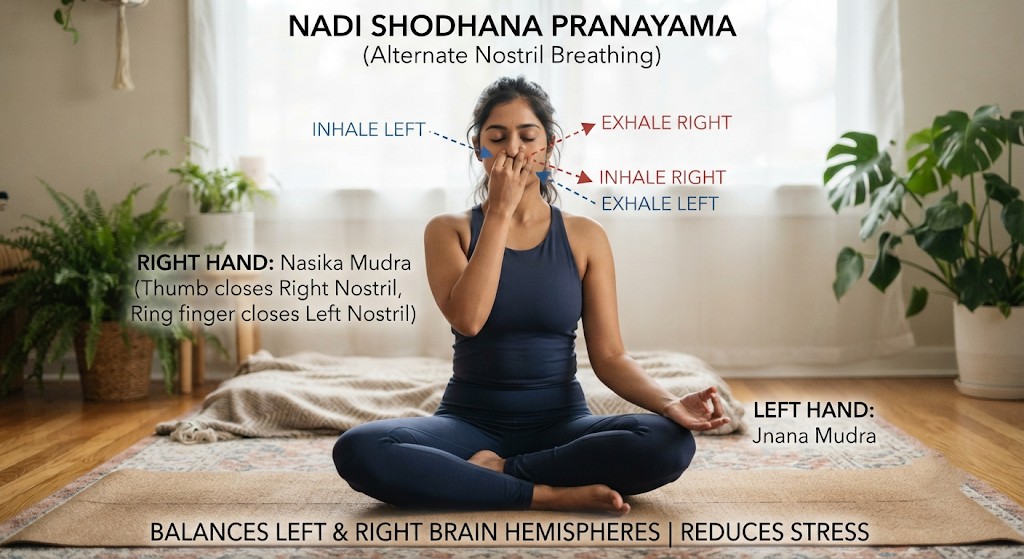
Nadi Shodhana Pranayama is a slow breathing practice where you inhale and exhale through one nostril at a time, and many people use it to settle down before sleep, work, or meditation. Beginners often get stuck on the finger positions and counting, which makes a simple practice feel complicated. This guide covers the steps, a beginner ratio plan, safety limits, and what studies have actually found.
What Is Nadi Shodhana Pranayama?
Nadi Shodhana Pranayama is a yogic breathing technique, also called alternate nostril breathing, in which you use your fingers to switch the nostril you breathe through. In Sanskrit, nadi means channel and shodhana means purification, so the name is often translated as “channel cleansing breath.”
- Also known as Nadi Shuddhi, alternate nostril breathing, or Anuloma Viloma
- Practiced seated, usually for 5 to 10 minutes
- Needs no equipment, only your right hand and a quiet spot
- Often taught as a warm-up for meditation
Yoga tradition describes nadis as channels that carry prana, or vital energy, through the body. That is a traditional concept. Research on the practice looks at measurable things such as heart rate and blood pressure instead.
If you already practice meditation, this breathing pairs well with the techniques in our guide to Kriya Yoga meditation techniques.
Why Does Nadi Shodhana Pranayama Matter?
It matters because it gives you a short, equipment-free way to slow your breathing and practice steady attention, which is hard to do on demand without a method.
- Takes only a few minutes, so it fits into a busy day
- Easy to learn once the hand position clicks
- Gives you something to focus on when your mind is racing
- Works as a bridge between breathing practice and longer meditation
- Can be scaled up gradually by changing the count
The practice also sits inside a bigger tradition. If you want to see where breathing fits into the wider yogic path, start with Kriya Yoga meaning and benefits.
What Are the Benefits of Nadi Shodhana Pranayama?
Early studies suggest alternate nostril breathing may lower blood pressure and heart rate in the short term, though the evidence is still limited and comes mostly from small trials.
- A randomized controlled trial in a hospital in Puducherry, India, asked patients with hypertension to practice alternate nostril breathing for 10 minutes twice a day for 5 days, alongside routine treatment. Systolic blood pressure, diastolic blood pressure, and heart rate were significantly lower afterward. (Source: Journal of Education and Health Promotion, 2019)
- A randomized comparison of 100 hypertensive adults had one group practice Nadi Shodhana for 20 minutes. Auditory reaction time dropped significantly, while heart rate variability showed no significant difference between the Nadi Shodhana and Bhramari groups. (Source: Journal of Ayurveda and Integrative Medicine, 2023)
- Yoga as a whole, which usually includes breathing practices, has been linked in studies to better stress management, mood, and sleep. (Source: National Center for Complementary and Integrative Health, 2024)
These results are encouraging, but they have limits. The trials were short, and the patients in the blood pressure study kept taking their usual treatment. Nothing here suggests the breathing practice can replace medication, and the traditional idea of cleansing energy channels is not something these studies measure.
For a calmer evening routine, see our yoga for better sleep. If your main goal is stress relief, our guide to yoga for stress relief covers more options.
How Do You Practice Nadi Shodhana Pranayama Step by Step?
To practice, sit upright, close one nostril with your thumb, breathe in through the other, then switch sides for the exhale. One full cycle, inhaling and exhaling on both sides, counts as a single round.
Before You Begin
- Sit on a cushion, folded blanket, or chair with your spine tall
- Relax your shoulders and soften your jaw
- Rest your left hand on your left knee
- Try to practice when you are not hungry or very full
- If your nose is blocked, clear it gently first
New to seated postures? Our Lotus Pose (Padmasana) guide shows comfortable ways to sit.
The Hand Position
The classic hand position is called Vishnu mudra. Fold your right index and middle fingers toward your palm, or rest them lightly between your eyebrows. Your right thumb closes the right nostril and your ring finger closes the left. Use light pressure and keep your elbow relaxed.
Step-by-Step Instructions
- Exhale completely through both nostrils.
- Close your right nostril with your thumb and inhale slowly through the left for a count of 4.
- Close both nostrils for a brief moment. Beginners can skip this pause.
- Release your right nostril and exhale slowly through the right.
- Inhale through the right nostril for the same count.
- Close the right nostril again and exhale through the left. That completes one round.
- Repeat for 5 to 10 rounds, then let your hand drop and breathe normally for a minute.

Breathing Ratios and Timing
Counts are a guide, so shorten them if you feel strained. These are common teaching ratios:
| Level | Inhale : Exhale | Example count | Suggested time |
|---|---|---|---|
| Beginner | 1 : 1 | 4 in, 4 out | 3 to 5 minutes |
| Steady practice | 1 : 2 | 4 in, 8 out | 5 to 10 minutes |
Some advanced teachers add breath holds, called kumbhaka. Skip them unless a qualified teacher is guiding you in person, and avoid them if you have high blood pressure or a heart condition.
What Mistakes Should You Avoid?
The most common mistake is forcing the breath, because strain defeats the purpose of a calming practice.
- Pressing hard on the nostrils, which can cause discomfort or noise
- Counting too long and ending up gasping
- Raising the shoulders or tensing the neck
- Holding the breath too early
- Practicing with a heavily blocked nose
- Rushing through rounds without paying attention to the sides
If you feel dizzy or lightheaded, stop, breathe normally, and shorten the count next time.
When Is the Best Time to Practice?
Early morning and evening are the most popular times, since the house tends to be quieter and your mind has fewer demands on it. Many teachers suggest practicing before meditation or a few hours after a heavy meal.
- Morning: before meditation or yoga
- Midday: a 3-minute reset during a busy workday
- Evening: before bed, with a gentle 1 : 2 ratio
A Simple Three-Week Plan
- Week 1: 3 minutes a day, 4 in and 4 out
- Week 2: 5 minutes a day, same ratio
- Week 3: 8 to 10 minutes a day, moving toward 4 in and 8 out if it feels easy

If you want to see whether the practice changes anything for you, You can also mix it with Bhramari pranayama humming bee breath for a longer session, or use it as part of a post-workout recovery routine to wind down after training.
Who Should Be Careful With Nadi Shodhana Pranayama?
People with high blood pressure, heart or lung conditions, pregnancy, glaucoma, or ongoing nasal problems should check with a healthcare professional before starting. Yoga is generally safe for most people, but MedlinePlus notes that some people need to modify practices, including those who are pregnant or have high blood pressure. (Source: MedlinePlus)
- Keep the breath gentle and never strain
- Skip breath holds unless a qualified teacher guides you
- Stop if you feel dizzy, short of breath, or unwell
- Do not stop prescribed medication because of any breathing practice
Learning with a qualified instructor lowers the risk of mistakes, and the NCCIH notes that learning yoga alone without supervision has been linked with higher injury risk. (Source: National Center for Complementary and Integrative Health, 2024)
Conclusion
Nadi Shodhana Pranayama is a short, gentle breathing practice that most healthy beginners can learn in a single sitting. Start with a 4-in, 4-out count for 3 to 5 minutes, keep the pressure on your nostrils light, and add length only when it feels easy. Research so far points to short-term drops in blood pressure and heart rate, but the studies are small, so treat the practice as a calming habit rather than a treatment. If you have a medical condition, talk to your doctor first, and take your next step by trying one three-minute round tomorrow morning.
FAQs
How long should I practice Nadi Shodhana Pranayama each day?
Most beginners do well with 3 to 5 minutes, and steadier practitioners usually work up to 5 to 10 minutes a day.
Is Nadi Shodhana the same as Anuloma Viloma?
The two names are often used for the same alternate nostril practice, though some teachers describe small differences in counts and breath holds.
Which nostril should I start with?
Most teachers start with an inhale through the left nostril, though traditions vary, so follow your teacher’s guidance if you have one.
Can Nadi Shodhana lower blood pressure?
Small trials report short-term drops in blood pressure and heart rate in people with hypertension, but it should not replace medication or medical care.
Can beginners hold their breath during the practice?
Beginners should skip breath holds, since they add strain, and avoid them if you have high blood pressure or a heart condition unless your doctor and teacher approve.
Can I practice Nadi Shodhana on a full stomach?
It is better to wait a few hours after a heavy meal, because a full stomach can make slow, deep breathing uncomfortable.
Sources
- Kalaivani, S., Kumari, M. J., et al. (2019). Effect of alternate nostril breathing exercise on blood pressure, heart rate, and rate pressure product among patients with hypertension in JIPMER, Puducherry. Journal of Education and Health Promotion.
- Journal of Ayurveda and Integrative Medicine. (2023). Effects of Nadishodhana and Bhramari Pranayama on heart rate variability, auditory reaction time, and blood pressure: A randomized clinical trial in hypertensive patients.
- National Center for Complementary and Integrative Health. (2024). 5 Things You Should Know About Yoga.
- MedlinePlus. Yoga for Health.
Disclaimer: This article is for informational and educational purposes only and is not a substitute for personalized medical advice. Consult a qualified healthcare professional before making significant changes to your diet, exercise routine, or supplement use.