

Bhramari pranayama is a slow breathing practice where you exhale with a steady hum, much like a bee. Beginners tend to like it because it needs no equipment, takes only a few minutes, and the sound gives the mind one simple thing to follow. This guide covers the steps, what the research does and doesn’t show, and how to build a routine you can keep up.
What Is Bhramari Pranayama?
Bhramari pranayama, also called bee breath or humming bee breath, is a yogic technique where you inhale through the nose and exhale slowly while making a humming sound with your lips closed.
- The name comes from bhramara, the Sanskrit word for a black bee.
- “Pranayama” refers to the regulation of breath, with prana meaning life energy and ayama meaning control (Source: Kuppusamy et al., 2016).
- You keep your lips closed, so the hum vibrates in your face and head.
- Most people practice it seated and quiet for a few minutes at a time.
It is one of the gentler pranayama techniques, which is why many teachers introduce it early. If you already know alternate nostril breathing, you will find the pacing similar.
Why Does Bhramari Pranayama Matter?
Bhramari pranayama matters because it gives you a short, low-effort way to slow your breathing and settle your attention, even on a busy day.
- It takes about three to five minutes, so it fits between meetings or before bed.
- The hum gives your mind something to listen to, which makes it easier to stay with the breath.
- It is quiet enough to practice almost anywhere you can sit.
- It uses slow exhales, which are generally considered a lower-risk style of breathwork than fast, forceful methods.
Slow breathing is one of the most studied simple tools for managing everyday stress.
Yoga Breathing Techniques for Beginners
How Do You Practice Bhramari Pranayama Step by Step?
To practice Bhramari pranayama, sit upright, close your lips, and hum steadily on each slow exhale through your nose.
Basic technique
- Sit comfortably with a straight spine, on the floor or on a chair. Let your shoulders drop.
- Close your eyes. Keep your lips closed with your teeth slightly apart and your jaw loose.
- Rest your index fingers (or thumbs) gently on the small flap of cartilage in front of each ear canal. Press lightly, or just rest them there. Do not push anything into the ear.
- Breathe in slowly through your nose.
- Breathe out slowly through your nose while humming. Aim for a smooth, even sound rather than a loud one.
- Pause, then breathe in again. That is one round.
- Repeat for 5 to 10 rounds, then breathe normally with your eyes closed for a few moments.
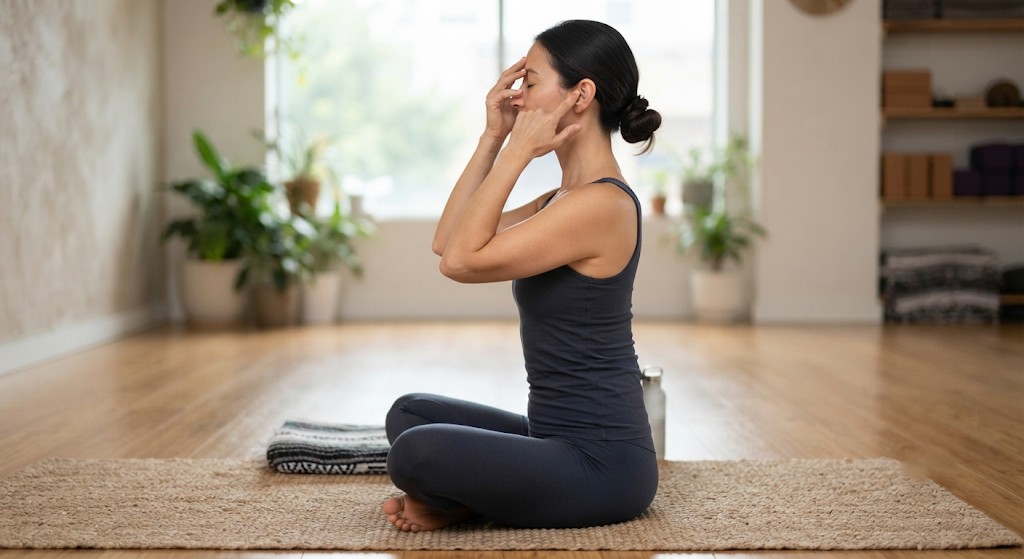
Optional variation with Shanmukhi mudra
- Rest your thumbs on the ear flaps, lay your index and middle fingers lightly over your closed eyelids, and place the remaining fingers beside the nose.
- Never press on the eyeballs. If the position strains your shoulders or neck, go back to the basic hand placement.
- Skip the variation until the basic version feels easy.
Sample beginner plan
This is a gentle way to build up. It is a suggestion, not a clinical protocol, so adjust it to how you feel.
| Week | Rounds per session | Sessions per day | Focus |
|---|---|---|---|
| 1 | 3 to 5 | 1 | Smooth, even hum |
| 2 | 5 to 7 | 1 to 2 | Longer, slower exhales |
| 3 and after | 7 to 10 (or about 5 minutes) | 1 to 2 | Staying relaxed through the whole session |
Sitting quietly for a minute after your last round is a natural bridge into a short meditation.
What Does Research Say About the Benefits of Bhramari Pranayama?
Small studies suggest Bhramari pranayama may help with heart rate, blood pressure and relaxation, but the evidence is early and most trials are small.
Heart rate and blood pressure
- In a trial of 60 healthy adolescents, the Bhramari group showed significant drops in heart rate and blood pressure measures compared with a control group that breathed normally (Source: Kuppusamy et al., 2016).
- A randomized trial of 100 people with hypertension compared Bhramari with alternate nostril breathing. Bhramari produced a clear drop in auditory reaction time, and the two groups did not differ significantly on heart rate variability (Source: Upadhyay et al., 2023).
- During the practice itself, results can look different. In 16 healthy volunteers, heart rate rose and heart rate variability shifted during a five-minute session, then returned to normal afterward. The authors suggested a temporary drop in parasympathetic activity and asked for more research (Source: Nivethitha et al., 2017).
None of this makes Bhramari a replacement for blood pressure medication or medical care.
Stress, anxiety and mood
- A 2025 meta-analysis of randomized trials covered 517 patients with PTSD, depression or mixed mental disorders. It found significant effects of pranayama on symptom severity and quality of life, but only in per-protocol samples and when compared with passive controls (Source: Mütze et al., 2025).
- The same review found adverse events were more common with fast breathing techniques than with slow ones (Source: Mütze et al., 2025).
- That review covers pranayama as a group, so its results cannot be credited to Bhramari alone.
Humming and nasal nitric oxide
- In 10 healthy people, humming raised nasal nitric oxide about 15-fold compared with quiet exhalation (Source: Weitzberg & Lundberg, 2002).
- Nitric oxide takes part in several body functions, including blood vessel dilation. Whether the extra release during humming brings a lasting health benefit has not been shown.
- A 2024 study found that humming-induced nitric oxide did not improve short-term cognitive performance or change emotional processing (Source: PLOS ONE, 2024).
What Are the Most Common Bhramari Pranayama Mistakes?
The most common mistakes are pressing too hard, humming too loudly, and forcing the breath, all of which turn a calming practice into a tense one.
- Pushing the fingers hard into the ears or onto the eyes.
- Humming loudly instead of keeping the sound smooth and steady.
- Slouching, which cramps the chest and shortens the exhale.
- Straining to make each exhale as long as possible.
- Holding the breath between rounds.
- Continuing through dizziness, ear pain or discomfort.
Stopping early and trying again the next day is always the better choice.
Who Should Be Careful With Bhramari Pranayama?
People with ear pain or infection, a heart condition, blood pressure problems, pregnancy or an anxiety disorder should check with a healthcare professional before starting.
- Stop if you feel dizzy, lightheaded or short of breath.
- Skip the ear-closing position if your ears are sore or infected, and hum without the hand placement.
- Keep the hum soft if a blocked nose or sinus pressure makes it uncomfortable.
- Treat it as a complement to medical treatment, never a substitute.
When Is the Best Time to Practice Bhramari Pranayama?
The best time to practice Bhramari pranayama is whenever you can sit quietly for a few minutes, and most people choose the morning, a work break or the evening.
- Morning: a few rounds before your day gets busy.
- Midday: a short reset between tasks.
- Evening: a calm wind-down before bed.
- After exercise: a few slow rounds can help you settle once your heart rate has come down.
How Does Bhramari Pranayama Compare With Other Breathing Practices?
Bhramari pranayama is a slow, humming exhale practice, which makes it calmer and simpler than fast, forceful techniques.
| Practice | Breathing style | Typical feel | Beginner notes |
|---|---|---|---|
| Bhramari pranayama | Slow nasal breath with a hum on the exhale | Soothing, quiet focus | Gentle; easy to start |
| Nadi Shodhana | Slow breathing through alternate nostrils | Steady, balanced | Needs hand coordination |
| Kapalabhati | Quick, forceful exhales | Energizing | Faster techniques were linked to more adverse events in one review, so learn with guidance |
Conclusion
Bhramari pranayama is a simple, low-risk breathing practice: sit tall, inhale through the nose, and hum on a slow exhale. Early studies report changes in heart rate and blood pressure measures, but they are small, and the benefits of humming itself are still being tested. Start with three to five rounds a day for a week, keep the hum soft, and build up only if it feels comfortable.
A calm breathing practice also pairs well with stretching and movement.
FAQs
Is Bhramari pranayama safe for beginners?
Yes, it is generally considered gentle, as long as you keep the hum soft and avoid pressing on your ears or eyes. Stop if you feel dizzy or have ear pain.
How long should I practice Bhramari pranayama?
Start with 3 to 5 rounds and build up to about 5 minutes. Research sessions have often been around five minutes, though a longer or shorter practice is fine if it feels comfortable.
Can Bhramari pranayama lower blood pressure?
Small studies report improvements in some blood pressure and heart rate measures, but the evidence is limited. It should not replace prescribed treatment.
Do I have to close my ears during Bhramari pranayama?
No, closing the ears is optional. Beginners can hum with their hands resting in their lap and add the hand position later.
Can I practice Bhramari pranayama on a full stomach?
A light or empty stomach is usually more comfortable, since a full stomach can make sitting upright and slow breathing feel heavy.
What is the best time to do Bhramari pranayama?
Any calm moment works. Many people practice in the morning, during a work break or in the evening before bed.
Sources
- Kuppusamy, M., Kamaldeen, D., Pitani, R., & Amaldas, J. (2016). Immediate Effects of Bhramari Pranayama on Resting Cardiovascular Parameters in Healthy Adolescents. Journal of Clinical and Diagnostic Research.
- Nivethitha, L., Manjunath, N. K., & Mooventhan, A. (2017). Heart Rate Variability Changes During and After the Practice of Bhramari Pranayama. International Journal of Yoga.
- Upadhyay, J., et al. (2023). Effects of Nadishodhana and Bhramari Pranayama on Heart Rate Variability, Auditory Reaction Time, and Blood Pressure: A Randomized Clinical Trial in Hypertensive Patients. Journal of Ayurveda and Integrative Medicine.
- Mütze, C., Mitzinger, D., & Haller, H. (2025). Effectiveness of Pranayama for Mental Disorders: A Systematic Review and Meta-Analysis of Randomized Controlled Trials. Frontiers in Psychiatry.
- Weitzberg, E., & Lundberg, J. O. (2002). Humming Greatly Increases Nasal Nitric Oxide. American Journal of Respiratory and Critical Care Medicine.
- PLOS ONE. (2024). Induction of Nitric Oxide via Humming Does Not Improve Short-Term Cognitive Performance or Influence Emotional Processing.
Disclaimer: This article is for informational and educational purposes only and is not a substitute for personalized medical advice. Consult a qualified healthcare professional before making significant changes to your diet, exercise routine, or supplement use.